The post Iranian port city hit by power cuts amid fresh US strikes appeared first on azeritimes.com.
 The South Caucasus News - SouthCaucasusNews.com
The post Iranian port city hit by power cuts amid fresh US strikes appeared first on azeritimes.com.

According to the presidency, the letter from the president’s chief of staff creating the Presidential Foreign Intervention Promotion Council (PFIPC) had been forged, News.Az reports, citing BBC.
***
The police have launched a manhunt for Adeniyi Adeyemi Matthew, who had been presenting himself as the “PFIPC director general”, on suspicion of forgery, impersonation and related offences.
Before going into hiding, Adeyemi told local media that he was innocent and now feared for his life.
He also promised to show up in court to clear his name, saying the body was lawfully established. He accused senior government officials of demanding bribes during the process of his appointment and later attempting to take control of the council’s funds. The presidency has denied those allegations.
Adeyemi said the council was set up in 2024 in order to attract foreign investment to Nigeria but there is no record of any deals being done.
It has a staff of three, who have been questioned by the police.
President Bola Tinubu on Tuesday directed the Independent Corrupt Practices and Other Related Offences Commission (ICPC) to investigate and submit a comprehensive report within 30 days.
BBC News Pidgin has found that the agency had secured office space within the Federal Secretariat – the vast government complex that houses many of Nigeria’s ministries in the capital Abuja – opened bank accounts with the Central Bank of Nigeria, and appeared in the 2026 Appropriation Act with an allocation of 1.3bn naira ($950,000; £700,000).
However, the Accountant-General’s Office says the PFIPC never had an operational account with the central bank and has not received any public funds or salaries.
The presidency claimed police forensic analysis had confirmed that the signature from the president’s chief of staff, Femi Gbajabiamila, on the disputed appointment letter had been forged.
According to the charges filed before the Federal High Court in Abuja, Adeyemi and two other defendants are accused of using forged official documents to establish and operate the purported council, opening multiple bank accounts in its name and seeking official recognition for an agency the government maintains does not exist.
The post Nigeria’s president probes alleged fake agency in his office appeared first on azeritimes.com.
According to the Eastern Flank Deterrence Initiative (EFDI) project, a network of satellites, drones, ground sensors, and robotic systems will be deployed along the entire eastern border of NATO, capable of detecting any troop movements. The obtained data on Russian units will be analyzed by artificial intelligence, News.Az reports, citing UNN.
***
For example, if a drone detects a Russian tank column near the Alliance’s borders, the system will automatically combine satellite images, sensor data, and radar readings. They will be available to all alliance countries in real time. NATO commanders will have a complete picture of events and will be able to quickly determine which forces and assets to deploy to repel an attack.
NATO will change its approaches to defending the eastern flank. Now, in the event of an attack, drones — attack drones, ground robots, and other unmanned systems — should be the first to engage. They must slow the enemy’s advance and inflict maximum damage before aviation, tanks, and ground units enter the fight.
According to the publication, the Alliance wants to implement the project in a short time frame and believes that the combination of digital surveillance, artificial intelligence, and automatic intelligence sharing will deter Russia and reduce the likelihood of an attack.
The post NATO to launch system tracking Russian troop movements appeared first on azeritimes.com.
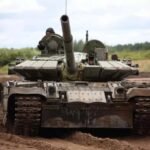
The new equipment was transferred to the 11th Separate Guards Mechanized Brigade, stationed in Slonim, Grodno region, News.Az reports, citing Militarnyi.
***
The modernization of the tanks was carried out at the 140 Repair Plant.
The company’s specialists developed the technical documentation and established the modernization process.
The Belarusian T-72BM2 modernization was first presented in July 2022. Since then, a small number of these vehicles have undergone field trials with the military.
It is stated that the tank was developed using experience from the employment of armored vehicles in modern armed conflicts. At the same time, no counter-drone protection systems are visible in the published photos.
During the modernization to the T-72BM2 standard, T-72B tanks receive an improved fire control system, including a new multichannel gunner’s sight with optical and thermal imaging channels, a guided missile control channel and a laser rangefinder.
The sensor suite has also been updated to improve firing accuracy. It includes a meteorological sensor, as well as wind, roll, pitch and charge temperature sensors.
In addition, the tank receives a new ballistic computer that automatically introduces sight corrections during firing. The “Double” mode has also been implemented, allowing the tank commander to control the weapons and fire.
The tank is also equipped with modern optical and thermal imaging observation devices for the commander and driver, as well as an auxiliary diesel power unit that allows the main systems to operate without starting the main engine.
Another feature of the T-72BM2 is a new dynamic protection system. Although it resembles the Russian Relikt system in appearance, it is a Belarusian development.
The layout of the dynamic protection elements is not optimal and leaves significant unprotected areas, including the upper frontal hull section, the turret ring area and the upper frontal section of the turret.
The post Belarus receives 30 upgraded T-72BM2 tanks appeared first on azeritimes.com.
#новости #mediaaz #Азербайджан #спорт #чемпионатЕвропы #медаль #награда #борьба
Recent developments highlight political missteps, including high-profile gaffes and controversial campaign dynamics, alongside renewed interest in Cold War-era espionage. Geopolitical tensions persist as NATO questions U.S. commitment to Europe, while intelligence partnerships like Five Eyes remain critical for global security. Historical spy narratives resurface in both media and academic circles, suggesting a broader fascination with covert operations.
Trump confuses world leaders in gaffe-filled press conference — During a recent press conference, Trump mistakenly referred to Ukrainian President Zelenskyy as Putin and misidentified Iran as Japan, raising concerns about diplomatic clarity. The errors underscore ongoing scrutiny of his foreign policy rhetoric.
Politico accused of omitting key detail in rape allegation report — A journalist authenticated messages showing Politico excluded a text about a glute massage from its reporting on Maine Senate candidate Graham Platner, who faces rape allegations. The omission fuels debates over media transparency and victim-blaming narratives.
NATO summit success measured by absence of crisis amid U.S. commitment doubts — Former Swedish PM Carl Bildt noted that NATO’s latest summit was deemed successful merely for avoiding major disruptions, though concerns persist about long-term U.S. support for Europe. The observation reflects growing unease over transatlantic stability.
New book on Trotsky assassination revives Cold War espionage intrigue — A forthcoming book by Keith Melton promises definitive insights into Leon Trotsky’s murder, reigniting interest in historical spy operations. The release coincides with broader cultural fascination with covert tactics, from WWII belly dancer spies to modern intelligence alliances.
Five Eyes partnership underscores enduring intelligence collaboration — The U.S. and U.K. reaffirmed their decades-long Five Eyes alliance, emphasizing its role in countering cyber threats and espionage. The statement highlights the continued reliance on multilateral intelligence-sharing amid evolving global risks.