
Russia’s Elections In Occupied Ukrainian Regions Dismissed As ‘Sham’ Radio Free Europe / Radio Liberty
 The NAASR / Calouste Gulbenkian Foundation Series on Contemporary Armenian Issues will host an online presentation by Dr. Bedross Der Matossian on Wednesday, September 20, 2023, at 7:30 p.m. Eastern / 4:30 p.m. Pacific, discussing the new publication Denial of Genocides in the Twenty-First Century, in conversation with Marc A. Mamigonian. This program is co-sponsored by the Society for Armenian Studies (SAS). The webinar will be accessible live on Zoom (registration required) and on NAASR’s YouTube Channel.
Denial of Genocides in the Twenty-First Century (Univ. of Nebraska Press, 2023), edited by Dr. Der Matossian, brings together leading scholars from across disciplines to add to the body of genocide scholarship that is challenged by denialist literature and provides insights into how genocide denial is becoming a fact of daily life in the twenty-first century.
Throughout the twenty-first century, genocide denial has evolved and adapted with new strategies to augment and complement established modes of denial. In addition to outright negation, denial of genocide encompasses a range of techniques, including disputes over numbers, contestation of legal definitions, blaming the victim and various modes of intimidation, such as threats of legal action. Arguably the most effective strategy has been denial through the purposeful creation of misinformation.
In this program, there will be an overview of the volume, which encompasses cases ranging from the genocide of Indigenous People in the United States to the genocidal violence in Syria in the past decade, including three chapters on denial of the Armenian Genocide. The conversation will also consider the key role of denial in the current crisis in Artsakh (Nagorno-Karabakh), which is increasingly being recognized as a genocide in progress.
Dr. Der Matossian is Professor of Modern Middle East History and the Hymen Rosenberg Professor in Judaic Studies at the University of Nebraska–Lincoln. He is the author of The Horrors of Adana: Revolution and Violence in the Early Twentieth Century and Shattered Dreams of Revolution: From Liberty to Violence in the Late Ottoman Empire.
Marc A. Mamigonian is the Director of Academic Affairs at NAASR and the author of “Weaponizing the First Amendment: Denial of the Armenian Genocide and the U.S. Courts” in Denial of Genocides in the Twenty-First Century.
For more information, contact NAASR at hq@naasr.org.
Author information
NAASR
Founded in 1955, NAASR is one of the world’s leading resources for advancing Armenian Studies, supporting scholars, and building a global community to preserve and enrich Armenian culture, history, and identity for future generations.
| Twitter |
The post NAASR to Host Denial of Genocides in the 21st Century webinar appeared first on The Armenian Weekly.
 Zareh Assadour Chalian passed away peacefully at age 91 on September 4, 2023 in his home in Burbank, California surrounded by his family.
Throughout his life, Zareh devoted himself to his family, his Armenian Apostolic faith, his career as a civil engineer and, above all, to Hai Tahd, the Armenian Cause. Born in Beirut, Lebanon in 1932, Zareh obtained his French baccalaureate “mathelem” and continued his studies at the Université St. Joseph, graduating with a degree in civil engineering.
In addition to his fluency in French and his native Armenian, he also spoke Arabic, Turkish, English and the Hadjin dialect of his ancestors. He was intensely focused on his studies, graduating first in his class in college. He applied this same intensity to pass the Professional Engineering licensing exam in New Jersey and California – which he prepared for by teaching himself the English version of all that he learned at his French college.
Zareh married Annie Baghdassarian in 1968 in Beirut. After welcoming daughters Maral, Arpi and Hoori, the family moved to the United States, fleeing the Lebanese Civil War. They settled in Fort Wayne, Indiana, then moved to Toms River, New Jersey, where they raised their children. In New Jersey, Zareh worked as a civil engineer for a real estate development company.
Even in his professional life, Zareh never missed an opportunity to spread awareness about Armenia and Hai Tahd. While working on a new development project in Toms River, he ensured that one of the streets was named “Armenia Drive.” To this day, a replica of this street sign is proudly displayed in his family home, a nod to his work as a professional civil engineer and a testament to his pride in his heritage.
Zareh and Annie moved their family to Los Angeles in 1986 when he joined its Department of Water and Power. He retired in 2002, culminating a professional career that spanned five decades. He received many recognitions and commendations during his long career. He was particularly proud that, as a young engineer, he was selected to represent the Lebanese Ministry of Water and Power Resources in France for a six-month project working with colleagues in the French Ministry of Public Works.
He held leadership positions in many community organizations. In Beirut, he served on the governing committee of the Order of Engineers and Architects, the founding Board of Trustees of the Levon and Sofia Hagopian Armenian College and as a member of the Executive Committee of the A.R.F. Zavarian Student Association. In the U.S., Zareh was a founding member of the Burbank Aghbalian Chapter of the Armenian Revolutionary Federation and active in civic life in Burbank.
Zareh was passionate about researching the Chalian family origins. One of his favorite pastimes was sharing the stories of his ancestors, heroes from the town of Hadjin in Cilicia, Western Armenia. Upon retirement, he dedicated himself to compiling the memoirs of his father Assadour, chronicling life before and during the Armenian Genocide and the displaced Armenian community’s resettlement in Beirut. With support from his entire family, he published the book Proud Son of Hadjin. He spent countless hours and sleepless nights gathering information, translating old documents, and contacting scholars and organizations who were also dedicated to preserving Armenian history. His laser-like focus on this work was a reflection of his loyal dedication to serving the Cause. The family he and Annie created and his extended Chalian kertastan proudly reflect his Armenian spirit.
Funeral services followed by interment will be held on September 23, 2023 at 9 a.m. at Forest Lawn Memorial Park (Hollywood Hills), Old North Church, 6300 Forest Lawn Drive, Los Angeles, CA 90068.
He is survived by his wife of 55 years, Annie (Baghdassarian); his daughter, Maral Chalian; his daughter and son-in-law, Arpi Chalian and Zareh Khachatourian; his grandchildren, Siran and Gayané; his daughter and son-in-law, Hoori Chalian and Mike Panu; his grandchildren Zabelle and Haig; his sister, Maro Chalian Read; his sister-in-law, Maral Chalian; his nephews and nieces Chris (Laurie) Chalian, Alice Chalian Manoukian (Arthur), Gena Douzdjian (Viken), Garo Chalian (Val), Raffi Chalian (Anush), Armen Chalian (Maro), Ara Chalian (Talar), Vicken Chalian, Luci Chalian, Sona Cleary (John) and Sam Read (Jenny); and the Chamsarian and Baghdassarian families along with many beloved cousins and friends.
He is predeceased by his brother Garo; brother and sister-in-law Varoujan and Zaroug; and brother and sister-in-law Toros and Ani.
In lieu of flowers, the family requests that donations be made to the Armenian National Committee of America, 1711 N Street NW, Washington, D.C. 20036.
Author information

Guest Contributor
Guest contributions to the Armenian Weekly are informative articles or press releases written and submitted by members of the community.
|
The post In Memory of Zareh Assadour Chalian appeared first on The Armenian Weekly.
Greater Detroit’s ARS Zavarian Armenian One-Day School welcomed students for a new academic year on Friday, Sept. 8 in Farmington Hills and Saturday, Sept. 9 in Novi, Michigan. Students aged 4-16 greeted old friends and met new ones as they received their schoolbooks and headed to their classrooms.
Now in its 80th year, the Zavarian School is operated by the ARS Mid-Council of Greater Detroit, which includes representatives from the ARS Maro, Shakeh, Sybille, Tsolig and Zabelle chapters. Students can attend class Fridays from 5:30-7:30 p.m. at North Congregational Church, Farmington Hills or Saturdays from 10:30 a.m.-12:30 p.m. at Novi Public Library.
Parents and students were enthusiastic about returning to school for a new year of learning Armenian language and culture.
“I love coming here,” said Liliana Bedikian as her mother Tamar completed school registration papers at the Novi school.
“We want to keep the culture alive,” Tamar added. “It’s important to us.”
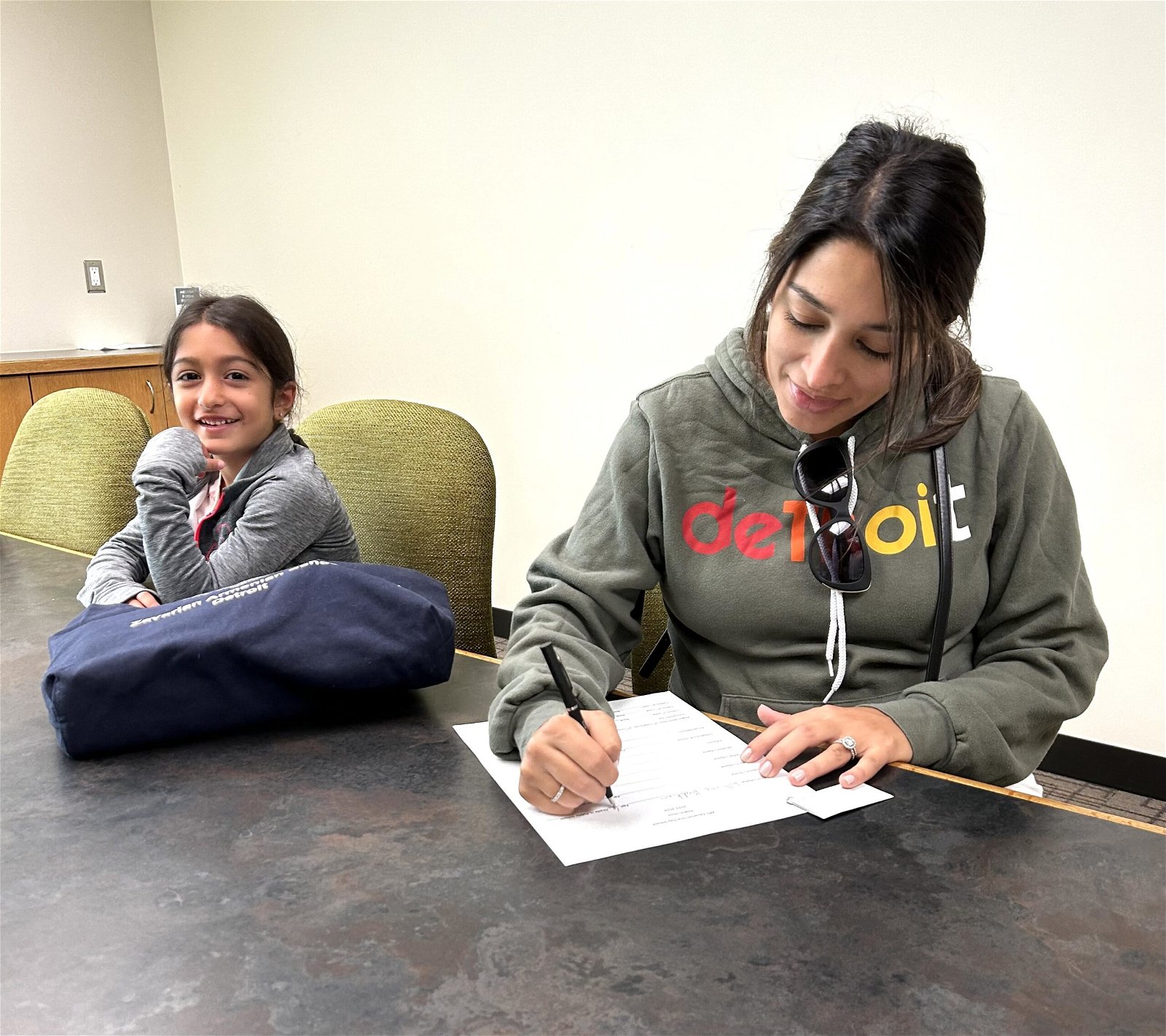 Tamar Bedikan fills out registration papers for her daughter, returning student Liliana Bedikian
Jennifer Morris enrolled her daughter Grace in Armenian school “for her to have a foundation with the language I wish I could have had.”
Lena Nazaryan will again lead the school and teach the older students at the Farmington Hills location. Narod Keyvanian will teach the younger students at the Farmington Hills and Novi locations.
“I want to help the kids to be Armenian and stay connected to their heritage and culture,” Keyvanian said, explaining why she signed up to teach classes for a fifth year. “I see kids falling in love with who they are as an Armenian and wanting to know more about their culture and language.”
Parents can still register their children for the 2023-24 academic year by calling ARS Mid-Council representative Sirvart Telbelian at (248) 661-8145 or (248) 210-9333.
Author information
Georgi Bargamian
Georgi Bargamian is a former editor of the Armenian Weekly. After 10 years working in community journalism, she attended law school and is an attorney, but she remains committed to her first love journalism by writing for the Armenian Weekly.
|
The post Greater Detroit ARS Zavarian School welcomes students back to class appeared first on The Armenian Weekly.
Georgian Government Launches Impeachment Proceedings Against Pro-European President – Jamestown The Jamestown Foundation