
Ukrainian territory occupied by #Russia‘s army in 2024 amounts to less than 1% of #Ukraine‘s total territory.
And at enormous cost. https://t.co/jaDuWaHkIn
— Steven Pifer (@steven_pifer) January 19, 2025
Category: Blogs and Tweets
Category Added in a WPeMatico Campaign
How the Azerbaijan Air Crash Unfolded – Communications Leaked https://t.co/cUFUcSehEX
A newly released transcript of radio communications reveals the tragic final moments of Azerbaijan Airlines Flight 8243, which crashed near Aktau on December 25, claiming 38 lives out of the 67… pic.twitter.com/UpX1LZEvZ7— Michael Novakhov (@mikenov) January 20, 2025
 |
Michael_Novakhov shared this story . |
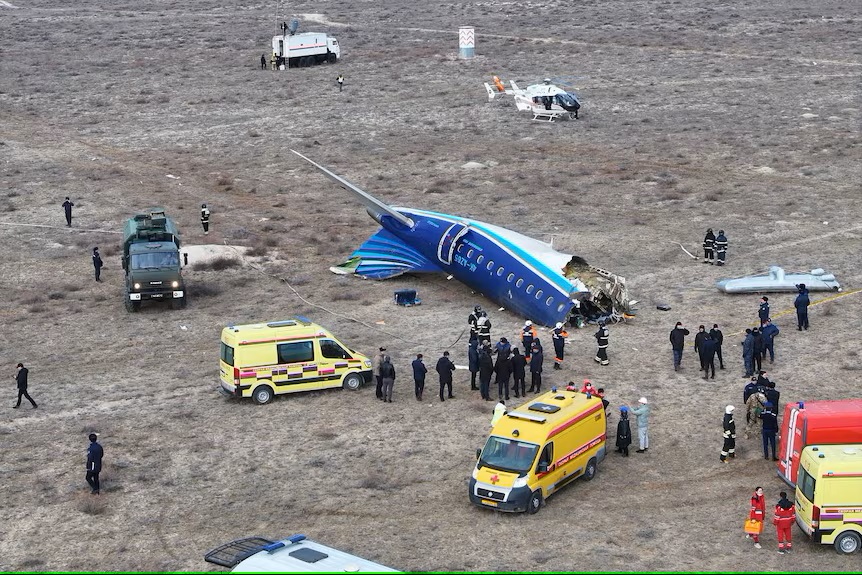
A newly released transcript of radio communications reveals the tragic final moments of Azerbaijan Airlines Flight 8243, which crashed near Aktau on December 25, claiming 38 lives out of the 67 people on board. The transcript released by Telegram channel Baza reveals a cascade of technical failures and emergencies that developed during what should have been a routine flight from Baku to Grozny.
We will take you through the simplified cascade of events as it happened.
The flight first encountered issues at 7:37 AM Moscow time when the crew reported losing both GPS signals while nearing Grozny airport.
‘Grozny tower, Azerbaijan, 8-2-4-3, good morning, approaching flight level 130, both GPS lost, request vectoring for NDB approach.’
At 7:53 flight 8243 aborted their first attempt to land
‘Azerbaijan 8-2-4-3, going around, unstable approach……Requesting vectoring for go-around, Azerbaijan 8-2-4-3. GPS signal lost.’
At 8:01 the control tower lost visibility of the flight 8243 on their radar
Control Tower: ‘Azerbaijan 8-2-4-3, for your information, I do not see you on the radar, maintain current course and report removal.’
Flight 8243: ‘Current heading 0-8-0 degrees, distance to airport…8:02:00 E: 3-0 miles, but GPS signal lost, information may not be accurate.’
Efforts to conduct non-precision approaches using traditional navigation aids (NDB) were hindered by worsening weather, including visibility reduced to 3,300 meters and a cloud ceiling of 240 meters. After two failed landing attempts, the crew opted to abandon their efforts to land at Grozny and instead head back to Baku.
The situation however took a dire turn at 8:16 when the crew reported a bird strike, quickly followed by what they described as two explosions within the cockpit.
‘Grozny, the controls failed. Bird strike in the cockpit… Uh, bird strike and two seats exploded in the cockpit…….What is the weather like in Mineralnye Vody ( EDIT: an airport in Russsia), please help.’
The aircraft began suffering from a series of critical system failures, including:
-
Loss of flight controls
-
Hydraulic system failure
-
Steering malfunctions, forcing the crew to use engine throttles for directional control
-
Pressurization issues affecting the cabin system
8:18 ‘I can’t execute, control is lost Give us vectoring to Mineralnye Vody. And please give us the weather in Mineralnye Vody.’
8:19 ‘I can’t maintain 150, we have increased pressure in the cabin’
8:20 ‘…my plane is losing control. Give me Makhachkala ( EDIT: a city in Russsia)
8:22 ‘ Our hydraulics failed’.
At 8:28 the pilots decided to again return to Baku after receiving weather reports for both Baku and Makhachkala.
The crew informed the controller At 8:39, that while the engines were operational, the aileron and elevator control systems had failed and not long after that oxygen was low. The pilots decoded to divert once again, this time to Aktau in Kazakhstan.
At 8:52 this terrifying communication is heard
‘So, we have the following situation. We are running out of oxygen in the passenger cabin. So, an oxygen tank exploded there, I think. And, that means, there is a smell of fuel. And, some passengers… that means, they are losing consciousness. May I ask if we can go at a lower altitude?’
At 9:02, flight 8243 declared a MAYDAY emergency to Aktau Tower, reporting complete control surface failure and relying solely on engine throttles for control.
During the final approach to Aktau, the crew requested and were granted vectors for a straight-in approach to reduce the need for complex manoeuvres since they only had engine throttles for control. The airport was temporarily closed to other traffic, and runway lights were activated to assist the distressed aircraft. The transcript ends at 9:27 with the crew’s final communications as they approach Aktau airport.
Head over to our Instagram page to watch FLIGHTRADAR24’s playback of the flight which shows the vast amount of time that the airlin3 was not visible on radar
Azerbaijani officials and aviation experts concluded that the crash was caused by a Pantsir missile system, currently deployed by Russia to counter Ukrainian drones in the region. The confirmation followed reports from Azerbaijani media that shrapnel from a Russian Pantsir missile had struck the Embraer E190 as it approached Grozny.
Furthermore, Azerbaijani media reported that Russian electronic warfare systems disrupted the aircraft’s communication equipment, causing it to vanish from radar over Russian airspace and reappear near the Caspian Sea.
If you would like to read the full transcript you can find that here.
Get the latest news and updates straight to your inbox
No spam, no hassle, no fuss, just airline news direct to you.
No comments yet, be the first to write one.
Azal crash: black boxes transcript – Google Search https://t.co/ZVVMbyEU3r pic.twitter.com/UTOwCgwOBE
— Michael Novakhov (@mikenov) January 19, 2025
Germany’s ambassador to the US wrote a cable warning that Donald Trump will undermine democracy. Andreas Michaelis said he expects Trump to rob legislators, law enforcement and the media of independence.https://t.co/QCYz3DIKaq
— DW News (@dwnews) January 19, 2025
“Kazakh Expert: Leaked AZAL Pilots’ Transcripts Intent” | AnewZ https://t.co/dem0OyPc6g
— Michael Novakhov (@mikenov) January 19, 2025
Azal crash: black boxes transcript – Google Search https://t.co/2Nc3hZIZvf https://t.co/hK1KiRoqJJ
— Michael Novakhov (@mikenov) January 19, 2025
https://t.co/GLx2CPz2rM
The South Caucasus News – https://t.co/68VWXDt66g#SouthCaucasus #SouthCaucasusNews#Armenia #Azerbaijan #Georgia Armenia Azerbaijan Georgiahttps://t.co/KYGCUA0Nwy
Comprehensive, Balanced, Timely
Starred posts – https://t.co/LAv0fftmPh
General News -…— Michael Novakhov (@mikenov) January 19, 2025
Russian media deflects attention: What is Moscow hiding about the AZAL crash? | https://t.co/PUdVE6N3h2 https://t.co/YuQiP2OmIK
By Tural HeybatovThe black boxes of the AZAL aircraft, downed by a Russian missile, have been decoded and are currently under investigation. As the… pic.twitter.com/oPIH2YX56t
— Michael Novakhov (@mikenov) January 19, 2025
|
Michael_Novakhov shared this story from  Economic news. Economic news.
|
By Tural Heybatov
The black boxes of the AZAL aircraft, downed by a Russian missile, have been decoded and are currently under investigation. As the investigation nears its conclusion, Russian propaganda appears increasingly agitated.
In recent days, Russian media have launched an aggressive campaign aimed at diverting attention away from Russia’s responsibility for the tragedy and shifting the blame onto Azerbaijan. Select excerpts from the pilots’ communications with air traffic control have been selectively published, speculative conclusions drawn, and “expert” opinions shared. This effort is accompanied by disparaging remarks and outright insults targeting Azerbaijan and its leadership. The goal seems to be to obscure the root cause of the tragedy, an effort that appears neither spontaneous nor isolated, but rather coordinated and systematic.
A key role in this campaign was played by the Telegram channel “Baza”, which has access to classified information and, by implication, to the structures that control it. “Baza” published a post claiming:
“Baza publishes the full transcript of the AZAL pilots’ communications with dispatchers. It shows that all decisions—choosing not to land in Grozny or Makhachkala, and instead flying back to Baku before heading to Aktau—were made by the crew of Azerbaijan Airlines independently. Dispatchers suggested landing in Grozny and later in Makhachkala, providing the crew with data on other Russian airports, but the crew decided not to land there.”
This narrative quickly spread to other Russian channels and media outlets. Adding to the furor, the Telegram channel “Svarshchik” propagated a fake claim that blamed the crash on a six-month-long operation by U.S. and Ukrainian intelligence agencies. The blogger behind this claim at least acknowledged that the plane was indeed struck by a Russian Pantsir air defense system located in the Visaitovsky district. According to this version, the system had targeted a Ukrainian drone but instead hit a civilian aircraft.
Russian blogs and media platforms erupted in an uproar. Various controversial commentators and journalists expressed their opinions in hysterical tones, resorting to insults and unfounded accusations. Some even suggested that Baku had colluded with NATO and was aware of the impending “provocation” to further discredit Russia.
While social media provides a platform for anyone to voice their opinion, the involvement of major media outlets raises serious concerns about the role of propaganda. Russian outlets emphasize the theory that the pilots themselves mentioned “birds” and an “oxygen tank” as potential causes, effectively echoing initial Russian attempts to deflect blame. However, these remarks by the pilots were made in the heat of the moment—they could not have imagined that their plane had been targeted by a Russian air defense system.

The facts remain clear: the airspace was not closed, and ground services failed to warn the civilian crew of any potential threats. This oversight points to a deliberate attempt to conceal the risks from the local population. Only after the AZAL crash did Russia start publicly declaring certain zones as restricted airspace. Before that, civilian flights operated in dangerous zones, setting the stage for tragedy.
As a result, many international airlines have since ceased flying over Russian territory, and Russian citizens are now acutely aware that the war, once fought on foreign soil, has reached their homes.
The “U.S. and Ukraine conspiracy” narrative mirrors the kind of disinformation Russia often accuses the West of spreading. Both sides engage in such exchanges to discredit one another. However, in this case, Russian propaganda is clearly aimed at deflecting attention from its own failures.
The circumstances of the AZAL crash are relatively clear. Visual inspections and preliminary data already provide enough evidence to draw conclusions. The sequence of events can be summarized as follows:
1. The aircraft’s navigation systems were disrupted by electronic warfare (EW) systems, preventing a safe landing.
2. While the crew attempted to land or return to Baku, the aircraft was mistakenly targeted by a Pantsir system, which identified it as a Ukrainian drone.
3. Throughout these events, no ground warnings were issued to the crew.
The Russian side’s much-touted Operation “Cover,” which coincided with the crash, was not communicated to the Azerbaijani crew. Instead of instructing the plane to leave the operational zone, ground control merely tried to guide it to land.
This was not a case of technical malfunction but a series of deliberate failures: the disabling of navigation systems via EW, the missile strike, and the subsequent loss of control. The decision by the pilots to divert to Aktau was not the cause of the disaster but a reaction to the dire circumstances. The ultimate cause was the Russian Pantsir system.
On December 28, Russian President Vladimir Putin called Azerbaijani President Ilham Aliyev to apologize, three days after the December 25 tragedy. During this period of silence, Russia’s allies in Azerbaijan expressed confusion over Moscow’s lack of response, while relations between the two countries deteriorated rapidly. The question remains: why did Moscow remain silent for so long, and does Russia truly believe it can afford to lose Azerbaijan as an ally?