
Categories
South Caucasus News

“He’ll throw me into pit”-Russian soldier asks his wife to send bribe to commander to avoid torture


Categories
South Caucasus News

Russia starts covert forced mobilization of citizens: Kremlin’s new plan revealed


Categories
South Caucasus News

Bitcoin Difficulty Climbs 3.87% as Hashrate Slips and Next Cut Looms


Bitcoin Difficulty Climbs 3.87% as Hashrate Slips and Next Cut Looms

After the previous difficulty epoch delivered a 7.76% reduction, Bitcoin’s difficulty moved higher by 3.87% at block height 943488. This latest adjustment represents the third increase recorded so far this year.

Key Takeaways:

  • Bitcoin difficulty rose 3.87% at block 943488 as hashrate fell 60.45 EH/s; a 15.73% cut is projected.
  • Miners face $30.67 PH/s hashprice and 0.56% fees, pushing firms toward AI over BTC mining.
  • Bitcoin network nears April 19, 2026, adjustment as slower 11:51 blocks signal easing difficulty ahead.

Bitcoin Mining Tightens

The Bitcoin network has logged a total of seven adjustments this year, comprising three increases and four decreases. The most recent reduction, two weeks ago, was sizable, arriving after consecutive gains of 14.73% and 0.45% across the prior two epochs.

Following the latest adjustment, the difficulty rating is now 3.87% higher, making blocks that much harder to discover, and it further stands at 138.97 trillion times more difficult than Bitcoin’s launch.

As of 4 p.m. Eastern time, 181 of the 2,016 blocks in the current epoch have been mined, placing the network roughly 9% of the way toward the next adjustment expected on April 19, 2026. While it remains early and conditions can shift considerably between now and then, current estimates point to a projected 14.27% reduction.
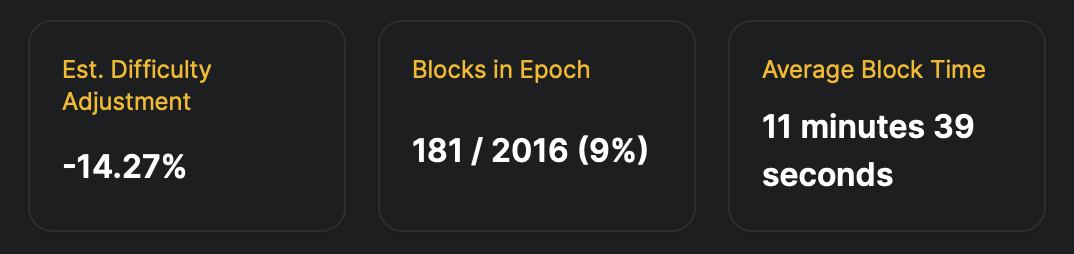
Bitcoin Difficulty Climbs 3.87% as Hashrate Slips and Next Cut Looms
Image source: hashrateindex.com on April 4, 2026.

This outlook stems from a noticeable slowdown in block intervals over the past day, with data from hashrateindex.com indicating an average block time of 11 minutes 39 seconds, well above the expected 10-minute cadence.
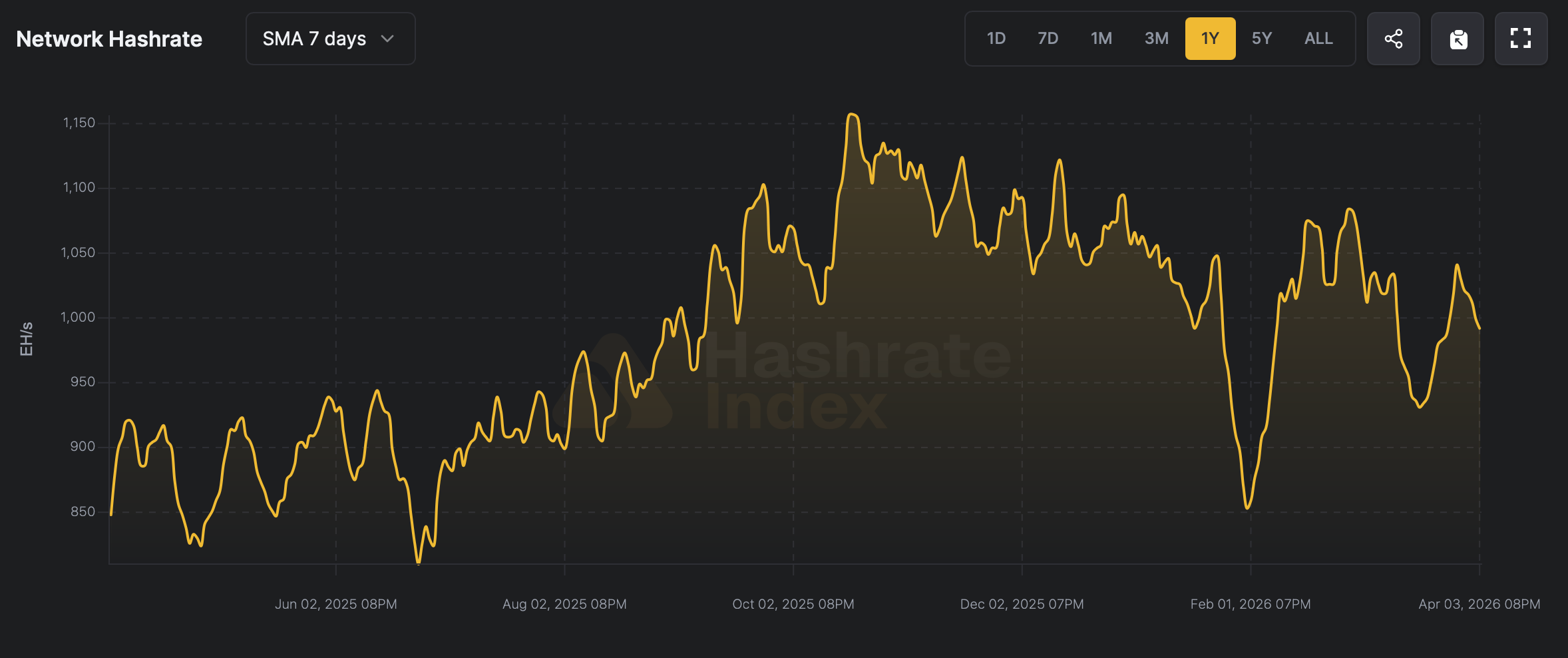
Bitcoin’s total hashrate on Saturday, April 4, 2026, via hashrateindex.com.

What’s behind the shift? A decline in hashrate. Bitcoin.com News reported on March 28 that the Bitcoin network’s total computational power had exceeded 1,000 exahash per second (EH/s), or 1 zettahash per second (ZH/s). On that day, hashpower reached 1,022 EH/s, whereas it now sits 60.45 EH/s lower at 961.55 EH/s.

Revenue Compression Tightens the Squeeze

Compressed revenues are likely a key factor behind the downturn, alongside mining operations opting to allocate resources toward artificial intelligence (AI) infrastructure rather than mining BTC in pursuit of stronger returns. An infrastructure provider deploying its megawatts toward AI rather than mining bitcoin can realize significantly higher returns, a dynamic that has persuaded many of today’s operators to redirect their focus.

A daily hashprice of $30.67 per petahash per second (PH/s) ranks among the lowest revenue levels bitcoin miners have faced since the network’s early years, when bitcoin carried a far smaller valuation. With 106,335 blocks remaining until the next halving, conditions are poised to tighten further.

Adding pressure, miners cannot rely on fees, which account for just 0.56% of the block reward. In effect, the system appears to be approaching a breaking point. Yet Bitcoin’s difficulty adjustment is engineered for precisely this scenario. If miners exit and hashrate declines, difficulty adjusts downward, drawing participants back with more accessible conditions.

Read More

The post Bitcoin Difficulty Climbs 3.87% as Hashrate Slips and Next Cut Looms appeared first on azeritimes.com.


Categories
South Caucasus News

Ukraine extradites foreign fighter who fought for Russia to Azerbaijan – Ukrinform


Ukraine extradites foreign fighter who fought for Russia to Azerbaijan  Ukrinform

Categories
South Caucasus News

Ukraine extradites foreign fighter who fought for Russia to Azerbaijan – Ukrinform – Ukrainian National News Agency


Ukraine extradites foreign fighter who fought for Russia to Azerbaijan  Ukrinform – Ukrainian National News Agency

Categories
South Caucasus News

US-Israeli strikes hit missile bases north of Tehran, petrochemical facility in southwest Iran


Categories
South Caucasus News

How BYD is expanding its EV dominance with the Great Tang SUV launch in China​


The new model is expected to build on the success of BYD’s Tang lineup, which has already established itself as one of the company’s flagship SUV series. The introduction of the Great Tang signals not only a product upgrade but also a broader push to strengthen BYD’s dominance in its home market while reinforcing its global ambitions.

***

At a time when competition in the electric vehicle sector is intensifying, particularly with rivals such as Tesla, the launch reflects BYD’s strategy of continuous innovation, rapid model rollout, and strong positioning in the mid to premium SUV segment.

What makes the Great Tang different

While full technical specifications are still emerging, early indications suggest that the Great Tang SUV will feature upgrades in design, performance, and digital integration.

The vehicle is expected to adopt BYD’s latest design language, combining a more refined exterior with a technologically advanced interior. Industry observers anticipate improvements in battery efficiency, driving range, and smart cockpit features, including enhanced infotainment systems and driver assistance capabilities.

BYD’s proprietary battery technology, particularly its Blade Battery, is likely to remain central to the model. This technology is known for its safety, durability, and cost efficiency, giving BYD a competitive edge in a market where battery performance is a key differentiator.

How the launch fits into BYD’s broader strategy

The introduction of the Great Tang aligns with BYD’s broader approach of scaling its product portfolio while maintaining competitive pricing and strong domestic penetration.

China remains the world’s largest electric vehicle market, and BYD has consistently leveraged its home advantage to drive volume growth. By expanding its SUV offerings, the company is targeting one of the fastest growing segments in the automotive industry.

SUVs account for a significant share of consumer demand in China, particularly among families and urban professionals. The Great Tang is positioned to capture this demand by offering a combination of performance, space, and advanced technology.

At the same time, BYD continues to expand internationally, entering markets across Europe, Southeast Asia, and Latin America. While the Great Tang is initially focused on China, it could later be adapted for global markets, depending on demand and regulatory requirements.

How BYD is competing with global rivals

BYD’s rise has reshaped the competitive landscape of the electric vehicle industry. The company has rapidly increased its production capacity, diversified its model lineup, and strengthened its supply chain through vertical integration.

Unlike many competitors, BYD manufactures key components in house, including batteries, semiconductors, and electric drivetrains. This approach allows for greater cost control and faster innovation cycles.

The launch of the Great Tang comes as competition intensifies not only with Tesla but also with traditional automakers transitioning to electric mobility. Companies across the United States, Europe, and Asia are investing heavily in new EV models, making the market more crowded and dynamic.

BYD’s ability to introduce new models quickly and at scale gives it a distinct advantage, particularly in price sensitive segments.

Why SUVs are central to EV growth

The focus on SUVs is not accidental. Globally, SUVs have become the dominant vehicle category, and this trend is mirrored in the electric vehicle sector.

Consumers are increasingly drawn to SUVs for their higher driving position, larger interior space, and perceived safety. Electric SUVs combine these advantages with the benefits of zero emission driving, making them particularly attractive in urban environments.

By launching the Great Tang, BYD is reinforcing its presence in this high demand segment, ensuring that it remains competitive as consumer preferences evolve.

What this means for the Chinese EV market

The arrival of the Great Tang is likely to intensify competition within China’s already crowded EV market. Domestic manufacturers are engaged in a rapid cycle of innovation, frequently launching new models with upgraded features and competitive pricing.

This environment benefits consumers, who gain access to a wide range of options, but it also puts pressure on manufacturers to differentiate themselves.

BYD’s strong brand recognition and technological capabilities position it well to navigate this landscape. However, maintaining leadership will require continuous innovation and responsiveness to market trends.

What to expect from the May launch

The official launch in May is expected to reveal detailed specifications, pricing, and availability. Industry analysts will be watching closely to see how the Great Tang is positioned relative to competing models.

Key factors that will determine its success include pricing strategy, range performance, charging capabilities, and the integration of smart technologies.

If the model meets expectations, it could further strengthen BYD’s position as a leading force in the global electric vehicle industry.

Conclusion

The upcoming launch of the Great Tang SUV represents more than just a new product release. It reflects BYD’s broader ambition to dominate the electric vehicle market through innovation, scale, and strategic positioning.

As competition intensifies and the EV market continues to evolve, the success of models like the Great Tang will play a crucial role in shaping the future of mobility, both in China and beyond.

The post How BYD is expanding its EV dominance with the Great Tang SUV launch in China​ appeared first on azeritimes.com.


Categories
South Caucasus News

How Elon Musk is tying SpaceX’s IPO to Grok AI subscriptions​


According to multiple reports, advisory firms working on the IPO are being asked to purchase subscriptions to Grok, an artificial intelligence chatbot developed by Musk’s AI company xAI.

***

The move effectively links participation in one of the world’s most valuable IPOs to financial support for Musk’s expanding AI ecosystem.

How the “Grok condition” works

Banks, law firms, auditors, and other advisers involved in the SpaceX IPO are reportedly required to subscribe to Grok as part of their engagement. Some institutions are said to have agreed to spend tens of millions of dollars annually on these subscriptions and have already begun integrating the AI tool into their internal systems.

Major global banks expected to play key roles in the IPO include Morgan Stanley, Goldman Sachs, JPMorgan Chase, Bank of America, and Citigroup.

This requirement effectively turns the IPO process into a dual business opportunity for Musk – raising capital for SpaceX while simultaneously scaling adoption of his AI platform.

Why Musk is pushing Grok through the IPO

The strategy appears to be part of Musk’s broader effort to integrate artificial intelligence into all of his ventures. Following the merger of SpaceX and xAI in early 2026, Grok has become a central component of Musk’s technological ecosystem.

By requiring financial institutions to adopt Grok, Musk is:

Expanding the user base of his AI product
Embedding Grok into high value enterprise environments
Generating recurring subscription revenue
Strengthening the integration between space, data, and AI businesses

This reflects a larger vision in which SpaceX is not just a space company but part of a broader technology platform combining satellite infrastructure, AI, and data services.

How this connects to the SpaceX IPO

The planned SpaceX IPO is expected to be one of the largest in history, with valuations projected above $1.7 trillion and possibly exceeding $2 trillion.

The company aims to raise tens of billions of dollars, potentially surpassing previous record breaking listings.

Given the scale of the offering, participation in the IPO is highly attractive for investment banks and advisory firms. This gives Musk significant leverage to impose unconventional conditions, such as the Grok subscription requirement.

Why banks may agree to the condition

Despite the unusual nature of the requirement, banks are likely to comply for several reasons:

The SpaceX IPO represents a rare and highly lucrative opportunity
Advisory roles in such a deal can generate substantial fees
Maintaining relationships with Musk and his companies is strategically valuable

For many institutions, the cost of subscribing to Grok may be relatively small compared to the potential earnings from participating in the IPO.

What this means for the AI industry

Musk’s approach highlights an emerging trend in the technology sector: leveraging one business line to accelerate growth in another.

By tying AI adoption to financial services, Musk is effectively forcing enterprise level integration of his technology. This could:

Increase competition with other AI firms
Accelerate adoption of generative AI tools in finance
Blur the lines between different sectors of the tech industry

However, some analysts have raised concerns about whether such practices could create conflicts of interest or raise regulatory questions.

How this reflects Musk’s broader strategy

Musk has increasingly moved toward building an interconnected ecosystem across his companies, including SpaceX, Tesla, xAI, and other ventures.

The goal appears to be creating a vertically integrated technology network that spans:

Transportation and energy
Artificial intelligence and data processing
Satellite communications and space infrastructure

The Grok subscription requirement fits into this strategy by embedding AI into the financial backbone supporting SpaceX’s growth.

What could happen next

As preparations for the IPO continue, several developments are likely:

Further integration of Grok into enterprise systems
Increased scrutiny from regulators and industry observers
Continued expansion of SpaceX’s valuation and investor base

The success of this strategy will depend on whether institutions see long term value in adopting Grok beyond the IPO requirement.

Conclusion

Elon Musk’s decision to link SpaceX IPO participation to Grok AI subscriptions represents a bold and unconventional business move. It demonstrates how influence in one domain – capital markets – can be used to drive growth in another – artificial intelligence.

As SpaceX moves closer to what could be a historic public listing, the strategy underscores Musk’s broader ambition: to build a unified technological ecosystem where space, AI, and finance are increasingly interconnected.

The post How Elon Musk is tying SpaceX’s IPO to Grok AI subscriptions​ appeared first on azeritimes.com.


Categories
South Caucasus News

Why Russia is warning of a nuclear risk​


The strike, which occurred amid ongoing conflict involving Iran, United States, and Israel, hit an area close to the country’s only operational nuclear facility.

***

Iranian authorities indicated that a projectile struck near the site, causing casualties and damaging nearby infrastructure, though the core nuclear facility itself remained intact and operational. Despite the limited physical damage, the proximity of the strike has raised serious concerns about potential escalation.

What happened near the Bushehr nuclear facility

Russia, which has played a key role in the construction and operation of the Bushehr plant, reacted sharply. Officials from Rosatom warned that repeated strikes near nuclear infrastructure could lead to a worst case scenario.

Russian officials stressed that even indirect damage to systems such as cooling units, power supply, or containment mechanisms could trigger a radiological incident. Meanwhile, Foreign Ministry spokeswoman Maria Zakharova called for an immediate halt to attacks near nuclear facilities, emphasizing that the situation is approaching a dangerous threshold.

How serious is the threat to the plant

Although no radiation leak has been reported, experts caution that the risk remains real. Nuclear facilities depend on complex and continuous safety processes. Even a near miss can disrupt essential operations.

Incidents such as Fukushima nuclear disaster have shown that damage to auxiliary systems, rather than the reactor core itself, can lead to catastrophic outcomes. In Bushehr’s case, its coastal location along the Persian Gulf increases the potential consequences, as any contamination could spread across regional waters.

How the strike fits into the wider conflict

The incident is part of a broader escalation in tensions across the region. Since early 2026, hostilities involving Iran, the United States, and Israel have expanded beyond military targets to include infrastructure and strategic facilities.

This widening scope has raised concerns that the conflict could inadvertently affect sensitive installations, including nuclear sites. Analysts warn that as the range of targets increases, so too does the risk of unintended consequences.

Why nuclear facilities are highly sensitive targets

Nuclear power plants are not designed to operate in active war zones. Even without a direct hit, nearby explosions can create shockwaves, power disruptions, or damage to critical support systems.

Potential consequences of attacks near such facilities include overheating of reactor components, failure of cooling systems, and release of radioactive materials. While modern plants have multiple safety layers, sustained external pressure can increase the likelihood of system failure.

What actions Russia is taking

In response to the situation, Russia has begun evacuating some of its personnel from the Bushehr facility. Russian engineers and specialists are essential to the plant’s operation, and their withdrawal reflects growing concern about safety.

Moscow has also called for de escalation and urged all parties to avoid targeting areas near nuclear infrastructure. The evacuation underscores the seriousness of the risk assessment being made by Russian authorities.

How the international community is reacting

International observers have urged restraint, warning that continued escalation near nuclear sites could have consequences far beyond the immediate conflict zone.

There is increasing concern that a miscalculation could trigger a crisis with regional or even global implications. Energy markets and geopolitical stability are also being closely monitored as the situation develops.

What could happen next

Several possible scenarios are emerging. The conflict could remain contained, with continued strikes avoiding direct hits on nuclear facilities. Alternatively, further escalation could increase the risk of accidental or deliberate targeting of such sites.

Diplomatic intervention remains another possibility, with international actors seeking to reduce tensions and prevent a broader crisis.

Conclusion

Russia’s warning about rising nuclear risks following the strike near Bushehr highlights the fragile balance between military operations and nuclear safety. While the facility itself remains intact, the proximity of attacks has brought the region closer to a potentially dangerous threshold.

The situation underscores a critical reality: in modern conflicts, the line between conventional warfare and catastrophic risk can be dangerously thin.

The post Why Russia is warning of a nuclear risk​ appeared first on azeritimes.com.


Categories
South Caucasus News

How do I delete my Quora account? – Quora Help Center


How do I delete my Quora account? Quora allows users to delete their account if they choose to do so. Deleting your Quora account means that the following content will be removed from public view: …