
Day: April 16, 2026

The partnership allows BMW and MINI drivers to access multiple charge point operators through a single account within the My BMW and MINI apps, simplifying station discovery, payment and trip planning, News.Az reports, citing foreign media.
***
The integration, introduced in March 2026, aggregates major Canadian charging networks including Shell Recharge, FLO, ChargePoint, Circuit électrique, BC Hydro and EV Connect Canada. It also supports cross-border access in the US, with compatible Tesla Superchargers added from today.
From 2026, new BMW models in Canada, including the upcoming iX3 and i3, will be equipped with the North American Charging Standard (NACS) port, allowing direct access to Tesla’s fast-charging network. Existing models using CCS connectors can access NACS chargers via an approved adapter, with compatibility enabled through app-based activation and over-the-air software updates.
The rollout also includes integration with BMW’s eRoute trip planning system, which recommends charging stops and enables route transfer directly to the vehicle, alongside Plug & Charge functionality for automated authentication and billing at supported stations.
The expansion is designed to improve charging convenience and coverage by leveraging North America’s largest fast-charging infrastructure, where Tesla Superchargers typically deliver between 250kW and 325kW DC charging, depending on vehicle and site conditions.
BMW said the initiative reflects its strategy to streamline EV ownership by combining expanded infrastructure access with a unified digital interface, aiming to make public charging more accessible, transparent and user-friendly for drivers.
The post BMW and MINI boost Canada’s EV charging via Shell Recharge, Tesla appeared first on azeritimes.com.

The truce will take effect at 5pm US East Coast time (21:00 GMT) on Thursday, Trump wrote on social media after speaking to Israeli Prime Minister Benjamin Netanyahu and Lebanese President Joseph Aoun, News.Az reports, citing Al Jazeera.
***
“These two Leaders have agreed that in order to achieve PEACE between their Countries, they will formally begin a 10 Day CEASEFIRE at 5 P.M. EST,” Trump wrote on Truth Social.
Lebanese Prime Minister Nawaf Salam welcomed the announcement in a post on X, describing the ceasefire as “a central Lebanese demand we have pursued since the first day of the war” and the primary goal of Tuesday’s meeting between Lebanese and Israeli officials in the US.
Lebanon was drawn into the US-Israeli war on Iran on March 2 when Hezbollah, the Iran-aligned Lebanese armed group, fired rockets at Israel in response to the killing of Iranian Supreme Leader Ali Khamenei, who was killed on February 28 in an Israeli strike on the opening day of the war on Iran.
Israeli forces responded with a ferocious campaign that has since killed more than 2,196 people in Lebanon and wounded thousands more. Israel has also issued forced evacuation orders covering roughly 15 percent of Lebanese territory.
The Lebanese Ministry of Public Health said strikes have killed nine people across the southern district of Tyre over the past two days, including a paramedic.
Salam also offered prayers for those killed and expressed hope that the more than one million people forced from their homes by Israel’s bombardment and invasion of Lebanon would be able to return “as soon as possible”.
Trump said he would invite Netanyahu and Aoun to direct talks, saying both sides wanted to resolve their differences and he believed “that will happen quickly”.
He also said he had directed Vice President JD Vance, Secretary of State Marco Rubio and the chairman of the Joint Chiefs of Staff, Dan Caine, to work towards a lasting settlement.
Hezbollah lawmaker Ibrahim al-Moussawi told AFP on Thursday that the group would respect the US-brokered ceasefire if Israeli attacks on its fighters fully stopped.
The ceasefire follows an intense week of diplomacy.
On Tuesday, Lebanese and Israeli envoys met in Washington, DC, in their countries’ first direct diplomatic contact in decades. The talks were hosted by Rubio.
Both sides described the talks as positive although Aoun refused to speak directly with Netanyahu, a government official familiar with the matter told The Associated Press news agency, adding that Washington “understands Lebanon’s position”.
The post Trump announces 10-day ceasefire between Lebanon and Israel appeared first on azeritimes.com.

The insights highlight how geopolitical disruption is reshaping long-haul networks, with established hubs benefiting from scale and flexibility, with implications for broader loaviation and cargo connectivity, News.Az reports, citing foreign media.
***
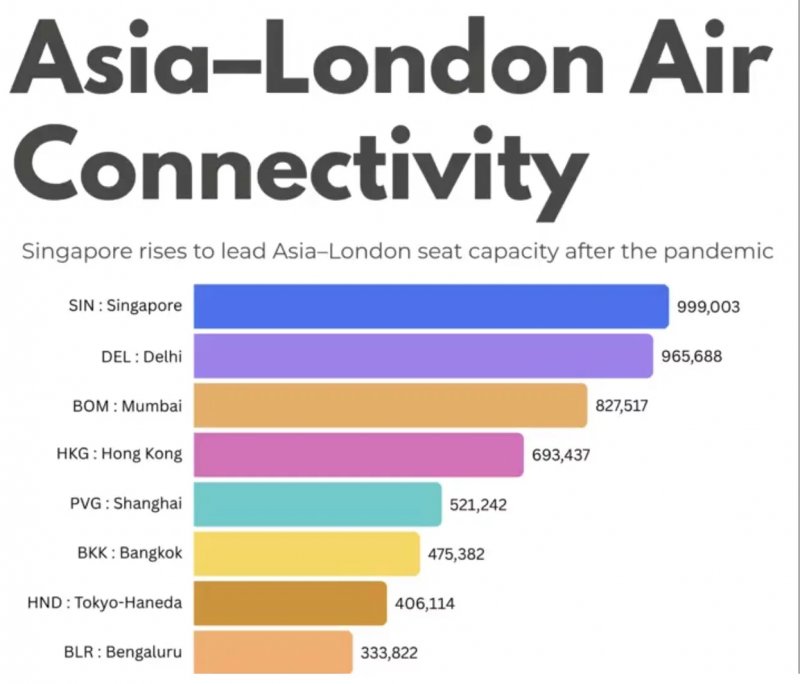
The analysis is supported by comparative visuals showing Asia–London seat capacity across a 20-year period, highlighting a clear shift in hub dominance. In 2006, Hong Kong was the leading gateway to London, with more than 1.1 million seats, followed by Singapore and other major Asian hubs such as Mumbai, Bangkok and Tokyo. At the time, Singapore ranked second, while airports like Delhi and Kuala Lumpur had more limited capacity.
By 2026, the picture has notably changed. Singapore has moved into the top position with approximately 999,000 seats, overtaking Hong Kong, which has dropped to fourth place. Indian hubs have gained prominence, with Delhi rising to second place and Mumbai maintaining a strong position.
The data also shows broader diversification across the market, with cities such as Shanghai, Tokyo-Haneda and Bengaluru strengthening their presence in the Asia–London corridor.
Historically, Hong Kong dominated Asia–London seat capacity, but Cirium data shows Singapore has strengthened its position in recent years, emerging as a leading gateway as long-haul travel recovers post-pandemic. This shift in passenger connectivity also has implications for air cargo, as increased long-haul capacity strengthens bellyhold freight options through major hubs such as Singapore.
The post Singapore rises as Asia’s top gateway to London appeared first on azeritimes.com.
According to the Korean Central News Agency, Kim attended the drill Wednesday, held by artillery units under the western front command of the Korean People’s Army to commemorate the birthday of his grandfather, Kim Il Sung, known as the Day of the Sun, News.Az reports, citing foreign media.
***
During the inspection, Kim called for intensified combat readiness and emphasized the need to strengthen artillery capabilities. He said the ruling party’s strategy to modernize artillery forces must be fully implemented within the current five-year national defense development plan.
Kim also urged the military to increase the frequency of training exercises tied to key national events, saying the armed forces should focus above all on preparedness for combat.
Despite the significance of the holiday, Kim did not attend a commemorative visit to the Kumsusan Palace of the Sun, where the bodies of Kim Il Sung and former leader Kim Jong Il lie in state. His absence marks the fourth consecutive year he has not taken part in the annual tribute.
His last known attendance on the Day of the Sun was in 2022. North Korean media reported that senior officials from the ruling Workers’ Party and government, including Politburo Presidium members such as Pak Thae-song and Jo Yong-won, visited the mausoleum Wednesday.
Officials from the Supreme People’s Assembly and the Cabinet were also present. Participants pledged loyalty to Kim under the ideology of “Kim Il Sung-Kim Jong Il-ism,” according to state media.
The post Kim Jong-un watches artillery drills on major North Korean holiday appeared first on azeritimes.com.
The announcement signals a significant escalation in the technological rivalry not only within China but across the global digital economy.
***
The new model is positioned as a high performance, large scale system capable of handling complex language, reasoning, and multimodal tasks. It reflects Alibaba’s ambition to move beyond its traditional dominance in e commerce and cloud computing into the core frontier of artificial intelligence innovation.
This development matters because AI models are increasingly becoming foundational infrastructure for modern economies. From enterprise automation to consumer applications, the ability to build and deploy powerful AI systems is now seen as a strategic capability on par with energy or telecommunications.
What exactly is the new AI model and what can it do?
Alibaba’s new AI system belongs to the category of large language models, often referred to as LLMs. These models are trained on vast datasets and can perform a wide range of tasks, including text generation, translation, coding assistance, data analysis, and conversational interaction.
Beyond basic language tasks, the model is designed to integrate multimodal capabilities. This means it can process and generate not only text but also images, and potentially video or audio. Such functionality positions it as a versatile tool for both enterprise clients and consumer facing applications.
The model reportedly emphasizes improved reasoning ability and contextual understanding. This is a key differentiator in the current AI race, where companies are striving to build systems that can move beyond simple pattern recognition toward more sophisticated problem solving.
How does this move position Alibaba against Tencent?
The rivalry between Alibaba and Tencent has traditionally played out across sectors such as digital payments, social media, gaming, and cloud services. However, artificial intelligence has become the new battleground.
Tencent has invested heavily in AI, integrating it into its vast ecosystem that includes messaging platforms, gaming networks, and enterprise solutions. Alibaba’s new model is a direct attempt to counter this influence by strengthening its own AI infrastructure and embedding it across its services.
While Tencent benefits from its dominance in user engagement through platforms like messaging and entertainment, Alibaba’s advantage lies in its deep integration with commerce and logistics. The introduction of a powerful AI model allows Alibaba to enhance everything from supply chain optimization to personalized shopping experiences.
This dynamic suggests that AI is not just a standalone product but a force multiplier across existing digital ecosystems.
Why is China’s AI competition intensifying now?
The intensification of AI competition within China is driven by several structural factors. First, the Chinese government has identified artificial intelligence as a strategic priority, encouraging domestic companies to accelerate innovation and reduce reliance on foreign technologies.
Second, the global AI race has entered a phase where scale and speed matter more than ever. Companies that fail to keep up risk being locked out of future technological ecosystems.
Third, the commercial applications of AI are expanding rapidly. From finance and healthcare to manufacturing and education, AI is becoming a core driver of productivity and competitiveness.
In this context, Alibaba’s move can be seen as both defensive and offensive. It is defending its market position while also seeking to capture new opportunities in emerging sectors.
How does this affect the global AI race?
Alibaba’s new model has implications far beyond China. The global AI race is increasingly shaped by competition between major technology hubs, including the United States, China, and to a lesser extent, Europe.
By introducing a competitive AI system, Alibaba contributes to a more multipolar technological landscape. This could lead to greater fragmentation in AI ecosystems, with different regions developing their own standards, platforms, and regulatory frameworks.
At the same time, it increases the pace of innovation. As companies compete to outperform each other, they invest more heavily in research and development, leading to rapid advancements in AI capabilities.
However, this competition also raises concerns about governance, ethics, and security. The deployment of powerful AI systems requires careful oversight to ensure they are used responsibly.
What role does Alibaba Cloud play in this strategy?
Alibaba Cloud is central to the company’s AI ambitions. As one of the largest cloud service providers in Asia, it offers the infrastructure needed to train, deploy, and scale AI models.
The integration of the new AI model into Alibaba Cloud allows businesses to access advanced AI capabilities without building their own systems from scratch. This democratizes access to AI and accelerates its adoption across industries.
For Alibaba, this creates a virtuous cycle. More users of its cloud services generate more data and revenue, which can then be reinvested into further AI development.
It also strengthens Alibaba’s position in the global cloud market, where it competes with major players such as Amazon Web Services and Microsoft Azure.
What industries are likely to be impacted first?
Several industries are expected to feel the impact of Alibaba’s AI advancements in the near term.
E commerce is the most immediate beneficiary. AI can enhance product recommendations, optimize pricing strategies, and improve customer service through intelligent chatbots.
Logistics and supply chain management will also see significant improvements. AI can predict demand, optimize delivery routes, and reduce operational costs.
In finance, AI can be used for risk assessment, fraud detection, and personalized financial services. In healthcare, it can assist in diagnostics, data analysis, and patient management.
Media and entertainment may also be transformed, with AI enabling content creation, localization, and personalization at scale.
How does this compare to global competitors?
Alibaba’s new AI model enters a competitive landscape that includes leading systems from companies in the United States and other regions. These models have set high benchmarks in terms of performance, scalability, and versatility.
Alibaba aims to differentiate itself through its integration with real world commercial applications. While some competitors focus heavily on research and consumer facing tools, Alibaba emphasizes practical deployment in business environments.
Another key factor is localization. Alibaba’s model is likely optimized for Chinese language and cultural contexts, giving it an advantage in domestic markets.
However, to compete globally, it will need to demonstrate comparable performance across multiple languages and use cases.
What are the geopolitical implications of this development?
The rise of advanced AI models is increasingly intertwined with geopolitics. Technology is now a central element of national power, influencing economic growth, military capabilities, and global influence.
Alibaba’s move contributes to China’s broader effort to establish technological self sufficiency and leadership. This has implications for international relations, particularly in the context of ongoing competition between major powers.
Countries may respond by investing more heavily in their own AI capabilities or by forming alliances to share technology and resources.
At the same time, there is a growing need for international cooperation on issues such as AI safety, ethics, and standards.
What challenges does Alibaba face moving forward?
Despite its ambitions, Alibaba faces several challenges in its AI journey.
First, the development of advanced AI models requires significant computational resources and investment. Maintaining competitiveness will require continuous funding and innovation.
Second, regulatory scrutiny is increasing. Governments around the world are introducing rules to govern the use of AI, which could impact how companies develop and deploy these technologies.
Third, there is intense competition. Both domestic rivals like Tencent and international players are investing heavily in AI, making it difficult to maintain a leading position.
Finally, there are technical challenges. Building models that are not only powerful but also reliable, transparent, and safe is a complex task.
How could this reshape the future of technology?
The introduction of new AI models by major companies like Alibaba is likely to accelerate the transformation of the global technology landscape.
AI is becoming a general purpose technology, similar to electricity or the internet. It has the potential to reshape entire industries and create new forms of economic activity.
As AI systems become more capable, they will increasingly be integrated into everyday life, from how people work and communicate to how businesses operate and compete.
Alibaba’s move is part of a broader trend toward the decentralization of AI innovation. Instead of a single dominant player, multiple companies and regions are contributing to the development of AI technologies.
This could lead to a more diverse and dynamic technological ecosystem, but it also introduces new complexities and risks.
What should businesses and consumers expect next?
Businesses can expect greater access to advanced AI tools that can enhance productivity and innovation. This may lower barriers to entry for smaller companies and enable new business models.
Consumers are likely to see more personalized and intelligent digital services. From shopping and entertainment to education and healthcare, AI will play an increasingly central role.
However, both businesses and consumers will need to navigate challenges related to data privacy, security, and ethical use of AI.
What is the broader significance of this moment?
Alibaba’s unveiling of a new AI model is not just a corporate milestone. It represents a broader shift in the global technology landscape.
The race to develop and deploy AI is becoming one of the defining features of the 21st century. It is shaping economic competition, geopolitical dynamics, and the future of innovation.
In this context, Alibaba’s move underscores the growing importance of AI as a strategic asset. It highlights the need for companies and countries to adapt to a rapidly changing technological environment.
As the competition intensifies, the outcomes will have far reaching implications for the global economy and society as a whole.
The post How Alibaba’s new AI model is challenging Tencent and reshaping the global tech race appeared first on azeritimes.com.