Categories
South Caucasus News

Georgia writes off $370m in fines for 157 energy companies


Fines written off for energy companies in Georgia

Under a government decision, fines totalling about 1 billion lari ($370m) have been written off for 157 companies in Georgia’s energy sector.

Authorities say the move is part of a “conditional write-off” scheme. Companies fined for network failures, periodic power outages, budget arrears and unmet obligations will have their penalties cancelled, provided they comply with deadlines in the future. If they fail to do so, the fines will be reinstated.

The government says the measure will allow energy companies to restore their resources.

Prime Minister Irakli Kobakhidze said the decision had been taken several months ago and the process has now been completed. He added that some companies declined the offer, meaning projects with a capacity of 535 MW will be terminated, while projects totalling 1,500 MW will continue.

Context

On 30 March 2026, it was announced that electricity tariffs in Georgia would increase. Household consumers will see prices rise by 5 tetri (about $0.02), while the commercial sector will face an average increase of 4–6 tetri ($0.01–0.02). Overall, tariffs have risen by 33%.

The higher tariffs came into effect on 1 April.

According to Georgia’s National Energy and Water Supply Regulatory Commission (GNERC), the main reasons for the increase are the country’s reliance on electricity imports and higher purchase prices.

The commission also said that planned investments for the new tariff period are affecting prices. These investments are aimed at gradually upgrading the electricity distribution system and reducing the number of outages. Officials say this will improve the reliability of electricity supply and reduce the frequency of disruptions for consumers.


Categories
South Caucasus News

Three Minors Sentenced to Multiple Years in Prison in Murder Case of Teacher Giga Avaliani


Three minors – Aleksandre Gabashvili, Giorgi Rikadze and Demetre Chikovani – were found guilty and sentenced to multiple years in prison in the high-profile murder case of 28-year-old teacher Giga Avaliani.

Tbilisi City Court Judge Romeo Tkeshelashvili, who delivered the guilty verdict on April 5, handed down the sentences on April 8. Their jail terms were reduced automatically by one-fourth under the juvenile justice code.

Aleksandre Gabashvili, the main defendant in the case, was sentenced to 14 years in prison, but will serve ten and a half years. He was convicted under Georgia’s Criminal Code for intentional infliction of serious harm to health resulting in death, committed by a group (Article 117), in the Avaliani case, and organizing and participating in group activity accompanied by violence (Article 225) in the Avaliani case and four other episodes.

Giorgi Rikadze, Gabashvili’s friend, who recorded the attack on Avaliani on the phone, faced identical charges and received the same sentence, serving ten and a half years.

Demetre Chikovani, another friend of Gabashvili, was accused of attempted intentional infliction of serious harm to health in the Avaliani case and organizing group violence in that case and four other incidents. He was sentenced to nine years in prison and will serve six years and nine months.

Avaliani, a 28-year-old doctor and private tutor, was attacked late at night on October 1, 2025, near the entrance to his apartment block in Tbilisi. He was hospitalized with critical head injuries and fell into a coma, and died on October 24.

The guilty verdicts follow protests by the victim’s mother, Eka Kupatadze, who publicly criticized the investigation and demanded accountability of all those involved in her son’s murder, including those who allegedly knew about the planned attack on Avaliani and did not inform the police. Among the family’s key demands was that the investigation be upgraded to a group crime qualification.

In February, Georgia’s Prosecutor General’s Office accused the three defendants, who were already in pretrial detention in Avaliani’s case, of taking part in group violence in four additional episodes.

According to the authorities, Gabashvili, Rikadze, and Chikovani, together with other individuals, “used various communication methods to impersonate girls, lured selected victims outside, arranged meetings at preselected times and locations, and subjected them to group physical assaults, including brutal beatings and verbal abuse.” All four episodes, like Avaliani’s case, occurred in Tbilisi in 2025.

Also Read:


Categories
South Caucasus News

More complaints against Georgia filed with European Court of Human Rights


Number of cases against Georgia at ECHR on the rise


Number of cases against Georgia at ECHR on the rise

The number of complaints filed against Georgia with the European Court of Human Rights (ECHR) has increased significantly in recent years, according to the Social Justice Center (SJC). The trend is reflected both in court statistics and in the rate of implementation of the court’s judgments..

According to an analysis published by the Social Justice Center (SJC), the number of complaints against Georgia has been rising sharply since 2017. In 2016, 74 complaints were filed with the European Court of Human Rights (ECHR). The figure increased steadily in subsequent years, reaching 197 in 2025 — more than double.

The number of pending cases has also grown. While 155 cases against Georgia were under consideration in 2022, this rose to 227 by 2025.

The number of complaints communicated to the Georgian government has likewise increased. There were 23 such cases in 2021, 38 in 2024, and 50 in 2025. Communication by the ECHR indicates that a complaint has been deemed sufficiently substantiated to proceed to examination on the merits.

The centre also highlights the problem of non-enforcement of court rulings. According to the Council of Europe, around 200 judgments have been delivered against Georgia. However, the Committee of Ministers has closed supervision in only 125 cases — 61.5% of the total — while the rest remain under execution.

By this measure, Georgia ranks among the lowest-performing Council of Europe member states, placing fourth from the bottom.

As of 13 December 2025, there were 78 judgments against Georgia that remained unimplemented. Of these, 48 cases were under enhanced supervision and 29 under standard supervision.

Enhanced supervision typically concerns systemic and wide-ranging issues. In recent years, the number of leading cases in this category has also increased, rising from five in 2021 to 10 in 2026.

The length of supervision remains a serious challenge. Five cases under enhanced supervision have been ongoing for more than five years, while nine cases under standard supervision have also remained unimplemented for an extended period.

On 28 March 2026, the Committee of Ministers of the Council of Europe published its 2025 report on the execution of ECHR judgments. It noted that while some countries have made clear progress, systemic problems persist — including in Georgia.

From a financial perspective, Georgia paid around $750,000 in compensation in 2025, a sharp increase from the previous year, when the figure stood at about $85,000.

Since ratifying the European Convention on Human Rights in 1999, a total of 202 cases have been brought against Georgia before the ECHR.

Of these, 82 are classified as “leading” cases, involving systemic issues, while 120 are considered repetitive cases.

A total of 125 cases have been closed, meaning the judgments have been fully executed.


Categories
South Caucasus News

Live of Beirut skyline and aftermath as multiple Israeli airstrikes hit Beirut


Categories
South Caucasus News

South Caucasus moves from isolation to integration with first trade steps


Recently, an intriguing statement emerged from Armenian official circles: Azerbaijan has expressed a potential interest in importing aluminum foil from Armenia. At first glance, the trade of a household staple like foil might seem trivial—a minor footnote in the grand ledger of international commerce. However, in the context of the South Caucasus, this development is a profound symbol of a shifting paradigm. It suggests that the long-standing barriers are finally thinning, replaced by the pragmatic language of trade and regional integration.

Categories
South Caucasus News

UNM-Era Minister Wanted by Tbilisi Appointed Head of Ukraine Police Department for Interpol Cooperation


Zurab Adeishvili, Georgia’s former prosecutor general and justice minister under President Mikheil Saakashvili, who is currently wanted by Tbilisi, has been appointed Director of Ukraine’s National Police Department of International Police Cooperation, which represents Ukrainian police in Interpol and Europol and coordinates the use of their tools in criminal investigations.

Adeishvili, who served as Georgia’s prosecutor general from 2004 to 2008 and minister of justice from 2008 to 2012 under the United National Movement government, left the country in 2012 after Georgian Dream came to power and has lived abroad since.

Tbilisi requested Interpol to issue a red notice against Adeishvili in 2013, after a Tbilisi court ordered his pre-trial detention in absentia over charges related to allegations of “organizing inhuman treatment of inmates” in September 2012. Interpol issued the notice that year but revoked it in April 2015, citing “granting of a refugee status to Adeishvili by one of the countries,” reportedly Hungary.

Adeishvili reportedly moved to Ukraine after the Maidan revolution and has been working with Ukrainian authorities. Georgian courts found him guilty in several high-profile criminal cases, though the opposition has denounced the rulings as politically motivated. Adeishvili, like Mikheil Saakashvili, taking up positions in Ukraine has repeatedly prompted uneasy dynamics between Kyiv and Tbilisi under Georgian Dream.

In 2024, Georgia appealed to the Netherlands, as well as Belgium and Germany, to arrest and extradite him after he was reported to be in The Hague and part of the Ukrainian delegations to Brussels and Berlin.

Also Read:


Categories
South Caucasus News

Aliyev’s Tbilisi visit spotlights Georgia’s shadow leadership – eurasianet.org


Aliyev’s Tbilisi visit spotlights Georgia’s shadow leadership  eurasianet.org

Categories
South Caucasus News

15 nations unite for maritime security in the Strait of Hormuz


French president Emmanuel Macron said about 15 countries were planning to facilitate the resumption of traffic through the Strait of Hormuz, through which a fifth of the world’s oil supply usually flows.

Categories
South Caucasus News

ComCom Issues Written Warnings to Four TV Channels for ‘Violating Impartiality Principles’


The Communications Commission (ComCom), Georgia’s state media regulator, has issued written warnings to four television channels, including pro-government Imedi TV and POSTV, and government-critical TV Pirveli and Formula, citing “violations of principles of impartiality” under the country’s Law on Broadcasting.

In its April 8 statement, the regulator said monitoring conducted between February and March found violations across all four broadcasters, with the highest number recorded at Formula (20) and TV Pirveli (18), followed by PosTV (7) and Imedi (4). ComCom said the violations included “spreading personal opinions,” one-sided coverage, and failures to present facts with “due accuracy.”

The warnings follow the regulator’s recent announcement that it would more proactively enforce the restrictive broadcasting law, in a statement that also slammed recent UK sanctions against Imedi TV and POSTV.

According to ComCom, the monitoring found that news broadcasts on all four channels included “instances of anchors/correspondents spreading personal opinions, and violations of the legally established requirements for impartiality and conveying facts with due accuracy.”

ComCom said four violations were identified at Imedi TV, noting that “program anchors were covering news on the basis of personal opinion and attitude.”

In the case of POSTV, the regulator identified seven violations, including breaches of “the prohibition on anchors of news broadcasts expressing personal opinions and the requirement to convey fact-based information with due accuracy.”

Regarding TV Pirveli, the regulator recorded 18 violations, stating that “instances were found of news broadcast anchors/correspondents covering news on the basis of personal opinions/attitudes, presenting only one side’s position (one-sided coverage), and violations of the due accuracy requirement.”

In the case of Formula TV, ComCom identified 20 violations, saying the breaches were “primarily related to the impartiality principle, in particular, the coverage of news based on personal opinion/attitude.” It added that “violations of the balance requirement were also observed, where only one side’s position was presented.”

While ComCom has not cited specific examples, Mediachecker, an independent media watchdog, said the use of phrases such as “Georgian Dream Prosecutor’s Office,” “Georgian Dream Parliament,” “Ivanishvili’s Prime Minister,” and “judicial clan” was flagged by the state regulator as breaches.

Citing the Law on Broadcasting, amended by Georgia’s disputed Parliament last April, ComCom noted that the legislation prohibits “reporting news and individual socio-political programs based on personal attitude or opinion” and requires that news be covered “with balance and proper factual accuracy,” so that the public receives “objective, multifaceted information.”

“Since no sanctions have been applied in the past year for similar violations by TV Imedi, PosTV, TV Pirveli, and Formula, the Communications Commission issued written warnings to the broadcasters,” the ComCom said.

Under the law, ComCom’s sanctions for content violations range from verbal warnings to the eventual revocation of a broadcasting license. The regulator has previously found violations under the rules in two opposition-leaning channels for using terminology questioning the legitimacy of the Georgian Dream government, though no fines have been imposed.

ComCom’s latest decision comes as Georgian media outlets not aligned with the ruling party, both broadcasters and online platforms, struggle for survival under a series of restrictive laws that are widely believed to be severely limiting their funding options.

Also Read:


Categories
South Caucasus News

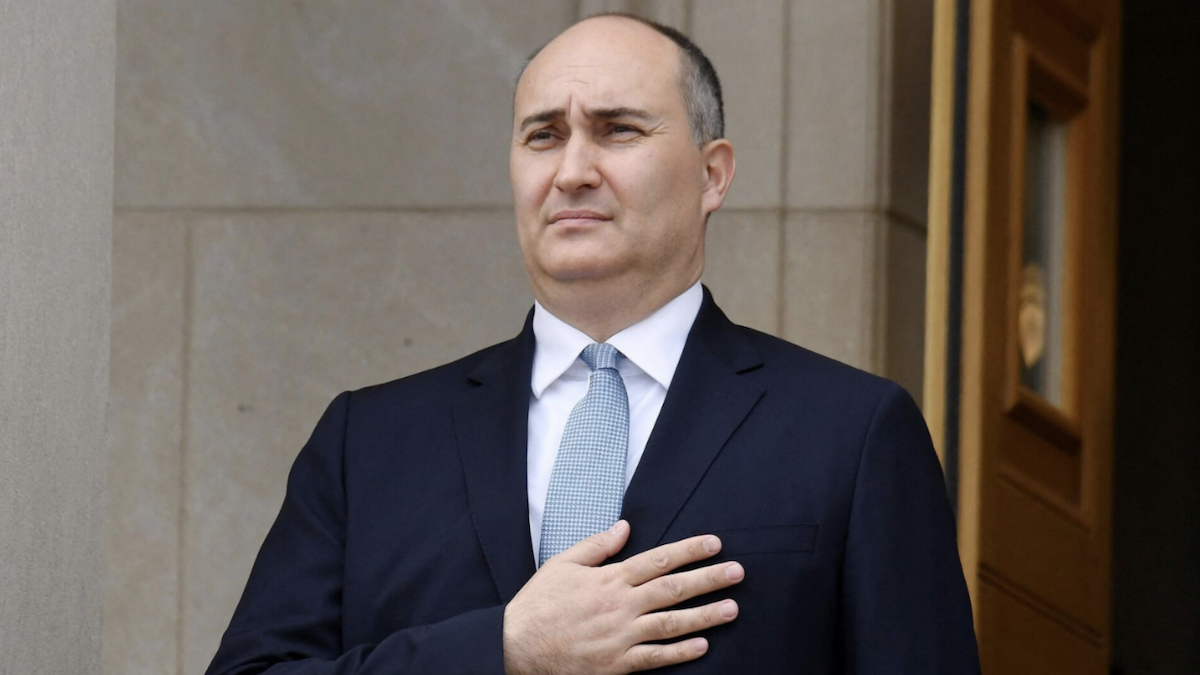
Prosecutors reject plea deal for Georgia’s former defence minister


Case of Georgia’s former defence minister

Georgia’s prosecution service has refused to offer plea agreements to former Defence Minister Juansher Burchuladze, who is under investigation, his brother-in-law Vasili Mkheidze, and former deputy Giorgi Khaindrava.

At a court hearing on 8 April, prosecutors called for all three defendants to be convicted.

A plea agreement is a deal between the defendant and the prosecution, under which the defendant admits guilt or cooperates with the investigation in exchange for a more lenient sentence.

A plea agreement will be concluded with only one defendant — former head of the Defence Ministry’s procurement department, Vladimir Gudushauri.

According to prosecutor Ani Lekiashvili, Gudushauri cooperated with the investigation from the outset of the case, while Burchuladze applied for a deal only on 26 March, at the final stage of the proceedings.

Case details

Juansher Burchuladze and his associates are accused of embezzling 1,333,728 lari (about $493,000) from the state budget. The case concerns the purchase of a CT scanner for a military hospital, which investigators say was bought at an artificially inflated price.

Burchuladze is also charged with money laundering. Prosecutors allege that he used illicit proceeds to purchase a residential property and a plot of land in Spain worth €544,000.

According to the prosecution, assets worth around 2.5 million lari (approximately $925,000) have already been seized from the former minister.

The case also includes a separate episode involving Vasili Mkheidze, related to an illegal cigarette factory set up in the city of Gori. Investigators say excise-free products worth more than 2 million lari (around $740,000) were seized at the site.

Juansher Burchuladze, who served as defence minister from 2021 to 2024, denies the charges. He faces between nine and 12 years in prison if convicted.

Case of Georgia’s former defence minister