Categories
South Caucasus News

Kenya tourism surges in 2025 as international arrivals rise 9 percent to 2.7 million


The Ministry of Tourism and Wildlife said the sector’s performance highlights its continued role as a key pillar of the national economy, supported by policy reforms and improved connectivity, News.az reports, citing Telegraph.
***
Visa policy and flights drive growth
Authorities attributed the increase in visitor numbers to a visa free policy, expanded flight connections, and sustained recovery in major source markets.
In its Kenya Tourism Sector Performance Report 2025, the ministry said the above average growth reflects rising global confidence in Kenya as a travel destination.
Enhanced destination marketing campaigns, improved tourism products, and streamlined travel processes have also contributed to the sector’s momentum.
Tourism earnings show strong recovery
The report said the sector generated approximately 0.5 trillion Kenyan shillings, equivalent to about 3.8 billion US dollars, underscoring a continued recovery from previous downturns.
Overall, Kenya received an estimated 7.9 million tourists during the year, including 2.7 million international visitors and 5.2 million domestic travellers.
Officials noted that domestic tourism remains a crucial stabilising force, helping to cushion the industry against external shocks and seasonal fluctuations.
Regional and global demand trends
Africa remained Kenya’s largest source market, accounting for 47 percent of total international arrivals. Europe followed with 25 percent, while the Americas contributed 14 percent.
The ministry said these figures point to strong regional mobility and sustained long haul demand from traditional tourism markets.
Leisure travel leads segments
Leisure travel accounted for the largest share of visits at 46 percent, followed by social visits at 20 percent and business travel at 19 percent.
The data reflects Kenya’s positioning as both a leisure destination and a regional hub for business and social travel.
Policy reforms and digital systems boost sector
Officials highlighted several drivers behind the sector’s growth, including improved road and air infrastructure, diversified tourism offerings, and supportive government policies.
The introduction of the Electronic Travel Authorization system has also helped streamline entry procedures, improving the overall visitor experience.
As global competition for tourists intensifies, Kenya’s authorities say continued investment in marketing, infrastructure, and policy innovation will be key to sustaining growth in the years ahead.

The post Kenya tourism surges in 2025 as international arrivals rise 9 percent to 2.7 million appeared first on azeritimes.com.


Categories
South Caucasus News

Portugal unveils €600m energy support package to shield firms from Middle East crisis fallout


The measures were unveiled on Thursday during a ceremony marking the government’s second anniversary, as authorities seek to cushion the economic impact of global energy price volatility, News.Az reports, citing CNN.
***
Support package targets energy intensive companies
The initiative, branded “Portugal Energy Resilience”, will be implemented through the state owned Banco Portugues de Fomento.
It is specifically designed for companies where energy expenses account for more than 20 percent of total production costs, a threshold that identifies firms most vulnerable to price shocks.
The funding will be provided in the form of credit lines to help businesses manage liquidity pressures and maintain working capital during a period of heightened uncertainty.
Government aims to protect competitiveness and jobs
Speaking at the event, Montenegro said the programme is intended to reinforce economic resilience and protect the country’s productive base.
“This will strengthen companies’ ability to respond to international instability and safeguard our competitiveness, employment, and the resilience of our national productive base,” he said.
The move reflects broader concerns across Europe about the economic spillover effects of geopolitical tensions, particularly in energy markets.
State guarantees to reduce financial risk
Under the scheme, the Portuguese government will provide substantial public guarantees to encourage lending.
Large companies will receive state backing covering 70 percent of loan values, while small and medium sized enterprises will benefit from guarantees of up to 80 percent.
Officials say this structure is designed to reduce risk for lenders while ensuring that businesses can access financing quickly.
Part of wider response to global uncertainty
The package forms part of Portugal’s wider strategy to navigate the economic consequences of international instability, including disruptions linked to the Middle East conflict.
By focusing on energy intensive sectors, the government aims to mitigate the immediate impact of cost pressures while maintaining industrial output and employment levels.
Economists note that such targeted interventions could help stabilise key sectors in the short term, though longer term resilience will depend on broader energy diversification and market conditions.

The post Portugal unveils €600m energy support package to shield firms from Middle East crisis fallout appeared first on azeritimes.com.

Categories
South Caucasus News

UN chief urges US and Israel to halt war with Iran as Middle East crisis deepens


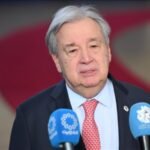
Speaking to reporters on Thursday, the UN chief delivered a stark message as hostilities entered their second month, highlighting mounting civilian casualties and growing economic fallout, News.az reports, citing BBC.
***
“My message is clear,” Guterres said. “To the United States and Israel, it is high time to stop the war that is inflicting immense human suffering and already triggering devastating economic consequences. To Iran, to stop attacking its neighbours.”
Escalating crisis raises global concerns
Guterres warned that the Middle East crisis is intensifying, with increasing reports of indiscriminate attacks and damage to civilian infrastructure. He stressed that the humanitarian situation is deteriorating rapidly as violence continues.
“The Middle East crisis has lurched into its second month,” he said, pointing to the rising scale of destruction and the expanding scope of the conflict.
According to the UN chief, the impact of the war is no longer confined to the immediate region, with ripple effects being felt across global markets and security dynamics.
Fears of a wider regional war
Guterres cautioned that the current trajectory could lead to a much larger confrontation, potentially engulfing the entire Middle East.
“The world is on the edge of a wider war,” he warned, adding that such an escalation would have “dramatic impacts around the globe.”
The warning reflects growing international concern that continued hostilities could draw in additional regional actors, further destabilising an already volatile geopolitical landscape.
Call for diplomacy and international law
The UN secretary-general emphasised that diplomatic initiatives are ongoing and must be given the opportunity to succeed. He underlined that any resolution must be rooted in international law and the principles of the United Nations.
Efforts to de-escalate the conflict, he said, should be “anchored firmly in international law, including the UN Charter.”
Guterres outlined key principles that should guide any path forward, including the peaceful settlement of disputes, respect for sovereignty and territorial integrity, and the protection of civilians and civilian infrastructure.
He also stressed the importance of safeguarding critical facilities, including nuclear installations, and maintaining freedom of navigation in regional waterways.
Appeal for urgent de-escalation
In his closing remarks, Guterres urged all parties to prioritise dialogue over continued military confrontation.
“We must find a peaceful way out,” he said. “Conflicts do not end on their own. They end when leaders choose dialogue over destruction.”
His appeal comes amid intensifying international efforts to prevent further escalation and to bring the parties back to the negotiating table, as fears grow that the conflict could spiral into a broader regional war with far-reaching consequences.

The post UN chief urges US and Israel to halt war with Iran as Middle East crisis deepens appeared first on azeritimes.com.


Categories
South Caucasus News

Pakistan economy grows 3.89 percent in Q2 FY2025-26 driven by industrial surge


The figures, approved at the 116th meeting of the National Accounts Committee, reflect a gradual recovery in economic activity, with industry emerging as the primary growth engine, News.az reports, citing Xinhua.
***
Industry leads economic expansion
Growth in the industry sector reached 7.40 percent in the second quarter, significantly outpacing other sectors. The performance was driven largely by improvements in large-scale manufacturing, which expanded by 5.71 percent, alongside notable gains in construction and utilities.
Analysts view the strong industrial output as a key signal of stabilisation in Pakistan’s production base after a period of volatility.
Services maintain steady momentum
The services sector recorded growth of 3.69 percent, supported by activity across wholesale and retail trade, transport, financial services, and public administration.
While not as strong as industry, the steady expansion of services suggests continued resilience in domestic demand and commercial activity.
Agriculture posts modest gains
Agriculture grew by 1.76 percent in the second quarter, reflecting mixed performance within the sector. While major crops experienced contractions, gains in livestock and related sub-sectors helped keep overall growth in positive territory.
The relatively weaker agricultural performance remains a concern, given the sector’s importance for employment and rural incomes.
Revisions to earlier growth estimates
The National Accounts Committee also revised earlier GDP figures, slightly adjusting the trajectory of Pakistan’s economic recovery.
First-quarter growth for fiscal year 2025-26 was revised down to 3.63 percent from an earlier estimate of 3.71 percent. The downgrade was attributed to lower-than-expected performance in agriculture and industry, although services growth was revised marginally upward to 2.44 percent.
Agriculture growth for the first quarter was adjusted to 2.72 percent, while industry growth was revised to 8.86 percent.
Annual growth figures adjusted
On an annual basis, GDP growth for fiscal year 2023-24 was marginally revised to 2.62 percent from 2.63 percent. Similarly, growth for fiscal year 2024-25 was adjusted to 3.06 percent from 3.09 percent.
These revisions indicate a relatively stable but moderate growth trajectory over recent years.
Outlook remains cautiously optimistic
Economists say the latest data points to a gradual strengthening of Pakistan’s economy, particularly in industrial production. However, they caution that sustained growth will depend on improvements in agriculture, continued policy stability, and external economic conditions.
The divergence between strong industrial output and weaker agricultural performance highlights structural imbalances that policymakers may need to address to ensure more inclusive and durable growth.
With services continuing to expand steadily, Pakistan’s near-term economic outlook remains cautiously optimistic, though challenges persist across key sectors.

The post Pakistan economy grows 3.89 percent in Q2 FY2025-26 driven by industrial surge appeared first on azeritimes.com.


Categories
South Caucasus News

Iran’s IRGC claims strike on Oracle data center in Dubai


The navy command of Iran’s Islamic Revolutionary Guard Corps (IRGC) claimed it launched an attack on a data center belonging to US technology firm Oracle in Dubai, News.Az reports, citing Al Jazeera.
Earlier, the IRGC said it had targeted an Amazon cloud computing center in Bahrain.

The post Iran’s IRGC claims strike on Oracle data center in Dubai appeared first on azeritimes.com.


Categories
South Caucasus News

Trump announces demolition of Iran’s tallest bridge


Trump posted footage on social media of smoke rising from the B1 bridge in Karaj, around 20 miles (35 kilometers) southwest of Tehran — and warned that there would be further destruction unless Iran comes to the table to end the five-week war, News.Az reports, citing foreign media.
***
“The biggest bridge in Iran comes tumbling down, never to be used again – Much more to follow! IT IS TIME FOR IRAN TO MAKE A DEAL BEFORE IT IS TOO LATE, AND THERE IS NOTHING LEFT OF WHAT STILL COULD BECOME A GREAT COUNTRY!” Trump said.
Iranian state television had earlier reported two U.S.-Israeli strikes on the bridge.
“A few minutes ago, the American-Zionist enemy once again targeted the B1 bridge in Karaj,” state TV said, adding that an initial strike had caused two civilian casualties.
It said the later attack took place as emergency teams were deployed to the site to help victims of the first strike.
The B1 bridge, which was still under construction, is considered the Middle East’s tallest according to Fars/Iranian media, with a 447-foot (136-meter) column.
Trump delivered a speech Wednesday in which he argued that the war launched by the United States and Israel on February 28 was almost over — even as he threatened to bomb Iran “extremely hard” if it didn’t bow to his demands.
“Over the next two to three weeks, we are going to bring them back to the Stone Ages, where they belong,” he said in his first prime-time address to the nation on the war.

The post Trump announces demolition of Iran’s tallest bridge appeared first on azeritimes.com.


Categories
South Caucasus News

Yemen fires missile towards Israel


According to Channel 14, Israel’s Home Front Command confirmed it had issued an early warning after detecting the launch, saying alerts covered most Israeli cities. Sirens sounded in several areas, including Jerusalem and the Dead Sea region, News.Az reports.
***

The post Yemen fires missile towards Israel appeared first on azeritimes.com.


Categories
South Caucasus News

UK and US secure pharmaceutical deal


The agreement offers a rare moment of clarity in an increasingly fraught phase of the U.K.’s “special relationship” with the U.S., with President Donald Trump recently lashing out at Britain for refusing to join his war against Iran and threatening to pull the U.S. out of NATO, News.Az reports, citing Politico.
***
Under the deal, announced last December, Britain agreed to increase the cost-effectiveness threshold used by the National Institute for Health and Care Excellence (NICE) by 25 percent, while slashing the maximum rebate the NHS can claw back from drugmakers to 15 percent.
In an announcement on Thursday, the government confirmed it had agreed a text with the U.S. that exempted the U.K. from tariffs on pharmaceuticals as well as mechtech for at least three years. It added that the countries had also agreed to work together towards mutual recognition of medical device approvals. The U.K. has also pledged to raise pharmaceutical spending to 0.6 percent of GDP by 2035. Industry figures see the text as a stepping stone to set out a credible timeline for reaching the 0.6 percent target.
The government’s oversight committee, led by Science Minister Patrick Vallance and Medicines Minister Zubir Ahmed, is currently mapping out how the spending increases will be delivered.
In a statement reflecting on the tariff deal, Vallance said: “Thanks to this partnership, patients right across the NHS will benefit from access to life changing new medicines that they previously would have been denied.
“Not only this, but as the first country in the world to benefit from a zero percent tariff on pharmaceuticals to the US, Britain’s life sciences sector will be further boosted.”
Earlier last month, the government laid secondary legislation to update rules around how NICE assesses the value of new drugs, lifting the cost-effectiveness threshold by £5000 to £25,000-£35,000 per quality-adjusted life year.

The post UK and US secure pharmaceutical deal appeared first on azeritimes.com.


Categories
South Caucasus News

Armenia’s Pashinyan Says Railway Issue With Russia Remains Under Negotiation – Eurasia Review


Armenia’s Pashinyan Says Railway Issue With Russia Remains Under Negotiation  Eurasia Review

Categories
South Caucasus News

OpenAI launches pay-as-you-go Codex and lowers ChatGPT Business price


The company said Codex-only seats will have no rate limits, with billing based on token consumption. This pricing structure aims to provide clearer cost tracking across budgets, workflows, and teams, News.Az reports, citing foreign media.
***
OpenAI reduced the annual price of ChatGPT Business from $25 to $20 per seat. Standard ChatGPT Business seats continue to include Codex usage limits for teams requiring broad ChatGPT access.
The company reported that Codex usage within ChatGPT Business and Enterprise teams has grown six times since January. More than 2 million builders use Codex weekly, according to OpenAI, with over 9 million paying business users relying on ChatGPT for work.
New features include Codex applications for macOS and Windows, along with plugins and automations designed to integrate with existing team systems. Eligible ChatGPT Business workspaces can receive $100 in credits for each new Codex-only team member, up to $500 per team, for a limited time.
Companies including Notion, Ramp, Braintrust, and Wasmer are using Codex in their engineering workflows, according to the announcement.

The post OpenAI launches pay-as-you-go Codex and lowers ChatGPT Business price appeared first on azeritimes.com.