
On April 2, President of the Republic of Azerbaijan Ilham Aliyev received Vice President of the …
Day: April 2, 2026
The Expert Council on NGO Law, an expert body of the Conference of INGOs of the Council of Europe, issued a critical opinion on a legislative package adopted on March 4 by Georgia’s disputed parliament that further restricted grants and political activity, saying the measures are incompatible with Georgia’s obligations as a CoE member, “entirely inappropriate,” and should be repealed.
The opinion examined amendments to the Law on Grants, the Law on Political Associations, the Criminal Code, and the Administrative Offences Code. With the changes, the disputed Parliament introduced additional curbs on foreign funding, criminalized “external lobbying,” restricted political activities, imposed limitations on businesses, and penalized “systematic acts” aimed at “establishing the perception” of the government’s illegitimacy.
According to the paper, the restrictions affected by the adoption of the laws will have “a very serious impact” on fundamental rights, including freedom of association and expression.
The document noted that “many of the provisions in the Laws do not fulfil the prescribed by law requirement for imposing any restrictions on rights guaranteed by the ECHR,” further stressing “serious grounds for doubting whether most of them have a legitimate aim.” The Expert Council further said most provisions cannot be considered “necessary in a democratic society,” given the scope of restrictions and penalties.
“In the circumstances, the adoption of the Laws will further exacerbate the grave and unjustified damage that has already been caused to civil society in Georgia,” the paper warned, adding, “Their adoption is inconsistent with a wide range of commitments that this member State of the Council of Europe has undertaken and is thus entirely inappropriate.”
“It would, therefore, be appropriate [to] repeal the amendments that have been effected by the adoption of the Laws, as well as to desist from any steps to enforce the implementation of the provisions previously addressed in the 2024 and 2025 Opinions,” the paper concluded.
Particular concern in the paper is raised over amendments to the Law on Grants, which it described as “problematic in several respects.”
The requirement that a legal entity of another state must obtain the consent from the Georgian government before disbursing a grant is described as “an attempt to interfere with the right of such an entity to seek funding for its activities without any substantiation of harm to Georgia,” as well as “an unjustified legislative overreach, effectively entailing an interference with the sovereignty of the State where such an entity is established.”
The opinion added that the breadth of this requirement could affect not only political disagreement with Georgian policies, but also “academic research on Georgia, which has no concern with current political issues.”
It also criticized the expansion of the definition of grants to include any form of technical assistance, warning that this could effectively prohibit exchanges of ideas related to Georgian policies without prior government approval, thereby constraining “legitimate social exchanges that are the lifeblood of democracy.”
The opinion further highlighted the severity of penalties introduced under the amendments, including imprisonment of up to six years. It noted that such sanctions “could be much greater than the fines” previously deemed “excessive” by the European Court of Human Rights in cases concerning Russia’s “foreign agent” legislation.
“Even if aspects of the amendments could be said to have a legitimate aim, there is no actual substantiation of the threat which the activities are alleged to pose and no consideration of whether there might be less draconian means of addressing it,” the document said, noting that the Venice Commission has similarly assessed such measures as “excessive and risk producing a serious chilling effect on civil freedoms.”
Also Read:
- 11/03/2026 – GD’s New Laws Restricting Grants, Political Activity Draw International Condemnation
- 06/03/2026 – EU’s Kallas, Kos Decry New GD Laws Restricting Foreign Funding and Political Activity
- 22/09/2025 – Dozens of CSOs Report New Inspections Under Amended Law on Grants
- 27/08/2025 – Authorities Freeze Bank Accounts of Seven NGOs in ‘Sabotage’ Criminal Probe

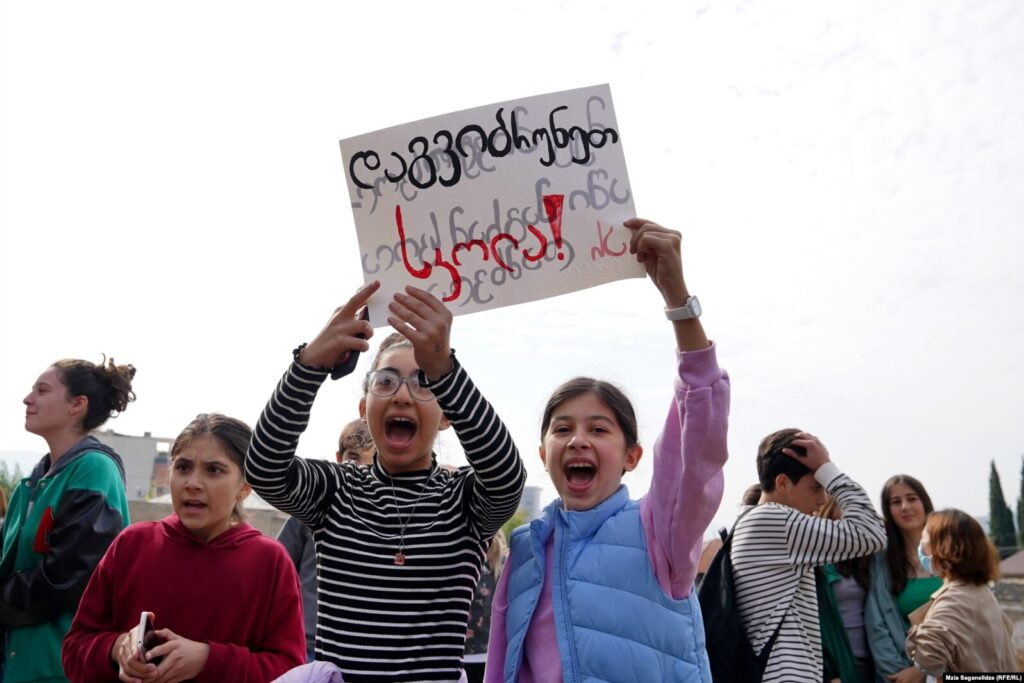
A total of 379,957 children are registered in Georgia’s Unified Database of Socially Vulnerable Families, including 23,322 newly registered cases, in a country with a population of around 3.9 million. The figures come from a report by the ombudsman assessing the state of human rights and freedoms.
According to the report, 278,639 children receive subsistence allowance, with 12,868 of them accessing this support for the first time. The findings indicate that reliance on the state welfare system among families with children remains widespread.
The database includes 186,163 families with at least one child, of whom 129,329 receive subsistence benefits. The report says these figures reflect both the scale of social need and the growing pressure on the system.
Particular attention in the report is given to the subprogramme “Emergency Assistance for Families with Children in Crisis”, which covered 5,875 families in 2025 — a significant increase compared to the previous year. However, the ombudsman notes that the programme is inherently reactive and does not provide long-term support to help families overcome crisis situations.
The report says that while state and municipal services do facilitate access for families with children to various support programmes, this involvement often does not translate into sustainable socio-economic improvement. As a result, helping families achieve independent livelihoods remains a key challenge.
The report also highlights the “Shelter Provision Subprogramme for Mothers and Children”, under which seven shelters operate across the country. Last year, the service was used by 75 adult and two underage mothers, as well as 139 children. Despite the existing infrastructure, the report stresses the need to further develop services to better address individual needs and ensure more stable social reintegration after leaving shelters.

The ombudsman adds that a systematic assessment of the true scale of child poverty and its underlying causes in Georgia remains insufficient. According to the report, the rise in the number of children and families included in social programmes may be linked to increased awareness, changes in the scope of assistance, the impact of employment support schemes and shifts in administrative practices. However, explaining the increase solely through these factors is considered inadequate.
The report stresses that inclusion in social assistance programmes itself points to existing economic vulnerability, and calls for a deeper analysis to reveal the real picture of child poverty and support the development of evidence-based policy.
Socially vulnerable children in Georgia


