
Day: May 5, 2026
Trade turnover between Azerbaijan and Kyrgyzstan recorded a sharp increase in the first quarter of 2026, reflecting a significant shift in bilateral trade dynamics, AzerNEWS reports. According to the State Customs Committee, in January–March 2026, total trade turnover between the two countries increased by 2.95 times compared to the same period of 2025, exceeding…
The United Kingdom and Finland, current co-chairs of the 51-member Media Freedom Coalition (MFC), have raised concerns over what they describe as “troubling trends” in Georgia’s media environment, in a joint op-ed marking World Press Freedom Day and supported by the Coalition’s fourteen other member states.
The statement, released by the British Embassy in Tbilisi on May 4, was endorsed by Austria, Belgium, Denmark, Estonia, Germany, Iceland, Ireland, Latvia, Lithuania, Luxembourg, the Netherlands, Norway, Poland, and Sweden. It also called for the release of Mzia Amaghlobeli, a jailed journalist and founder of Netgazeti and Batumelebi outlets.
“At a time when international peace feels fragile and democracy is under strain, we are proud to stand with those journalists who continue to speak truth to power, often at great personal risk,” the statement said.
“In Georgia, we see troubling trends,” the co-chairs outlined, citing the recent ranking of the Reporters Without Borders (RSF), which showed that Georgia’s press freedom ranking has “fallen dramatically,” dropping from 77th place in 2022 to 135th in 2026, characterizing it as “one of the steepest declines.”
“RSF categorises Georgia’s media environment as ‘difficult,’ citing official interference, violence against journalists, and restrictive legislation that is shrinking the space for free expression. There are at least 50 journalists documented injured, beaten, detained, or obstructed during demonstrations. These attacks are unacceptable. Journalists must be free to investigate, to report, and to question those in power without fear,” the statement said.
The co-chairs also cited the OSCE’s Moscow Mechanism critical report released on March 12, in which, according to the statement, the Sole Rapporteur “highlights a pattern of violence during protests in Tbilisi and other Georgian cities during 2024-2025 protests, including against journalists.”
It further said that “in his recent report the Council of Europe Human Rights Commissioner notes the lack of accountability for allegations of unlawful arrests and excessive use of force against protesters and journalists during protest in 2024-2025, as well as increasingly restrictive legislation affecting the rights to freedom of expression, peaceful assembly, and association.”
- 21/04/2026 – CoE Commissioner Calls for Police Accountability, Repeal of ‘Foreign Influence’ Laws After Georgia Visit
The co-chairs singled out the case of jailed journalist Mzia Amaghlobeli, saying it “powerfully symbolises what is at stake,” noting that “her arrest, treatment and imprisonment following protests in 2025 were condemned internationally as unjust and politically motivated.”
“We call again for her release,” the statement said, noting that “aim of imprisoning a journalist like Mzia Amaghlobeli is to intimidate an entire profession.”
Reacting to the joint op-ed, Shalva Papuashvili, speaker of the disputed parliament, who shared the statement on social media, dismissed it as “crocodile tears” filled with “false pathos.” He said it came “from an embassy that has been trying for two months to kill off two leading Georgian media outlets,” apparently referring to the UK’s recent sanctions on pro-government channels PosTV and TV Imedi as part of its wider measures against Russia.
Also Read:
- 08/04/2026 – ComCom Issues Written Warnings to Four TV Channels for ‘Violating Impartiality Principles’
- 03/06/2025 – Georgian Dream Targets Critical Broadcasters for Questioning Government Legitimacy
- 25/11/2025 – RSF: Press Freedom Violations in Georgia Reach ‘Unprecedented’ Levels, 600 Attacks in One Year
- 21/10/2025 – Watchdog: Georgian Dream Channels Millions to Loyal Online Media Through Party and State Funds
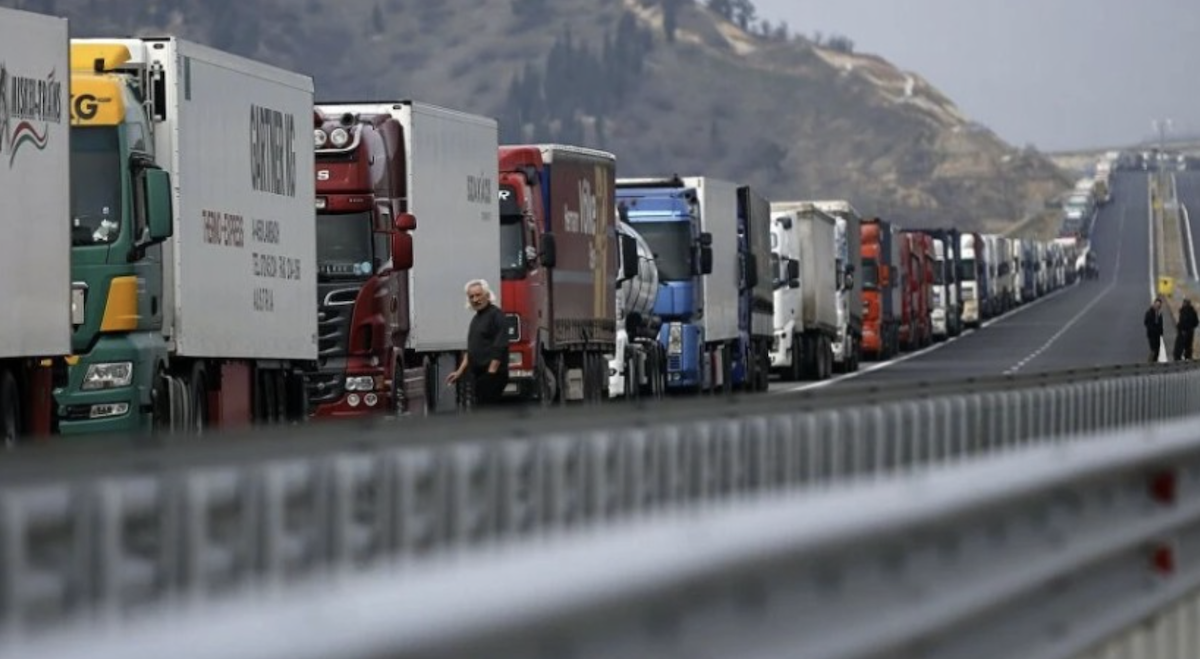
According to Russian media reports, truck drivers from Georgia and other CIS countries will be required to submit an electronic application stating the purpose of their entry into Russia. Russian Interior Ministry spokeswoman Irina Volk has announced the new rules.

“Citizens of CIS countries and Georgia must submit, in electronic form via the public services portal mobile application (RuID), an application stating the purpose of their entry into Russia and their stay (residence) there. When submitting the application, they must attach copies of identity documents and documents confirming the professional activity of an international freight driver,” Irina Volk said.
The changes will come into force on 30 June 2026. They follow a decision by the Russian government to extend the permitted period of temporary stay for foreign drivers. Under a decree issued by Russian Prime Minister Mikhail Mishustin on 27 April, truck drivers from CIS countries and Georgia may stay in Russia for up to 180 days in total within a calendar year.
The measure is expected to “ease the burden” on the logistics sector, particularly at a time when transport flows in the region have shifted significantly. At the same time, however, the new requirements suggest an effort by Moscow to tighten control over foreign labour and movement.
For Georgia, where a significant share of freight traffic is bound for Russia, the rules could create an additional administrative burden. This is likely to affect small and medium-sized carriers in particular, as they already face long queues at the border and complex procedures.
New entry rules for Russia