
Armenia recognized the territorial integrity of Azerbaijan in order to protect its own lands, Prime Minister Nikol Pashinyan said, Report informs.
 The South Caucasus News - SouthCaucasusNews.com
Category Added in a WPeMatico Campaign
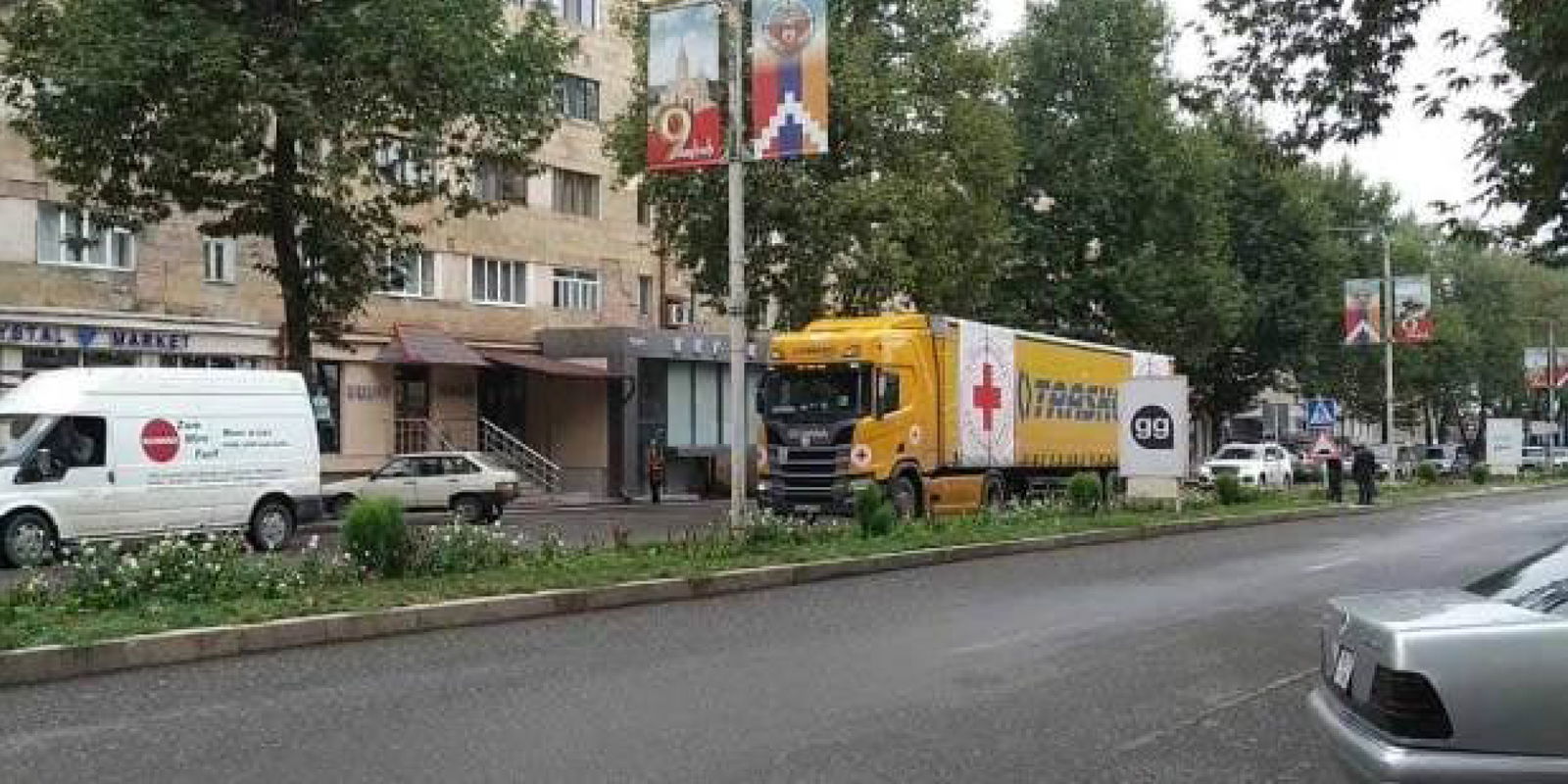 Russian aid truck in Stepanakert (Photo: Former State Minister and Human Rights Ombudsman of the Republic of Artsakh Artak Beglaryan, Twitter)
YEREVAN – The Berdzor (Lachin) Corridor has not been opened to humanitarian aid as of September 13, despite an agreement to open the route 12 hours after the entry of Russian aid to Artsakh through Aghdam.
More than two years after a trade made by the Armenian and Azerbaijani governments for the return of 15 Armenian prisoners of war in exchange for the maps of the mined areas of Akna (Aghdam), the use of the Aghdam road has become a topic of discussion following Azerbaijan’s complete blockade of the Berdzor Corridor to humanitarian aid in mid-June this year.
On September 9, Artsakh authorities announced that Russian aid would be delivered through the Aghdam road, and an agreement had been reached to restore movement for humanitarian aid through the Berdzor Corridor.
Russian co-chair of the OSCE Minsk Group Igor Khovayev met with Azerbaijan’s President Ilham Aliyev in Baku and presented Moscow’s clear position, according to which no Azeri goods will enter the Armenian-inhabited part of Artsakh.
An agreement was reached stating that very limited products, not of Azerbaijani origin, will be sent through the Aghdam road. According to the agreement, after the Russian aid passes, the Aghdam road will be closed again, and no other vehicles will pass. According to another arrangement, the Berdzor Corridor will be opened 12 hours after the Russian aid passes through Aghdam, and the Armenian trucks will be able to go to Stepanakert.
Since July 26, an Armenian government convoy containing 360 tons of humanitarian aid has been blocked in Kornidzor by the Azerbaijani government. The convoy of nineteen trucks contains flour, pasta, sugar, vegetable oil, powder milk, salt, baby food and medicine.
According to the Artsakh Information Center, “On September 12, the humanitarian cargo entered the Artsakh Republic through the city of Askeran, with the permission of the authorities of the republic, through the Russian Red Cross and the vehicles of that organization. The aid contains vital Russian-made goods.”
Russian aid includes blankets, bed sheets for hospitals, soap, toothpaste, shampoo, baby cereal, vitamins, baby cream, diapers, wet wipes and 11.4 tons of food including flour, sugar, rice, green peas, lentils, corn, pasta, semolina and buckwheat.
The mayor of Askeran, Hayk Shamiryan, mentioned that concerned citizens of Artsakh that were gathered near the Tank Memorial initially protested the entry, but then came to an agreement, after which the Russian Red Cross truck, accompanied by the police, reached the Artsakh capital of Stepanakert.
While the Azerbaijani side had agreed to create conditions for the transportation of humanitarian aid through the Berdzor Corridor 12 hours after the entry of Russian aid through the Aghdam-Stepanakert road, there are no changes thus far.
A statement issued by the Foreign Ministry of Artsakh on June 16 affirms, “The complete closure of the Lachin Corridor, used in a limited mode and exclusively for humanitarian purposes because of the ongoing illegal blockade of Artsakh for more than six months, is another practical demonstration of Azerbaijan’s gross violation of its international obligations, disregard for the fundamental norms of international law, including the legally binding decision of the International Court of Justice. In fact, the illegally established checkpoint in the Lachin Corridor is being used by Azerbaijan purely as a tool to continue its policy of ethnic cleansing against the people of Artsakh.”
After a provocation near Khakari Bridge on June 15, Azerbaijan completely blocked all humanitarian passenger and cargo transportations via the Berdzor Corridor in both directions. As a result of Azerbaijan’s actions, the planned medical evacuation of patients from Artsakh to Armenia by the International Committee of the Red Cross (ICRC) did not take place, and the planned transportation of passengers in urgent humanitarian need through the mediation of the Russian peacekeeping contingent on the Goris-Stepanakert route was canceled. The movement of trucks of Russian peacekeepers en route to Goris to deliver humanitarian goods to Artsakh was also stopped.
The first proposal of the use of the Aghdam road was made on July 14 by Azerbaijan’s Minister of Foreign Affairs Jeyhun Bayramov while meeting with the head of the ICRC representative office in Azerbaijan Dragana Kozic. “As for meeting the needs of Armenian residents, the Azerbaijani side does not rule out the possibility of providing assistance on the Aghdam-Stepanakert road,” stated Bayramov.
According to political analyst Edgar Elbakyan, “It is not the first time that Azerbaijan first terrorizes the Artsakh Armenians, then allegedly extends a ‘helping hand’ as a ‘show of goodwill.’ This is called forced integration. By depriving the Artsakh Armenians of necessary resources, Azerbaijan shows that the faucet is in its hands – Azerbaijan opens and closes the faucet when it pleases, leaving the people of Artsakh to submit to the whims of Azerbaijan.”
Following talks of opening the Aghdam-Stepanakert road and a statement made by European Council President Charles Michel noting Azerbaijan’s willingness to provide humanitarian supplies via Aghdam, a group of Artsakh citizens blocked the road from Askeran to Aghdam by placing concrete barriers on July 18. Signs held by protesters read, “Aghdam is the road of death” and “Charles Michel, the Aghdam road is not a humanitarian corridor.”
 Residents of Artsakh block the Aghdam-Askeran road on July 18 (Arshak Abrahamyan, Facebook)
In response to the Armenians of Artsakh blocking the road from Askeran to Aghdam, President Aliyev questioned the protestors’ actions, stating, “Why should food be delivered from another country? After all, Karabakh is Azerbaijan, and everyone knows that. Therefore, why should the goods be delivered from another country?”
Encouraged by Aliyev’s statement, his Foreign Policy Advisor Hikmet Hajiyev stated that it is not necessary to politicize the issue and insist on the use of the Berdzor Corridor only, keeping the Aghdam road closed. “There is no alternative to the Aghdam-Stepanakert road and the reintegration of Karabakh Armenians. The game is over,” Hajiyev said.
Baku utilized Michel’s remarks to advance its new narrative and ease the pressure from international actors regarding the unblocking of the Berdzor Corridor. This new reality became evident during the United Nations Security Council emergency meeting on the situation in Artsakh, where major actors emphasized the importance of opening both the Berdzor Corridor and alternative roads. This phrasing provided Baku with an opportunity to evade responsibility while extending its blockade of Artsakh.
Former Artsakh President Arayik Harutyunyan announced that during the session of the Council of Ministers on August 29, discussions were held to open the Aghdam road. Discussions about opening the road started in July of this year. Azerbaijan presented this option as a solution to the “conflict situation.” Considering that there were no other proposals, particularly from Yerevan, the agenda proposed by Baku was put into circulation again.
In the midst of these talks regarding the opening of the Aghdam road, two trucks loaded with 40 tons of flour from Baku arrived in Aghdam on the evening of August 29. Lusine Avanesyan, the former president’s spokesperson, commented that Baku’s move to send humanitarian aid through Aghdam was not agreed upon with Artsakh authorities.
Askeran Mayor Shamiryan stated that residents of the Askeran region of Artsakh held a demonstration on the Armenian side of the road leading to Aghdam. The protestors once again reaffirmed that they would not allow the cargo sent by the Azerbaijani side through Aghdam.
Speaker of the National Assembly of the Republic of Artsakh Davit Ishkhanyan stated, “This move by Azerbaijan is understandable, because they are pursuing political goals, trying to show the world that they have an internal problem, and the humanitarian crisis in Artsakh does not concern the outside world. Azerbaijan continues to resort to provocative steps and is trying to show the world that from their side all possible steps are being taken to ensure the needs of the residents of Artsakh.”

Hoory Minoyan was an active member of the Armenian community in Los Angeles until she moved to Armenia prior to the 44-day war. She graduated with a master’s in International Affairs from Boston University, where she was also the recipient of the William R. Keylor Travel Grant. The research and interviews she conducted while in Armenia later became the foundation of her Master’s thesis, “Shaping Identity Through Conflict: The Armenian Experience.” Hoory continues to follow her passion for research and writing by contributing to the Armenian Weekly.
The post Road of Death vs. Road of Life: Aghdam open to aid, Berdzor remains closed appeared first on The Armenian Weekly.
Armenia
The joint Armenian-American military exercise, Eagle Partner 2023, commenced on September 11 and will last until September 20. 85 American and 175 Armenian soldiers are participating in these exercises in preparation for international peacekeeping missions. The opening ceremony took place near Yerevan at the “Zar” training center of the Peacekeeping Brigade of the Ministry of Defense of Armenia.
Artsakh
On September 10, a special session was convened in the National Assembly of the Republic of Artsakh dedicated to the inauguration ceremony of President of the Republic of Artsakh Samvel Shahramanyan. Shahramanyan was the only candidate and received 22 votes in favor and one vote against from a total 33 parliamentarians. The vote came nine days after former President Arayik Harutyunyan submitted his resignation to Artsakh’s National Assembly. Shahramanyan presented his priorities as president, stating that the President of Artsakh must turn Stepanakert from an object of conflict settlement to a subject of negotiations.
Azerbaijan
Azerbaijan’s Foreign Ministry issued a statement calling the elections of the Republic of Artsakh illegal activities “under the false pretext of ‘presidential elections’ by the puppet regime, created as a result of the occupation by Armenia” and “a gross violation of the Constitution and legislation of the Republic of Azerbaijan as well as norms and principles of international law.” “Holding the so-called ‘elections’ once again clearly shows that Armenia and the puppet regime created by it, which have taken steps to maintain the status quo and continue its occupation policy, are not really interested in the peace process, [but] on the contrary, have taken the path of provocation and escalating the situation.”
Iran
The spokesperson for the Ministry of Foreign Affairs of Iran, Nasser Kanaani, said they are closely monitoring the developments in the South Caucasus. “Armenian officials voiced concern about the possibility of [military] clashes, but the Azerbaijani officials gave a message that they have no intention of clashing,” Kanaani added, describing the Republic of Azerbaijan’s recent deployment of troops as a “conventional military action” ahead of winter. While Iran has continuously made clear that they will not allow any geopolitical changes of borders in the region, their stance on Artsakh remains unchanged – “Nagorno-Karabakh is part of the Republic of Azerbaijan, and the rights and security of its residents must be defined within a definite framework,” said Kanaani.
Turkey
Following the elections in the Republic of Artsakh and possible hints at escalation, Prime Minister Pashinyan requested to speak with Turkish President Recep Tayyip Erdogan. The phone call took place on Monday, September 11. According to information from the Armenian Prime Minister’s office, the conversation touched on Armenia-Turkey relations and regional issues. Leaders of the two countries emphasized that achieving long-term peace and stability in the region would contribute to the development and prosperity of all nations in the region. Both sides reaffirmed their commitment to continue diplomatic efforts in this direction.
Hoory Minoyan was an active member of the Armenian community in Los Angeles until she moved to Armenia prior to the 44-day war. She graduated with a master’s in International Affairs from Boston University, where she was also the recipient of the William R. Keylor Travel Grant. The research and interviews she conducted while in Armenia later became the foundation of her Master’s thesis, “Shaping Identity Through Conflict: The Armenian Experience.” Hoory continues to follow her passion for research and writing by contributing to the Armenian Weekly.
The post The Region in Brief appeared first on The Armenian Weekly.
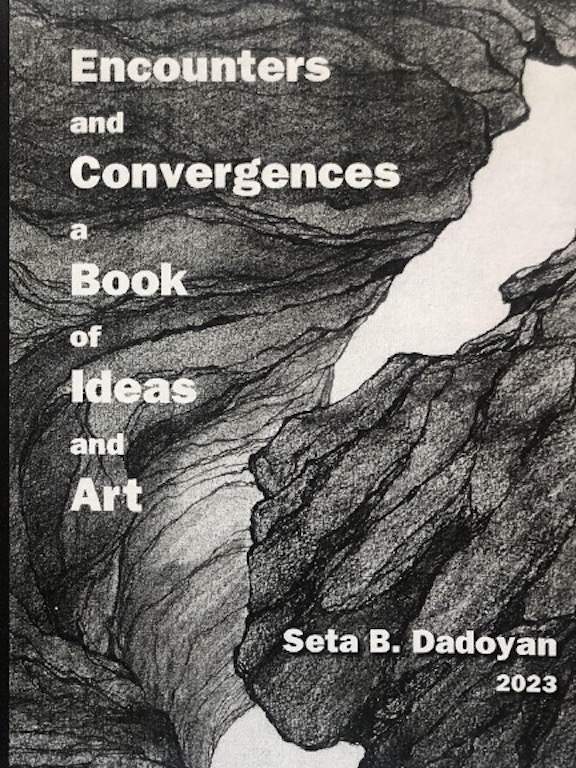
Professor Seta B. Dadoyan recently published her latest book, titled “Encounters and Convergences. A Book of Ideas and Art.”
An amalgam of philosophy and art, the book is an oeuvre in form and content, and as such, a statement about the author’s scholarly, aesthetic, and intellectual endeavors in general. Opposed to conventional and “strictly academic” practices, the opus is also an illustrated argument in favor of critical vantage points and interdisciplinary approaches. Dadoyan strongly posits the basic commonality and unity of the humanities, the arts and the social sciences, including Armenian Studies in particular. Since artworks and texts are responses to circumstances, and their motives and objectives are understanding human “situatedness” and debating the social-historical conditions, then their social embeddedness is common ground.
Similar to her over ten books and many studies in the history of the Armenian experience in the Near East, philosophy, and art history, this opus in turn is self-reflective in conception, cross-disciplinary in scope, dialectical in method, hermeneutical in approach, and in this case, artistic in expression. The accumulation of almost sixty “wartime” drawings, and half that number on “the spirit of matter,” two phases separated by an interval of rigorous academic work over three decades, establishes the legitimacy of her criteria for the “truth-content” as the meaning of both writings and artworks. Since both happened in phases and in response to specific circumstances, Part Two of the book is structured on a schematic autobiographical grid.
The book consists of 175 large pages. Its contents may be summarized as follows: the ‘Prologue on Scholarship and the Arts’ introduces the subject; Part One in five chapters, entitled ‘My Aesthetic’, provides the theoretical-critical context by brief discussions of aesthetic theories through art history and the contemporary situation of the arts and mass cultures; Part Two, ‘The Quest and the Path’ is in four chapters, ‘The Prelude’ (10 works in color illustrations), ‘Encounters with Strife and Suffering’ (7 works in full page illustrations), ‘Wartime Art and Aesthetic’ (44 works in full page illustrations), ‘Of the Spirit of Matter’ (28 works in full page illustrations). The ‘Epilogue’ concludes the book, culminating with an Appendix: ‘Content with List of Illustrations.’