
Day: October 12, 2026
Knitting, gardening, pottery, baking and reading may seem like simple ways to spend free time, but they are receiving fresh attention from researchers studying leisure and mental well-being. These activities require patience and practice, and their results cannot always be achieved at the touch of a button.
Pensions for people under the age of 70 will increase by GEL 45 to GEL 415 (USD 160) from January 1, Georgian Dream Prime Minister Irakli Kobakhidze announced on October 12, reversing the government’s initial plan to raise them by GEL 20. He also announced a new, optional scheme allowing eligible internally displaced persons (IDPs) to receive GEL 10,000 (USD 3,860) per family member instead of state-provided housing.
“We have decided that, instead of the GEL 20 increase provided for under the indexation rule, we will raise the pension for retirees under the age of 70 by GEL 45. Accordingly, from January 1, the pension for retirees under 70, except those living in high-mountain settlements, will be GEL 415,” Kobakhidze said during the October 12 briefing.
The draft 2027 state budget, registered in Parliament in early October, had envisaged raising pensions for people under 70 to GEL 390, while those aged 70 and over were set to receive GEL 555, an increase of GEL 60. Pensioners aged 70 and over living in high-mountain settlements are set to receive GEL 665. The announced changes will only affect the first group.
According to Kobakhidze, the increase will raise state budget spending on pensions by GEL 128 million. He said that “social spending accounts for more than 33% of the state budget,” adding that “In 2026, over 5 billion GEL was allocated to age-related pensions, and 540 million GEL to co-financing the funded pension scheme.”
“For comparison, in 2012 only 1 billion 65 million GEL was allocated to pensions,” he noted.
Kobakhidze argued that “social spending is already at the limit of the acceptable norm and of the recommendations of international financial institutions.” Exceeding that limit, he warned, would “significantly slow economic growth and fuel inflationary processes,” altering the effectiveness of social spending.
- 30/09/2026 – Georgia’s GDP Up by 6.3% in August 2026
“Increasing social spending above the limit would reduce the quality of fiscal consolidation, which would also have a negative impact on the financing Georgia receives from international financial institutions,” he argued.
Nevertheless, Kobakhidze said the government would seek to increase pensions for people under 70 beyond the indexation rule in the coming years, “within the limits of the acceptable norm.”
Compensation Scheme for IDPs
Kobakhidze also announced a new program allowing eligible IDP families to choose monetary compensation instead of state-provided housing. Under the scheme, each family member will be eligible for GEL 10,000 in compensation, only if the family has not previously received housing or corresponding monetary compensation.
He stressed that participation would be “entirely voluntary,” noting that GEL 58 million would be allocated to the program this year, with funding set to increase in subsequent years. The new scheme, according to him, is intended to accelerate the resettlement of IDPs, alongside the government’s existing housing programs.
Hundreds of thousands are estimated to have fled Georgia’s currently occupied regions of Abkhazia and Tskhinvali/South Ossetia as a result of armed conflicts in the 1990s and the 2008 war.
“Since 2012, the Georgian government has been successfully implementing the IDP resettlement program. Compared to 2012, the budget allocated to support IDPs has increased tenfold,” Kobakhidze said, adding that as a result, more than 45,000 IDP families have received new housing as their own property.
He also cited the House in the Village (Soplad Sakhli) program, through which up to 2,000 families have been able to purchase houses in rural areas with state support this year. Once ongoing construction is completed, another 2,600 IDP families are expected to receive new apartments, he said.
“However, despite these impressive results, many IDP families remain to be provided for. Given their number, fully resolving the resettlement issue will take at least 10 more years,” Kobakhidze noted.
“Therefore, to speed up the process, we have decided that, alongside the construction of residential buildings, we will introduce a program under which IDP families can be given monetary compensation instead of housing. Participation in this program will be entirely voluntary,” he said.
Kobakhidze clarified that “alongside the payment of monetary compensation, the construction of residential buildings and the House in the Village program will continue for those IDP families that do not apply for monetary compensation.”
“We are confident that thousands of IDP families will benefit from the program we are offering. We wish every IDP family well-being and a swift return to their native land.”
Public-Sector Salaries to Increase in 2027
The draft 2027 state budget also envisages salary increases for public-sector employees, including senior officials and judges.
According to calculations by RFE/RL’s Georgian Service, the monthly salaries of the President, Prime Minister, and Parliament Speaker are set to receive GEL 17,350 (USD 6,687), up GEL 1,350 from their current (16,000) salaries.
The salaries of deputy Parliament Speakers would increase to GEL 15,615, up GEL 1,215, while ministers and parliamentary faction chairs would receive GEL 14,748, up GEL 1,148. MPs’ salaries are set to rise to GEL 13,880, up GEL 1,080.
The draft budget also raises the public-sector base salary to GEL 1,735, up from GEL 1,600 in 2026.
Also Read:
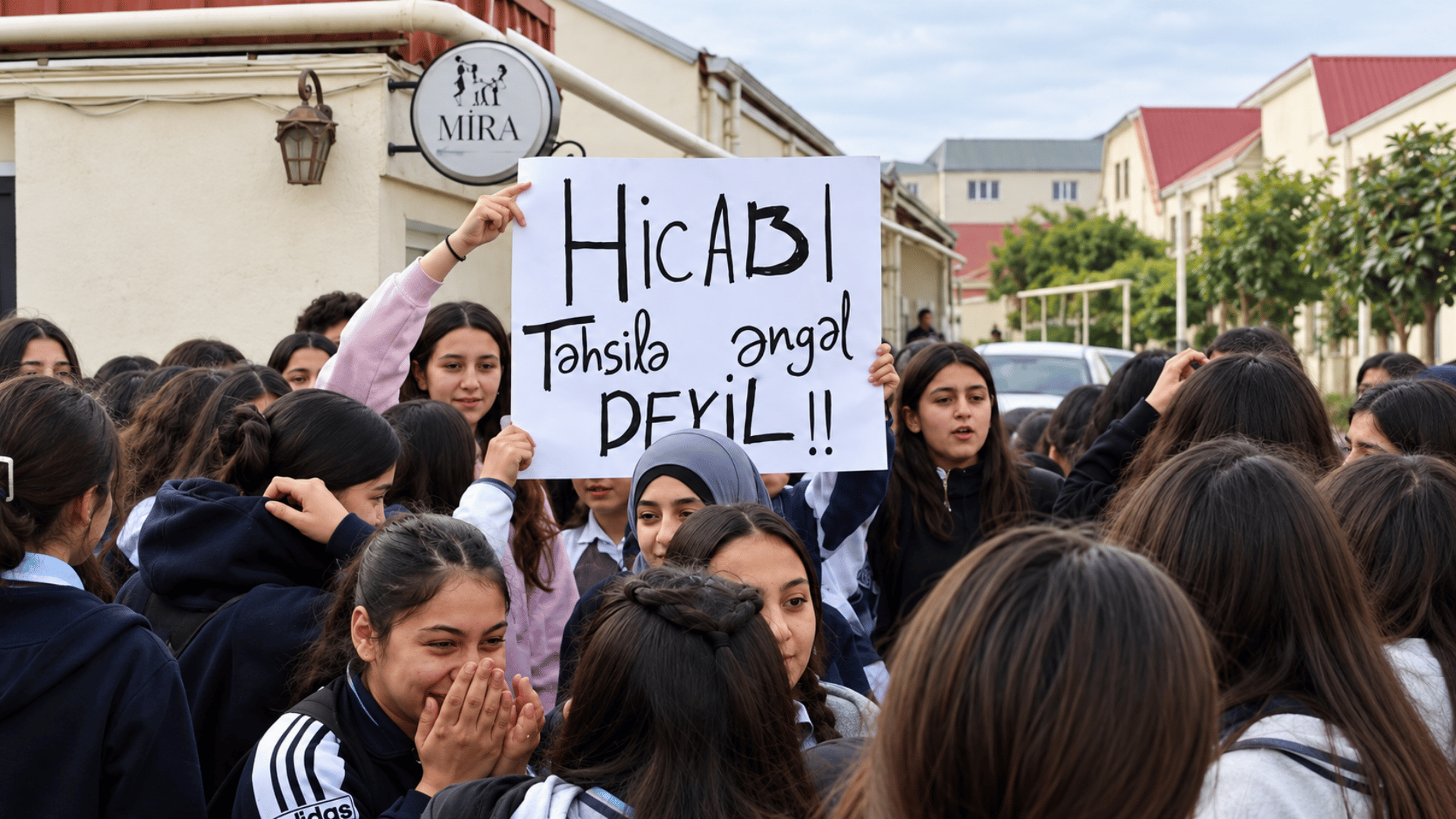
The hijab ban in Azerbaijan’s schools
In Azerbaijan’s schools, a ban on wearing the hijab has led to female students being barred from classes, demands for female teachers to remove their headscarves and protests. On 12 October, the Interior Ministry announced the arrest of 37 people in connection with incidents over compliance with school uniform rules. As a result, parents demanding that schools allow their children to attend lessons now face criminal proceedings.
The authorities justify the restrictions by citing the need for a uniform school dress code and secular education. However, the consequences for students barred from classes are tangible: they must give up religious clothing to attend lessons.
At the heart of the dispute is the question of how the state exercises its authority to set school dress code requirements and how these restrictions undermine children’s right to education.
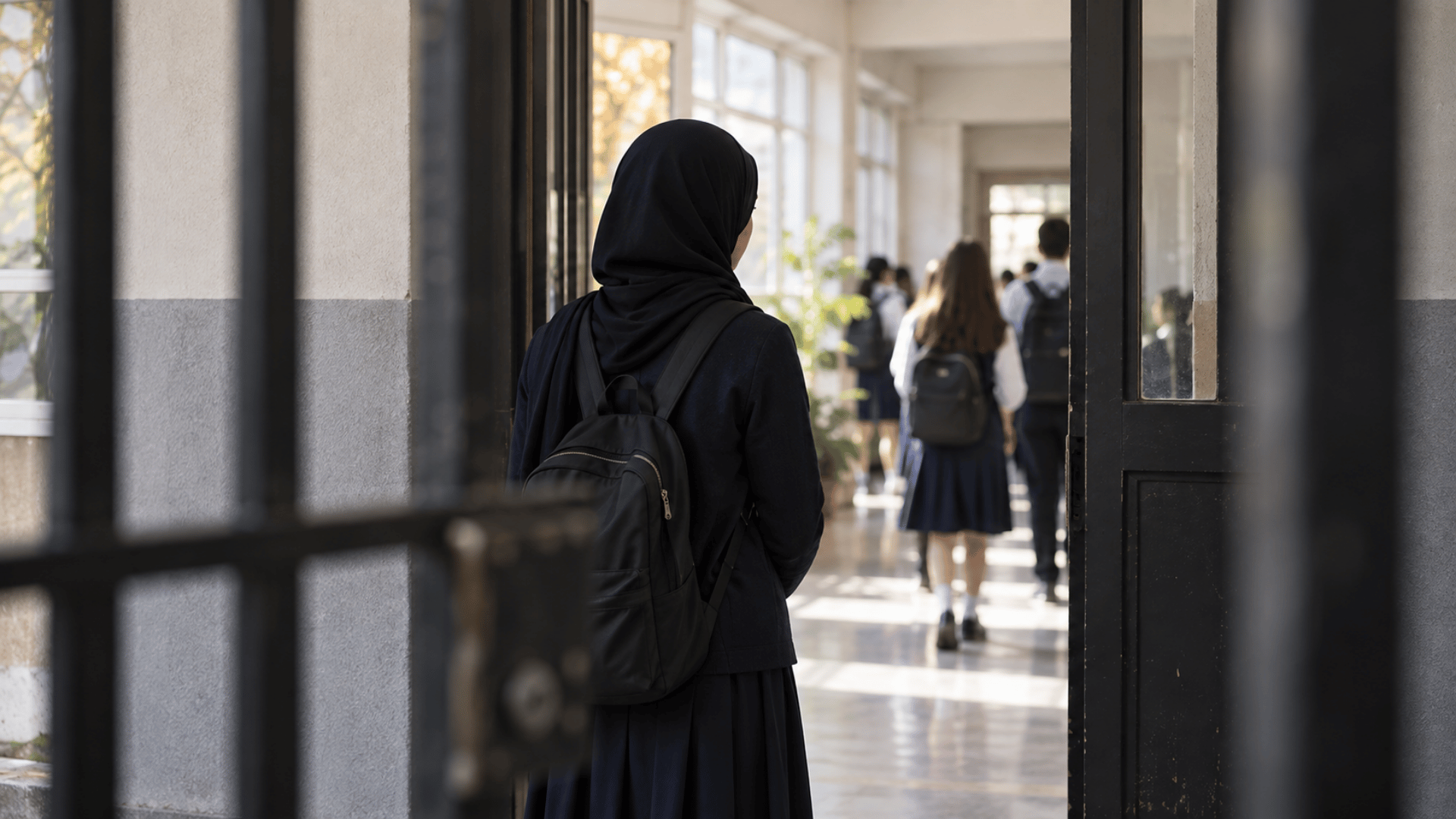
Schoolchildren show solidarity with classmates who wear hijabs
Videos shared today from several settlements in Baku show schoolchildren gathering at school entrances. Some of the girls are wearing hijabs. Students at School No. 322 are protesting the ban on wearing hijabs and demanding that the girls be allowed to attend classes.
A video published on 9 October and filmed outside School No. 69 in Baku shows schoolchildren refusing to go to lessons in solidarity with their classmates who wear hijabs.
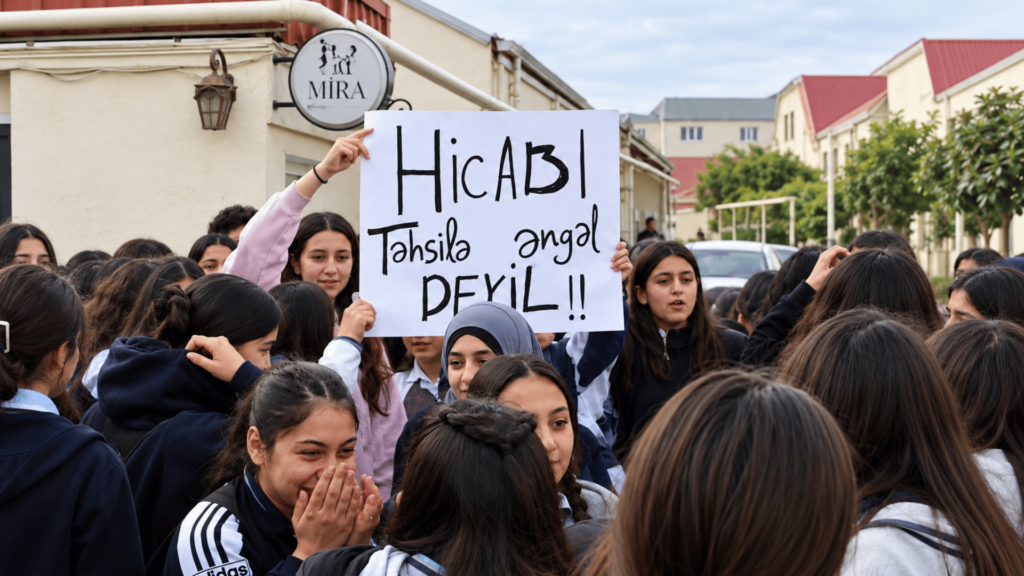
Schoolchildren have also staged protests at a school in the village of Mollaoba, in the Masally district.
A video shared from School No. 9 in the Jalilabad district shows girls being barred from entering the building because they wear hijabs. In another video, published in the Baku settlement of Khokhmeli, parents warn that they will stop sending their sons to school as well.
Protesters are expressing their discontent in various ways: gathering outside schools, refusing to attend classes and calling for boycotts. But they all have the same demand: girls who wear hijabs must not be denied access to education.
The solidarity shown by classmates demonstrates that the conflict affects not only girls who wear hijabs and their families. The restrictions also affect relationships between students and the learning process.
The consequences of missing classes go beyond the material a child fails to learn in a single day. When every visit to school brings arguments over clothing, the ability to continue studying comes into question. While families face demands to change their religious practices, children bear the brunt of this confrontation.
From school uniform requirements to a ban
Cabinet of Ministers Resolution No. 309, adopted on 21 September, prohibits additional items of clothing that violate uniform school dress code requirements and contradict the principle of secular education. Although the document does not explicitly mention the hijab, complaints from schools indicate that, in practice, the provision applies specifically to headscarves.
It is important to distinguish between the wording of the resolution and the consequences of its implementation. Barring female students who wear hijabs from classes effectively amounts to a ban on wearing this head covering. When authorities present such measures solely as a way to enforce school uniform rules, the issue of restricting children’s access to education takes a back seat. The amendments introduced by the resolution do not, however, explicitly provide for suspension from classes as a separate measure. This raises the question of what legal grounds school administrations rely on when adopting this practice.
On 9 October, the Baku City Education Department announced inspections to check whether students and teachers comply with clothing requirements. This suggests that the problem extends beyond decisions made by individual school administrations. The resolution, the mechanisms for enforcing it and the way schools apply it must be considered together. Yet in a system that places particular emphasis on parental responsibility, the question of who must ensure that children have access to education remains unanswered.
Criminal proceedings launched against protesters
In a statement issued on 12 October, Azerbaijan’s Interior Ministry directly linked the detention of 37 people to events surrounding the introduction of uniform school dress code requirements. Authorities have opened a criminal case under Article 233 of the Criminal Code, which provides for liability for organising actions that disrupt public order or actively participating in them.
The ministry accuses the detainees of provoking confrontations with education workers in Baku, damaging educational institutions and attempting to obstruct school operations and traffic. However, the statement does not specify which schools sustained damage or what specific actions the detainees allegedly committed. It also does not disclose their names or ages.
The lack of this information raises serious questions, particularly against the backdrop of protests involving schoolchildren. Are any of the detainees minors? On what grounds do law enforcement agencies distinguish between peaceful protest and the specific actions they accuse the detainees of committing?
The ministry says the measures are necessary to ensure the safety of students and teachers. However, opening a criminal case amid protests over the right to education could deter other families from taking part in similar demonstrations. Parents demanding that schools allow their children to attend classes must now also consider the risks associated with participating in protests.
Aliyev’s remarks and the Iranian factor
On 2 October, speaking at the 8th congress of the New Azerbaijan Party, Ilham Aliyev placed particular emphasis on the role of education in safeguarding ideological security:
“Therefore, we must protect ourselves from ideological provocations. How? First and foremost, of course, through education.”
The president also criticised Azerbaijani-language media outlets operating in neighbouring countries. Although he did not explicitly mention Iran or the hijab in this part of his speech, some political commentators interpret his remarks as a signal directed against Iran’s religious influence in Azerbaijan.
Asif Narimanli, a political commentator close to the authorities, links the events surrounding the hijab ban to attempts by Iran at “political and ideological interference”. In this context, he refers to a religious gathering in Qom and a protest in Istanbul. Aygun Muradkhanli, a journalist at a pro-government media outlet, has also argued that religious groups opposing the ban have links to centres abroad.
This interpretation risks pushing demands to allow female students who wear hijabs to attend classes into the background, as debate over foreign influence takes centre stage. Families defending the right to religious choice find themselves in a situation where they are effectively expected not only to explain their position but also to prove their political loyalty. However, general claims about Iranian influence do not, in themselves, justify treating an individual schoolgirl’s decision to wear a hijab as a security threat. Allegations of foreign interference require evidence of specific links and actions.
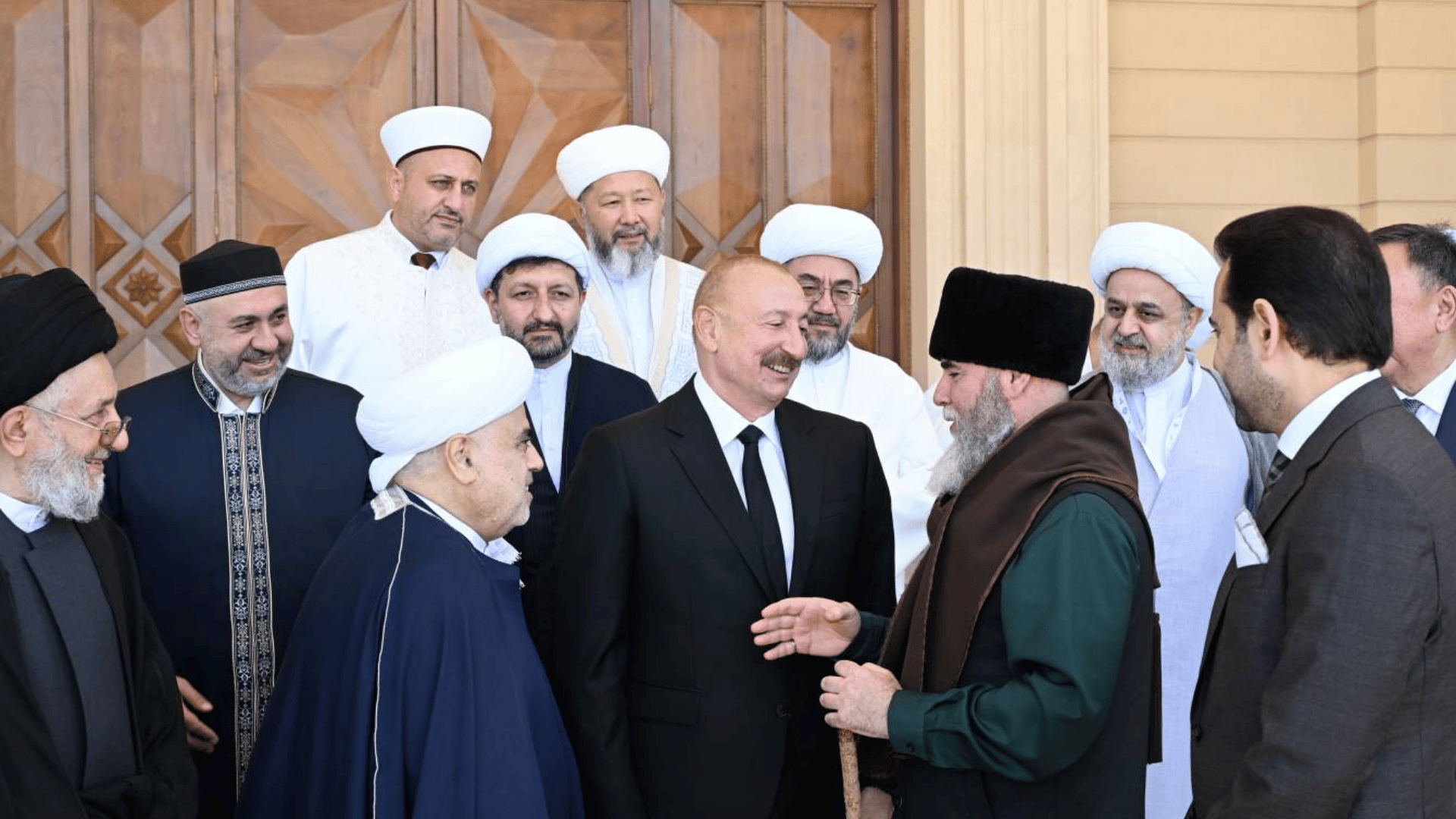
Parents’ rights and the state’s obligations
Article 18 of the International Covenant on Civil and Political Rights enshrines parents’ right to ensure the religious and moral education of their children in accordance with their own beliefs. Articles 5 and 14 of the Convention on the Rights of the Child also recognise the role of parents in raising their children and guiding their development.
These rights must be protected with due regard for the child’s evolving capacities, freedom of conscience and best interests. The secular nature of education does not negate a family’s right to provide religious education for its children. Ensuring that the educational process remains secular and barring schoolchildren from classes because of their religious clothing are fundamentally different measures.
Authorities enforcing these restrictions must explain what specific obstacles headscarves create for the learning process and why they consider excluding a child from classes necessary. When access to education becomes a means of pressuring a family to abandon its religious choices, invoking secularism to justify such restrictions loses its meaning.
Teachers risk losing their jobs
Following the approval on 6 October of separate dress code requirements for teachers, reports emerged of pressure on teachers who wear hijabs. Teachers told Toplum TV that some schools in Sumgayit were demanding that they remove their hijabs or submit letters of resignation. Journalist Arzu Abdulla reported a similar situation at School No. 90 in the Ramana settlement.
For teachers, the issue concerns not only their religious beliefs but also their livelihood. Requiring them to submit letters of resignation can create the impression that they are ending their employment voluntarily. However, when teachers must choose between giving up religious clothing and losing their jobs, the voluntary nature of that decision becomes questionable. Restrictions on teachers’ clothing, when authorities have not justified them on the grounds of professional requirements, also call into question the value of the experience they have accumulated over years of work.
Public reaction: protests and support for the ban
Public opinion on the ban is divided. Press Council chairman Rashad Majid defends the restrictions as necessary to protect the secular nature of the state and says he sees foreign influence behind the protests. Jailed journalist Polad Aslanov, by contrast, announced a hunger strike to protest restrictions imposed on female students and teachers who wear hijabs.
Comments on a HamamTimes post about protests at a school in the Buzovna settlement also include claims that the protesters have links to Iran. Other discussions express a different view: some participants oppose children wearing hijabs but nevertheless believe that barring schoolchildren from classes for this reason is unacceptable.
Turkey’s reaction and previous crackdowns
On 3 October, protesters gathered outside Azerbaijan’s consulate in Istanbul in a demonstration. They demanded that the restrictions be lifted and called on the Turkish authorities to intervene. However, on 7 October, Omer Celik, spokesperson for Turkey’s ruling Justice and Development Party (AKP), said that groups opposing Azerbaijan had no ties to either the party or the government.
Protests against the hijab ban in Azerbaijan have previously led to arrests and criminal proceedings. On 6 May 2011, police intervened during a demonstration outside the Education Ministry, followed by arrests and the opening of a criminal case. Abgul Suleymanov, known for taking part in protests against the hijab ban, was arrested that year and later sentenced to 11 years in prison on charges he denied. In September this year, authorities placed him under administrative arrest for another 30 days. His family links the arrest to his posts about the hijab.
The current events are unfolding against a backdrop of previous crackdowns. The successive decisions on dress code requirements for schoolchildren and teachers, inspections to enforce them, and the arrest of 37 people have now become part of a single process. However, assessing the consequences of this policy requires more than the authorities’ statements about secular education. It is necessary to establish how many children have missed classes, how many teachers have faced the threat of losing their jobs, and on what grounds the authorities arrested the protesters.
The hijab ban in Azerbaijan’s schools