
Je sais pas si tu es au courant, mais dans la réalité aussi les noms des pays, des villes et des gens changent suivant les pays et la langue (France – frankreich, Suisse – Swiss – switzerland …
Day: May 23, 2026
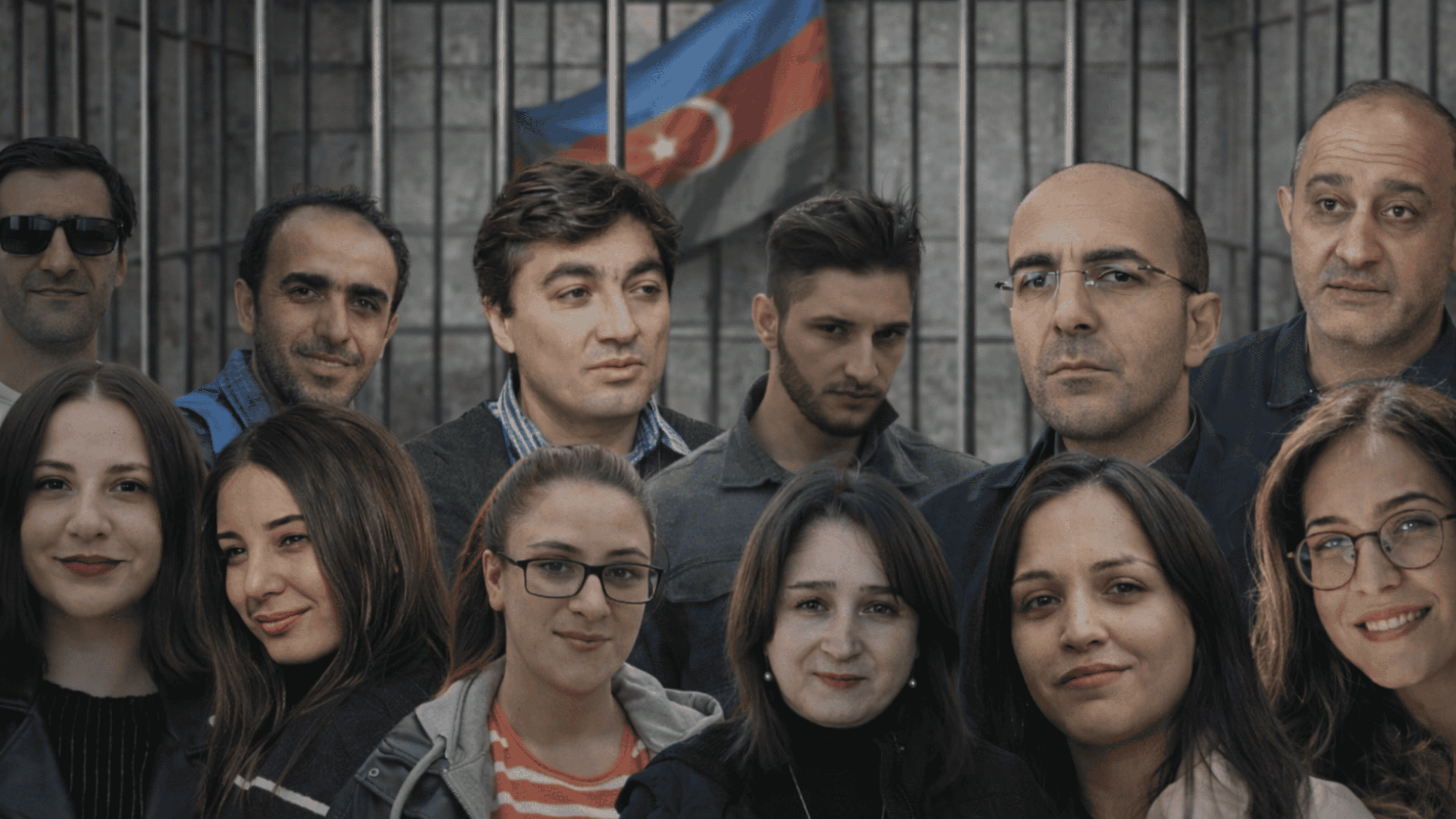
Meydan TV journalists protest in court in Azerbaijan
On May 22, during the trial in the Meydan TV case at the Baku Serious Crimes Court, journalist Khayala Agayeva made a free statement.
The judges interrupted her several times. During the last interruption, they ordered guards to remove Agayeva from the podium and seat her next to her lawyer.
In response, the jailed journalists began shouting: “Cowards!”
The “Meydan TV case” began on December 6, 2024, when several staff members of the popular online outlet Meydan TV — Ramin Deko (Jabrayilzade), Aynur Ganbarova (Elgunesh), Aysel Umudova, Aytaj Ahmadova (Tapdig), Khayala Agayeva and Natig Javadli – were detained in Baku. They were charged under Article 206.3.2 of the criminal code: smuggling committed by a group acting in conspiracy.
The criminal case became known as the “Meydan TV case.” Later, journalists Shamshad Aga, Nurlan Libre, Fatima Movlamli, Ulviya Ali and Ahmed Mukhtar were also arrested in connection with the case.
In August this year, the charges against the journalists were expanded with additional criminal articles. Meydan TV says the arrests are linked to the journalists’ critical reporting about the authorities.
At the start of the May 22 hearing, Natig Javadli protested, saying he had been unable for two months to obtain a notarized document allowing his children to travel abroad.
“My children need to leave to study. For two months the court has been unable to properly prepare one document. The notary keeps returning it, saying it is written extremely poorly. I demand that the document be prepared correctly immediately,” he said.
After that, Khayala Agayeva approached the podium to make a statement. Before speaking, she asked the court to turn the podium sideways. The journalist said she did not want to speak with her back to the people who came to observe the trial.
“That is impossible. This is a court, defendants must face the judge,” the judges replied.
“For us this is not a court, but a platform. So I will stand at the podium the way I think is right,” Agayeva answered before beginning her speech.
“Shortly before my arrest, I filmed a report about Bayirshahar that I never got to publish”
“This week Baku is hosting the World Urban Forum. Foreign guests are being shown the decorative streets of our city. The head of state tells them about preserving Baku’s history and architectural heritage. He says we are proud of our ancient heritage.
But he does not mention how the memory of the capital is being destroyed and how historic buildings are being flattened.
What the authorities hide, we again have to speak about ourselves. The last report I filmed shortly before my arrest, which the authorities did not allow to be published, was about Bayirshahar. Footage seized by police during the search of my home showed a historic area marked for destruction.
At the time, historic buildings that opponents of preserving old Baku called a ‘black stain’ on the city’s image were under threat of demolition. For the last 18 months this issue has remained in the spotlight. Residents repeatedly protested, and the ‘Save Bayirshahar’ initiative group appealed to the president to stop the demolitions.
After all these voices were ignored, calling this year the ‘Year of Architecture’ while telling fairy tales about urban development is a major contradiction.”
At that point, Judge Vugar Guliyev interrupted her, saying: “Speak to the point, this is not a podium for speeches.”
Agayeva replied that she was speaking exactly to the point.
From her seat, Aytaj Tapdig also protested, saying: “You will not be able to silence us.”
“The alternative media theory we created under Aliyev’s dictatorship”
After that, Khayala Agayeva continued her statement.
“This week, while foreign guests at the forum were being shown around Baku’s White City, the history of Bayirshahar was already lying in ruins, and we were marking the 13th anniversary of Meydan TV behind barbed wire. Because we were arrested on orders from a single center and are being tried in a fabricated case.
This trial is the result of our many years of work. It is a practical demonstration of the alternative media theory we created during Ilham Aliyev’s dictatorship.”
After these words, Agayeva’s microphone was switched off. She fell silent for a moment. When the microphone was turned back on, the journalist repeated the last sentence and continued speaking.
At that point, Judge Vugar Guliyev interrupted her again.
“Do not speak so loudly. You are speaking as if you are at a rally. You are shouting, and it is bad for our health.”
“Is there any rule that defines the tone people must use in court?” journalist Shamshad Aga asked the judges in protest.
“When the president’s young son was only nine years old, $75 million in assets in Dubai had already been registered in his name”
Khayala Agayeva continued reading her statement out loud.
“We always tried to break free from the authorities’ system of political control and tear down the barrier built to block the spread of information. Our work was aimed against government pressure and manipulation, like a weapon pointed directly at it.
By speaking about problems, we ourselves became a problem and disrupted the authorities’ plans to completely silence people’s voices in Azerbaijan.
Our goal was to reach all parts of society, expose the lies of officials, and give people the truthful information they deserve and need. When speaking about ineffective and criminal governance, we placed no one above criticism.
The Meydan TV case is another political order from the Azerbaijani authorities at the highest level, aimed at completely silencing this critical voice – the independent press. Before us, journalists from AbzasMedia and Toplum TV, as well as members of independent civil society and NGOs, faced similar repression.
The charges in the Meydan TV case were fabricated. The prosecution unsuccessfully tried to artificially construct various criminal accusations. Every page of the case materials practically screams that this is a politically ordered case.
Since the ‘Sherlock Holmeses’ from Baku’s main police department could not find a single piece of evidence against this so-called ‘organized group,’ they tried to present our foreign trips as smuggling.
For example, until the age of 28, I went through border checks every time I crossed the border, and no violations were ever found.
But let me tell you about a person who was never checked at all. When the current president’s son, Heydar Aliyev, who is the same age as me, was only nine years old, $75 million worth of assets in Dubai had already been registered in his name.
This happened in 2006 – the same year our government stopped paying child benefits in the country. At the same time, they were moving millions of dollars abroad for their own children. Isn’t that smuggling?”
After these remarks, the judges interrupted Agayeva again.
“Let state prosecutor Ergun Gafarov, who is carrying out the government’s political order in our trial, ask these questions to Heydar Aliyev. He has grown up now and is capable of answering,” Agayeva continued.
But the judges interrupted her once again.
“The authorities paid PACE members $3 billion in bribes”
Ignoring the judges’ interruptions, Khayala Agayeva continued her statement.
“Many investigations by Meydan TV and other independent media outlets revealed that top Azerbaijani officials own property in London worth millions of dollars.
Have prosecutors, police officers, or judges ever investigated how these assets were bought abroad? Do they even have the courage to think about it?
Another Meydan TV investigation was about Azerbaijani authorities bribing members of the Parliamentary Assembly of the Council of Europe. To achieve these criminal goals, the government paid about $3 billion in bribes, while those lawmakers who sold their honor secretly acted in support of the Azerbaijani government.
Has the Prosecutor General’s Office ever questioned the people who moved these $3 billion out of the country – where the money came from and how it was transferred abroad?”
At that point, the judges interrupted again, saying: “You are not speaking to the point. You cannot speak like this here.”
“We were falsely accused by Ilham Aliyev’s government, so we will speak about it. Be quiet and listen!” Agayeva replied to the judges.
The judges then stopped her from continuing.
“Guards, remove her from the podium and take her back to her seat!” Judge Elmin Rustamov ordered. Guards approached the podium and prevented the journalist from continuing her speech.
The jailed journalists stood up, shouted “Cowards!” and began banging on tables and the glass cage around them. As the chanting continued, the panel of judges left the courtroom without explanation.
“Our trials are being deliberately delayed. Everything is being done to drag this process out,” Ulviya Ali told people in the courtroom.
“We were falsely accused by Ilham Aliyev. His name will be mentioned in these trials, and everyone must hear it,” Fatima Movlamli said.
“If we are not allowed to speak during the hearings, we will begin a dry hunger strike,” Aytaj Tapdig said.
The last hearing in the Meydan TV case took place on April 3. Hearings scheduled for April 17 and May 1 were postponed.
No date was announced for the next hearing.
News in Azerbaijan
Categories
如何看待雅虎在中国大陆停止产品与服务 – 知乎
The usually distant and frowning face of Metropolitan Shio was overtaken by sudden vulnerability as he ascended the patriarchal throne on May 12, 2026.
The day was meant to be historic. Falling on the Day of St. Andrew the First-Called, Christ’s apostle believed to have first preached Christianity in Georgia, the ceremony marked the country’s first patriarchal enthronement in nearly half a century. The previous one had taken place in the same Svetitskhoveli Cathedral in 1977, inaugurating the rule of Ilia II, Shio’s widely venerated predecessor. Shio — from now on, Shio III, 57 — would have to fill perhaps the largest shoes imaginable in Georgia’s public life.
The historical significance of the day, however, appeared eclipsed by an air of uncertainty. Svetitskhoveli Cathedral, located in Mtskheta, Georgia’s ancient capital near Tbilisi, was filled with clergy, officials, and faithful, but the surrounding area was not particularly crowded despite free transportation provided by Tbilisi authorities.
Since being named Locum Tenens by Ilia II in 2017, Metropolitan Shio, lay name Elizbar Mujiri, had steadily moved into the spotlight. Amid Ilia II’s declining health, he was often seen as the Church’s de facto leader. His upbringing in central Tbilisi, his early years spent among a circle that would later produce influential figures, and the tall stature that made him instantly recognizable in any crowd all seemed to mark him out for prominence in Georgia. Yet all these years, much of the future patriarch’s persona has remained obscure.
Perceiving him as Ilia II’s chosen successor, many of Georgia’s Orthodox Christians appear ready to embrace Shio III as their new shepherd. Critics, on the other hand, worry either that he will continue the Church’s hardline course or that things may take a worse turn under his leadership. Yet those willing to love him appear to be still figuring out whom to love, and those fearing him are yet to clearly articulate what to fear.
Cellist-Turned-Monk
Elizbar Mujiri was born in downtown Tbilisi in 1969, with observers noting him as the only Georgian Orthodox Church Patriarch raised in the capital in more than a century. He attended Tbilisi’s well-known 53rd Public School, where his circle of friends included future Georgian President Giorgi Margvelashvili and Levan Vasadze, currently a Moscow-friendly ultraconservative businessman. During his school years, Mujiri studied music, performing at concerts and reportedly winning contests, later continuing his cello studies at the Tbilisi State Conservatoire.
Those who knew Mujiri in his younger years describe him as a charming “aristocrat” and a talented cellist, born and raised in a respected, elite family of engineers, doctors, and academics in Tbilisi.

Irakli Kakabadze, a prominent leftist figure who was also friends with the young Elizbar Mujiri, remembers him as “the most secular” member of their circle. Film director Giorgi Mgeladze, Mujiri’s childhood friend, recalls him as someone who lived in downtown Tbilisi, “and could walk with a cello without anyone having a problem with that,” alluding to the masculine cultural norms of late-1980s Tbilisi. Mgeladze has also been cited as recalling the friend group’s early meeting with Ilia II, during which Mujiri was reportedly the only one to refuse to kiss the patriarch’s hand, saying that “men are not kissed on the hand.”
Mgeladze, however, recounts Mujiri later describing struggles with his musical path, saying he would feel sick whenever he sat with the instrument, and developing an interest in theology. According to Mgeladze, friends took him after that to the prominent Shio-Mgvime Monastery near Tbilisi for what was expected to be a short stay, but Mujiri remained there for five years, eventually returning to the capital as Monk Shio. According to his official biography, Shio became a novice at the monastery at the age of 22 and was ordained as a monk only days after turning 24. Shio, however, is hardly the only Georgian cleric who started out as an artist in the late Soviet years but ultimately ended up in the Holy Synod.
According to theologian Shota Kintsurashvili, Shio’s formative period at Shio-Mgvime Monastery coincided with theological isolationism within the Georgian Church, with the monastic groups in Shio-Mgvime, among others, promoting strong anti-ecumenical positions. The movement that would eventually lead the Georgian Church to withdraw from the World Council of Churches and the Conference of European Churches, Kintsurashvili says, noting that Shio’s theological outlook was likely shaped by “this period of rigorism and isolationism.”

Education and Clerical Career
Shio’s clerical career advanced over the years largely out of the public spotlight. He was ordained as a priest in 1996, became an igumen in 1998, and went on to hold senior clerical positions at churches in Tbilisi and the diaspora church in Moscow. In 2003, at the age of 34, he was appointed bishop of the Senaki and Chkhorotskhu diocese in western Georgia, while eventually also leading the Georgian Orthodox parish in Australia and New Zealand. He was elevated to the rank of Metropolitan in 2010 and, in 2017, was named by Ilia II as his Locum Tenens.
Mujiri graduated from Batumi Theological Seminary in 1999, later studying remotely at Moscow Theological Seminary before completing a doctorate at Moscow’s St. Tikhon’s Orthodox University in 2015. His thesis focused on the life of Georgian saint Monk Aleksi Shushania, whom Shio would also include in his address delivered during the extended church assembly, which led to his election as a Patriarch.
Not much else is known about Mujiri from the pre-Locum Tenens years.
In his rare surviving radio interview from 2000, which has resurfaced recently, 31-year-old Mujiri — then a head of Tbilisi’s Narikala Church — is heard speaking in a somewhat melancholic voice, extensively reflecting on love and describing God as one who loves humans rather than seeking to punish them. He also spoke about abandoning music for a spiritual path, recalling a “creative crisis” during which he “lost the sense of life” and was “unable to find it.” He said he came to see that “the only path toward saving one’s soul is Christ,” while everything else merely serves as a “means,” adding that the new path gave him “a sense of fullness.”
According to Kintsurashvili, the theologian, the doctoral degree places Shio III among the relatively few hierarchs in the Georgian Church with such academic credentials.
‘Not Russia’s Candidate, But Supported by Russia’
Ever since becoming the Locum Tenens, his Moscow background, as well as his ties to Moscow-connected ultraconservative businessman Levan Vasadze, flagged Mujiri among critics as a man aligned with the Russian church. Some cited the visit of Hilarion Alfeyev, Moscow church official, to Tbilisi days before his designation as Locum Tenens as a possible proof of external pressure behind his career. Bishop Zenon (Iarajauli), one of the Synod members critical of Mujiri, suggested in his remarks with Formula TV shortly before the patriarchal election that Shio “was not Russia’s candidate, but Russia supports him.”
In the weeks before Shio’s election, Moscow’s clerical and official circles repeatedly demonstrated interest in succession. First, Russia’s foreign intelligence accused Constantinople Patriarch Bartholomew of meddling with the process, while Moscow’s Patriarch Kirill later expressed hopes that the Georgian Church under the new Patriarch would not change its stance on refraining from recognizing Ukrainian autocephaly.
Since Ilia II’s death, however, Shio III has not demonstrated any particular favoritism toward the Russian Church. Observers noted that the Russian delegation largely remained in the background during ceremonial services both at Ilia II’s funeral and during the festive services following Shio III’s enthronement. Representatives of Western Orthodox churches, on the other hand, received more prominent roles and greater visibility, including Constantinople Patriarch Bartholomew, who conducted the funeral service for the late Ilia II. Shio III also spoke by phone with the Constantinople Patriarch on May 17, during which Bartholomew reportedly invited him to Constantinople in the “near future.”
But there have been separate concerns over Shio III’s perceived alignment with the increasingly repressive and conservative rule of the ruling Georgian Dream (GD) party. The perceptions stem from the Church’s statements in recent years endorsing GD’s policies, as well as allegations that, following Ilia II’s death, there has been a coordinated campaign by pro-ruling party circles in favor of Shio III’s candidacy. Shio III’s sermons and remarks regarding abortion, which he fiercely opposes, including by floating legislative moves, as well as gender views stressing women’s role as “mother and wife,” have fueled further worries, especially amid the ruling party’s growing record in instrumentalizing conservative views for its political gains.

Heavy Cross to Bear
There is broad agreement that the path ahead will not be easy for the new Patriarch.
For years to come, Shio III is expected to struggle to come from under the shadow of Ilia II, who had attained an almost saint-like stature during his lifetime, to rule the Church that, too, is set to emerge from decades of single dominant rule. That will probably lead to a push for greater pluralism and overdue reforms in Church governance. Both of his rivals in the patriarchal race outlined their own visions for change, including a stronger social role for the Church and revisiting the governing statute that fueled controversy during the succession process. No such vision has been presented by Shio ahead of the vote.
Those controversies may also have undermined, at least in part, perceptions of Shio’s legitimacy. Although he secured victory in the first round, the new Patriarch received 22 votes from the 39-member Synod in an election marred by the exclusion of two strong contenders based on an interpretation of the governing statute containing the vague criterion of “theological education.” It could damage both the Church’s reputation and Shio’s own authority if he fails to find a common ground with more than one-third of the hierarchs who did not vote for him.
His main work, however, is expected to be with the parish.
Although the Georgian Orthodox Church has for years remained the country’s most trusted and influential non-state institution, and massive crowds attended Ilia II’s wake, there is also a growing sense that some of that influence could be slowly waning, regardless of the new Patriarch’s personality. Personal appeal, however, may still matter more than ever: assuming his patriarchal throne, Shio faces a politically divided society, where divisions have inevitably seeped into the more than 80 percent of the population that identifies with Orthodox Christianity.
The Patriarch has yet to develop a warmer, more personal, and empathetic appeal that could draw broader public confidence. His tone has remained relatively strict, and his voice less distinctive compared to his predecessor’s deep, measured, and wise manner of speaking. In his first sermon as a Patriarch, Shio spoke about the need to “throw open the doors of the Church to everyone.” However, his remarks days later, on May 17, in which he said that families carrying the “sin” of abortion are doomed and warned against Georgians being outnumbered by “other peoples,” drew backlash over alienating and divisive framing. Then, two days later, he met, after repeated requests, with the parents of children diagnosed with Duchenne muscular dystrophy, whose appeals for access to modern treatments have been repeatedly rejected by the authorities. The Church pledged to get involved in seeking a solution.
Depending on the course Shio III ultimately takes, he may come to be seen either as the figure held responsible for the Church’s declining influence or as the one credited with transforming it into a more socially oriented, pluralistic, and dynamic institution with greater flexibility in responding to contemporary challenges.
Also Read: