
Plataforma Gubernamental Financiera, Amazonas entre Unión Nacional de Periodistas y Alfonso Pereira, Bloque Amarillo Piso 7 Quito – Ecuador Teléfono: 593 2 2440050
Day: May 19, 2026
Токаев провозгласил Казахстан наследником Золотой Орды ru.themoscowtimes.com/2026/0…
— Michael Novakhov (@mikenov) May 19, 2026
On May 4, another court hearing in the “Toplum TV case” was held at the Baku Serious Crimes Court.
According to Toplum TV, at the hearing presided over by Judge Azer Taghiyev, the first statement was heard from one of the defendants, Ramil Babayev, an employee of the Institute for Democratic Initiatives (IDI).
Babayev stated that he has been on a hunger strike for five days because his complaints have not been addressed at the Baku Pretrial Detention Center, where he is being held.
He said that after the previous court hearing, he requested a meeting with the detention center’s head, Elnur Ismayilov, but for a week he has been repeatedly brushed off.
“They kept saying ‘today or tomorrow’ and did not allow me to meet with the head. Deputy head Javid Gulaliyev reviewed the applications I submitted. My first demand was for criminal proceedings to be opened against Gulaliyev over acts of torture. He responded, ‘Am I the only one here who beats people?’ Regarding my other demands, he said I could raise them in a meeting with the head. I told him that according to the law, he is required to forward my application to the court and my complaint must be formally reviewed. Five days ago, I began a dry hunger strike. Although I demanded a medical examination and transfer to another cell, neither request was fulfilled. Only last night did they realize there was a court hearing in the morning and call a doctor. I told them I would not participate in the hearing and that if they tried to bring me by force, I would harm myself. I was brought here by force. While being brought here, I was preparing to injure myself by hitting my head against the wall in the holding room. Akif Gurbanov advised me to take part in the hearing so that the issue could be publicized” he said.
Babayev added that he feels unwell and has vomited blood twice over the past five days, requesting that the hearing be postponed.
Speaking afterward, IDI head and Third Republic Platform speaker Akif Gurbanov said that he had tried to meet with Babayev at the detention center in recent days but was denied permission.
“A few days ago, my cell was searched, my old writings were confiscated, and my phone calls were restricted. Ramil included ending these practices among his demands. I only learned of this later and requested permission to meet with him on May 2. I said perhaps I could persuade him to end the hunger strike, because his health is important to us. The deputy head said, ‘We’ll see,’ because he was waiting for a response from the detention center head, who in turn was waiting for the Penitentiary Service, and they were waiting for the Presidential Administration. Later they falsely claimed that Ramil had ended his hunger strike. The authorities’ aim is to create an information blockade,” he said.
Later, another defendant, Toplum TV co-founder and media expert Alasgar Mammadli, asked that Babayev be provided with a doctor and that his complaints be investigated.
Although Judge Taghiyev proposed calling emergency medical services to the court for Babayev, the defendant refused. He said he wanted to meet with detention center head Elnur Ismayilov and would then switch to a water-only hunger strike.
Taking Babayev’s demands into account, Judge Taghiyev postponed the hearing until May 18. At the insistence of the defense lawyers, the judge also ordered that a doctor be called for Babayev.
A total of 10 people have been charged in the “Toplum TV case.” Those arrested include Third Republic Platform speaker Akif Gurbanov, founding member Ruslan Izzatli, Toplum TV co-founder Alasgar Mammadli, video editor Mushfig Jabbar, journalist Farid Ismayilov, and IDI employees Ali Zeynal, Ilkin Amrahov, and Ramil Babayev.
Journalist Elmir Abbasov has been placed under police supervision, while Toplum TV editor Shahnaz Baylargizi was initially placed under house arrest and later released under police supervision.
Those arrested in the “Toplum TV case” were initially charged with smuggling, but the charges were later escalated.
They deny all accusations and state that they were arrested on politically motivated charges.
The post Toplum TV Case: Journalist Ramil Babayev reports serious health decline due to hunger strike appeared first on MEYDAN.TV.
The post Toplum TV Case: Journalist Ramil Babayev reports serious health decline due to hunger strike appeared first on azeritimes.com.
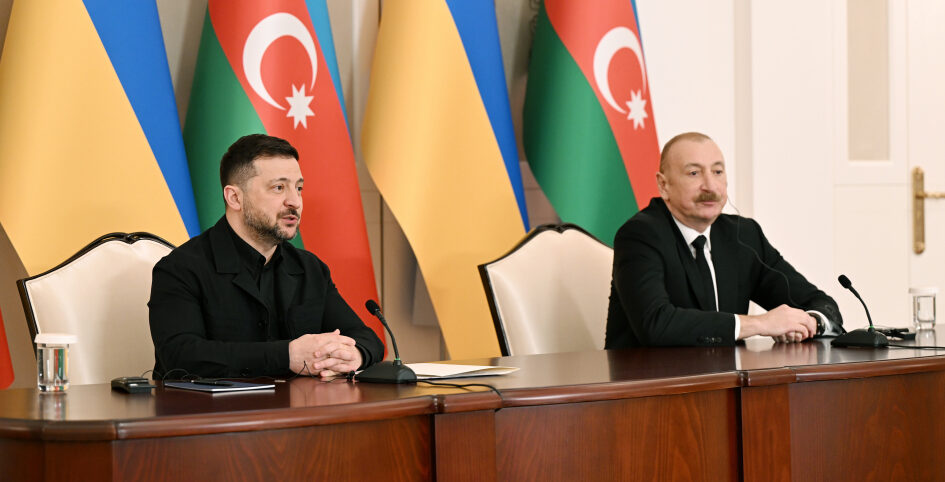
In the past month, the Azerbaijani government has demonstrated parallel diplomatic activity with the West, Ukraine, and Russia.
On April 25, Ukrainian President Volodymyr Zelensky’s working visit to Azerbaijan, the signing of six documents, and statements on expanding security cooperation showed that Baku–Kyiv relations have entered a new phase. Just ten days earlier, Baku and Moscow had reached an agreement on compensation for the AZAL aircraft crash in Aktau, followed by positive messages on developing economic cooperation during Aleksey Overchuk’s visit to Baku.
Meanwhile, leaders of European Union countries are also arriving in Baku one after another. In the visits of Lithuanian Prime Minister Inga Ruginienė, Latvian President Edgars Rinkēvičs, and Czech Prime Minister Andrej Babiš over the past few weeks, the main focus has been on energy cooperation. Italian Prime Minister Giorgia Meloni’s visit to Baku also appears to be a continuation of this trend. As European Commissioner for Energy Dan Jørgensen said in Baku in March, “The gas we can get from Azerbaijan is extremely important for us.”
All this diplomatic mobility appears to be the next stage of Baku’s multi-vector foreign policy: simultaneously reducing tension with Moscow, strengthening ties with Kyiv, and deepening energy partnerships with Europe. However, these approaches have one common feature—issues such as human rights, political prisoners, and democratic backsliding are almost never discussed. This raises again the question of whether the EU’s policy toward Azerbaijan is driven by interests rather than values.
Events from mid-to-late April show that Azerbaijan is trying to pursue a balanced policy simultaneously toward Russia, Ukraine, and Europe.
Photo: Azərtac
A shift in politics or a shift in interests?
In recent weeks, Azerbaijan’s diplomatic activity toward Europe has noticeably increased. Meetings with Lithuania, Latvia, and the Czech Republic, and the planned visit of Italy, all align along one path. Official rhetoric describes this process as “deepening strategic partnership.” However, the real substance of this term remains unclear.
During the meeting with Lithuania, the main topics were energy, investment, education, and agriculture. The meeting with Latvia was held in a more structured format. The 2017 strategic partnership agreement is presented as the legal basis of relations. Business forums, investment opportunities, defense industry, and logistics were discussed.
Cooperation with the Czech Republic is characterized by more concrete economic figures. Trade turnover exceeds $800 million, most of which comes from Azerbaijani oil exports. At the same time, Azerbaijani gas exports to Europe are expanding, covering more than 10 EU countries. Here, “strategic partnership” is no longer an abstract political term but an economic reality measured by energy flows.
Photo: Azərtac
As for Italy, the process is still at the planning stage. Visits planned within the European Political Community framework, along with energy and regional cooperation agendas, are shaping future relations. However, this line is still at the level of political signaling rather than implemented cooperation.
European countries are more interested in Baku in the context of energy security. There is political dialogue and cultural ties, but energy remains at the center of the agenda. All other “strategic partnership” language is diplomatic framing built on this reality.
Energy remains at the center
In recent years, the European Union has been trying to reduce its dependence on Russian energy. The issue of gas supply in particular has become the center of European politics. Since 2022, this process has accelerated even further, and the search for alternative sources has come to the forefront.
In this context, Azerbaijan has taken a leading role.
Baku is one of the countries that exports gas to Europe and has gained access to the European market via the Southern Gas Corridor. This corridor is presented as one of the main routes transporting gas from the Caspian region to Europe. Azerbaijani gas is already delivered to several European countries and is used as a new source in the energy portfolio.
Officials describe this as “energy security,” meaning the goal is to reduce Europe’s energy risks.
EU Energy Commissioner Dan Jørgensen’s statement that “the gas we can get from Azerbaijan is extremely important for us” confirms this approach. His remarks emphasize the importance of alternative energy sources and reliable suppliers. These types of statements show one thing: for Europe, the main priority is energy stability.
Ərəstun Oruclu, Mənbə: Meydan TV
Speaking to Meydan TV, political commentator Arastun Oruclu also notes that energy is primarily at the center of Europe’s interest in Azerbaijan. According to him, sanctions against Russia and uncertainty in the Middle East have pushed Europe to search for alternative sources.
“They are now looking for alternative sources, and they see Azerbaijan as one of them. For this purpose, they continue economic cooperation with Azerbaijan”.
Here, the difference between political rhetoric and real interests becomes clear.
On one hand, there is talk of democracy, reforms, and values; on the other, there are tangible figures, gas supplies, and transit routes.
The facts show that Baku is valued more as an energy supplier, not as a model for political transformation.
In short, for Europe, Azerbaijan is first and foremost an energy partner. The political and democratic agenda is not the main driving force of these relations, but is secondary.
Questions regarding political prisoners, media freedom, the electoral environment, and civil society are not included in the main statements of European officials during their visits. In official speeches, these areas are either absent altogether or mentioned in a marginal context.
This creates a contradiction.
On one side, there is the language of a broad “strategic partnership.” On the other side, topics related to the internal political situation of society are not visible.
Why are energy and trade discussed in such detail, while the human rights agenda is pushed to the background?
Arastun Orujlu believes that for Europe, the issue of human rights is not a priority in practical politics, and economic interests push this agenda to the background.
“For European countries and European politicians, economic issues are a higher priority than human rights issues.”.
The same region, two different approaches
The EU’s policy in the South Caucasus shows two parallel approaches: Georgia and Azerbaijan.
Regarding Georgia, in recent years, Brussels has openly raised allegations of “democratic backsliding.” Criticism regarding the judicial system, political processes, and the electoral environment has increased. This criticism is accompanied not only by statements but also by sanction mechanisms, financial pressure, and political conditionality. In other words, a harsher and conditional line is visible in relations with Tbilisi.
The picture regarding Azerbaijan is different.
Reports on the country’s authoritarian model of government, systematic repression, restricted media environment, and political prisoners are included in international documents. Nevertheless, in relations with European Union countries, the main line is built on strategic partnership. Political criticism remains in the shadow of energy and economic cooperation.
This creates a clear contradiction:
On one side – Georgia: sanction mechanisms, political pressure, and demands for democracy.
On the other side – Azerbaijan: authoritarian model of governance, yet the language of strategic cooperation.
Why is there pressure on Tbilisi and not on Baku?
There is no official answer to this question. But facts show that the European Union’s approach is determined more by the country’s geopolitical function than by universal standards of democracy.
In other words, if one may say so, democratic standards in the eyes of European Union countries are not fixed—they become flexible based on geopolitical utility.
The main reason for this, as we mentioned, is energy security which is the main interest of Europe. The second reason is the Middle Corridor project. This route is becoming increasingly important in the China Europe trade connection. As an alternative to routes passing through Russia, the corridor passing through the Caspian Sea has strategic importance for Europe in terms of both logistics and trade.
Photo: From Rauf Mirgadirov’s personal archive
According to political commentator Rauf Mirgadirov, Azerbaijan’s importance for Europe is not limited only to energy. The Middle Corridor also plays a strategic role here.
“It is the Middle Corridor that is currently relatively stable, and the full use of the opportunities of this corridor seriously meets the interests of the European Union.”
The next factor is regional security. The South Caucasus is presented to Europe as a zone where stability is maintained. The main goal here is to prevent new conflicts and keep energy and transport lines safe. This also makes cooperation with Azerbaijan more important from a practical perspective.
Another factor is the Iran balance. Iran’s influence potential in the region is also taken into account, and the South Caucasus is seen by Europe as part of a broader geopolitical balance. In this regard, relations with Azerbaijan are also evaluated as a tool for maintaining regional equilibrium.
When you put all these factors together, the overall picture does not change. For Europe, interests often take precedence over values. When energy, security, and geopolitical balance are priorities, democratic standards fall to the background.
Political Gain
In addition, the visits of officials from Lithuania, Latvia, and the Czech Republic to Baku in April one after another, the high-level meetings held in Gabala, and the planned visit to Italy show the Azerbaijani leadership as an active actor on the European political map. Although all of these meetings are held within the framework of official protocol, the image remains the same: European leaders come to Baku, sit at the table with Aliyev, and issue joint statements.
This is one of the key elements that strengthens the factor of external legitimacy. In other words, the Azerbaijani leadership is presented on international platforms not as an “isolated actor,” but as a political partner with whom cooperation is carried out. Regular meetings with the leaders of the European Union and its member states serve to continuously reinforce this image.
The second line is related to internal legitimacy. Foreign meetings and high-level visits strengthen the narrative of a “internationally accepted leader” within the country. In other words, the image of a political figure who is accepted on international platforms becomes one of the ideological pillars of domestic political stability.
Arastun Orujlu believes that the main goal of Aliyev’s foreign policy is not geopolitical partnership, but the protection of his power.
“Ilham Aliyev has always built his foreign policy on such combinations. His foreign policy has never had clear priorities and vectors. He has only conducted politics through such maneuvers to protect his own power and remain in power.”
In short, cooperation with Europe is not only an economic and diplomatic gain for the Azerbaijani government, but also a political gain for Aliyev.
All these visits, statements, and strategic meetings make one question even sharper: Is the principle of democracy in the European Union’s foreign policy truly a universal rule, or is it a tool of choice that is set aside when necessary?
In Rauf Mirgadirov’s opinion, the fact that the human rights issue has moved to the background in the European Union’s policy toward Azerbaijan is no longer accidental, but a structured political choice.
“In the European Union’s relations with Azerbaijan, priority issues are the Middle Corridor, energy carriers, economic cooperation, and security issues. The human rights issue moves to the background.”
Relations with Azerbaijan show that the principle of democracy in the European Union’s foreign policy often works not as a universal norm, but as a situational choice that changes according to interests.
And in this model, the basic rule is simple: values are talked about, but most of the time, interests make the decisions.
The post “Strategic partnership” built on energy or human rights lost in the shadow of interests appeared first on MEYDAN.TV.
The post “Strategic partnership” built on energy or human rights lost in the shadow of interests appeared first on azeritimes.com.
Iran might face ‘another big hit’ if negotiations fail and tensions continue, Trump says wlos.com/news/nation-world/i…
— Michael Novakhov (@mikenov) May 19, 2026