
Speaking to AzerNEWS on the sidelines of the World Urban Forum 13 in Baku, Ugandan infrastructure coordinator Isaac Mutenyo praised the country’s transport systems, urban planning efforts, and reconstruction experience, describing them as valuable examples for other nations seeking sustainable development solutions.
Day: May 18, 2026
Baku’s Forum on Sustainable Cities
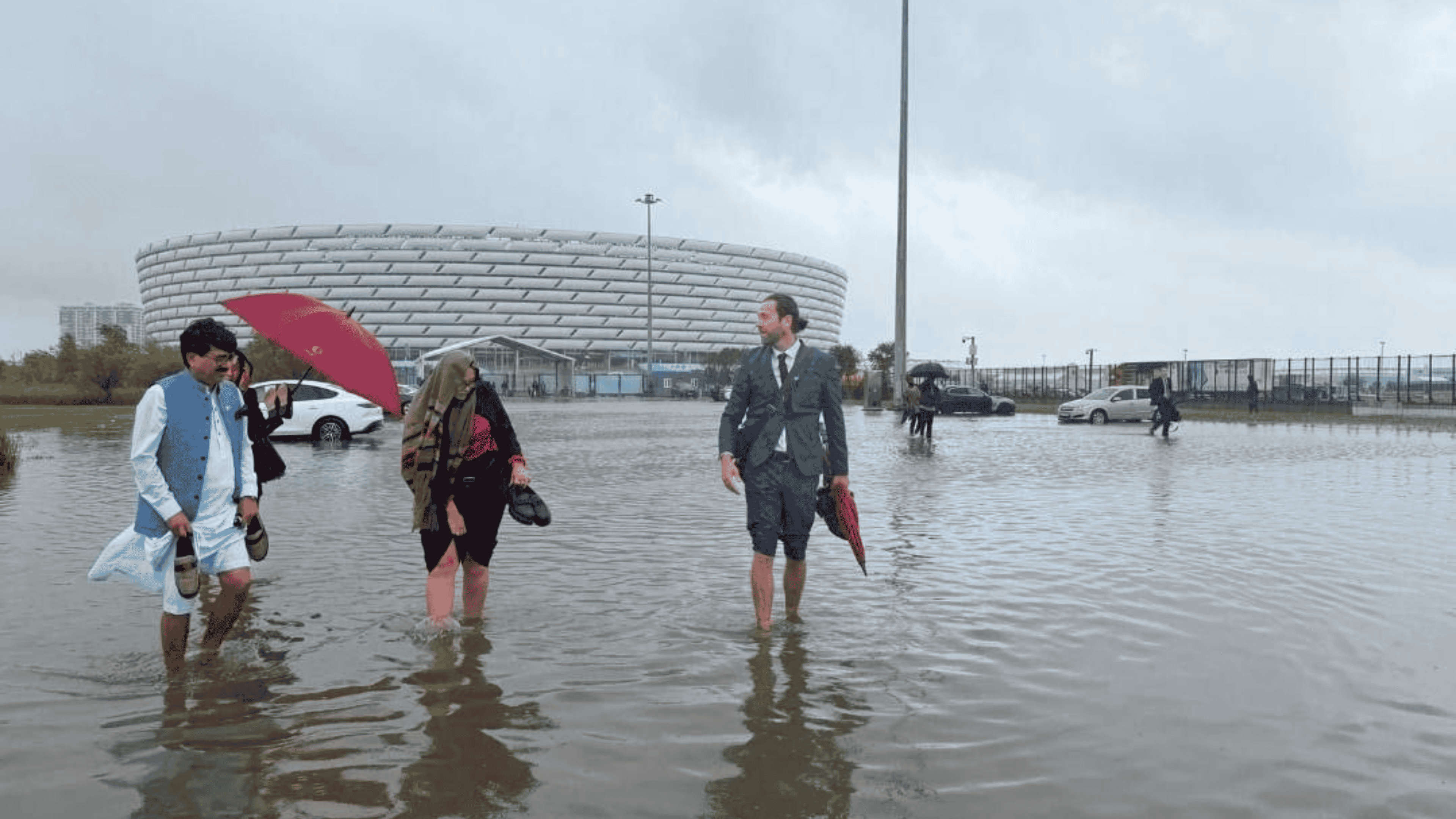
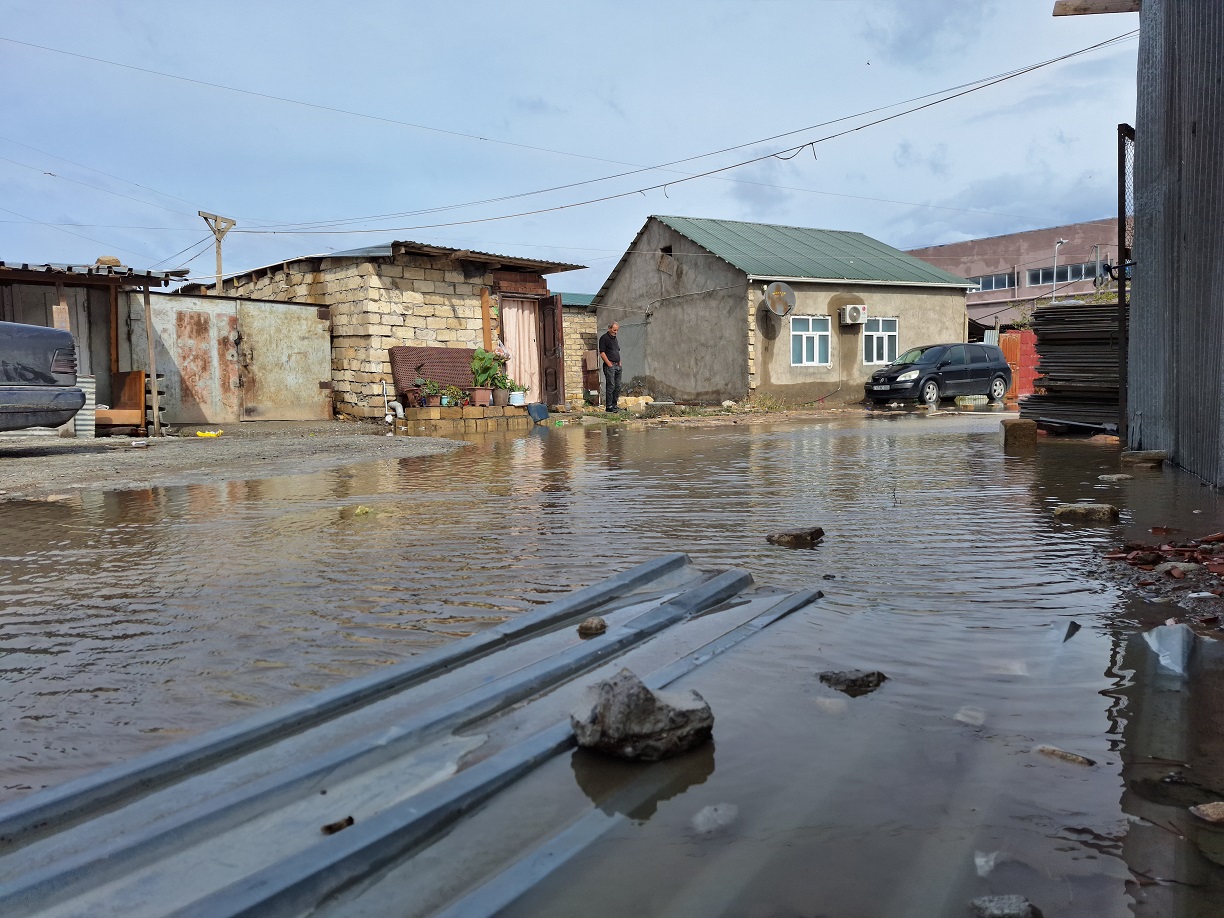
Heavy rain disrupted the opening ceremony of the 13th World Urban Forum (WUF-13) in Baku on 17 May, forcing participants from more than 180 countries to take shelter. Architects, urban planners and UN representatives had gathered at the city’s Olympic Stadium for the event.
Photo of the Day
Baku was hit by heavy flooding on the opening day of the the World Urban Forum 13.
Delegates in the forum venue got a firsthand look at the very urban planning and infrastructure challenges Baku. pic.twitter.com/DA2D1pM57X
— The Azeri Times (@AzeriTimes) May 17, 2026
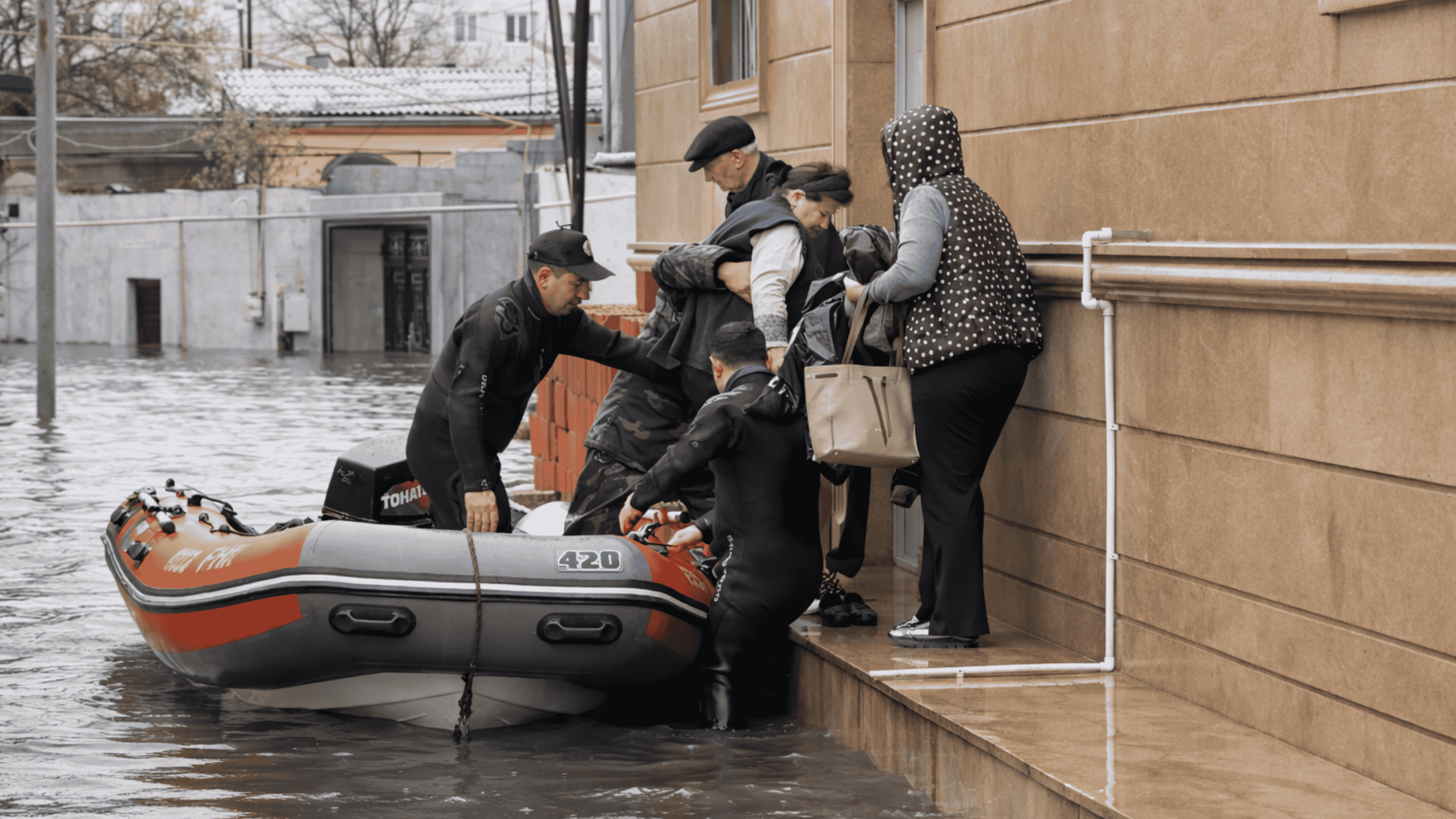
The opening ceremony of the World Urban Forum in Baku, planned as an outdoor event and featuring a flag-raising ceremony, took place amid record rainfall. Azerbaijan’s National Hydrometeorological Service had warned of heavy rain in advance, later reporting that 103mm of rain fell across Baku and the Absheron Peninsula within nine hours – more than five times the historical average.
For a forum held under the slogan “Housing for Peace: Safe and Resilient Cities and Communities”, it would be hard to imagine a more symbolic start. As delegates discussed urban resilience and safety, torrential rain in the Azerbaijani capital raised an old question once again: how resilient is Baku itself?
What is WUF-13?
The World Urban Forum was established by the UN in 2001, with its first session held in Nairobi in 2002. Since then, it has become UN-Habitat’s largest and most inclusive global platform on sustainable urbanisation and urban development.
The forum aims to bring together discussions on architecture and urban planning, as well as challenges arising from the intersection of rapid urbanisation with housing, climate change, inequality, infrastructure and governance. The theme of this year’s forum reflects those concerns. According to UN estimates, around three billion people worldwide currently live in inadequate housing conditions, 1.1 billion live in informal settlements, and more than 300 million people are homeless.
The scale of the session hosted by Baku is also significant. According to official figures released on 16 May, more than 40,000 participants from 182 countries had registered for WUF-13 — one of the highest participation levels in the forum’s history.
The programme includes 40 main sessions, around 350 partner events and the largest Urban Expo in the history of the forum. As such, Baku is hosting not just another conference, but one of the key gatherings in global urban diplomacy.
The real value of platforms like this lies in their ability to shape policy agendas, build partnerships between cities and, at times, bring neglected issues — long overlooked by national governments — back into focus.
Local and regional leaders came together today at the World Assembly of Local and Regional Governments at #WUF13 to help shape the future of urban governance, housing and sustainable development. pic.twitter.com/dg1Q1wASbL
— World Urban Forum (@WUF_UNHabitat) May 17, 2026
Why is Baku hosting the forum?
Baku’s selection as host also appears to have been deliberate. According to UN-Habitat, the city emerged as a finalist among eight bids and, in late 2023, secured the right to host the forum. In the official presentation, Baku was described as a place where heritage and innovation coexist, as well as an example of urban transformation.
Azerbaijan has also declared 2026 the “Year of Urban Planning and Architecture”. In a presidential decree, the White City project in Baku, the Heydar Aliyev Centre and more than 100 settlement plans in territories under Azerbaijani control are presented as examples of this strategy. On the official website of the White City project, it is likewise described as a model of social, economic and environmental sustainability.
Recent academic research has examined Azerbaijan as a state that systematically invests in hosting major international events. On the one hand, this is linked to efforts to strengthen the country’s international image and attract tourism and investment; on the other, it reflects attempts to create new sources of revenue, influence and legitimacy for a resource-based economy.
In other words, while WUF-13 is officially a forum on urban development, from a political economy perspective it can also be seen as a soft power instrument aimed at supporting resilience in a post-oil future. As the country looks beyond dependence on hydrocarbon revenues, it is seeking to turn global visibility into part of its long-term development strategy.
Between image and everyday urban reality
Baku itself, however, remains the strongest test of that narrative.
According to an official summary of a meeting chaired by President Ilham Aliyev on 12 January, the head of the state water resources agency, Zaur Mikayilov, said that water supply and sewage systems in Baku and across the Absheron Peninsula had largely been built by the late 1980s. Since then, however, the area covered by settlements has expanded by 2.6 times, while the population has grown by 2.1 times.
According to him, the operational lifespan of major pipeline networks has already expired, while the connection of stormwater drainage to sewage systems places additional pressure on infrastructure. He also said that “all rainwater systems that existed in Baku were converted into sewage collectors in the 1990s”.
Officials further reported that more than 1,600 structures were obstructing the operation of major networks and that, between 2014 and 2025, some lakes that had functioned as water retention basins were built over.
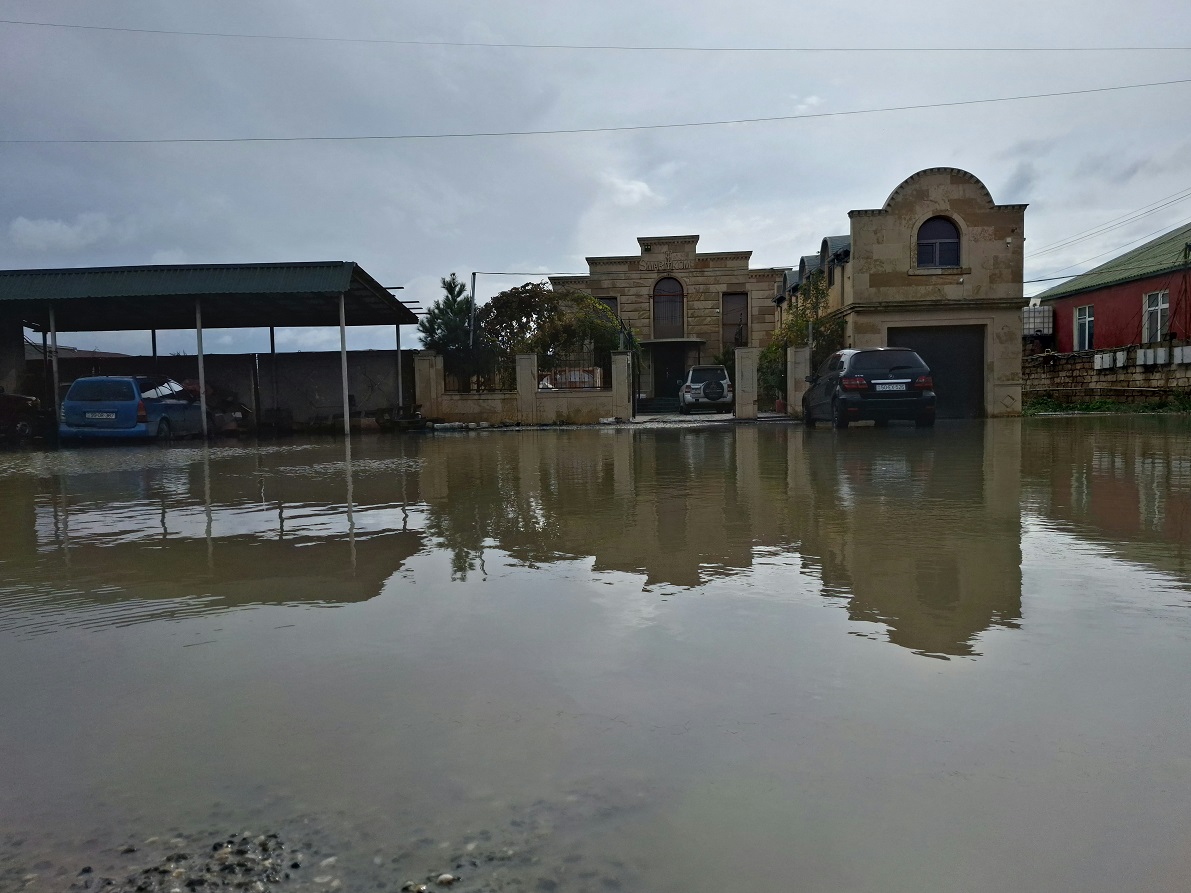
In other words, the issue is not only rainfall above historical averages. It also lies in a model of urban development that leaves little space for water.
The government’s state programme for 2026–2035 indirectly reflects these shortcomings. It includes plans to build 30 new reservoirs, develop new stormwater collectors on 30 streets, increase uninterrupted water supply coverage from 70% to 95%, and expand access to sewage services from 50% to 95%.
In that sense, WUF itself presents a certain irony. Baku is speaking to the world about resilient cities, while for many of its own residents, “resilience” is still measured by whether their shoes stay dry on a rainy day.
The real test begins after the forum
What happened does not make WUF meaningless. On the contrary, the forum could bring tangible benefits to Baku. That would require new partnerships, knowledge-sharing, investment, as well as a more serious approach to urban policy and stronger standards of accountability. Yet the real test for events like this begins only after the closing ceremony.
If polished presentations about a city do not translate into solutions to everyday problems, such forums risk creating little more than a showcase. But if events of this kind are capable of influencing how cities address their real needs, they may prove to be an important turning point for Baku’s future.
The heavy rain that hit the city on 17 May brought that question into sharp focus. The key issue is not how Baku wants to be seen by the world, but what kind of city it is capable of being for its own residents. It is here that the city’s true priorities become visible.
Baku’s Forum on Sustainable Cities
President Ilham Aliyev: We have a record number of participants at WUF13 Latest news from Azerbaijan
Money transfers to Georgia from abroad reached USD 318.06 million in April, marking a 7.6% (USD 22.5 million) increase compared to the same period last year, according to the latest data published by the National Bank of Georgia (NBG).
The largest share of money transfers continued to come from the European Union and the United States, which together accounted for 62,8% of total inflows, USD 199,82 million.
Transfers from EU member countries alone totaled USD 141.52 million, representing 44.4% of all inflows and a 6.7% increase compared to April 2025.
By country, the United States ranked first with USD 58.3 million (18.3%), followed by Italy with USD 53.42 million (16.8%). Other major sources included Russia with USD 42.06 million (13.2%), Germany with USD 28.61 million (8.9%), and Israel with 27.24 million (8.5%).
Armenia recorded the highest year-on-year growth, with transfers rising by 50% to USD 1.54 million. Significant growth was also reported from Tajikistan, up 46.4% to USD 1.07 million; Turkey, up 34.4% to USD 11.57 million; Israel, up 22.8% to 27.24 million; and Belgium, up 17.8% to 1.53 million.
By contrast, transfers from Kyrgyzstan fell by 39% year-on-year to USD 4.72 million, marking the sharpest decline among reporting countries.
Meanwhile, money transfers from Georgia totaled USD 35.2 million in April 2026, up 10.2% from USD 31.9 million in April 2025.
Personal remittances to Georgia account for 11.9% of the country’s gross domestic product (GDP), according to the World Bank’s 2024 data.
Also Read:
- 30/04/2026 – Georgia’s GDP Up 10.7% in March, Q1 Growth at 9.1%
- 16/04/2026 – Money Transfers to Georgia Up 9.8% in March, EU and US Lead
- 17/03/2026 – Money Transfers to Georgia Up 17% in February, EU and US Lead
- 16/02/2026 – EU, U.S. Remain Top Sources as Money Transfers to Georgia Rise 16.6% in January
Georgia’s pro-government TV channels – Imedi, Rustavi 2, and POSTV – accounted for more than three-quarters of all television advertising revenue of GEL 25.6 million (approximately USD 9.5 million) during the first quarter of 2026, according to independent media watchdog Mediachecker, based on official data from the Communications Commission (ComCom), the state media regulator.
Imedi TV and POSTV, which were the first and third-largest recipients with GEL 10.8 million (approximately USD 4 million) and GEL 1.9 million (approximately USD 709,000), respectively, were sanctioned by the United Kingdom on February 24 over “Russian disinformation.” It is unclear, however, whether the reported advertising revenue, which covers the January-March period, was received before or after the sanctions. Another pro-government channel, Rustavi 2, came as the second-largest recipient with GEL 7.9 million (approximately USD 2.9 million).
According to Mediachecker, among Imedi TV’s largest contributors were Meama, a coffee company, Anagi, a construction firm, and Avenue By Orbi, a hotel complex developed by Orbi Group in Batumi, each spending more than GEL 500,000 (approximately USD 187,000) on advertising with the channel.
Meanwhile, critical TV Pirveli and Formula TV received GEL 1.26 million (approximately USD 470,000) and GEL 978,200 (approximately USD 365,000), respectively. The continued disparity between the pro-government and government-critical channels’ advertising revenues comes as broadcasters in Georgia are banned from receiving foreign funding, except for commercial transactions, under amendments to the Broadcasting Law adopted in 2025.
Formula TV reported on May 4 that its broadcast had been partially suspended for part of its audience due to an outstanding debt to Stereo Plus, an operator that distributes the channel’s free-to-air signal via a digital multiplex to viewers without cable television. The channel said on May 13 that it resumed the disrupted broadcasting.
In March, TV Pirveli also said that its satellite broadcasting was halted due to unpaid fees. The shutdown in TV Pirveli’s case mainly affected viewers in regions and remote areas, where online streaming and on pay TV platforms were less available.
According to ComCom’s data, total television commercial advertising revenue reached GEL 25.6 million in the first quarter of 2026, marking a 72.7% increase compared to the same period last year. In January-March 2025, broadcasters received GEL 14.8 million in advertising revenue, with Imedi also leading the market at the time with GEL 6.1 million.
In December, Transparency International-Georgia, a local watchdog group, reported that “17 regional broadcasters” halted operations in 2025 due to financial difficulties.
Also Read: