
The Yerevan summit of the European Political Community was not merely a major international event for Armenia. It became a political symbol of a new stage in the struggle for influence in the South Caucasus. The holding of the 8th EPC summit in Yerevan on 4 May 2026, followed by the first-ever Armenia–EU summit on 4–5 May, effectively demonstrated that Europe no longer wants to remain a passive observer in a region long perceived as an area of Russia’s dominant influence. Brussels is making a demonstrative entry into the South Caucasus through Armenia — a country that, after deep disappointment with the Russian security system, is seeking new foreign policy anchors.
The official agenda of the summit appeared fairly neutral: resilience, democracy, energy and economic security, transport connectivity, and dialogue between European states and partners. Yet its real political meaning was much broader. Yerevan became the platform where Europe sought to show that Armenia is no longer viewed as a peripheral post-Soviet partner, but as a potential part of a new European architecture in the region. That is why the summit was important not only for Nikol Pashinyan, but for the entire South Caucasus.
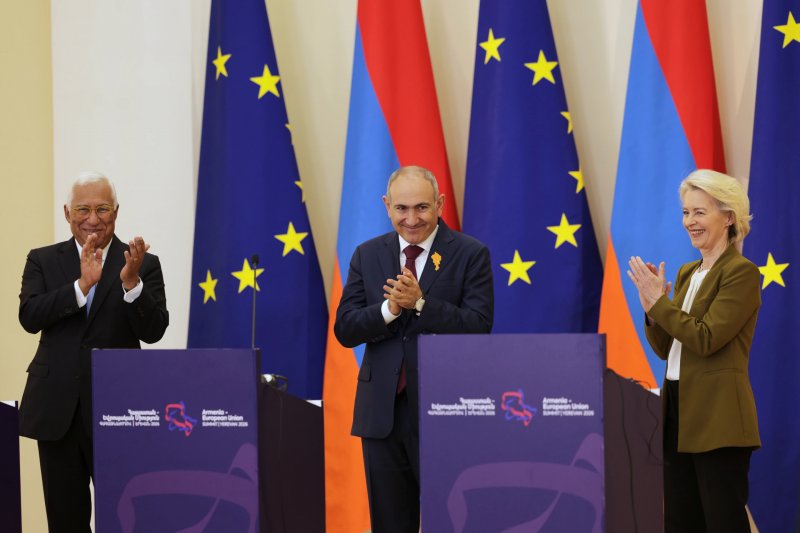
For Armenia, it was an opportunity to demonstrate that its turn toward Europe is bringing tangible results. Yerevan received not only verbal support, but also high-level political attention. European Council President António Costa and European Commission President Ursula von der Leyen arrived in Armenia, while French President Emmanuel Macron used his visit to Yerevan to openly support Pashinyan’s pro-European course. Against the backdrop of upcoming elections in Armenia, this carried clear domestic political significance: the West is showing Armenian society that the European path can offer the country new opportunities.
***
However, the key question is different: how solid is the economic foundation of this European engagement? The political optics in Yerevan looked impressive, but the figures reveal a more complex reality. The European Union is indeed an important partner for Armenia, but not yet its main one. According to the European Commission, in 2024 the EU was only Armenia’s fourth-largest trading partner, accounting for 7.5% of the country’s foreign trade. The EU accounted for 4.7% of Armenian exports and 9.7% of imports. In other words, Europe is important for Armenia, but economically it has not replaced either Russia or other key trading partners.
The trade imbalance is even more telling. Armenia mainly exports industrial goods and mining-sector products to the EU, while importing machinery, equipment, chemical products, vehicles, and other higher value-added goods from Europe. This means that economic relations between Armenia and the EU remain asymmetric: Armenia imports far more from Europe than it exports to it. Politically, Brussels speaks of rapprochement, partnership, and integration, but in trade terms Armenia still remains more of a small market for European goods than a major economic partner.
Source: AP
At the same time, recent trends show that the European direction is becoming increasingly important for Yerevan. According to ARKA, Armenian exports to the EU rose to $667 million in 2025, compared with $610.7 million in 2024. These are not large figures by European standards, but for Armenia the trend is politically significant. Against the backdrop of an overall decline in the country’s foreign trade, even moderate growth in exports to the EU becomes an argument in favour of further rapprochement with Brussels.
Meanwhile, Armenia’s overall foreign trade picture in 2025 was far from strong. According to Armenian statistics, the country’s foreign trade turnover stood at $21.4 billion, with exports at $8.4 billion and imports at $13 billion. Compared with 2024, Armenia’s exports fell by 36.1%, while imports dropped by 23.6%. This means that Armenia is entering a new stage of European rapprochement not from a position of strong economic footing, but as a country searching for new markets, investment, and external guarantees.
This is why Europe’s entry into Armenia should be viewed primarily as a geopolitical investment in the future. Today, the trade figures do not yet match the scale of the political declarations. But Brussels appears to be betting not on current volumes, but on the future transformation of the region. If Armenia is able to open communications, normalise relations with its neighbours, improve transport infrastructure, and become part of new routes between Europe and Asia, its importance for the EU could grow significantly.
It is no coincidence that one of the key documents signed during the first Armenia–EU summit was an agreement on a connectivity partnership. The EU also pledged up to €2.5 billion in investments under the Global Gateway programme, aimed at developing infrastructure, transport, energy, and digital links. This shows that Brussels sees Armenia not only as a political partner, but also as a potential element of the region’s future logistics map.
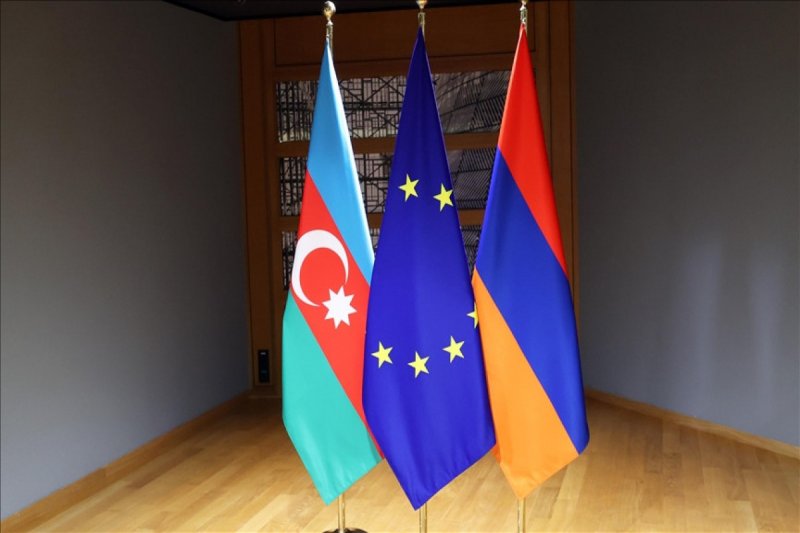
Yet this is where the main regional paradox emerges. Europe can make a demonstrative entry into the South Caucasus through Armenia, but without Azerbaijan, no full-fledged regional architecture is possible. Any serious transport scheme, energy logic, or model of sustainable security in the South Caucasus inevitably depends on Baku. Azerbaijan is already a key energy partner for Europe, a crucial participant in East–West routes, and, after restoring its territorial integrity, the main centre of power in the region.
Therefore, any attempt to build a European strategy solely through Yerevan may look politically impressive, but in practical terms it will remain limited. Armenia alone cannot become a full-fledged transport hub without open borders, sustainable peace, and normalised relations with its neighbours. Its geography can become an advantage only under conditions of regional agreement. Otherwise, European plans will remain attractive documents that sound good at summits but are difficult to implement on the ground.
Source: APA
For Azerbaijan, the EU’s current activity through Armenia looks ambiguous. On the one hand, Baku is interested in a stable South Caucasus, the development of communications, and the expansion of economic ties. On the other hand, if Europe advances its policy through one-sided support for Yerevan while ignoring Azerbaijan’s interests and the real balance of power, this will inevitably deepen mistrust.
Baku understands well that some European institutions, especially the European Parliament, have in recent years taken a sharply unbalanced position on issues related to Azerbaijan. Therefore, Brussels will have to prove that its new regional activity is aimed not at creating another dividing line, but at genuinely supporting peace and cooperation.
The French factor makes this picture even more complex. Paris has long viewed the Armenian track as an important part of its South Caucasus policy. Macron’s visit to Yerevan and his open support for Pashinyan reinforced the impression that France seeks to become Armenia’s main European patron. For Yerevan, this is a diplomatic asset. For Moscow, it is a signal of declining influence. For Baku, it is a reason to closely monitor whether European policy in the region will turn into an instrument of one-sided pressure.
The Yerevan EPC summit showed that Europe is returning to the South Caucasus more actively and more visibly than before. But for now, this entry has a clearly Armenian vector. For Armenia, it is a diplomatic success. For Pashinyan, it is an important political argument before a domestic audience. For Brussels, it is an opportunity to show that the EU can act not only within its own borders, but also in neighbouring strategic regions. For Russia, it is a clear signal that its monopoly of influence in Armenia has already been broken.
But the real test will begin not at summits, but after them. If Europe limits itself to symbolism, statements, and support for one side, its entry into the South Caucasus may only increase regional suspicions. If, however, Brussels acts pragmatically — taking into account Azerbaijan’s role, supporting a genuine peace process, investing in infrastructure, and proceeding from a balance of interests — the European presence could become a factor of stability.
Today, Yerevan has gained a powerful political image: European leaders, high-profile statements, investment promises, and symbolic recognition of Armenia’s new course. But the figures point to a more sober reality: Armenia’s trade with the EU remains limited, its economic dependence on the European market is modest, and regional communications will not function without the consent of its neighbours.
Therefore, Europe’s entry into the South Caucasus through Armenia is not an end point, but only the beginning of a larger game. The success of that game will depend not on how prominently the summit in Yerevan was staged, but on whether Europe can turn political demonstration into a real, balanced, and workable strategy for the entire region.
The post EU moves into the South Caucasus through Yerevan appeared first on azeritimes.com.