
Oh, what a surprise!
The ex-chief of a local Ukrainian military recruitment office was just casually strolling around with a cool million stashed away in shoe boxes.American taxpayers money at work….
😂😂😂😂#Ukraine️ #Russia #Putin #UkraineRussianWar#UkraineRussiaWar… pic.twitter.com/gY6SfdPIYZ— Richard (@ricwe123) February 26, 2024
Day: February 26, 2024
There are no more A-50s. Another one will fall, and round-the-clock duty will have to be stopped – @ChiefDI_Ukraine
The head of the Main Intelligence Directorate says that #Putin has only 6 working A-50s left. pic.twitter.com/JwS2QTE11e
— Lew Anno Suport #Ukraine 24/2-22 (@anno1540) February 25, 2024
Navalny’s ally: Before the murder of Alexei Navalny, his team agreed to exchange him for employee of the Federal Security Service of the Russian Federation Vadim Krasikov#navalny #russia #putin pic.twitter.com/v15eaHzMYx
— SOTA English (@sotavisioneng) February 26, 2024
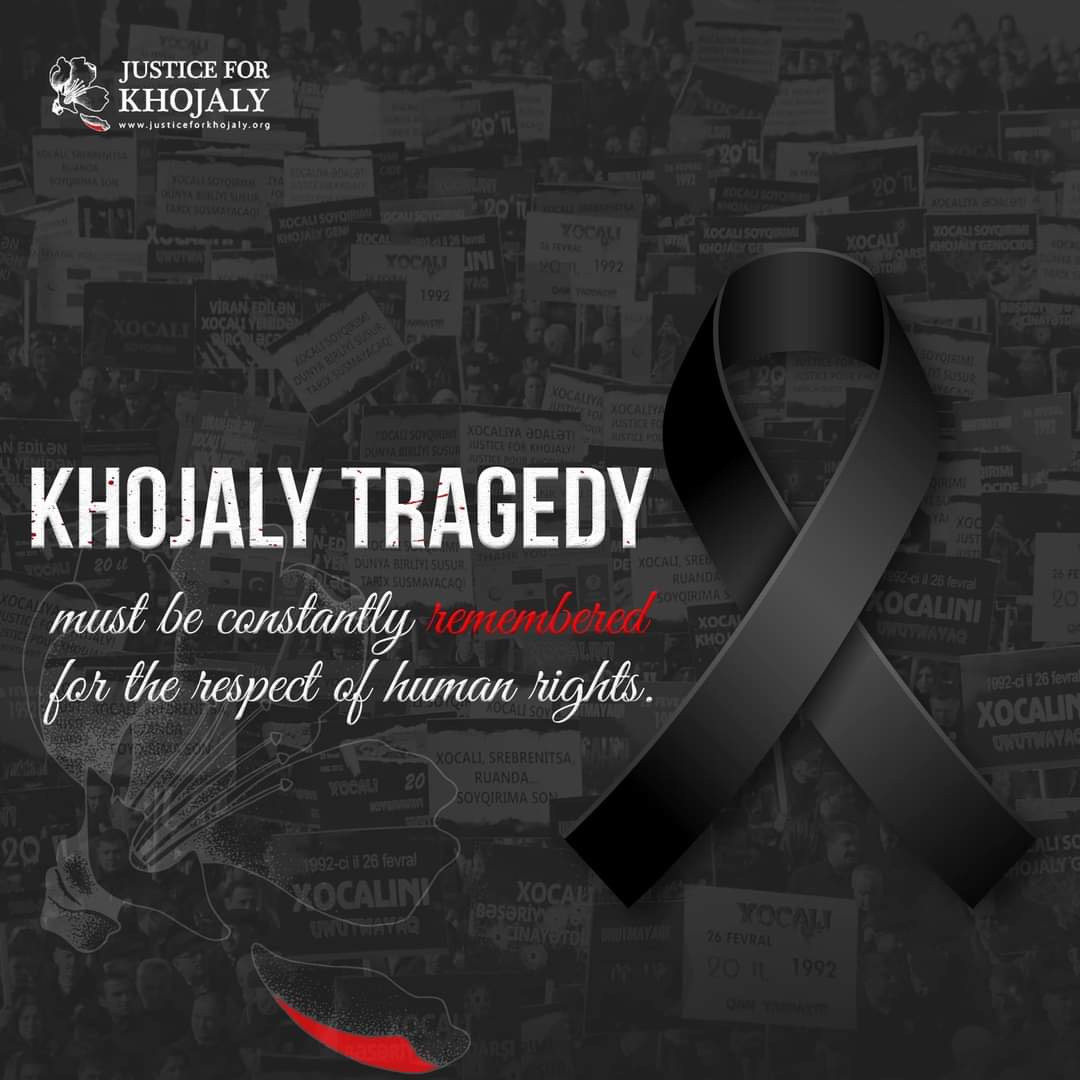
The occupation and ethnic cleansing of Azerbaijan’s Karabakh region and seven surrounding districts in the early 1990s by the armed forces of Armenia was a process of immeasurable atrocities and extreme violence. The Armenian leaders, having realized that more than 700,000 people based in this region would not be easily persuaded to flee and leave their homes, decided to force them into it. The ethnic cleansing of the region by the Armed Forces of Armenia in early 1990s resulted in numerous humanitarian tragedies over the years, but the most tragic event was the massacre of over 600 Azerbaijani civilians in Khojaly, a town with a population of seven thousand people, in bitterly cold morning of February 26, 1992.
Serzh Sargsyan, Armenia’s President in 2008-2018, once admitted that one major goal of the massacre of the civilians in Khojaly was to scare off other Azerbaijanis and forced them flee the region. Sargsyan, who was the commander of military forces of the separatist regime in Karabakh in 1992, told Thomas de-Wall, a British journalist, in an interview dated December 2000 that “Before Khojaly, the Azerbaijanis thought that they were joking with us, they thought that the Armenians were people who could not raise their hand against the civilian population. We needed to put a stop to all that. And that’s what happened.”
The Armenian Armed Forces committed ruthless war-crimes to reach this objective. More than 600 people, including 106 women and 63 children, were tortured and brutally murdered. The fate of 150 of them, including 68 women and 26 children, remains unknown to date. As a result of the massacre, 487 were injured, 8 families were completely destroyed, 130 children lost one and 25 children lost both parents. This massacre in Khojaly was documented in detail by journalists and later reported by the human rights organizations including the Human Rights Watch which described this tragedy as “the largest massacre to date in the conflict” between Armenia and Azerbaijan.
The occupation of Khojaly, a strategically important part of the Karabakh region of Azerbaijan and the town that hosted the only airport of the region, was a critical step in Armenia’s plans to seize the control over the surrounding districts. In the following months, a series of other towns and villages in the region were forcefully occupied, its residents were expelled and all the occupied areas were subject to relentless looting and destruction.
The Khojaly Genocide was documented by some journalists and later reported by various international human rights organizations, including Human Rights Watch (HRW). The HRW described the mass killing in Khojaly as “the largest massacre to date in the conflict” between Armenia and Azerbaijan. Following the Second Karabakh War (September 27-November 10, 2020) that ended with Azerbaijan’s victory and liberation of the occupied territories, the significance of the Khojaly tragedy has grown, with an increasing number of states and world parliaments recognizing it as genocide. To date, 17 national legislative bodies, 24 U.S. states, the Organization of Islamic Cooperation, and the Organization of Turkic States have adopted resolutions condemning the massacre and categorizing it as both a crime against humanity and an act of genocide. In its judgment of 22 April 2010, the European Court of Human Rights arrived at an important conclusion with respect to the crimes committed in Khojaly, denouncing the behavior of those carrying out the atrocities as “acts of particular gravity which may amount to war crimes or crimes against humanity”.
Azerbaijan’s Ministry of Foreign Affairs pointed out in its statement on the occasion of the 30th anniversary of the Khojaly genocide that, “The indiscriminate killings of civilians at Khojaly stemmed from a policy of ethnic hatred and racial discrimination against Azerbaijanis at the state level in Armenia. It led to the killing of innocent people based simply on their ethnicity. The crimes committed at Khojaly were an integral part of Armenia’s policy of systematic violence against Azerbaijanis. The Khojaly massacre and other crimes committed by Armenia in the course of its aggression against the Republic of Azerbaijan, including war crimes, crimes against humanity and genocide, constitute serious violations of international humanitarian and human rights law. These include violations of the Convention on the Prevention and Punishment of the Crime of Genocide; the Convention against Torture and Other Cruel, Inhuman or Degrading Treatment or Punishment; the International Convention on the Elimination of All Forms of Racial Discrimination and others.”
2024 is the first year that Azerbaijan commemorates the victims of the Khojaly genocide with the town of Khojaly liberated. Azerbaijan’s anti-terror operations in September 2023 dismantled the separatist regime in the Karabakh region and brought liberty back to the territories that remained under the illegal control of this regime following the Second Karabakh War. In the aftermath of the liberation of Azerbaijan’s occupied territories and the resolution of the conflict, Armenia and Azerbaijan are now unprecedentedly close to peace and reconciliation.
The recent peace process between the two countries has highlighted the need for accountability for the atrocities committed against Azerbaijani civilians. However, instead of offering apologies for their actions, Armenia continues to pursue policies destructive to regional peace and security. The reality is that there can be no alternative to recognizing past tragedies and holding those responsible for their actions. This is the only way to establish lasting peace, security and reconciliation between the two countries. Khojaly, a tragic genocide that occurred over 30 years ago, is still waiting for justice. It is time for Armenia to take responsibility and make amends for its war crimes. Only then can the two countries move forward towards a peaceful future.
https://eng.ghn.ge/news/16602-azerbaijan-commemorates-the-khojaly-genocide?fbclid=IwAR3CAGTDygETg-z3B4wqtirJaHNNBFx2li1Zapg4wDd5XlTGvCCmkN0GM6s
The article is also available in the Georgian, Latvian, and Swedish languages.
https://www.la.lv/azerbaidzana-piemin-hodzali-genocidu
https://diplomaticworld.se/2024/02/25/azerbaijan-hogtidlighaller-minnet-av-offren-i-folkmordet-i-khojaly/

Azerbaijan will host the 2024 UN Climate Change Conference (UNFCCC COP 29) for the first time in the region from November 11- 22, 2024. One can ask a question what is the COP, and why is the COP important? It is worthwhile here to note that the COP is the supreme decision-making body of the Convention. All States that are Parties to the Convention are represented at the COP, at which they review the implementation of the Convention and any other legal instruments that the COP adopts and take decisions necessary to promote the effective implementation of the Convention, including institutional and administrative arrangements. It is an enormous opportunity to bring heads of state and governments, civil society organizations, business, and international institutions together in the South Caucasus to discuss climate change, measures to accelerate the implementation of the Paris Agreement, and focus on long-term climate strategies and goals.
The host country of the COP normally rotates among the five United Nations regional groups (Africa, Asia-Pacific, Eastern Europe, Latin American and the Caribbean, and Western European and Others), with regional group members determining which country from their region will make an offer to host the conference. The first COP was held in Berlin, Germany from 28 March – 7 April 1995. The Parties started long negotiations and consultations before delegates with vastly different priorities and concerns came to agreement on what many believed to be the central issue before COP1. Delegates also reached agreement on a number of other important decisions, including the establishment of a pilot phase for the implementation of joint projects, agreement that the Permanent Secretariat should be located in Bonn, and decisions on the budget for the Secretariat, financial procedures and the establishment of the subsidiary bodies. This year’s summit (COP29) will be held in Baku, Azerbaijan after winning backing from other Eastern European nations. Even though Azerbaijan is rich in fossil fuels, and its energy mix is heavily concentrated in fossil fuels (oil and natural gas), the country supports a sustainable energy future and a green economy.
The 2024 was declared “Green World Solidarity Year” in Azerbaijan, and it is an important measure to demonstrate Azerbaijan’s commitment to environmental protection and climate action. Baku’s high-profile role as an experienced country in hosting international events supports Azerbaijan’s ultimate goal of hosting such an important event in Baku. Moreover, Azerbaijan has proved itself as a reliable energy partner and a responsible member of the international community in the fight against global warming. Even though the country is rich in fossil fuels, and its energy mix is heavily concentrated in fossil fuels (oil and natural gas), Azerbaijan supports a sustainable energy future and a green economy.
To this end, Azerbaijan has already started the green transition process, and after signing the Paris Agreement on climate change, the country aims reducing greenhouse gas emissions (GHG) by up to 35% by 2030, and 40% by 2050. Moreover, developing renewable energy sources in the country became a key part of Azerbaijan’s clean energy strategy. Renewable energy sources are expected to make up 30% of Azerbaijan’s electricity generation by 2030. Such potential of the country would help the country save natural gas for exports as well as reduce the country’s GHG emissions to meet its Paris Agreement commitment.
Last year, Azerbaijan accelerated the process of development of green energy, therefore the country signed several important green energy agreements with the UAE’s global renewables company Masdar, ADNOC, ACWA Power, TEPSCO, bp, and China Gezhouba Group Overseas Investment to implement renewable energy projects in the country. Also, transforming Azerbaijan into a “green energy hub” is a key component of the country’s energy policy. Karabakh, East Zangezur, and Nakhchivan have already been declared a green energy zone. Azerbaijan’s green growth strategy and green energy projects will transform the country into a “green energy hub” in the region to supply renewable energy sources from the South Caucasus to Europe.
It should be noted that in COP28 in Dubai, the parties discussed many important issues and agreed on the “loss and damage” fund that could start handing out money. During the Dubai COP28 discussions continued on setting a ‘new collective quantified goal on climate finance’ in 2024, taking into account the needs and priorities of developing countries. COP29 in Baku will be an important platform to support international cooperation to act on climate change, implement the Paris commitments, and focus on long-term goals.
To sum up, the COP29 summit will be the biggest international event ever hosted by Azerbaijan, and in order to plan and organize this important event successfully, President of the Republic of Azerbaijan Ilham Aliyev signed a decree on the establishment of the Organizational Committee. The COP29 will contribute positively to infrastructure development and improvements, upgrading communication infrastructure, providing digital technology, and last but not least, supporting the tourism sector in Azerbaijan. At the same time, COP29 may support regional peace in the South Caucasus, as the end of war between Armenia and Azerbaijan opens up new opportunities for regional economic integration and durable peace. In the end, COP29 may turn out to be an important opportunity for Azerbaijan to support a wider use of renewable energy sources, and speed up the green transition.
https://news.az/news/azerbaijan-speeds-up-the-green-transition-by-hosting-the-cop29-un-climate-change-conference-analytics?fbclid=IwAR3O8E1N7-bW8G1HYpmH3IRTFSgKlgdgiWiZDAFsYVUJD2XFymi3HgRPVDg