
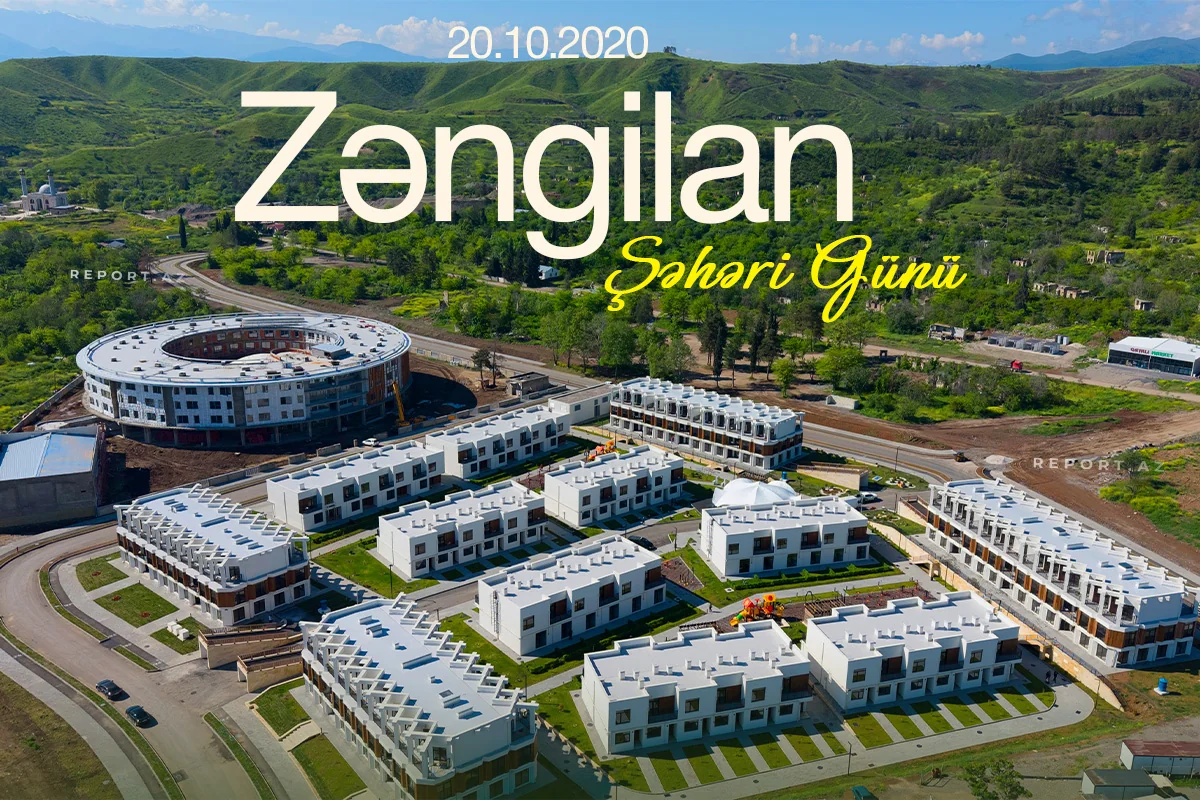
Today marks six years since the liberation of Zangilan.
Report recalls that on October 20, 2020, Azerbaijani President and Commander-in-Chief Ilham Aliyev announced in an address to the nation that the city of Zangilan and six more villages of the district – Havali, Zarnali, Mammadbayli, Hakari, Sharifan and Mughanli – had been liberated from occupation.
The battles for Zangilan were among the most successful operations conducted by the Azerbaijani Army along the Araz River during the Second Karabakh War and ended in victory.
Under decrees signed by President Ilham Aliyev on December 25, 2020, and June 24, 2021, a group of servicemen were awarded the “For the Liberation of Zangilan” medal for taking part in combat operations to liberate the district and demonstrating personal courage and bravery.
Following the liberation, reconstruction and restoration work has continued in Zangilan alongside mine-clearance operations.
Infrastructure restoration is being carried out across the district, and life has already returned to Zangilan.
The return of former internally displaced persons to the liberated territories began with this district.
Former IDPs have returned to Aghali village, which was rebuilt under the smart village concept. The resettlement of residents in their native village began in July 2022 and is continuing.
The first airport in the district was also constructed following the liberation.
The inauguration of Zangilan International Airport took place on October 20, 2022, and the airport was granted international status.
Under a decree signed by President Ilham Aliyev on July 31, 2023, Zangilan City Day is celebrated annually on October 20.
Zangilan district is located in the south of Karabakh, on the border with Iran.
The district covers 707 square kilometers and has a population of 45,000, compared with 39,000 in 1993.
It lies on the southern side of the Lesser Caucasus Mountains, along the Araz River.
The area is known for its distinctive natural landscape, including steep cliffs, tulip-covered plains, forests and shrubland.
The district mainly has a moderately warm climate.
The Araz, Okhchuchay, Hakari and Basitchay rivers flow through the district.
These rivers, which carry abundant water throughout the year, were used not only for household and agricultural purposes but also in various other sectors.
The district also has deposits of construction stone, limestone raw materials, gold, black marble and other mineral resources.
Zangilan district was occupied by the Armenian Armed Forces on October 30, 1993.
At the time of the occupation, the district consisted of one city, five settlements and 79 villages.
Alongside crop production, livestock farming had also been developed in Zangilan.
According to the article, during the 27 years of occupation, Zangilan’s resources were devastated, its infrastructure was destroyed and its settlements were subjected to vandalism.
Homes and historical monuments in the district were completely destroyed, while trees were cut down.