Categories
Selected Articles

The New Kings Of Jihadist Terrorism


caucusus

The vicious war against the Armenian Republic of Artsakh (Nagorno-Karabagh) and Armenia by Azerbaijan, Turkey, and thousands of their jihadist terrorists has passed the one month mark.

The jihadis’ presence, which includes ISIS, is consistent with the debauched political cultures and national ambitions of Azerbaijan and Turkey.  It also tells us that the U.S./NATO/EU stance towards those countries continues to be dangerously passive.

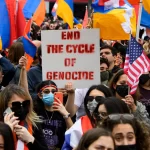
Just days ago, right in our nation’s capital, Azeri demonstrators chanted “jihad, jihad, jihad” and flashed the hand signal of Turkey’s homicidal, neo-fascist Grey Wolves.

It’s not surprising.  Azerbaijan and Turkey are longtime Turkic allies of jihadist terrorists.

Turkic Jihadist Terror

  • In the early 1990s, Azerbaijan deployed thousands of jihadis and terrorists, including Afghan Mujahedin, Chechens, and Grey Wolves against Artsakh’s Armenians who had voted for self-determination. Turkish army officers also took part.
  • Al-Qaeda cells in Baku, Azerbaijan helped to plan the 1998 bombings of U.S. embassies in Kenya and Tanzania. A dozen Americans and 212 others were killed.
  • The U.S. Military Academy’s Combating Terrorism Center reports that ISIS ranks have included over 900 Azerbaijanis and 7,400 Turks.
  • Ahmet S. Yayla, Turkey’s chief of counterterrorism from 2010-13, wrote: “Turkey was a central hub for the travel of over 50,000 ISIS foreign fighters, and the main source of ISIS logistical materials … making Turkey and ISIS practically allies.”
  • Secret wiretaps revealed that Turkey has supplied ISIS in Syria via Ilhami Bali, codenamed Abu Bakr, a 36-year-old Saudi-born Turk.
  • Columbia University has issued two valuable studies: ISIS-Turkey Links and Turkey-ISIS Oil

Today’s Turkic Jihadist Terror

  • Since September, Azerbaijan and Turkey have brought in ISIS commander Sayf Balud, the Hamza and Sultan Murad Brigades, Syrian terrorists, and thousands of other jihadis to battle Armenians. Many were present even before September.
  • Some of the jihadis had committed atrocities against Christian Armenians and Assyrians, Kurds, Yazidis, and others in Syria and elsewhere.
  • Azerbaijan is using some jihadis as human shields for its soldiers. Others are thrust into battle while Azeris point guns at their backs to prevent retreat.
  • Armenian forces have dealt them severe blows. One jihadi warned, “Jihadi, don’t come, we have been deceived, everything is a lie.  This is a meat grinder.”

Artsakh’s Ordeals

In the early 1920s, Soviet dictator Josef Stalin transferred the ancient Armenian territory of Artsakh (96% Armenian) to Azerbaijan to indulge Turkey.  No country/people named Azerbaijan/Azeri had ever existed before 1918.

Artsakh’s Armenians subsequently suffered brutal repression, deportations, and mass murders under Soviet Azerbaijan’s scimitar.  By 1988, Armenians had been reduced to 76% of the population.  All this was due to raw, ethno-racial, Azeri fanaticism.

Artsakh’s Armenians voted in 1988 and 1991 for self-determination and independence from Azerbaijan according to Soviet law and then international law.  Armenians won the ensuing war.

Note that Azerbaijan claims not only Artsakh but Armenia too.

Artsakh and Armenia are reformist democracies.  Dictatorial Azerbaijan is light-years away from that.  Turkey is a similar political and human rights disaster.

If you lived in Artsakh, would you ever agree to Azeri rule?  Of course not.

America’s Global War for Terror

The Global War on Terror (GWOT) has been American foreign policy’s pièce de résistance since 2001.  Supposedly, therefore, regimes that use jihadis/terrorists against civilized people should become pariahs.

Yet American administrations and Congress have acted largely deaf, dumb, and blind regarding Turkey and Azerbaijan’s support for jihadis/terrorists.

In 2016, I presented evidence to Richard M. Mills, U.S. Ambassador to Armenia, that Turkey supported ISIS.  He foolishly lied and denied it all.

The U.S. (and Europe) fawn over Azerbaijan’s gas and oil deposits and westbound pipelines despite its sickening record on jihadis and human rights.

Our government lies about our GWOT, but we remain silent.  What kind of people are we?

Rename the GWOT to GWFT: the Global War for Terror.

Azerbaijan has signed and is violating the “UN Convention against the Recruitment, Use, Financing and Training of Mercenaries.”  Neither the UN, State Department, nor Congress has spoken up.

America provides “counterterrorism” assistance to Azerbaijan.  Thus, Americans pay it to fight terrorists while Azerbaijan turns around and hires terrorists.  This is sick stuff in which we as Americans are complicit.

Now consider the jihad against Armenian/Armenia/Artsakh by Israel and the Jewish American lobby.

The Kosher Jihad

Countless Jewish academicians, writers, human rights advocates, and elected officials have supported Armenian Genocide recognition and helped Armenians in other ways.  Not so for top Jewish organizations such as the ADL, AIPAC, AJC, and JINSA.

For decades, they have diminished/denied the Armenian Genocide and colluded with Turkey and Israel to defeat Armenian Genocide resolutions in Congress.  The ADL and AJC have relented a bit, though insincerely and only under pressure.

For years, Israel and most of these organizations, led by AJC, have supported Azerbaijan.

Azerbaijani dictator Ilham Aliyev has given his country’s highest award to AJC Executive Director David Harris.

Israel demands worldwide recognition of and legislation on the Holocaust but refuses to recognize the Armenian Genocide.

Israel is probably Azerbaijan’s biggest weapons supplier.  Israeli cluster bombs — usually banned under international law — are killing Artsakh’s civilians.

As Azerbaijan runs short of weapons and ammo, Israel is now sending more.

There are 24 righteous Armenians in Israel’s Yad Vashem Holocaust memorial but no Azeris.  No problem, bomb the Armenian goyem anyway using Israeli weapons.

Meanwhile, scores of Jewish and Israeli writers defame Armenia and Armenian Americans.

Israel always complains it’s the victim of terrorists and jihadis.  Now it’s on the same side as the jihadis and terrorists in Azerbaijan.

Countless Americans, including Christians, sell their souls to the Jewish lobby for political expediency, money, and career advancement and dare not whisper a word of dissent. You know who you are.

Meanwhile, Armenian Genocide 2.0 beckons.

Artsakh’s ombudsman correctly notes that “various representatives of the international community are either blind or incapable.”

How long will this remain so?

Much of the author’s work can be found at http://www.armeniapedia.org/wiki/David_Boyajian.
SIGN UP FOR COUNTERCURRENTS DAILY NEWSLETTER


Categories
Selected Articles

Azerbaijan concerned over alarming surge in hate speech: Minster


188290-0528906.jpg

Azerbaijan is convinced that promoting tolerance and non-discrimination is one of the essential elements in ensuring the protection of the rights of people and building sustainable societies, the country’s foreign minister said at the 54th session of the UN Human Rights Council.

Minister Jeyhun Bayramov noted that Azerbaijan is concerned about the growing trend of intolerance and discrimination, Islamophobia, other religious misconceptions, and an alarming surge in hate speech.

“These attitudes pose a grave threat to our societies’ harmony, security, and stability. Burning and desecrating the Holy Quran in some parts of the world under the guise of freedom of expression is inadmissible and constitutes a hate crime. Effective prevention and countering of these phenomena require joint international efforts,” he said.

With the centuries-long tradition of diversity and multiculturalism, Azerbaijan is renowned for its efforts and contributions to promote intercultural and interfaith dialogue, the top diplomat added.

Minister Bayramov stressed that Azerbaijan acknowledges the crucial role of the United Nations in promoting human rights through cooperation and dialogue among its Member States.

“As we mark the 75th anniversary of the Universal Declaration of Human Rights, Azerbaijan remains actively engaged in cooperation and constructive dialogue with the U.N. human rights bodies and mechanisms,” he said.

News.Az 


Categories
Selected Articles

Armenian Anarchist Group Rises in Besieged Artsakh


04b519_e3cdb80f284840e08bf228772b8d177fm

What You Need To Know: 

The ongoing Azerbaijani blockade of food, fuel, and medical supplies from reaching the Armenian statelet of Artsakh, also known as Nagorno-Karabakh, and home to around 120,000 people has today triggered the creation of a new anarchist group – Anarchist Artsakh. 

The blockade dates back to Soviet-era territorial claims both Azerbaijan and Armenia have to the Nagorno-Karabakh region, which is situated inside Azerbaijan, but in which, ethnic Armenians make up 95 per cent of the population. Following the collapse of the Soviet Union in 1991, both nations took up arms against one another over the area.

The first Nagorno-Karabakh conflict, (1991-94) left Armenia with the majority of the autonomous zone. Following a 2010 strategic partnership agreement with Azerbaijan Turkey has become a key player in the conflict, supplying Azerbaijan with military aid when fighting broke out again in July 2020. This material support, alongside the aid of Syrian mercenaries, enabled Azerbaijan to recapture swaths of the Nagorno-Karabakh before a ceasefire was brokered by Russia in November 2020. The gains made by Azerbaijan in 2020 left Nagorno-Karabakh surrounded. 

Anarchist Artsakh:

The group, in their first post on Telegram stated, “Comrades! A new front of anarchist resistance is maturing. This time Artsakh. For almost a year now, the fascist government of Azerbaijan has kept the local Armenian population under complete blockade, seeking forced submission from the Armenians. 

The dictatorial power of Ilham Aliyev is actually starving our people in order to subjugate them, assimilate them and deprive them of the freedom for which we have fought for a very long time. In the territories occupied in 2020, the occupiers are destroying our cultural objects in order to erase our traces from our own lands. 

We already had the sad experience of living under the rule of the Azerbaijani leadership in the 1980s – 1990s. We will no longer allow the fascists to enslave our people. We – Armenian anarchists – will fight for the freedom of our (and not only our) people. Most likely, the Azerbaijani tyrants will soon begin a ground operation on the territory of Artsakh. We are trying to organise ourselves to resist the onslaught of the imperialists.

Comrades! We ask you to support us in our fight. After all, solidarity is our main weapon. Help spread the word about the chaos going on. Glory and freedom to all oppressed peoples!” 

The current siege is the result of the December 2022 blocking of the Lachin Corridor, a lifeline between Armenia and Artsakh by Azerbaijan, which claims that Armenia has been using the corridor to smuggle arms. 

Russian Mediation?: 

However, on early Tuesday, a truck carrying Russian humanitarian aid was given access through Azerbaijani territory to the besieged region’s capital, Stepanakert. According to DW, the Russian Foreign Ministry claimed the aid package represents “a first step” to resolving the crisis. It is unclear if this move by Russia will satisfy the clearly frustrated members of Anarchist Artsakh. 


Categories
Selected Articles

What is Pashinyan’s EU mission group looking for in region?


1117432.jpg

What and whom Armenia serves is still opaque. The
pseudo-independent state, which once had ninety percent of its
border territory under the control of Russia, today is gradually
breaking away from the influence of Russia and trying to hand over
its territories to the West.

We would not be wrong if we say that 2020 is the year when
Azerbaijan restored its territorial integrity and simultaneously a
period that political players swapped over Armenia. The 30-year
occupation seemed to have led Armenia into a deep sleep under the
shadow of Russia, and its inability to wake up from that sleep has
kept it far off the political ground in the region. In addition,
Armenia’s lack of appreciation for the opportunities it had and its
short-sighted behavior left it in a desperate situation. The
question is, why has Armenia never been able to benefit from the
fact that it is surrounded by countries with strong economies in
the South Caucasus, such as Azerbaijan in particular?

Although the answer to this question needs an in-depth
interpretation, it can be enough to consider the events happening
today. If we look at recent events, we can witness that Armenia has
plunged into an extremely complex political game. Especially by
partially skipping the Russian factor, Pashinyan seems to have
given a bit more privilege to the Western forces. As they look more
active in the South Caucasus today creates the impression that
Yerevan is being played on a gambling table. Being in a confused
state in political games, Armenia backs the wrong horse; completely
ignores the priorities for the future of its country, and is
currently trying to turn the region into a battleground between the
West and Russia.

After the full operation of Azerbaijan’s Lachin State Border
Checkpoint, Armenia began to seek refuge in the West. So, starting
from January 2023, the European Union Mission group, whose real
mission is unknown, suddenly appeared in the region. First, under
the guise of humanitarian aid to Armenian minority in Garabagh, and
then by misinterpreting Armenian armed provocations, the mission
group began to expand its activities.

Yesterday, the mission group celebrated the opening of its base
with a new name – European Union Mission in Armenia (EUMA) in the
town of Ijavan, Tavush province of Armenia. It is noted in the
information that this is already the 5th base of EUMA opened in the
territory of Armenia so far. I wonder what the head of the mission
Mr. HoM Markus Ritter intends to do in Armenia by opening so many
bases.

If the mission group or EUMA has any interest in the
conventional borders between Azerbaijan and Armenia, then it would
be a more objective step for some of their representatives to come
to Azerbaijan as well, to observe the situation from the flipside
of the event. If we are talking about eliminating tension and
ensuring security in the region, there is an answer here – Armenia
and Azerbaijan, as two independent states, are capable of ensuring
peace between themselves. However, there is an exception, which is
Armenia’s taking an adequate step… But what does EUMA do for
this? Is the mission group really taking purposeful steps for peace
talks to take place?

Two days ago, after a long wait, a truck with food belonging to
the Russian Red Cross Committee on the Aghdam-Khankendi route was
able to enter Khankendi. This plan was actually an unambiguous
solution to some groundless disputes surrounding Lachin BCP.
Unfortunately, the European Union mission group and many
representatives of the West expressed their “true intentions” by
showing a stronger and pro-Armenian position regarding the border
with Lachin. In particular, the ICRC’s involvement in political
rather than humanitarian issues has made it somewhat of a spy for
the West. If the separatists in Garabagh did not accept the food
sent from Azerbaijan, it was an internal matter, but the fact that
the Western forces did not let in the food sent from Russia this
time began to look like the West was deviating from its
mission.

It means that the West intends to put pressure on Russia through
Armenia, and this means that external forces want create a battle
ground for themselves in the region. As I mentioned earlier,
Armenia completely confuses internal politics and tries to create
tension instead of peace in the region. As a tool in the hands of
certain forces, it deliberately exaggerates the issue of the
Armenian minority living in Azerbaijan’s Garabagh economic region
and deliberately focuses the attention of the outside audience on
the region.

In fact, this is the helplessness and incompetence of Pashinyan,
who cannot find a common language with the other side, i.e.
Azerbaijan. All these are factors that lead to his repeated lies
and denial of what he says. Pashinyan chooses not just what is in
front of him and what is available to him, but on the contrary, he
chooses the means that is wide of the mark and can put his country
and the region in danger. The reason is simple – Armenia’s lack of
perspective and political agenda and inability to see the error of
its ways and most importantly, yet finding hard to recover from the
trauma of 2020. These factors still seriously prevent Armenia from
choosing the right path

—

Elnur Enveroglu is AzerNews’ deputy editor-in-chief, follow him
on @ElnurMammadli1

Follow us on Twitter @AzerNewsAz


Categories
Selected Articles

Kidnapped Nagorno-Karabakh students reportedly released after 10-day detention in Azerbaijan


Kidnapped Nagorno-Karabakh students reportedly released after 10-day detention in Azerbaijan
15:44, 7 September 2023

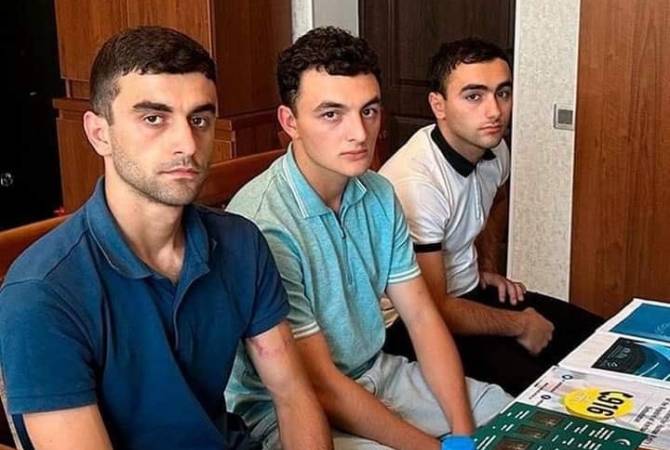
YEREVAN, SEPTEMBER 7, ARMENPRESS. The Azerbaijani media have reported the release of the three Nagorno-Karabakh students who were kidnapped by Azeri border guards while traveling to Armenia through Lachin Corridor in late August. 

The three men were kidnapped and subsequently jailed on August 28. Azeri authorities had announced that the men would be jailed for 10 days for allegedly “dishonoring” the Azeri flag.

The kidnapping was condemned by the Armenian Foreign Ministry as a gross violation by Azerbaijan of the “Trilateral Statement of November 9, 2020, legally binding Orders of the UN International Court of Justice and open contempt for the unequivocal and targeted calls of the international community, including voiced by members of the UN Security Council.”


Categories
Selected Articles

Azerbaijan eager to explore more opportunities


pak-azerbaijan1683178499-0.jpg


ISLAMABAD:

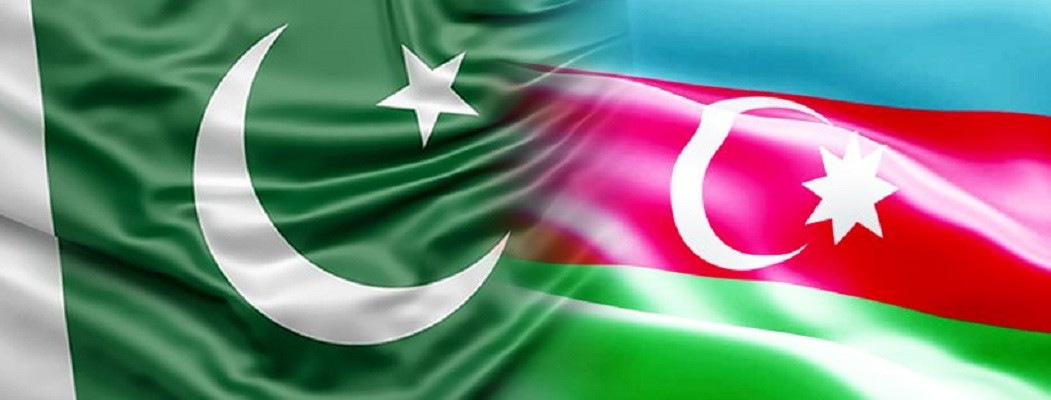
Pakistan and Azerbaijan reaffirmed their commitment to enhancing collaboration in multiple areas, including trade, energy, and the economy. Caretaker Minister for Planning, Muhammad Sami Saeed, met with Azerbaijan’s ambassador to Pakistan, Khazar Farhadov, to discuss the positive trajectory of their bilateral relations.

Both sides expressed their determination to bolster ties, focusing on trade, connectivity, energy, tourism, and Information Technology. Ambassador Farhadov highlighted the positive impact of direct flights between Azerbaijan and Pakistan since 2022, with approximately 50,000 Pakistani tourists visiting Azerbaijan that year. He also noted the convenience of Azerbaijan’s online visa system, which processes visas for Pakistani tourists in just three hours.

Published in The Express Tribune, September 13th, 2023.

Like Business on Facebook, follow @TribuneBiz on Twitter to stay informed and join in the conversation.


Categories
Selected Articles

EU High Representative: bloc wants to see Georgia succeeding on European path


eu1.jpg

Josep Borrell, the High Representative of the European Union for Foreign Affairs and Security Policy, on Monday reviewed his visit to Georgia last week by saying the bloc wanted to “see Georgia succeeding on its European path”.

In an article over the visit, the bloc’s top diplomat noted “there is no doubt for the European Union that Georgia belongs to the European family”, and further highlighted the “overwhelming” European aspiration of Georgian citizens.

During my stay, all my interlocutors made a plea for Georgia to receive candidate status to the EU shortly. It is a call that we have heard over the past months consistently from the authorities, from the opposition and from the civil society representatives”, Borrell said.

The EU official stressed one of the “main” challenges on the European path for Georgia was the “strong” political polarisation, and for the country to become an EU candidate, “all political forces need to work together constructively”.

The EU accession process is a national endeavour that needs to stand over party politics. All institutions have to work together, i.e. cooperate. Georgian leaders should not miss this historic opportunity”, he noted.

Borrell added there were no “shortcuts” to EU accession neither for Georgia, nor anyone else as the enlargement process always followed “clear” criteria. 

It requires, for sure, hard work, political will and clear commitment to the European Union’s values. […] This hard work is worth it, not only to become a member of the European Union, but, more importantly, for improving the everyday life of citizens. Georgia has a robust administration and a vibrant civil society. It has all the potential to achieve this historic task”, he said.

The European official also welcomed the clear position of Georgia in international fora in support of Ukraine and noted “it is crucial to coordinate our efforts with our closest partners to isolate Russia internationally”.

In the piece, Borrell also reiterated the EU’s “unwavering” support to Georgia’s security, sovereignty and territorial integrity, and further pointed out that “our longstanding commitment to stand by Georgia is today as strong as ever in light of Russia’s aggression against Ukraine”.


Categories
Selected Articles

Armenia Holds Drills With US Amid Rift With Russia


The United States and Armenia opened military drills on Monday, the latest sign of Yerevan drifting from Moscow’s orbit as Russia’s invasion of Ukraine reshapes post-Soviet relations.

The exercises come amid mounting frustration in Armenia over what it sees as Russia’s failure to act as a security guarantor amid mounting tensions with its historic rival Azerbaijan.

Exercise Eagle Partner opened with some 85 US soldiers to train around 175 Armenian soldiers through September 20, according to the US Army Europe and Africa Command.

Armenia’s defense ministry said the exercises aimed to “increase the level of interoperability” with US forces in international peacekeeping missions.

The US military said the drills would help Armenia’s 12th Peacekeeping Brigade meet NATO standards ahead of an evaluation later this year.

Kremlin spokesman Dmitry Peskov said Armenia’s decision not to conduct drills with the Moscow-led Collective Security Treaty Organisation (CSTO) alliance and instead work with the United States required “very deep analysis.”

“Of course, we will try to comprehend and understand all this. But in any case we will do so in close partnership dialogue with the Armenian side,” he said.

The United States brushed off the Kremlin critique and pointed to Russia’s wars with both Ukraine and Georgia.

“I think that given Russia has invaded two of its neighbours in recent years, it should refrain from lecturing countries in the region about security arrangements,” State Department spokesman Matthew Miller told reporters.

He said that the United States has had security cooperation with Armenia since 2003 and called the latest drill “a routine exercise that is in no way tied to any other events.”

But Moscow last week summoned Armenia’s ambassador to complain about “unfriendly steps” the country was taking.

The ministry said Armenia’s envoy was given a “tough” rebuke but insisted that the countries “remain allies.”

“It sounded more like a threat to Yerevan than a description of reality,” said Gela Vasadze, an independent political analyst.

“In fact, Russian-Armenian relations have reached a strategic impasse,” he told AFP.

‘Weakened Russia’

In Yerevan, residents expressed frustration over Russia’s lack of military and political support as tensions with Azerbaijan flared again.

Mariam Anahamyan, 27, told AFP that Armenia had made a mistake by “pinning its hopes on the Russians.”

“So now let’s try with the Americans. The consequences may be bad but not trying would be even worse,” she said.

For Arthur Khachaduryan, a 51-year-old security guard, “Russia failed to keep its commitments during the war and has even made our situation worse.”

He was referring to a brief but bloody conflict in 2020 for control of Nagorno-Karabakh, a separatist region in Azerbaijan.

Russia brokered a ceasefire and deployed 2,000 peacekeepers to the Lachin corridor, which connects Armenia to Nagorno-Karabakh.

But Armenian Prime Minister Nikol Pashinyan recently said Moscow was either “unable or unwilling” to control the passage.

His government has accused Azerbaijan of closing the road and blockading the mountainous region, spurring a humanitarian crisis in Armenian-populated towns.

Pashinyan also recently claimed that Armenia’s historic security reliance on Russia was a “strategic mistake.”

Bogged down in its invasion and isolated on the world stage, “weakened Russia is rapidly losing influence in its Soviet-era backyard,” said independent analyst Arkady Dubnov.

“Armenians are frustrated with Russia, which failed to help them during the Karabakh war and its aftermath,” he said, adding that Moscow “also seems to be lacking a clear plan, strategy in the Caucasus.”

An Azerbaijani soldier takes a selfie with the national flag in Fuzuli, a liberated city, last November 26, 2020.Azerbaijani soldiers hoisted their flag in the final district given up by Armenia under a peace deal ending fighting over the Nagorno Karabakh region. Photo: AFP

‘New Allies’

Nagorno-Karabakh was at the center of two wars between Azerbaijan and Armenia.

In the 1990s, Armenia defeated Azerbaijan and took control of the region, along with seven adjacent districts of Azerbaijan.

Thirty years later, energy-rich Azerbaijan, which built a strong military and secured backing from Turkey, took revenge.

After the 2020 war, Yerevan was forced to cede several territories it had controlled for decades.

The situation in Nagorno-Karabakh remains volatile, and Armenia has accused Azerbaijan of moving troops near the region recently, raising the specter of a fresh large-scale conflict.

The European Union and United States have taken a lead role in mediating peace talks but have so far failed to bring about a breakthrough.

“The Kremlin has no resources — neither the will — to help Armenia and is letting Azerbaijan and Turkey to pursue their objectives,” Dubnov said.

“In that situation, Armenia is trying to forge strong new alliances.”


Categories
Selected Articles

US Hosts Armenia-Azerbaijan Peace Talks


gettyimages-1231474336_custom-4d2b1d6e04

The United States hosted negotiations between Armenia and Azerbaijan on Monday, seeking to quell recent tension over the disputed enclave of Nagorno-Karabakh.

The two sides have gone to war twice, in 1990 and 2020, leaving tens of thousands dead, and clashes regularly erupt over the territory, an Armenian-majority region inside Azerbaijan.

Tensions have spiked again this week after Azerbaijan announced it had set up a checkpoint on the Lachin Corridor, the only land link between Armenia and Nagorno-Karabakh, sparking an angry response from Yerevan.

Armenia views the move as a violation of the cease-fire negotiated between the two sides.

On Sunday, US Secretary of State Antony Blinken held a dinner with Armenian Foreign Minister Ararat Mirzoya and Azerbaijani Foreign Minister Jeyhun Bayramov.

The US diplomat then kicked off the expected four days of talks between the two sides Monday at a State Department facility outside Washington.

“The US is pleased to be hosting Foreign Minister Mirzoya of Armenia and Foreign Minister Bayramov of Azerbaijan to facilitate negotiations this week, as they work together to pursue a peaceful future for the South Caucasus region,” said State Department spokesman Vedant Patel.

“The secretary believes that direct dialogue is key to resolving issues and reaching a lasting peace,” Patel added.

Blinken also spoke Sunday with Azerbaijan President Ilham Aliyev, expressing concerns about the checkpoint, which he said “undermines efforts to establish confidence in the peace process,” according to a State Department statement on their call.

“We have not parsed our words about the need for the free flow of traffic and people and commerce through the Lachin corridor,” said Patel.

Aiming to Normalize Relations

Speaking on grounds of anonymity Monday, a US official said the talks aim more at “an agreement on normalization of relations” rather than a peace treaty.

“Our goal is to make sure the ministers can sit down and talk to each other,” the official said.

The United States expects the two sides to have a forthright and frank discussion, the official said, adding “all the issues are being discussed.”

Moscow brokered a ceasefire between Yerevan and Baku after the latest bout of fighting in 2020, and posted peacekeepers along the Lachin corridor. 

With Russia bogged down in Ukraine and unwilling to strain ties with Azerbaijan’s key ally Turkey, the United States and European Union have sought to steer a thaw in ties.

France’s Foreign Minister Catherine Colonna visited the two countries last week aiming to cool down tensions over the border checkpoint.

She visited Baku and then Yerevan, urging Azerbaijan to restore “unhindered movement” through the Lachin corridor.

In Yerevan she said in a news conference that Armenia’s territorial integrity must be respected.

“The purpose of the visit is to reaffirm France’s support for the Armenian government and people,” Colonna said.

But Azerbaijan reiterated that it had set up a checkpoint on “Azerbaijan’s territory.”

Colonna said it was important for Armenia and Azerbaijan to resume negotiations to secure a resolution to their decades-long standoff.

“We encourage you to resolutely take this path,” Colonna said, adding this was “the only way to achieve a just and lasting peace.”

Blinken has already taken part in two trilateral meetings with the two Caucasus rivals, in November last year and then again in February, on the margins of the international security conference in Munich, Germany.

On Saturday Blinken spoke with Armenia’s Prime Minister Nikol Pashinyan, emphasizing the importance of peace discussions and pledging continued US support.


Categories
Selected Articles

US Senator Urges Sanctions on Azerbaijan to Prevent ‘Genocide’


A top senator on Tuesday urged the United States to impose sanctions on Azerbaijan’s leader, accusing him of starting a campaign of “genocide” against an ethnic Armenian enclave, charges rejected by Baku.

Armenia has accused Azerbaijan of spurring a humanitarian crisis by closing Armenia’s only road link into Nagorno-Karabakh, although the enclave’s separatist authorities said Tuesday that a Russian aid convoy was able to arrive.

Senator Bob Menendez, the chairman of the Senate Foreign Relations Committee who is close to the Armenian diaspora, welcomed the three rounds of US-led peace talks between the countries but also called for action against Azerbaijani President Ilham Aliyev.

“The Aliyev government in Azerbaijan is carrying out a campaign of heinous atrocities that bear the hallmarks of genocide against the Armenians in Artsakh,” Menendez said, using the Armenian name for the rebel government’s self-styled republic.

“We need to call out those individuals perpetrating this campaign of ethnic cleansing,” Menendez said on the Senate floor.

“We need to target them – including President Aliyev – with sanctions. We need to be cutting off their access to the wealth and oil money they have stashed away at financial institutions around the world, to their yachts and mansions across Europe.”

He pointed to comments by a former International Criminal Court prosecutor, Luis Moreno Ocampo, who accused Azerbaijan of waging the “invisible genocide weapon” of starvation by depriving food to Nagorno-Karabakh.

Azerbaijani soldier stands guard at a checkpoint on a road entering Fuzuli from Hadrut in Nagorno KarabakhAzerbaijani soldier stands guard at a checkpoint on a road entering Fuzuli from Hadrut in Nagorno Karabakh, December 2, 2020. Photo: AFP

Azerbaijan denies blocking aid. A senior US official, speaking on condition of anonymity, said the State Department was “deeply concerned” about the humanitarian situation in Nagorno-Karabakh but had no one on the ground to offer firsthand accounts.

“We do not have any confirmed cases of death due to famine or malnutrition,” the official said.

Another US official rejected suggestions of “international complicity” in the situation, saying, “We’re doing everything we can to focus on how practically to get food assistance in.”

Armenia and Azerbaijan have fought two wars for control of Nagorno-Karabakh, the last in 2020 when Azerbaijan, allied with Turkey, took back territory controlled by Armenia for decades.

Armenian Prime Minister Nikol Pashinyan has warned of a return to all-out conflict and accused Russia, which stationed peacekeepers after 2020, of being either “unable or unwilling” to control the Lachin corridor into Nagorno-Karabakh.

The first US official insisted that the United States, which is carrying out military exercises with Armenia that have drawn Kremlin concern, is “not trying to displace Russia.”

“This is not about Russia,” he said. “This is about a lasting and durable peace in the region.”