The geopolitical repercussions from the war in Ukraine continue to reverberate across Eurasia.
With global attention preoccupied by Moscow’s invasion of Ukraine, Azerbaijan has been depriving the estimated 120,000 ethnic Armenian population in the disputed enclave of Nagorno-Karabakh access to humanitarian aid in a blockade that has lasted over eight months and has recently intensified.
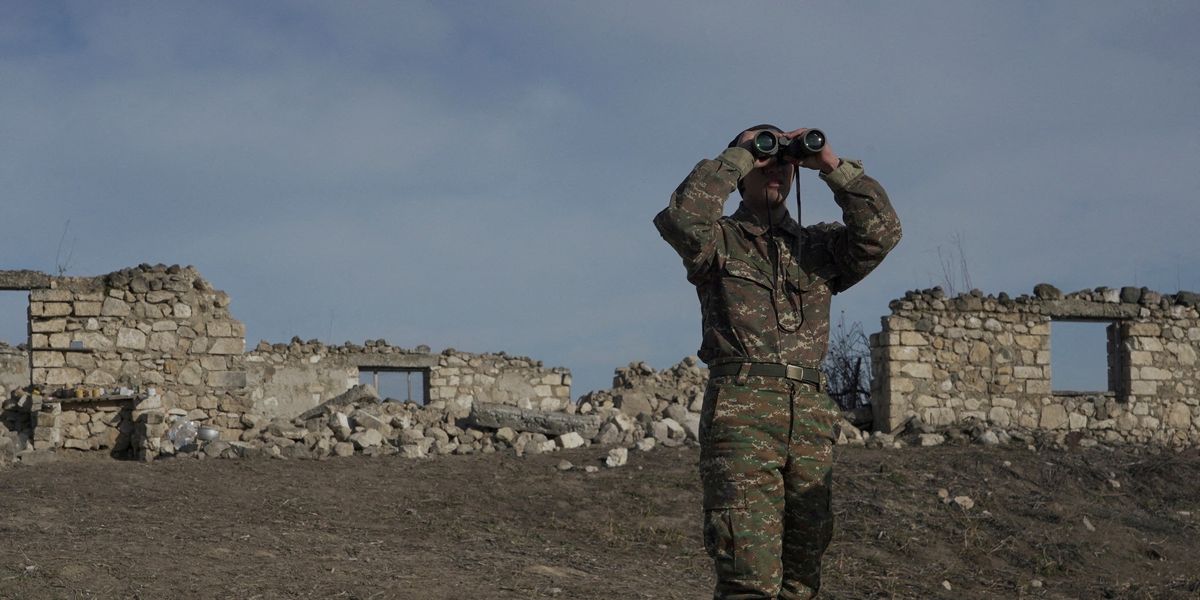
Much to Armenia’s consternation, the 2,000 Russian peacekeeping forces stationed in the enclave since the most recent round of fighting in 2020 have appeared ineffective in the face of increasing Azerbaijani pressure against the besieged Armenian population.
As a result, Armenia is openly seeking to diversify its security relationship away from Russia, its longstanding ally, including conducting joint military drills with the United States in Armenia that began Monday and is set to end on September 20.
Yerevan, Armenia’s capital, has increasingly expressed a sense of betrayal at Moscow’s inability, or unwillingness, to lend support to its treaty ally since last September when Azerbaijani armed forces attacked Armenia’s internationally recognized territory and where they still occupy 10 square kilometers, according to Armenian officials.
The Backdrop of Current Tensions
The two former Soviet Republics fought the First Nagorno-Karabakh War during the early 1990s after the indigenous Armenian majority in the autonomous oblast proclaimed their independence from the Azerbaijan Soviet Socialist Republic. Following the disintegration of the Soviet Union, a full-scale war broke out between the two newly independent countries, eventually leaving tens of thousands casualties dead and hundreds of thousands displaced between 1992 and 1994. The war ended with a victory by Armenia.
A Russian-brokered ceasefire resulted in Armenian control of Nagorno-Karabakh and adjacent regions of Azerbaijan proper. The United Nations and international community, however, continued to recognize Nagorno-Karabakh as part of Azerbaijan.
After over 25 years of unsuccessful negotiations under the auspices of the OSCE Minsk Group co-chaired by the U.S., France, and Russia, Azerbaijan’s President Ilham Aliyev, bolstered by the “brotherly” military support from NATO member Turkey and years of stockpiling Israel-supplied weapons, launched an all-out assault to recapture the disputed territory in September 2020.
The 44-day war saw Azerbaijan secure a military victory with further territorial gains guaranteed under a Moscow-brokered ceasefire, leaving a rump self-governing Nagorno-Karabakh Republic alongside a Russian peacekeeping contingent as stipulated by the November 2020 ceasefire agreement. That agreement also guaranteed that a link between the Nagorno-Karabakh enclave and Armenia, the Lachin Corridor, would be sustained and controlled by the Russian peacekeeping contingent. The status of Nagorno-Karabakh and its inhabitants remained unresolved.
Last December, however, Baku effectively blockaded the Lachin Corridor and, five months later, it established a checkpoint on the road, formalizing the blockade. While the European Union, Russia, the U.S., and even the International Court of Justice have increasingly called for lifting the blockade, Azerbaijan remains defiant. The Azerbaijan foreign ministry insists that claims of a blockade are “completely baseless” and has accused Armenians of transporting arms into the territory, a claim Yerevan denies. Nevertheless, even the International Committee of the Red Cross struggles to continue its vital deliveries into the territory, resulting in what several United Nations Special Rapporteurs describe as a “dire humanitarian crisis.”
There were hopes the dispute over Nagorno-Karabakh, which has been at the heart of the conflict between Armenia and Azerbaijan, would be resolved by negotiations facilitated by a complementary EU and U.S. approach (although a separate track by Moscow also persists). However, the ongoing blockade has dimmed hopes for a viable negotiated settlement.
Current Tensions
The war in Ukraine has drained the Kremlin’s military resources and room for maneuver, especially in a region like the South Caucasus where Russia vies with Turkey for regional hegemony. Moscow’s increased reliance on Ankara over the last 18 months to balance against the West diplomatically has resulted in its inability to fulfill its own obligations in the ceasefire agreement following the 2020 war.
Given this new reality, Armenia has started to hedge against Moscow by actively searching for new military partners and security guarantors.
The publicity surrounding Eagle Partner 2023, the Armenian-hosted joint military exercise with the U.S., clearly worries the Kremlin, which has said it would “deeply analyze” the latest events. However, these exercises are “narrowly focused on peacekeeping operations” and do not represent a “breakthrough in U.S.-Armenia defense cooperation,” according to Benyamin Poghosyan, senior fellow at APRI, a Yerevan-based think tank.
Nevertheless, the exercises follow Armenia’s refusal in January to host Russian-led Collective Security Treaty Organization exercises on its territory, citing the organization’s unwillingness to support Yerevan during last September’s escalation by Azerbaijan.
Armenian Prime Minister Nikol Pashinyan, has recently made a distinctly public effort to distance itself from Russian actions in Ukraine and even from Moscow itself. In just the last weeks Yerevan has moved to ratify the Rome Statute of the International Criminal Court and recalled its ambassador to the CSTO. Pashinyan said depending solely on Russia for security was a “strategic mistake.” Pashinyan’s spouse, Anna Hakobyan, traveled to Kyiv last week and delivered the first package of Armenian humanitarian aid to Ukraine.
However, the fact remains that only Russia has sent peacekeepers to Nagorno-Karabakh, and that these peacekeepers are all that stands between the local Armenian population and Azerbaijani conquest, almost certainly leading to massacre and expulsion. As Poghosyan sees it, the driving cause behind a potential new attack is “Azerbaijan’s desire to establish control over Nagorno Karabakh without providing any status or special rights to Armenians.”
This aligns with the view of Shujat Ahmadzada, a Baku-based researcher on foreign and security policies of the South Caucasus countries, who believes Azerbaijan is pursuing a “3D policy” with regard to Nagorno-Karabakh. The three D’s stand for “De-internationalization, De-territorialization, and De-institutionalization.” Such a process is intended to transform the status of the ethnic Armenians living there into a “purely ‘internal matter’ of Azerbaijan” while “incorporating the self-governing institutions into the Azerbaijani political system in such a way that there is no single territorially defined unit for the ethnic Armenian community.”
While the deployment of over 80 U.S. troops on Armenian soil will hopefully guarantee against imminently anticipated Azerbaijani attacks on Nagorno-Karabakh or Armenia itself, Washington’s move in a region Moscow has long viewed as a vital interest does not come without risk. Moscow views Washington’s increased involvement as the Biden administration taking advantage of Russia’s war in Ukraine in order to weaken or challenge its influence in the South Caucasus region, where Russia has a history of over 200 years of regional military domination.
The latest American proposal for unblocking the Lachin Corridor plans to simultaneously open an alternative route to Nagorno-Karabakh through the Azerbaijani town of Aghdam. However, Armenians have regarded this proposal as a clear threat. Tigran Grigoryan, a Karabakh-born analyst and head of the Regional Center for Democracy and Security, a Yerevan-based think tank, assessed that, even if both the Lachin Corridor and the Aghdam route were to be opened, the potential remained for Baku to again close the corridor and create a “new status quo on the ground.”
Recent reports show that the first delivery of aid by the Russian Red Cross has entered Nagorno-Karabakh from Azerbaijan. However, the acute crisis in food, energy, and humanitarian supplies continues as the Lachin Corridor remains shut and Azerbaijan continues its buildup along the border regions.
The Biden administration would do better to use its leverage over Azerbaijan to ensure an end to the Lachin Corridor blockade while simultaneously working to achieve a solution to the Nagorno-Karabakh conflict that would both recognize Azerbaijani sovereignty and provide enforceable guarantees for the future rights and security of the Armenian population there. For such an approach to work would likely require coordination with Russia.
While such a scenario might be hard to imagine, Washington and Moscow have worked together in the past over Nagorno-Karabakh, even when relations were severely strained elsewhere. Such coordination is particularly compelling given the tens of thousands in the enclave who currently face famine. Rather than taking steps that Moscow views as threatening to its military presence in the South Caucasus (a process which led to disastrous consequences for neighboring Georgia 15 years ago), Washington, and the region itself, would be better off if American involvement instead demonstrated its commitment to ensuring human rights.