
Category: Selected Articles
Category Added in a WPeMatico Campaign
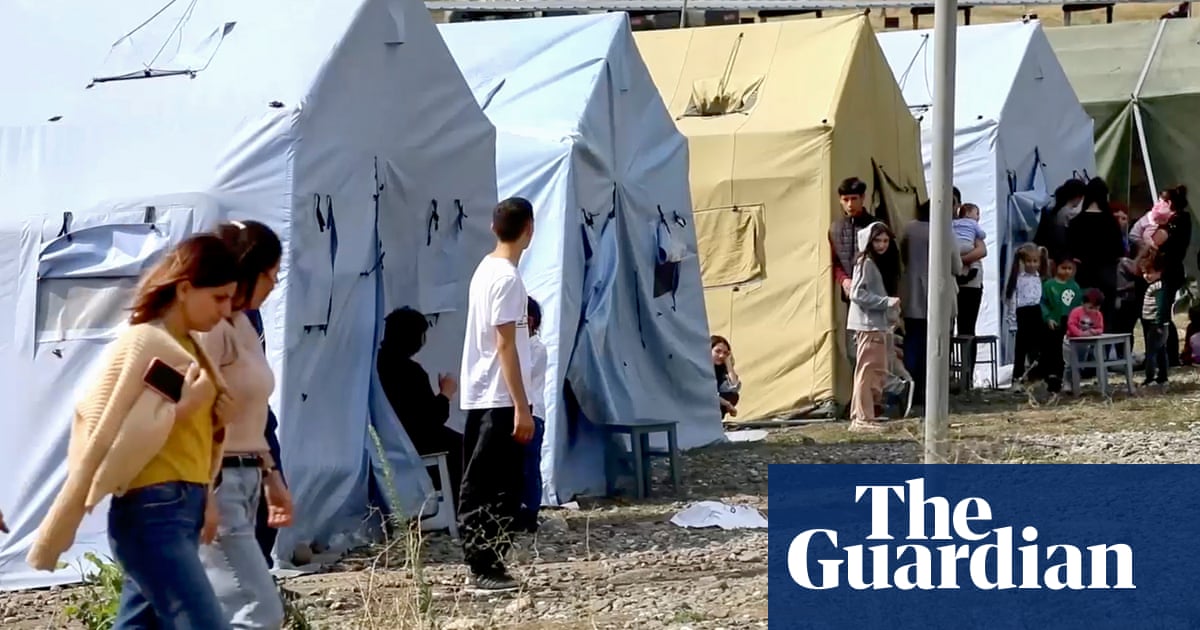
Armenia’s prime minister, Nikol Pashinyan, has expressed hopes that ethnic Armenians can stay in Nagorno-Karabakh amid fears that Azerbaijan, which says it controls the region after a military offensive this week, is seeking to push out tens of thousands of people.
Speaking during a government meeting in Yerevan, Pashinyan said Armenia would welcome ethnic Armenians who lived in the breakaway region but mass resettlement would only happen if it became impossible for Karabakh Armenians to remain there.
About 120,000 ethnic Armenians live in the South Caucasus enclave, which is recognised internationally as part of Azerbaijan but had largely been under ethnic Armenian control since 1994.
A ceasefire agreement was reached on Wednesday between Azerbaijan and the local government in Nagorno-Karabakh, a day after Azerbaijan launched its new military offensive. The two sides held the first round of talks on Thursday to discuss the future of the region and its residents.
A senior Azerbaijani official said on Friday that Baku would ensure that civilians could travel safely in their own vehicles along the road leading from Nagorno-Karabakh to Armenia through the Lachin corridor.
Hikmet Hajiyev, a foreign policy adviser to Azerbaijan’s president, also said Azerbaijan would guarantee an amnesty for Karabakh Armenian fighters who gave up their arms, though he claimed some Karabakh military units had said they would continue their resistance.
Meanwhile, a Karabakh representative told the AFP news agency that Azerbaijani troops were on the edge of the region’s capital, Stepanakert, which is known in Azerbaijan as Khankendi, prompting residents to hide in basements in fear.
“The situation in Stepanakert is horrible, Azerbaijani troops are all around the city, they are on the outskirts and people fear Azerbaijani soldiers could enter the city at any moment and start killings,” said Armine Hayrapetyan, a separatist spokesperson.
Pashinyan stressed on Thursday evening that the ceasefire in the breakaway region had largely been held. But other Armenian officials said Azerbaijan was preparing for an “ethnic cleansing” in the region.
Speaking at a meeting of the UN security council, Armenia’s foreign minister, Ararat Mirzoyan, said: “The intensity and cruelty of the offensive makes it clear that the intention is to finalise ethnic cleansing of the Armenian population of Nagorno-Karabakh.
There have also been warnings over a deteriorating humanitarian situation in Karabakh. Karabakh’s human rights ombudsman, Gegham Stepanyan, said on social media that the streets of Stepanakert were “filled with displaced people, hungry, scared, and in uncertainty”.
“People are desperately looking for each other,” Stepanyan said.
Observers have said many in Karabakh were already weakened after Azerbaijan established a blockage of the Lachin corridor last spring, cutting off the flow of people and goods between Armenia and Nagorno-Karabakh.
On Friday, the ethnic Armenian leadership of Nagorno-Karabakh said an agreement had been reached for a humanitarian convoy to come from Armenia.
There have been unconfirmed reports of civilians being targeted by Azerbaijani forces. One separatist official in Nagorno-Karabakh said at least 200 people had been killed and more than 400 wounded after Azerbaijan launched its offensive, including at least 10 civilians and five children.
Siranush Sargsyan, a freelance journalist in Nagorno-Karabakh, shared videos online showing destroyed civilian vehicles and damage to apartment buildings on Azatamartikneri Avenue in Stepanakert.
Nagorno-Karabakh and sizeable surrounding territories had been under ethnic Armenian control since the end of a separatist war in 1994, but Azerbaijan regained the territories and parts of Nagorno-Karabakh during the 2020 fighting. That ended with an armistice placing Russian peacekeepers in Nagorno-Karabakh.
On Thursday, Azerbaijan’s president, Ilham Aliyev, apologised in a phone call with Vladimir Putin for the death of six Russian peacekeeping troops who came under Azerbaijani fire while returning from a patrol in Nagorno-Karabakh.
Representatives of Nagorno-Karabakh have met with Azerbaijani officials in the central Azerbaijani city of Yevlakh, to discuss the future of the region following Nagorno-Karabakh’s surrender.
Thursday’s meeting reportedly lasted around three hours, with further meetings expected in the days and weeks ahead. The discussions were said to involve the rights, security, and ‘reintegration’ of Nagorno-Karabakh into Azerbaijan according to the Azerbaijani constitution.
Nagorno-Karabakh surrendered on Wednesday after Azerbaijani forces began a large-scale offensive on the region the day before. The authorities in Nagorno-Karabakh agreed to Azerbaijan’s terms, including the ‘disbandment and complete disarmament’ of their armed forces.
Davit Melkumyan, an MP from Nagorno-Karabakh’s Foreign Relations Committee, and Sergey Martirosyan, the Deputy Secretary of the Security Council, represented Nagorno-Karabakh in Yevlakh. They were accompanied by vehicles of the Russian peacekeepers to Yevlakh.
Azerbaijan was represented by Ramin Mammadov, a ruling party MP, and Bashir Hajiyev and Ilkin Sultanov from the presidential administration.
In a statement following the meeting, the authorities in Nagorno-Karabakh said that ‘a number of issues of mutual importance’ were discussed.
‘The parties especially emphasised that all existing issues need to be discussed in a peaceful atmosphere, with a readiness to continue the meetings’, the statement said.
Azerbaijan’s Presidential Administration also released a statement saying that the meeting was held in a ‘constructive and positive environment’ and that they had presented their plans for the ‘reintegration’ of the population of Nagorno-Karabakh.
‘The issues of reintegration of the Armenian population of Karabakh, restoration of infrastructure, and the organisation of activities based on the Constitution and laws of the Republic of Azerbaijan [were discussed]’, the statement said.
They said that the delegation from Nagorno-Karabakh had requested humanitarian aid, including food, fuel, medical supplies, heating systems for kindergartens and schools, and firefighting services. They added that they planned to ‘quickly’ supply these.
According to Azerbaijan, the importance of disarming the armed forces of Nagorno-Karabakh ‘as soon as possible’ was emphasised.
They said the next meeting would be held ‘soon’.
Speaking on Sky News Arabia, Elchin Amirbeyov, a representative of the President of Azerbaijan, said that it was unrealistic to expect all problems to be solved in one meeting, but that ‘the further fate of the Armenians in Karabakh is an internal matter of Azerbaijan’.
As the meeting took place, there were reports of gunfire in Stepanakert. Armenian journalist Tatul Hakobyan said that Azerbaijani troops had fired from positions taken in previous days in the outskirts of the city.
Artak Beglaryan, the Former State Minister of Nagorno-Karabakh, also confirmed the shooting, claiming that Azerbaijani troops had taken new positions in the city. He also said that one civilian had been killed in Haterk (Hasanriz) in the north of Nagorno-Karabakh. Azerbaijani vehemently denied that their troops were attacking.
Following the meeting, Russian Presidential Press Secretary Dmitry Peskov reportedly told reporters that ‘all the prerequisites’ were now in place for a peace treaty between Armenia and Azerbaijan. Russian officials have continued to blame Armenia for the latest outbreak of violence. Speaking on the Caucasus Digest on Wednesday, Tom de Waal, a senior fellow at Carnegie Europe, told OC Media that what was happening represented a ‘switch of Russian allegiance and support [from Armenia] to Azerbaijan.’
On Thursday, Armenian Prime Minister Nikol Pashinyan hit back. ‘If the peacekeepers could agree on a ceasefire, why couldn’t they agree before the attack that the attack would not take place on Nagorno-Karabakh, after all’, he said in a public address. ‘Everyone was raising the alarm about it, we were also raising the alarm that Nagorno-Karabakh is surrounded by Azerbaijani military equipment, why did that mediation did not take place? These are questions that must be answered’.
[Hear more: Podcast | The end of Nagorno-Karabakh?]
The cost of war
The number of casualties remains unknown. On Tuesday, Azerbaijani forces launched attacks along the entire line of contact. Drones and heavy artillery were employed, with a number of settlements coming under fire.
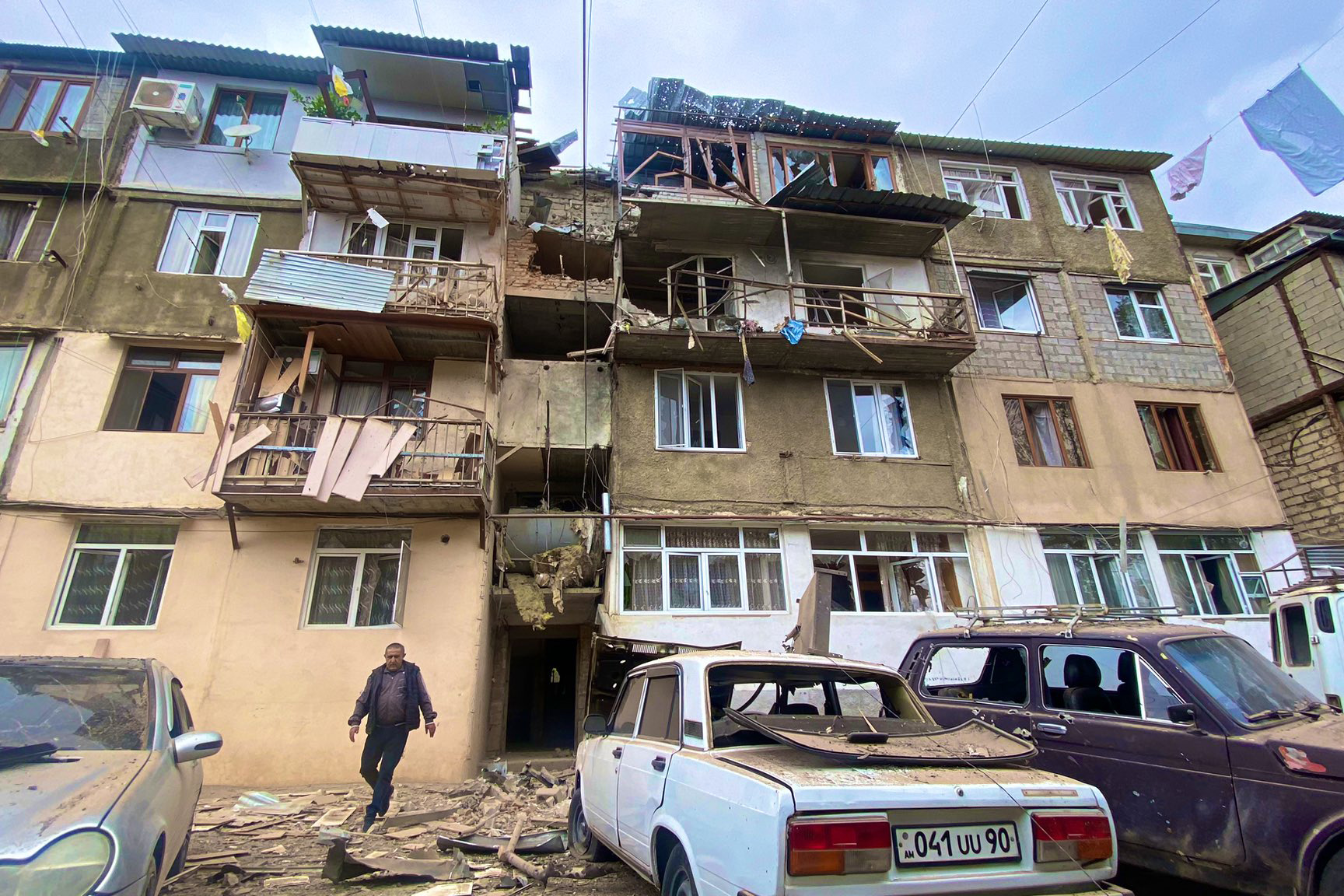 Stepanakert on 19 September 2023. Photo: Siranush Sargsyan.
The authorities in Nagorno-Karabakh have confirmed that at least 200 people were killed and over 400 wounded. Of those killed, at least 10 were reportedly civilians, including five children.
Azerbaijani authorities have not released casualty figures. However, independent Azerbaijani news site MeydanTV reported to have confirmed the identity of 80 soldiers killed in the fighting, by checking with local municipal authorities, family members of those killed, and other sources. Independent journalist Habib Muntazir said he had already confirmed the deaths of over 100 people.
According to the authorities in Nagorno-Karabakh, over 10,000 people were displaced, while many remain missing.
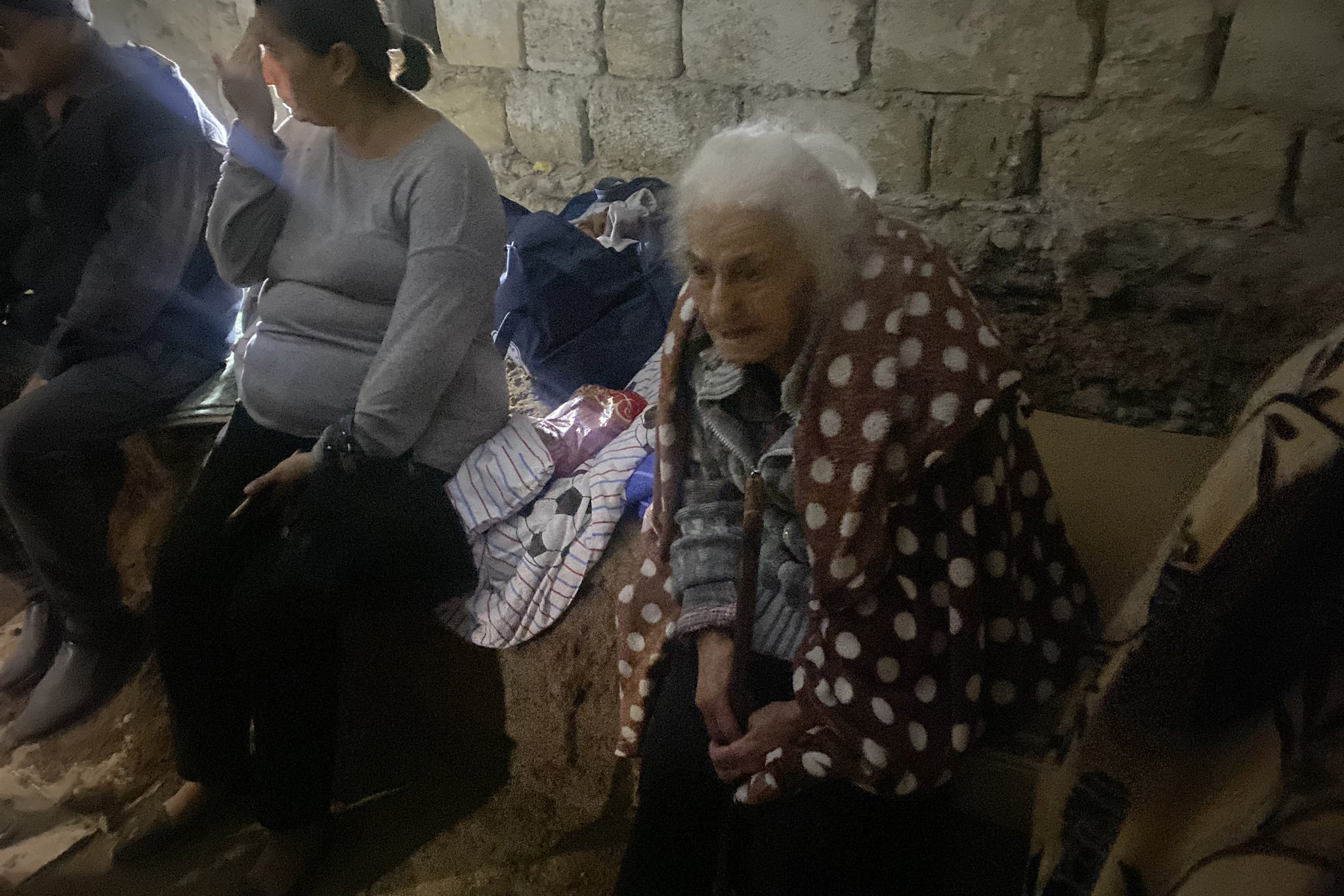 Stepanakert-based journalist Siranush Sargsyan published images of civilians hiding in bomb shelters in Stepanakert on 19 September. Photo: Siranush Sargsyan.
The Russian peacekeeping mission said that 1,340 people were at their base in the region, including 607 children.
The power supply to Nagorno Karabakh has not yet been restored, after being taken offline on Tuesday afternoon following a reported Azerbaijani strike. The authorities there reported that ‘a number of substations feeding the electrical system’ were under Azerbaijani control and that they were negotiating with the Russian peacekeepers in an attempt to resolve the situation.
Marut Vanyan, a journalist from Stepanakert, described the situation as ‘horrible’.
‘Smells smoke everywhere in Stepanakert’, he said. ‘People looking outside. No electricity. Mobile connection/Internet is weak. Been in the Hospital this morning. Just horrible…’
While the authorities in Stepanakert have remained vague about the advances by Azerbaijani forces prior to the ceasefire, Armenian journalist Tatul Hakobyan claimed to have mapped much of their losses.
He said Azerbaijan’s armed forces had taken control of two of the outer districts of Stepanakert, Armenavan (Krkzhan) and Ajapnyak (Malibeilu), as well as positions in the village of Drombon (Heyvaly) in the north.
He also reported that Azerbaijani forces had cut several major roads, including the road between Martuni (Khojavand) and Stepanakert. He also confirmed earlier reports that Azerbaijani troops had taken control of the Amaras monastery, a mediaeval Armenian monastery and important religious and cultural site.
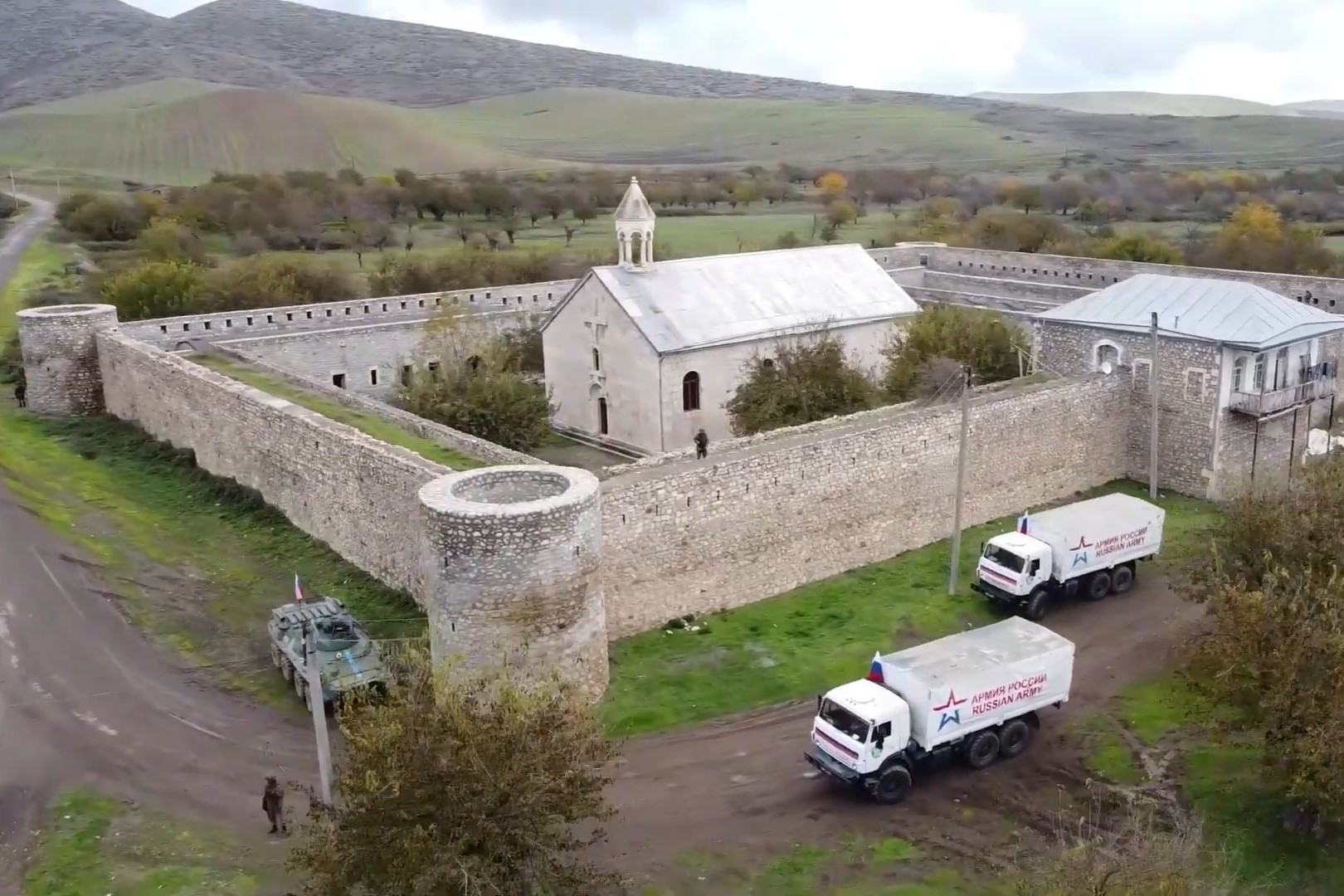 The Amaras monastery in 2021, under the control of Russian peacekeepers. Photo: mil.ru.
Martakert (Aghdara), one of the largest towns in Nagorno Karabakh, had also been cut off from Stepanakert, he said. CivilNet also confirmed that Martakert had been surrounded, with its residents stuck inside.
A number of Russian peacekeepers were also killed after their vehicle came under fire. Azerbaijan has claimed that they were killed by forces from Nagorno-Karabakh, however in a phone conversation on Thursday, Azerbaijan’s President Ilham Aliyev apologised to Russian President Vladimir Putin and offered to compensate their families.
Russia’s Defence Ministry also stated that the Azerbaijani soldiers responsible for the peacekeepers’ deaths had been discharged from Azerbaijan’s armed forces.
While paying tribute to the Russian peacekeepers who died, Russian foreign ministry spokesperson Maria Zakharova again blamed Armenia for what happened.
The fate of the people of Nagorno-Karabakh
As negotiations continue between officials from Nagorno-Karabakh and Azerbaijan over the future of the region’s Armenian population, there is uncertainty over how many, if any, will choose to stay.
Anecdotal evidence suggests that many are hoping to leave. Speaking on the Caucasus Digest on Wednesday evening, Knar Khudoyan, a Yerevan-based journalist, told OC Media that members of her family she had spoken to in Nagorno-Karabakh were already searching for a way to reach Armenia.
On Wednesday, there were widespread reports that thousands of people had gathered at Stepanakert airport. Tigran Grigoryan, a Yerevan-based political analyst from Nagorno-Karabakh, said they were stuck without food or water.
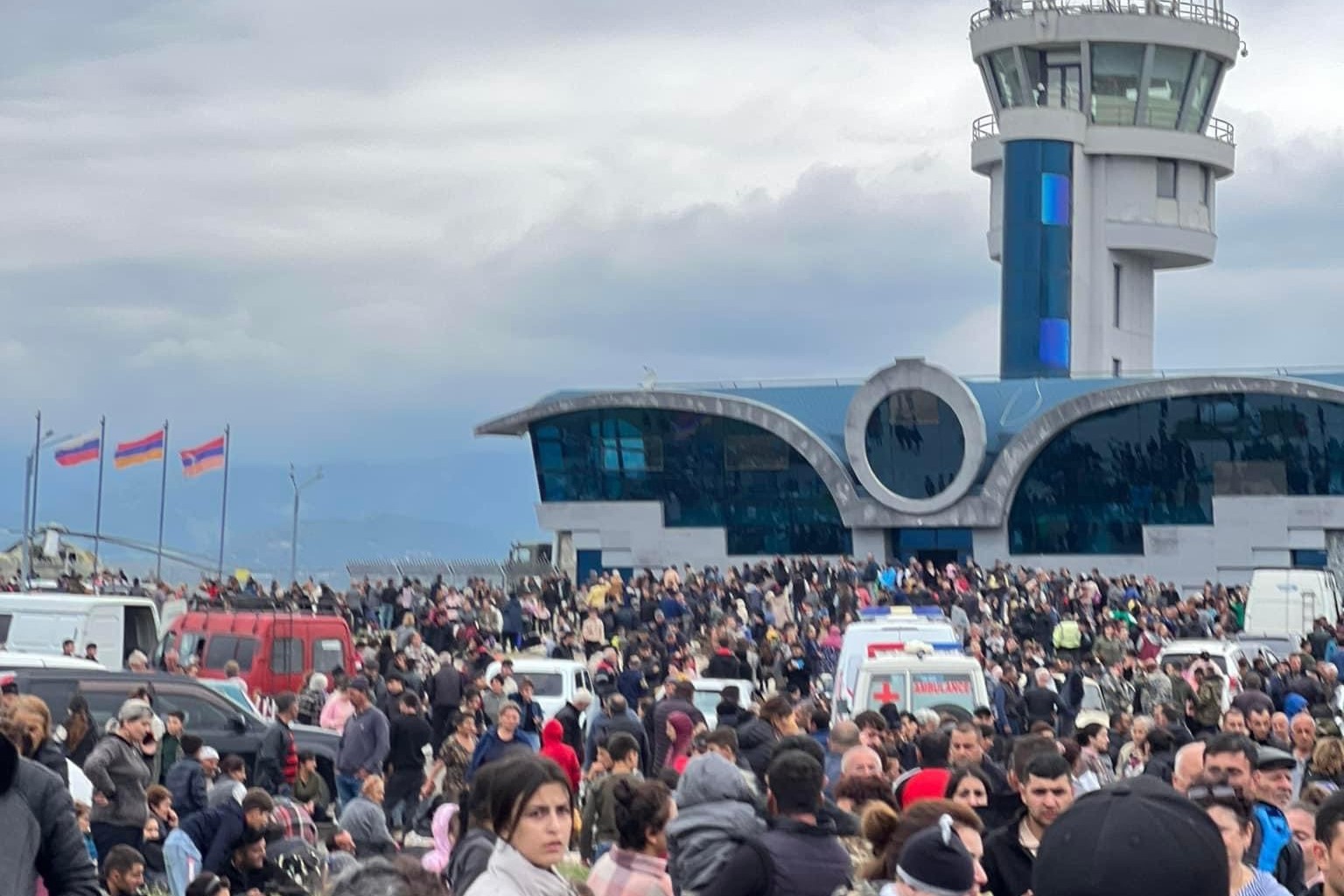 Images of a packed Stepanakert airport appeared online on 20 September.
Armenian media also reported on Thursday that people were carrying out civil disobedience actions in Yerevan, demanding the Armenian authorities open a humanitarian corridor and ensure the safe transfer of Nagorno-Karabakh’s population to Armenia.
Despite the concerns and calls for the Armenian Government to help facilitate people’s evacuation to Armenia, in his address on Thursday, Pashinyan said they had assessed that ‘at this moment […] there is no direct threat to the civilian population’ of Nagorno-Karabakh.
Earlier that day, the PM’s office told Armenpress that the government ‘does not seek the displacement of the Armenians of Nagorno-Karabakh and believes that the rights of the Armenians of Nagorno-Karabakh to live safely and in dignity in their homes must be guaranteed.’
They added that if their situation became ‘impossible’, ‘the necessary decisions will be taken’.
Before Thursday’s meeting, Tom de Waal from Carnegie Europe told OC Media that much depended on what, if any, concessions Azerbaijan made. He remained sceptical, pointing to the lack of education and language rights other ethnic minorities in Azerbaijan are granted.
‘A lot depends on how Azerbaijan conducts itself, whether what, if anything, happens to those Armenians who choose to stay in Karabakh, and what kind of existence they lead’, he said.
‘We’re looking at a very — I think what the Karabakh Armenians would think of as — a very restrictive and punitive arrangement for them.’
‘To be honest, under those conditions, a lot, if not a majority of the Karabakh Armenians will simply be unable to live in Azerbaijan and just leave.’
For ease of reading, we choose not to use qualifiers such as ‘de facto’, ‘unrecognised’, or ‘partially recognised’ when discussing institutions or political positions within Abkhazia, Nagorno-Karabakh, and South Ossetia. This does not imply a position on their status.
The post Nagorno-Karabakh and Azerbaijani officials meet in Yevlakh to discuss region’s future appeared first on OC Media.


Azerbaijan and representatives of Nagorno-Karabakh’s de-facto Armenian government have begun re-intergration talks for the territory after a 24 hour offensive by Azerbaijani forces. On Tuesday, September 19 Azerbaijan launched a new offensive against the self-governing Armenian-populated region. The attack followed a nine-month blockade of the territory by the Azerbaijani authorities, which prompted international condemnation.
Azerbaijan’s armed forces initially attacked Nagorno-Karabakh’s capital Stepanakert with drones and artillery, breaking through the line of contact (the front line separating Armenian and Azerbaijani troops) to surround key settlements.
Azerbaijan’s President Ilham Aliyev declared that the country had “restored its sovereignty” to the area internationally recognised as part of Azerbaijan, and a ceasefire was declared. However, at the time of writing there are reports of continued shelling and small arms fire in some areas.
Since the advance of Azerbaijani forces and the capitulation of Nagorno-Karabakh’s de-facto authorities thousands of Armenian civilians have fled their homes; Armenia’s prime minister has accused Azerbaijan of carrying out a policy of ethnic cleansing in Nagorno-Karabakh. Bellingcat has previously documented human rights violations by Azerbaijan’s forces in areas of Nagorno-Karabakh which came under Baku’s control in 2020.
Since the start of Azerbaijan’s latest offensive, Bellingcat has been monitoring open source information about the humanitarian consequences — in particular attacks on the territory’s civilian infrastructure and the movement of its ethnic Armenian population.
Azerbaijan declared an end to operations on the evening of Wednesday, September 20, however there are reports that gunfire could still be heard near Stepanakert on the morning of September 21, hours before aforementioned talks between Azerbaijani and Karabakh Armenian representatives commenced in the town of Yevlakh. Widespread and prolonged disruptions to internet services in the area have resulted in sporadic filtering of information out of the region.
Area controlled by Karabakh Armenian forces between November 2020 and September 2023 highlighted in red.
Armenian officials and international experts fear the ethnic cleansing of the approximately 100,000 ethnic Armenians in the enclave. Last month, Luis Moreno Ocampo, the former lead prosecutor of the International Criminal Court, released a report warning there is a “reasonable basis” to believe there is a genocide against Armenians living in Nagorno-Karabakh — for the past nine months, Azerbaijani security forces have blocked access to Nagorno-Karabakh, cutting off essential supplies including food and medicine.
Videos Show Damage to Civilian Areas, Civilians Fleeing
Bellingcat has seen evidence of attacks on residential areas of Nagorno-Karabakh.
Early reports on social media place the start of the hostilities shortly after noon on September 19. The Azerbaijani Ministry of Foreign Affairs (MFA) released videos throughout the day showing its armed forces striking Armenian military targets. Among these were videos shared on the MFA’s YouTube page featuring drone footage of military positions and the bombing of military equipment.
Hikmet Hajiev, foreign policy adviser to Azerbaijan’s president, claimed in an interview to CNN that Azerbaijan only targeted military infrastructure with “precision weapons” in the offensive. However, available open source evidence shows that residential areas were also impacted in the attack. The country’s Defence Ministry also released a statement on September 19 claiming that “humanitarian aid stations” had been opened along the Lachin Corridor connecting Nagorno-Karabakh to Armenia to ensure the “evacuation of the population”, but no open source evidence of civilians fleeing towards them has yet emerged.
The Human Rights Defender of the Republic of Artsakh (as Nagorno-Karabakh is also known to its Armenian population) announced on the evening of September 20 that at least ten civilians — including five children — were among the 200 fatalities in the hostilities.
The entity also decried the worsening humanitarian situation in the area, pointing out that civilians in the region had been suffering through prolonged interruptions to electrical, heating, and internet services. Importantly, critical fuel shortages had caused all public transport to cease during the nine-month blockade, complicating any evacuation or humanitarian efforts.
Siranush Sargsyan, a freelance journalist in Nagorno-Karabakh, shared videos showing destroyed civilian vehicles and damage to apartment buildings on Azatamartikneri Avenue (39.821232, 46.758423) in downtown Stepanakert.
Images of damage to a car and commercial buildings in Stepanakert, from Siranush Sargsyan’s Tweet
Sargsyan shared a video of damage to another civilian building apparently in central Stepanakert, which Bellingcat was unable to immediately geolocate.
Other videos shared on September 20 showed Armenian civilians fleeing their homes. A large number of them arrived at the Russian peacekeepers’ base at the airport near Khojaly:
Stills from a video showing Armenian civilians walking in the premises of the Russian peacekeeping force’s base at Khojaly. Video by AlphaNews, shared by Leonid Ragozin on Twitter.
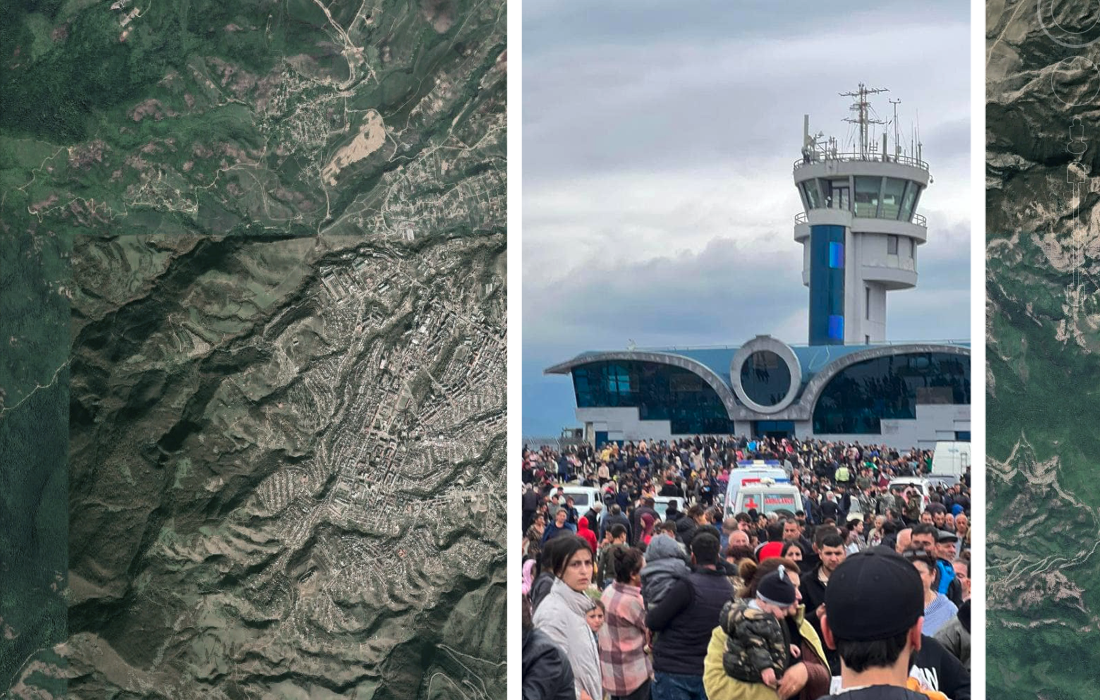
One photograph whose initial author is unknown was then widely circulated on social media, showing a large crowd gathering at the terminal building of the airport.
Photo from Andranik Shirinyan’s Tweet
At 2:00 PM local time, footage appeared showing a large group of Armenian civilians and vehicles near the airport’s terminal building (39.899226, 46.787836).
The television channel of Russia’s military, TV Zvezda, also released footage of Russian peacekeepers letting a large group of Armenian civilians into the base. Images later appeared of a group of civilians at an Orthodox Church on its premises at (39.902255, 46.793253).
The independent Russian news website Meduza reported on a brief from the Russian Presidential Administration which instructed state media to highlight the role of peacekeepers in “evacuating the civilian population”, particularly stressing the fact that some took shelter in the aforementioned Orthodox Church.
A statement posted to Russia’s Defence Ministry website on September 20 notes that Russian peacekeepers evacuated 3,154 people from the Mardakert, Martuni and Askeran Regions. It is not known whether these are the civilians seen in the videos mentioned above.
Given extensive cloud cover over the airport yesterday, Bellingcat tasked a synthetic aperture radar (SAR) satellite image of the site. Unlike visible light satellite images, SAR can penetrate through clouds and, in effect, “see” certain objects.
The SAR images that Bellingcat obtained, seen below, are not strongly conclusive. However, they show what appear to be a large number objects on the road adjacent to the Russian base. Two large groups of these are also visible, one in a parking lot by the airport terminal and another in a field nearby.
These objects could plausibly be vehicles, which have also been seen in the area in large numbers in one video uploaded by an Armenian social media user and another video bearing the coat of arms of Russia’s Defence Ministry.
SAR data © 2023 Umbra Lab, Inc. (Licensed under CC BY 4.0). Annotations by Logan Williams. The raw SAR magnitude image is available as a GeoTIFF and can be downloaded here for further reference, analysis, and reproduction under the terms of the CC BY 4.0 license.
At the time of writing, there are numerous claims on social media that Azerbaijani soldiers have advanced into the city of Stepanakert. This morning, local journalist Marut Vanyan posted images of internally displaced people from across Nagorno-Karabakh on the streets of Stepanakert.
https://twitter.com/marutvanian/status/1704733065673687175
An Uncertain Future
The future of Nagorno-Karabakh’s 100,000 ethnic Armenians remains uncertain. In his speech on Wednesday, Aliyev assured that the rights of Armenians would be preserved under Baku’s rule, however some experts have argued that most Karabakh Armenians are unlikely to put much faith in Baku’s assurances.
Armenia’s Prime Minister Pashinyan has “taken into account” the decision of the Karabakh Armenian authorities and in a video address argued that the Russian-negotiated ceasefire obliged Moscow to guarantee their security, reported Armenian news website CivilNet. Yesterday the same website reported confusion on the ground as to whether “humanitarian corridors” to Armenia via the Lachin Corridor will be opened at all.“Fears of expulsion and ethnic cleansing are justified because there is precedent. Every time territory has changed hands in the Armenian-Azerbaijani conflict, ethnic cleansing has taken place,” said Laurence Broers, an Associate Fellow at Chatham House’s Russia and Eurasia Programme, in comments to Bellingcat.“The previous nine months of blockade followed by yesterday’s offensive are not the ideal background to discussions of co-existence. What we’ve seen here is a coercive model, where we now have no trust whatsoever and a deep asymmetry in power. This is not a setting that can provide for a successful process, which would need painstaking negotiations and transitional arrangements.”
Bellingcat will continue to monitor the situation to track the humanitarian consequences of this latest escalation of the Nagorno-Karabakh crisis.
Giancarlo Fiorella, Maxim Edwards and Narine Khachatryan contributed research alongside members of Bellingcat’s Global Authentication Project (GAP)
The transfer of our compatriots from Nagorno-Karabakh to Armenia may take place in the conditions when it is recorded that it is impossible for our compatriots to stay in Nagorno-Karabakh; that is, if this situation continues. Prime Minister Nikol Pashinyan stated this at Friday’s Cabinet meeting of the Armenian government.
“We assess that this impossibility exists at the moment. If the situation does not improve, that situation will be on the agenda of all of us. But also, I want to inform that back on September 19, that is, the day of the start of [Azerbaijan’s military] operations [in Nagorno-Karabakh], I gave an instruction to Deputy Prime Minister Tigran Khachatryan to discuss with his government colleagues how, where, and with what we will assist our compatriots in the event of a possible flow of people to Armenia. More than 40,000 places have been prepared; it’s about places to stay, as well as simultaneously in terms of health care, food. This is an agreed position with Nagorno-Karabakh colleagues. Our Plan A is not to de-Armenianize Nagorno-Karabakh. We must do everything in our actions so that our compatriots have the chance to live in their homes without fear, with dignity,” Pashinyan said.
19:19, 21 September 2023
YEREVAN, SEPTEMBER 21, ARMENPRESS. Prime Minister Nikol Pashinyan has said that Armenia bears its share of responsibility but the failures of the Russian peacekeeping mission in Nagorno-Karabakh shouldn’t be ignored.
Addressing the nation live on Thursday, PM Pashinyan commented on Russian media claims that Armenia is trying to blame Russia for its own failures.
“We are not shifting responsibility of any of our failures on anyone. There is the clear 9 November 2020 trilateral statement, by which the Lachin Corridor was supposed to be under the full control of the Russian peacekeeping contingent, the Russian peacekeeping contingent was supposed to oversee the safety of the civilian population. And we’ve been consistently raising this issue for over one and a half years, raising that the processes aren’t proceeding in the right course. We bear our share of responsibility, but I don’t think that we all should turn a blind eye on the failures that the Russian peacekeeping contingent has had in Nagorno-Karabakh,” Pashinyan said, mentioning the deadly incident in 2022 when Russian peacekeepers had assured a farmer in Nagorno-Karabakh that it was safe to conduct agricultural work but the farmer was shot dead by an Azeri sniper in the presence of the peacekeepers.
“Why did this latest outbreak happen? If the peacekeepers were able to agree a ceasefire, why couldn’t they do so before the attack, so that an attack on Nagorno-Karabakh wouldn’t have happened? After all, we’ve all been warning about this, we were saying that Nagorno-Karabakh is blockaded by Azerbaijani military equipment. Why didn’t this mediation take place back then? These are questions that require answers,” the Armenian PM said.