
Ukraine, the former head of the presidential office: “Zelensky is no longer a legitimate president” Agenzia Nova
Category: Selected Articles
Category Added in a WPeMatico Campaign

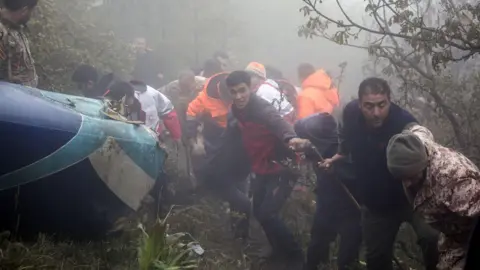 EPA
EPARescuers found the crash site after daybreak on Monday
President Ebrahim Raisi and seven other people were killed on Sunday when the helicopter they were travelling in came down near the border with Azerbaijan, Iranian authorities have confirmed.
This is what we know so far about the crash.
Why was the president flying in a helicopter?
Raisi flew to the far north-western province of East Azerbaijan on Sunday morning for the inauguration of the Qiz Qalasi and Khoda Afarin dams, a joint hydroelectric power project with neighbouring Azerbaijan on the Aras river.
He was joined at the ceremony by Azerbaijan’s President, Ilham Aliyev, who said he had bid a “friendly farewell” before the helicopter departed the dam area and flew towards the city of Tabriz, about 130km (80 miles) to the south.
Raisi had been scheduled to inaugurate a project at the Tabriz oil refinery.
Who else was on board the aircraft?
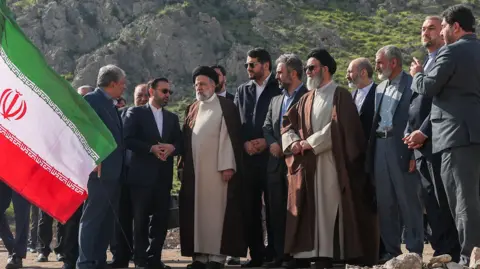 EPA
EPAPresident Ebrahim Raisi (3rd L) was in north-western Iran for the inauguration of a dam, along with Foreign Minister Hossein Amir-Abdollahian (2nd R), East Azerbaijan Governor Malek Rahmati (2nd L) and Ayatollah Mohammad Ali Al-e Hashem (5th R)
There were seven people accompanying the president who also died in the crash, according to the commander-in-chief of the Islamic Revolution Guard Corps (IRGC), Major General Hossein Salami.
They included Iran’s Foreign Minister, Hossein Amir-Abdollahian, as well as the governor of East Azerbaijan province, Malek Rahmati, and Tabriz’s Friday prayer leader, Ayatollah Mohammad Ali Al-e Hashem, a senior Shia cleric who was also Supreme Leader Ali Khamenei’s official representative in East Azerbaijan.
Gen Salami identified the others as IRGC Brig-Gen Mohammad Mehdi Mousavi, the head of the president’s security team, pilots Col Mohsen Daryanush and Col Seyyed Taher Mostafavi, and technician Maj Behrouz Qadimi.
Where did the helicopter crash?
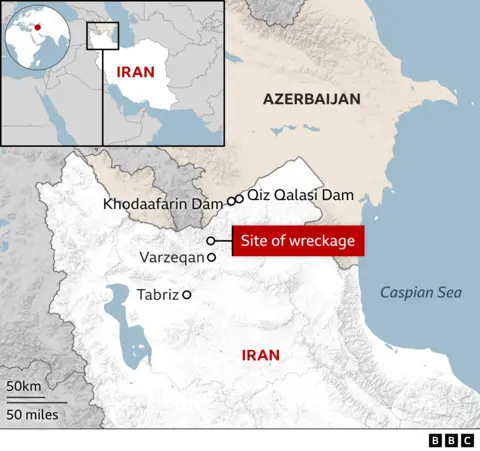
The incident occurred at around 13:30 local time (10:00 GMT) in a remote, mountainous area about 58km (36 miles) south of the Qiz-Qalasi Dam and 2km south-west of the village of Uzi, according to Iranian officials and photographs published by state media.
But it was not until after 16:00 local time (12:45 GMT) that Iranian state TV reported that the helicopter carrying the president had experienced what it called a “hard landing” while flying to Tabriz in heavy fog and rain.
Interior Minister Ahmad Vahidi later confirmed that the president’s delegation had been travelling in a convoy of three helicopters and that his aircraft was “forced to make a hard landing due to bad weather conditions and fog in the area”.
He said multiple rescue teams were heading to the area but that fog, snow and rain and the local terrain were hampering the search operation.
As for the other two helicopters that were flying alongside the president’s helicopter, they had initiated a search for 15 to 20 minutes after communication was lost. They were then forced to make emergency landings, an official told state TV as the operation continued into the night.
Vice President for Executive Affairs Mohsen Mansouri also said contacts had been made with two people on the president’s helicopter – a flight crew member and one other individual.
“This indicates that the severity of the incident was not very high, as two of the individuals inside the helicopter managed to communicate with our team multiple times,” he added, without providing further details.
However, any hopes that Raisi and his entourage had survived were dashed after daybreak on Monday.
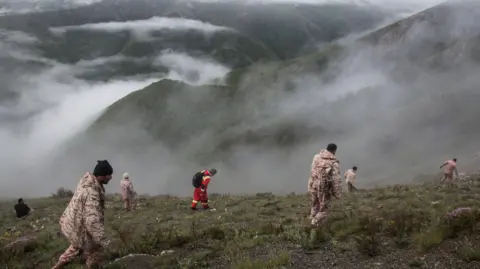 Reuters
Photographs from the scene on Monday showed rescuers climbing a steep mountainside, shrouded in fog
What was found at the scene?
At about 05:00 (01:30 GMT), rescuers spotted the wreckage from a distance from about 2km (1.2 miles) and then took about an hour to reach it, according to the head of the Iranian Red Crescent, Pirhossein Kolivand.
Once at the crash site, which was at an altitude of around 2,200m (7,200ft), they found “no signs of life”, Mr Kolivand told state TV.
State TV also broadcast grainy footage of the crash site on a mountainside, as seen from across a valley. It appeared to show the blue-and-white tail of a helicopter next to a number of burnt shrubs.
Later, after the death of President Raisi and the others on board had been announced, state TV broadcast footage showing a correspondent standing in front of the tail and what appeared to be other parts of the wreckage.
State news agency Irna also posted video showing rescuers carrying a body wrapped in a blanket in a stretcher.
The bodies were recovered and transferred to a cemetery in Tabriz, state TV said.
The head of Iran’s crisis management agency, Mohammad Nami, told the semi-official Tasnim news agency that all of the bodies were identifiable, with “no need for DNA examinations”.
He also said Ayatollah Al-e Hashem was alive for an hour after the crash and that he made contact with the head of the president’s office before he died.
How Iranian state TV broke news of President Ebrahim Raisi’s death
What was the cause of the crash?
Iranian authorities have so far not given a cause.
However, government ministers have described how the helicopter crashed after getting into difficulties in heavy fog and rain.
What do we know about the helicopter?
 Reuters
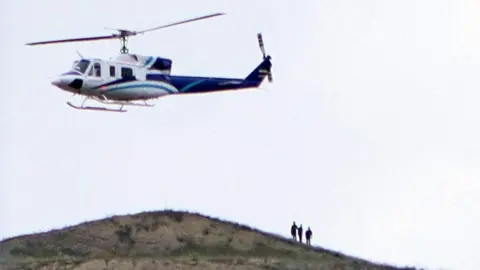
The Bell 212 carrying President Raisi was filmed taking off from the Qiz-Qalasi Dam before the crash
State media identified it as Bell 212, a model which was developed by a US company for the Canadian military in the 1960s.
Iran’s navy and air force have a total of 10, according to FlightGlobal’s 2024 World Air Forces directory, but it is unclear how many the Iranian government operates.
State-run IRNA news agency says the helicopter carrying the president could carry six passengers and two crew.
According to the Flight Safety Foundation, the last fatal incident in Iran involving a Bell 212 before Sunday happened during a medical evacuation in April 2018.
What has been the reaction in Iran?
Iran’s Supreme Leader Ayatollah Ali Khamenei – who has ultimate authority in the Islamic Republic – expressed his condolences over what he called the “bitter tragedy” and declared five days of public mourning.
“With deep sorrow and regret, I have received the bitter news of the martyrdom of the people’s president, the competent, hard-working Hajj Sayyed Ebrahim Raisi, and his esteemed entourage,” he said.
A statement issued by Iran’s cabinet said the president had “made the ultimate sacrifice on the path of serving his nation”.
Ministers also promised Iranians that they would follow Raisi’s path and there would “be no problem with management of the country”.
Raisi’s moderate rival and predecessor, Hassan Rouhani, expressed his condolences and said “a bitter page has turned in the Islamic Revolution’s book”.
Former foreign minister Mohammad Javad Zarif told state TV that the US was indirectly to blame for the crash because it had maintained years of sanctions that prevented Iran from buying new aircraft.
Who has succeeded Raisi as president?
 Reuters
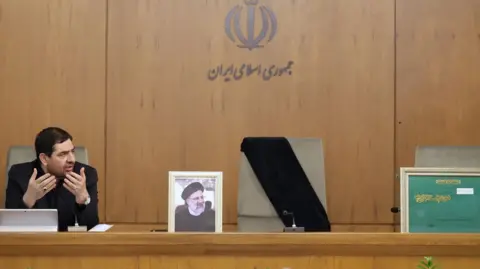
Mohammad Mokhber, Ebrahim Raisi’s deputy, has been named acting president
Ayatollah Khamenei confirmed that Vice-President Mohammad Mokhber had been appointed acting president, in line with Article 131 of Iran’s constitution.
The constitution states that the acting president will then jointly with the heads of parliament and the judiciary oversee an election for a new president within a maximum of 50 days.
Iran’s veteran nuclear negotiator and deputy foreign minister, Ali Baqeri Kani, was also named as the acting foreign minister, a government spokesman said.
He can serve in the post for a maximum of three months before a permanent replacement must be nominated and approved by parliament.
https://t.co/NqjOayPXMb
TNT Review#NewsAndTimes #NT #TNT #News #Times#World #USA #POTUS #DOJ #FBI #CIA #DIA #ODNI#Israel #Mossad #Netanyahu#Ukraine #NewAbwehr #OSINT#Putin #Russia #GRU #Путин, #Россия #SouthCaucasus #Bloggershttps://t.co/O0SIgLVWzMhttps://t.co/DO5LG3PY4T…— Michael Novakhov (@mikenov) May 30, 2024
AUDIO POST: Russian Intelligence and Western Counterintelligence https://t.co/d1ZpSTs5gP pic.twitter.com/jlUQsOJeUp
— Michael Novakhov (@mikenov) May 30, 2024
US will remove Biden’s $320M Gaza pier because it is ‘sinking’ https://t.co/3dq4VLOxs0 pic.twitter.com/cnZJTeaQxY
— Michael Novakhov (@mikenov) May 29, 2024
#Israel : Ex-#Mossad -Chef soll Chefanklägerin des Strafgerichtshofs gedroht haben – DER SPIEGEL https://t.co/7oScuI9xJP
— Presseclub (@Mediainfodienst) May 29, 2024
#NaziSionist#IsraelIsATerroristState #IsraeliNewNazism#Mossad
#YossiCohen ex capo del Mossad, l’agenzia di intelligence straniera israeliana, avrebbe minacciato #FatouBensouda all’epoca procuratore della Corte penale internazionale
la storia….https://t.co/K0sTJ73GK7— simo pen (@PennaSimonetta) May 29, 2024


Palestinian health officials said 19 civilians had been killed in Israeli airstrikes and shelling across Gaza. Israel accuses Hamas militants of hiding among civilians, something Gaza’s ruling Islamist group denies.
Majed Abu Raman, the health minister, urged Washington to pressure Israel to open the Rafah crossing to aid, saying there was no indication that Israeli authorities would do so soon and that patients in besieged Gaza were dying for lack of treatment.
Fighting in Gaza will continue throughout 2024 at least, said Tzachi Hanegbi, Israel’s national security adviser, signalling Israel was not ready to end the war as Hamas has demanded as part of a deal to exchange its hostages for Palestinian prisoners.
“The fighting in Rafah is not a pointless war,” Mr Hanegbi said, reiterating that Israel aimed to end Hamas rule in Gaza and stop it and its allies attacking Israel.
Antony Blinken, US secretary of state, said Israel needed to craft a post-war plan for Gaza or risk lawlessness, chaos and a Hamas comeback in the enclave.
The US, Israel’s closest ally, reiterated its opposition to a major ground offensive in Rafah on Tuesday while saying it did not believe such an operation was under way.
More than 36,000 Palestinians have been killed in Israel’s Gaza offensive, the enclave’s health ministry said.
Israel launched its war after Hamas-led militants attacked southern Israeli communities on Oct 7, killing around 1,200 people and seizing more than 250 hostages, according to Israeli tallies.
Hostage release talks
There was no word on Wednesday on developments in the ceasefire and hostage release talks. Hamas has said talks are pointless unless Israel ends its offensive on Rafah.
The armed wing of Hamas, and that of allies Islamic Jihad, said they confronted invading forces in Rafah with anti-tank rockets and mortar bombs. They said they blew up explosive devices that had been planted, resulting in numerous successful hits.
The Israeli military said three Israeli soldiers were killed and three badly wounded. Public broadcaster Kan radio said an explosive device had been set off in a Rafah building.
Palestinian health officials said several people were wounded by Israeli fire. They said stores of aid were set ablaze in eastern Rafah, where residents said Israeli bombardment had destroyed many homes in an area Israel has ordered to be evacuated.
Around a million Palestinians who had taken shelter in Rafah at the southern end of the Gaza Strip have now fled after Israeli orders to evacuate, UNRWA, the UN agency for Palestinian refugees reported on Tuesday.
The Palestine Red Crescent Society (PRCS) said it had evacuated its medical teams from its field hospital in the Al-Mawasi area, a designated civilian evacuation zone, because of continued bombardments.
PRCS said two of its staff were killed when an ambulance was struck while on a mission to rescue people in Rafah. In another Israeli air strike on a house in Gaza City, medics said five other Palestinians were killed.
In the nearby city of Khan Younis, an Israeli air strike killed three people overnight, including Salama Baraka, a former senior Hamas police officer, medics and Hamas media said. Another killed four people, including two children, medics reported.
In northern Gaza, Israeli forces shelled Gaza City neighbourhoods and moved deeper into Jabalia, where residents said large residential districts were destroyed.
Malnutrition has become widespread in Gaza as aid deliveries have slowed to a trickle. The UN, which has warned of famine, said on Wednesday the amount of humanitarian aid entering the enclave has dropped by two-thirds since Israel began its assault on the Rafah region this month.