
Can G-7 Leaders Use Frozen Russian Assets to Pay Ukraine? Foreign Policy
Category: Selected Articles
Category Added in a WPeMatico Campaign
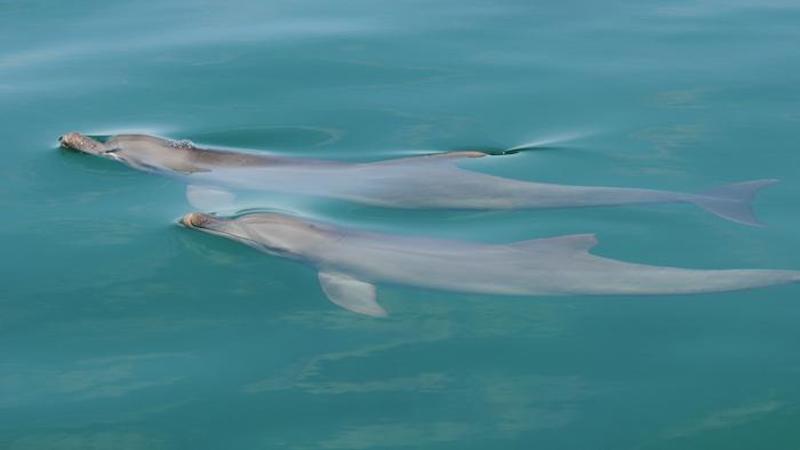
Juvenile social play predicts adult reproductive success in male bottlenose dolphins, a new study has found.
Fresh findings published today in Proceedings of the National Academy of Sciences led by researchers from the University of Bristol and University of Western Australia, show that juvenile male dolphins with strong social bonds practice adult-like reproductive behaviours when playing together, and those juvenile males who spend more time practicing will father more offspring as adults. The study provides rare evidence for a link between juvenile social play and reproductive success in a wild animal.
In collaboration with international colleagues, the scientists spent years observing the behavior of juvenile male Indo-Pacific bottlenose dolphins in Shark Bay, Western Australia, and using long-term behavioral and genetic data from this population, they investigated the role of juvenile social play in developing adult male reproductive behavior.
Lead author Dr Katy Holmes, who completed this work as part of her doctoral research at the University of Western Australia, said: “We found that juvenile play involves immature versions of adult reproductive behaviors that are crucial for males to access and mate with estrous females, and the time spent doing these play behaviors predicts how many offspring males eventually sire as adults.”
Adult male dolphins in Shark Bay form long-term alliances to help each other secure access to females and these alliances are formed between males who were closely bonded as juveniles. As adults, pairs or trios of allied males will coordinate their behavior to consort individual females, and this work shows that young males practice this coordination with their likely future allies, years before they become sexually mature. “Our work is exciting because historically it has been notoriously difficult to link play behavior to reproductive success, in this case the number of sired offspring, in wild animals,” Holmes noted.
Senior author Dr Stephanie King, Associate Professor from Bristol’s School of Biological Sciences added: “Play behavior is widespread in humans and other animals, but the reasons that animals play together have long remained a mystery. This study provides compelling support for the idea that animals in the wild play together to practice behaviors that will be important for them as adults, and that if they practice enough, they will be more successful as adults.”
С политологом беседует Сергей Медведев
The post Антон Шеховцов: “Россия использует в мире “темную силу” first appeared on The Russian World.

- U.S.
- World
- Business
- Arts
- Lifestyle
- Opinion
- Audio
- Games
- Cooking
- Wirecutter
- The Athletic

Credit…Alexander Zemlianichenko/Associated Press

By Paul Krugman
Beware, Vladimir Putin: Spring is coming. And when it does, you’ll lose much of whatever leverage you had left.
Before Putin invaded Ukraine, I might have described the Russian Federation as a medium-size power punching above its weight in part by exploiting Western divisions and corruption, in part by maintaining a powerful military. Since then, however, two things have become clear. First, Putin has delusions of grandeur. Second, Russia is even weaker than most people, myself included, seem to have realized.
It has long been obvious that Putin desperately wants to restore Russia’s status as a Great Power. His already infamous “there is no such thing as Ukraine” speech, in which he condemned Lenin (!) for giving his neighbor what Putin considers a false sense of national identity, made it clear that his aims go beyond recreating the Soviet Union — he apparently wants to recreate the czarist empire. And he apparently thought that he could take a big step toward that goal with a short, victorious war.
So far, it hasn’t worked out as planned. Ukrainian resistance has been fierce; Russia’s military has been less effective than advertised. I’ve been especially struck by reports that the early days of the invasion were hampered by severe logistical problems — that is, the invaders had a hard time providing their forces with the essentials of modern war, above all fuel. It’s true that supply problems are common in war; still, logistics is one thing advanced nations are supposed to be really good at.
But Russia is looking less and less like an advanced nation.
The truth is that I was being generous in describing Russia as even a medium-size power. Britain and France are medium-size powers; Russia’s gross domestic product is only a bit more than half as large as either’s. It seemed remarkable that such an economically underweight state could support a world-class, highly sophisticated military — and maybe it couldn’t.
That’s not to deny that the force ravaging Ukraine has immense firepower, and it may well take Kyiv. But I wouldn’t be surprised if post-mortems on the Ukraine war eventually show that there was a lot more rot at the heart of Putin’s military than anyone realized.
And Russia is starting to look even weaker economically than it did before it went to war.
Putin isn’t the first brutal dictator to make himself an international pariah. As far as I can tell, however, he’s the first to do so while presiding over an economy deeply dependent on international commerce — and with a political elite accustomed, more or less literally, to treating Western democracies as their playground.
For Putin’s Russia isn’t a hermetic tyranny like North Korea or, for that matter, the old Soviet Union. Its standard of living is sustained by large imports of manufactured goods, mostly paid for via exports of oil and natural gas.
This leaves Russia’s economy highly vulnerable to sanctions that might disrupt this trade, a reality reflected in Monday’s sharp plunge in the value of the ruble despite a huge increase in domestic interest rates and draconian attempts to limit capital flight.
Before the invasion it was common to talk about how Putin had created “fortress Russia,” an economy immune to economic sanctions, by accumulating a huge war chest of foreign currency reserves. Now, however, such talk seems naïve. What, after all, are foreign reserves? They aren’t bags of cash. For the most part they consist of deposits in overseas banks and holdings of other governments’ debt — that is, assets that can be frozen if most of the world is united in revulsion against a rogue government’s military aggression.
True, Russia also has a substantial amount of physical gold held within the country. But how useful is this gold as a way to pay for things the Putin regime needs? Can you really conduct large-scale modern business with ingots?
Finally, as I noted last week, Russia’s oligarchs have stashed most of their assets overseas, making them subject to freezing or seizure if democratic governments can muster the will. You might say that Russia doesn’t need those assets, which is true. But everything Putin has done in office suggests that he considers it necessary to buy oligarchs’ support, so their vulnerability is his vulnerability.
Incidentally, one puzzle about Russia’s pre-Ukraine image of strength was how a kleptocratic regime managed to have an efficient, effective military. Maybe it didn’t?
Still, Putin has one remaining ace in the hole: Feckless policies have made Europe deeply dependent on Russian natural gas, potentially inhibiting the West’s response to his aggression.
But Europe mainly burns gas for heat; gas consumption is 2.5 times higher in the winter than it is in the summer. Well, winter will soon be over — and the European Union has time to prepare for another winter without Russian gas if it’s willing to make some hard choices.
As I said, Putin may well take Kyiv. But even if he does, he will have made himself weaker, not stronger. Russia now stands revealed as a Potemkin superpower, with far less real strength than meets the eye.
Paul Krugman has been an Opinion columnist since 2000 and is also a distinguished professor at the City University of New York Graduate Center. He won the 2008 Nobel Memorial Prize in Economic Sciences for his work on international trade and economic geography. @PaulKrugman

Helen Mirren and Jason Clarke as Catherine the Great and Potemkin in the Sky series. Right, Russian troops guard the Kakhovka hydroelectric station by the vital dam
ALAMY
In the most macabre and symbolic act of the war so far, Russian special forces last month secretly entered the cathedral crypt in the occupied Ukrainian city of Kherson and removed the dusty bones of an 18th-century Russian prince.
Grigory Potemkin was the lover, favourite and chief adviser of Catherine the Great: soldier, statesman, highly cultured anglophile, a priapic, gambling, church-going libertine and visionary described by one contemporary as “an inconceivable mixture of grandeur and pettiness, laziness and activity, bravery and timidity, ambition and insouciance”.
Above all, Potemkin was an indefatigable empire-builder. In the 1770s, he persuaded the empress to expand Russian rule into what is now southern Ukraine. Kherson was founded by royal decree in 1778 on the high bank of the Dnipro
Benny Gantz, a centrist member of Israel’s three-man war Cabinet, announced his resignation on Sunday.
Videos
Centrist Benny Gantz resigns from Israeli war cabinet
Benny Gantz, a centrist member of Israel’s three-man war Cabinet, announced his resignation on Sunday.
Israel’s Netanyahu hails ‘warriors’ who took part in Gaza raid which freed four hostages
Israeli Prime Minister Benjamin Netanyahu held a cabinet meeting in Jerusalem on Sunday and hailed the “warriors” who took part in the Gaza raid which freed four hostages.
Photos
Updated [hour]:[minute] [AMPM] [timezone], [monthFull] [day], [year]
JERUSALEM (AP) — Benny Gantz, a centrist member of Israel’s three-man war Cabinet, announced his resignation Sunday, accusing Prime Minister Benjamin Netanyahu of mismanaging the war effort and putting his own “political survival” over the country’s security needs.
The move does not immediately pose a threat to Netanyahu, who still controls a majority coalition in parliament. But the Israeli leader becomes more heavily reliant on far-right allies who oppose the latest U.S.-backed cease-fire proposal and want to press ahead with the war.
“Unfortunately, Netanyahu is preventing us from achieving true victory, which is the justification for the painful and ongoing price,” Gantz said. He added that Netanyahu was “making empty promises,” and the country needs to take a different direction as he expects the fighting to continue for years to come.
The popular former military chief joined Netanyahu’s government shortly after the Hamas attack in a show of unity. His presence also boosted Israel’s credibility with its international partners. Gantz has good working relations with U.S. officials.
Gantz had previously said he would leave the government by June 8 if Netanyahu did not formulate a new plan for postwar Gaza.
He scrapped a planned news conference Saturday night after four Israelihostages were dramatically rescued from Gaza earlier in the day in Israel’s largest such operation since the eight-month war began. At least 274 Palestinians, including children, were killed in the assault, Gaza health officials said.
Gantz called for Israel to hold elections in the fall, and encouraged the third member of the war Cabinet, Defense Minister Yoav Gallant, to “do the right thing” and resign from the government as well. Gallant has previously said he would resign if Israel chose to reoccupy Gaza, and encouraged the government to make plans for a Palestinian administration.
On Saturday, Netanyahu had urged Gantz not to leave the emergency wartime government.
“This is the time for unity, not for division,” he said, in a direct plea to Gantz.
Gantz’s decision to leave is largely “a symbolic move” due to his frustration with Netanyahu, said Gideon Rahat, chairman of the political science department at the Hebrew University of Jerusalem. He noted it could further increase Netanyahu’s reliance on extremist, right-wing members of his government, led by National Security Minister Itamar Ben-Gvir and Finance Minister Bezalel Smotrich.
“I think the outside world, especially the United States, is not very happy about it, because they see Gantz and his party as the more responsible people within this government,” Rahat said.
On Sunday evening, Ben-Gvir demanded a spot in the war Cabinet, saying Gantz and the smaller Cabinet had bungled the war effort due to “dangerous” ideological decisions.
Hamas took some 250 hostages during the Oct. 7 attack that killed about 1,200 people. About half were released in a weeklong cease-fire in November. About 120 hostages remain, with 43 pronounced dead. At least 36,700 Palestinians have been killed in the fighting, according to Gaza’s HealthMinistry, which does not distinguish between fighters and civilians.