
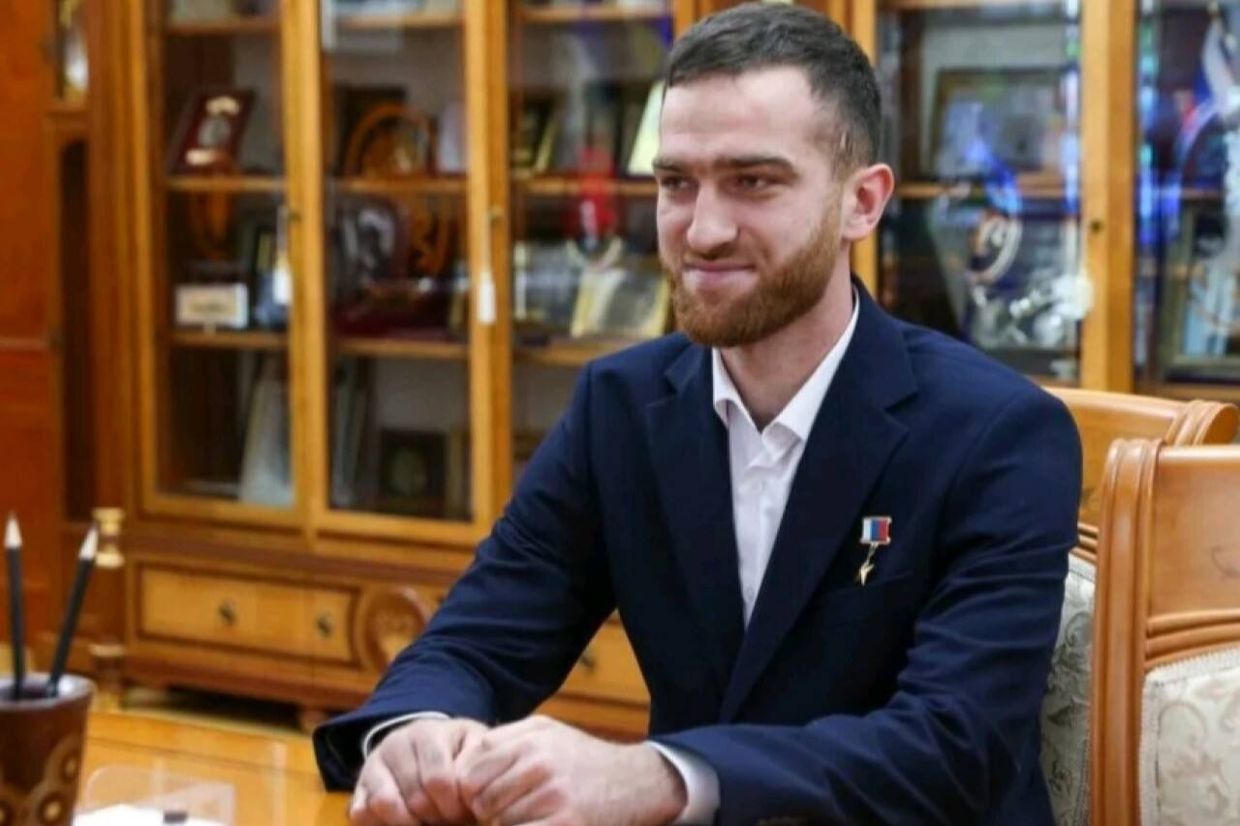
Russia’s Federal Security Service (FSB) claimed that former Ukrainian Security Service (SBU) officer Vitalii Zhykovich was behind an attempt on the life of Daghestan’s acting National Policy Minister Temirlan Abutalimov. Zhykovich is suspected of orchestrating a bomb attack on Ukrainian businessperson Vadym Yermolaiev in Monaco in late June.
On 16 July, the Russian state-run television channel RT reported, citing the FSB, that security forces had prevented a series of planned terrorist attacks, including an attack on Abutalimov in Makhachkala.
Zhykovich is reportedly a suspect in the case of the murder of Anastasia Berezovskaya, who was herself accused of carrying out the unsuccessful Monaco bombing. Ukrainian authorities have claimed the failed attack on Yermolaiev was a rogue operation.
According to the channel, it obtained audio recordings in which Zhykovich allegedly discusses preparations for terrorist attacks. According to these claims, he was involved in organising at least 20 planned attacks, including in the Stavropol region and Daghestan.
According to the report, the alleged agent converted to Islam in order to recruit radical Islamists to carry out attacks and attempted to organise the killing of Abutalimov. Zhykovich allegedly instructed an accomplice to place an explosive device in a juice carton inside a rubbish bin that the acting minister was expected to pass.
The FSB claims that Russian security forces were aware of the plan and decided to simulate its successful execution. As a result, according to the agency, Abutalimov survived and continues to head the ministry.
It is unclear when this alleged attack on Abutalimov took place. However, several sources claimed in March that the Daghestani official was the target of an assassination attempt.
The Telegram channel NIYSO claimed on 12 March that an explosive device had been placed in a rubbish bin near the entrance to a house in Karaman, near the Caspian Sea, and that the blast caused Abutalimov ‘serious injuries’.
Activists alleged that Abutalimov had been visiting a woman who provided him with ‘intimate services’.
After the alleged attack, Abutalimov did not appear in public for around a month. A month later, he published a photograph showing him with his head bandaged, wearing a neck brace, and with his arm in a sling.
Although Abutalimov did not directly explain the reason for his absence, he wrote that his ‘appearance speaks for itself’ and that he had ‘returned to duty’ after a ‘forced break’. He also reminded his followers to follow traffic rules, always use seat belts and child seats, and not exceed speed limits.
Abutalimov was born in 1997 in the village of Temiraul in Daghestan’s Khasavyurt district. After graduating from the law faculty of Daghestan State University, he completed compulsory military service in the Russian army and later worked as an investigator at the Khasavyurt police department. In 2022, he signed a contract with the Russian army.
He commanded an assault unit within the 70th Guards Motor Rifle Regiment of the 42nd Division of Russia’s Southern Military District. Russian official sources claim that he was wounded during fighting in Ukraine’s Zaporizhzhia region but continued to command his unit. In 2023, he was awarded the title of Hero of Russia.
Ukraine’s military intelligence agency (HUR) considers Abutalimov one of five commanders allegedly involved in the execution of four Ukrainian prisoners of war in May 2024 near the village of Robotyne in Zaporizhzhia. The accusation is based on intercepted radio communications.
Drone footage published at the time shows four unarmed people, reportedly Ukrainian soldiers, surrendering with their hands raised. The captors, believed to be Russian soldiers, force the Ukrainians to lie face down before shooting them at close range.
The HUR also said that Russian forces, including Abutalimov, may have been involved in the killing of several other Ukrainian prisoners of war in late May 2024.
After returning from the war, Abutalimov became a participant in the presidential personnel programme Time of Heroes, created to train managers from among participants in Russia’s invasion of Ukraine. In 2025, he was appointed acting Minister for National Policy and Religious Affairs of Daghestan.
In his new position, Abutalimov oversaw issues related to interethnic relations, cooperation with religious organisations, and programmes aimed at countering the ‘ideology of terrorism’. He also took part in meetings of the regional anti-terrorism commission.