Dear meeting participants,
I extend my greetings to you on the occasion of the Third Ministerial …
I extend my greetings to you on the occasion of the Third Ministerial …
 The South Caucasus News - SouthCaucasusNews.com
Fake pro-government accounts in Georgia
The organisation Myth Detector has identified a new network of so-called “trolls” comprising 445 fake accounts. The findings follow monitoring of the Facebook pages of TV channels Imedi and Rustavi 2, whose editorial policies align with the government’s agenda.
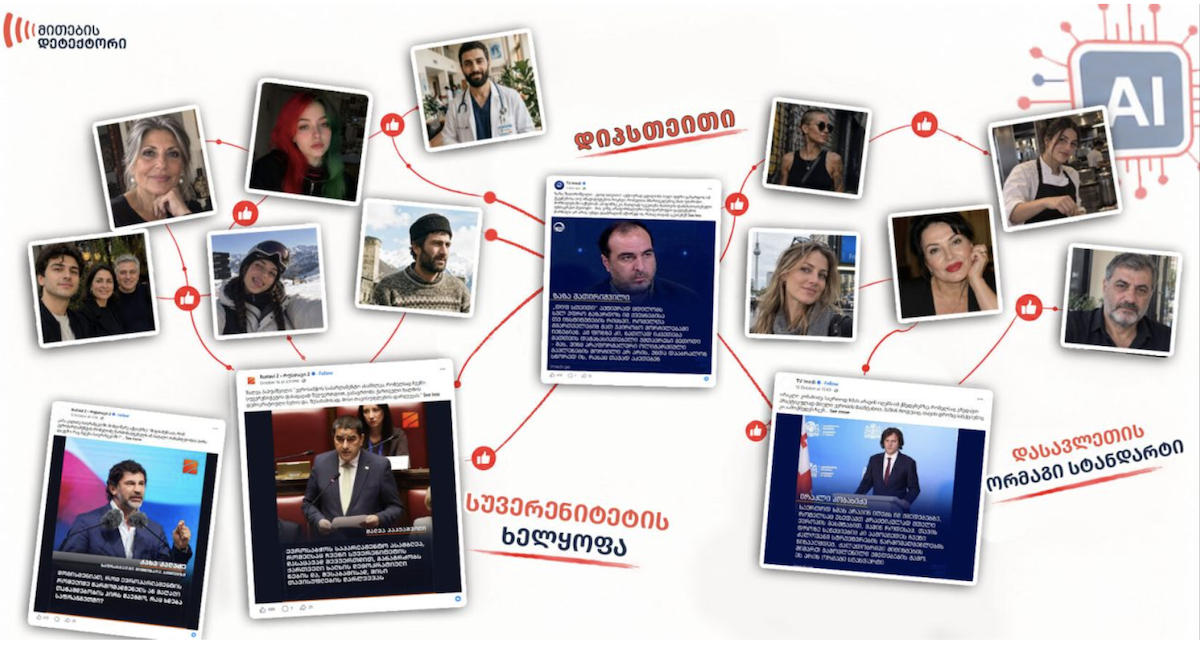
The accounts operate in a co-ordinated manner, liking posts by Prime Minister Irakli Kobakhidze, Parliament Speaker Shalva Papuashvili, Tbilisi Mayor Kakha Kaladze and pro-government philosopher Zaza Shatirishvili.
The posts cover topics including bans on opposition parties, Western interference in Georgia’s domestic affairs and threats to the country’s sovereignty. Myth Detector believes the aim is to create the impression of widespread public support for the government’s rhetoric.
In an earlier investigation, the same organisation identified 434 similar profiles. Myth Detector concludes that the emergence of new accounts indicates that the practice is continuing.
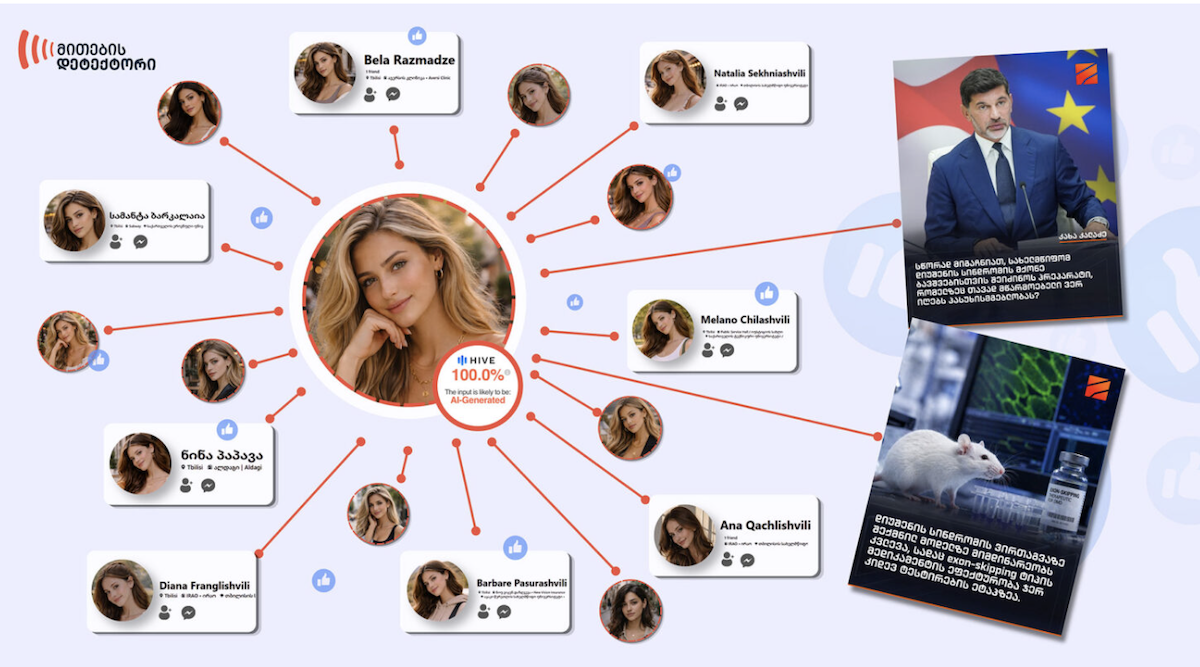
Monitoring revealed several common characteristics across the network of fake accounts: identical profile pictures; anatomical and geographical inconsistencies typical of AI-generated images; recurring first and last names; and similar patterns of behaviour on social media.
According to Myth Detector, most of these accounts were created within a two-day period. A total of 329 profiles were registered on 25 August 2026 and another 109 on 26 August.
Of the 445 accounts identified, 316 use AI-generated profile pictures. The remaining 129 feature images of public figures, landscapes, posters or photographs belonging to other social media users.
The organisation says some of the newly discovered accounts overlap with profiles identified in October by the non-governmental organisation ISFED.
According to Myth Detector’s analysis, the suspicious Facebook accounts were mobilised around posts published by TV channels Imedi and Rustavi 2. Their activity focused primarily on political statements by Prime Minister Irakli Kobakhidze, Parliament Speaker Shalva Papuashvili and Tbilisi Mayor Kakha Kaladze.
Co-ordinated likes were particularly noticeable under posts about a possible ban on opposition parties, Western interference in Georgia’s domestic affairs and alleged threats to the country’s sovereignty from Western institutions.
The fake accounts actively liked posts by Irakli Kobakhidze and Kakha Kaladze concerning a lawsuit against opposition parties filed with the Constitutional Court. Co-ordinated activity was particularly evident under a Rustavi 2 post in which Georgia’s Foreign Ministry described critical comments by EU representatives about a possible ban on opposition parties as interference in Georgia’s domestic affairs and an attempt to put pressure on the Constitutional Court.
Accounts mobilised around statements by Shalva Papuashvili supported the argument that foreign interference threatens freedom and democracy in Georgia.
Co-ordinated likes were also recorded under posts criticising the methods used to disperse protests in France and other European cities, drawing parallels with the situation in Georgia.
The accounts’ activity is not limited to engaging with posts by senior officials.
According to Myth Detector, co-ordinated likes also appeared under posts by pro-government philosopher Zaza Shatirishvili. He is one of the leading ideologues of the ruling team and the anti-Western platforms associated with it. His rhetoric closely echoes the narratives of the ruling party and its affiliated People’s Power movement.
Co-ordinated likes were also recorded under a post showing Bidzina Ivanishvili attending a party event, as well as under material covering a statement by Georgia’s Foreign Ministry.
According to the investigation, a significant proportion of the fake accounts attempt to imitate real people’s profiles.
They use photographs and biographical details of people with different ages, professions and interests, creating the impression of a diverse group of government supporters.
The profiles list a wide range of employers, including municipal and government institutions, banks, insurance companies, microfinance organisations and major media outlets such as Radio Free Europe/Radio Liberty and even the Pirveli TV channel.
In some cases, the stated place of employment does not match other information in the profile. For example, an account registered under the name Levan Kavtaradze features a photograph of a man standing beside a car during the grape harvest, yet lists the perfume and cosmetics retailer Voulez-Vous as his employer.
Keti Giorgadze’s profile lists Radio Free Europe/Radio Liberty as her employer, while the accounts of Temo Khitarishvili and Nutsa Simonia name the news service of Pirveli TV.
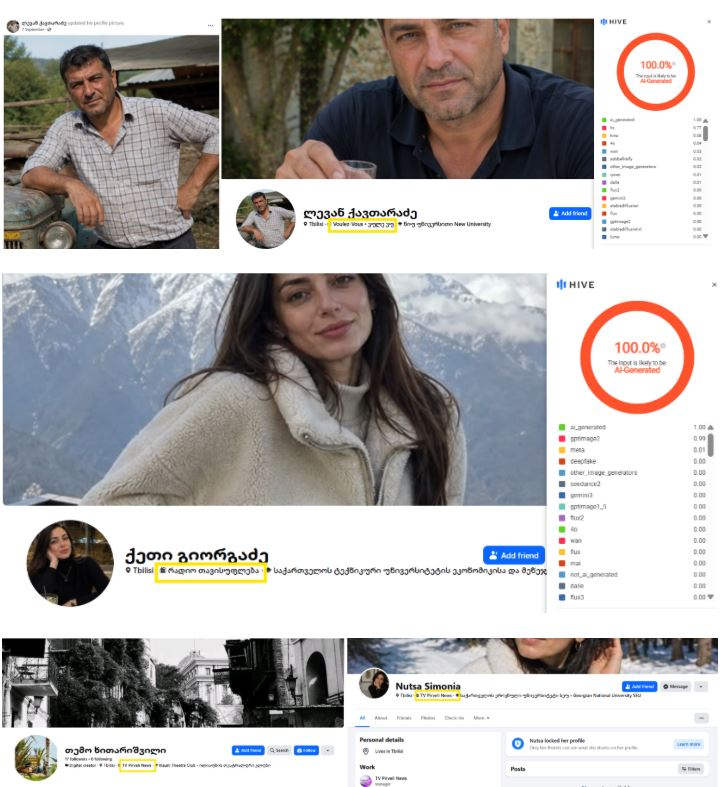
According to Hive Moderation, there is more than a 90% probability that the photographs found in the 445 accounts were generated using artificial intelligence. In some cases, the probability reaches 100%.
The images contain anatomical defects, inconsistencies in the surrounding environment and distorted text — all characteristic signs of AI-generated content. In some pictures, the number or shape of fingers looks unnatural, while others show altered architectural details, logos and national symbols.
A photograph posted by an account under the name Simoniko Janashia shows a person holding a cup with their left hand, which has six fingers instead of five. A mark associated with images generated by the Gemini AI model is also visible in the bottom-right corner of the picture.
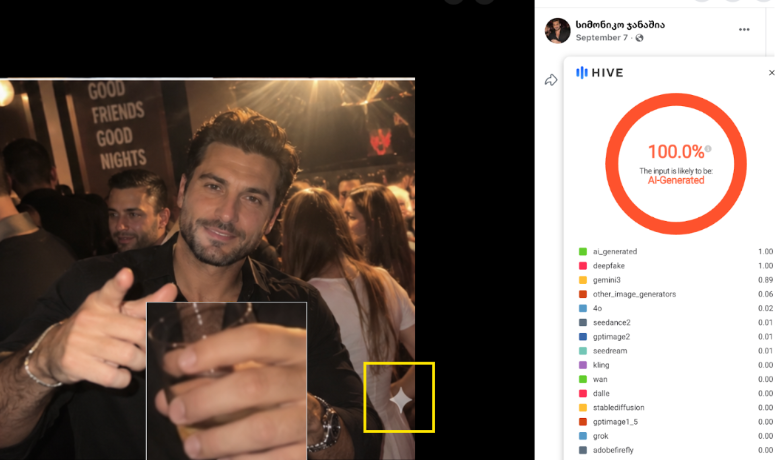
In other examples, a hand holding a wine glass is missing its little finger, while hands appear unnaturally fused together or blended into clothing.
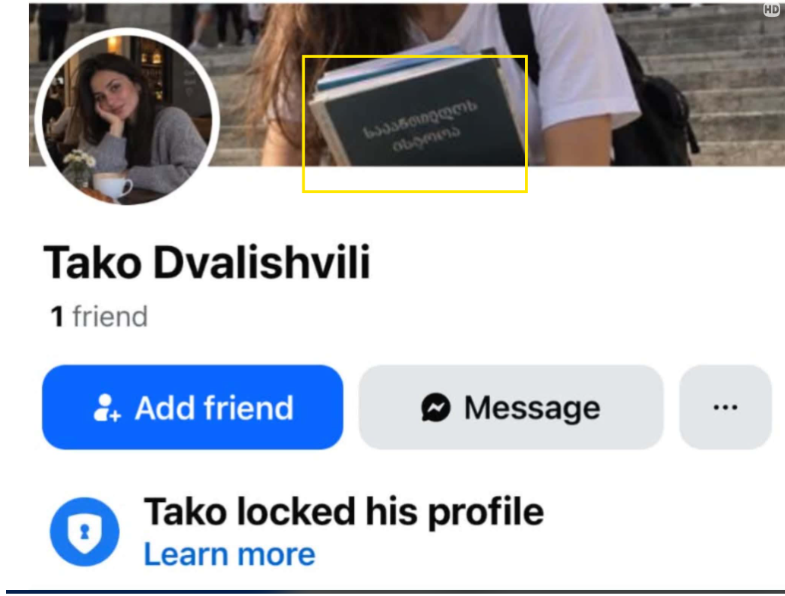
A photograph shared by Tako Dvalishvili shows a person holding a book. However, the text on its cover is distorted: instead of the words “History of Georgia”, it displays something illegible.
The organisation also identified geographical inconsistencies. Comparisons with genuine images of well-known locations in Georgia show that AI alters architectural details and surrounding landscapes, sometimes even adding structures that do not actually exist.
The investigation found that some of the newly identified accounts use profile pictures that had previously appeared on accounts uncovered by Myth Detector and later removed by Facebook.
In some cases, these visual similarities include identical anatomical flaws characteristic of AI-generated images. For example, photographs used in personal profiles under the names Tako Chagelia and Nia Gamkrelidze show the same finger defect previously observed in the profile picture of an account attributed to Maiko Vibliani.
The investigation also identified other common patterns in the behaviour of some accounts. A total of 196 profiles had liked the Tbilisinews.ge page, 14 had liked Ai Politika and three had liked Rustavi 2. Fake accounts identified by the organisation in previous investigations had also liked the Ai Politika page.
Most of the suspicious profiles have no friends at all, while some have only one or two. The investigation also uncovered accounts created in 2024 with friend lists ranging from 169 to 4,800.
Fake pro-government accounts in Georgia