Categories
South Caucasus

Georgian election monitoring watchdog finds hundreds of fake Facebook accounts supporting Georgian Dream


Photo: ISFED.

The NGO International Society for Fair Elections and Democracy (ISFED) has identified a coordinated network of 424 inauthentic Facebook accounts that artificially boosted posts by Georgian Dream leaders.

The accounts were reacting positively to posts by Georgian Dream leaders, including Prime Minister Irakli Kobakhidze, Parliamentary Speaker Shalva Papuashvili, Tbilisi Mayor Kakha Kaladze, and parliamentary leader Irakli Kirtskhalia.

Meta hasn’t responded to the study, but has previously blocked accounts that ISFED identified as bots.

Many of the posts that the network amplified dealt with similar themes: criticism of the 4 October ‘peaceful revolution’ in 2025, negative depictions of EU relations, and criticism of Western partners.

Papuashvili dismissed the findings in response to a question from opposition-leaning media outlet TV Pirveli; the parliamentary speaker suggested that NGOs could be creating such accounts themselves and then identifying them. He claimed that Georgian Dream had 1.2 million genuine supporters, a figure he said had remained consistent for 14 years, and accused one of TV Pirveli’s main donors, Mamuka Khazaradze, of having an interest in fabricating support. Khazaradze is also chair of the opposition Lelo party.

ISFED found that 424 of the accounts they studied were created on 25–26 August 2026, with 303 created on 25 August and 109 the following day. The organisation said their Facebook identification numbers were close to one another, suggesting the accounts had been registered in bulk within a short period.

Of the 424 accounts, the watchdog found that 295 used AI-generated profile pictures, while 298 had private profiles. ISFED also identified 22 accounts using pictures of well-known athletes, actors, and directors.

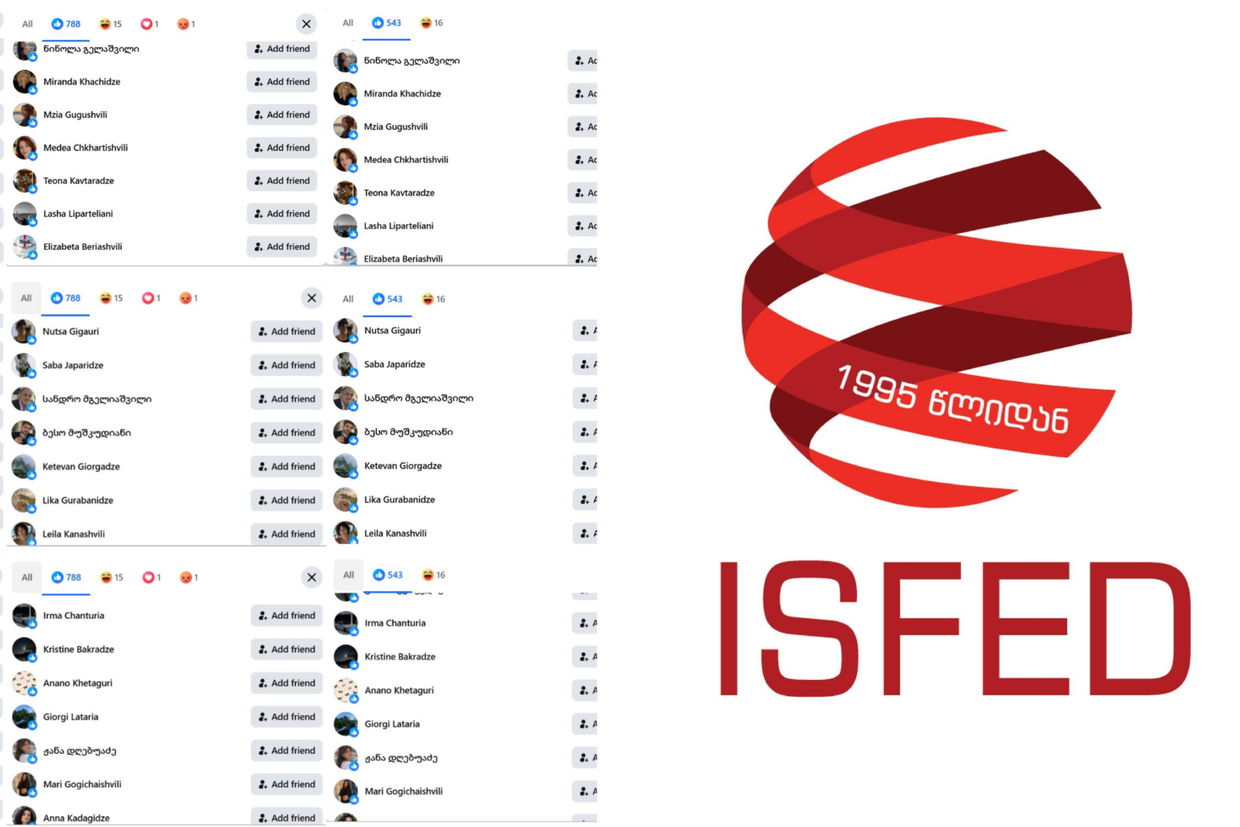
The organisation found several signs of coordinated activity suggesting that they operated as bots.  For example, the accounts appeared in identical order in lists of people reacting to at least 10 posts, with groups of accounts repeatedly appearing together across different posts. ISFED said this suggested that the accounts were liking posts in coordinated groups rather than acting independently.

Many of the accounts also followed the same Facebook pages. For example, 235 followed a page called ‘Tbilisi news’.  333 accounts that liked one of the Georgian Dream leaders’ posts had also reacted to two posts published by the page.

Counterintuitively, the ‘Tbilisi news’ page, created on 3 September 2026, does not publish news about Tbilisi. Instead, it posts English-language content about artificial intelligence in business and social media automation.

While most of its posts received almost no reactions, two posts published on 7 and 9 October received 352 and 349 likes respectively, without any comments or shares.

ISFED found that the overwhelming majority of people who liked these posts belonged to the same network.

The organisation claims the findings indicated that the accounts were managed from a single centre and aimed to create an artificial impression of public support for the ruling party.

ISFED also identified 11 accounts in the newly discovered network that were created in January and April 2024, around the same time as accounts in a previously identified network that boosted an Imedi TV Facebook post featuring Bidzina Ivanishvili alongside Georgian independence figures Merab Kostava and Zviad Gamsakhurdia. Following the publication of its investigation into the earlier network, 1,343 of the 1,551 accounts were no longer searchable on Facebook, ISFED reported.

Separately, another watchdog, Myth Detector, which is part of the Media Development Foundation NGO, has identified more than 400 profiles using AI-generated profile pictures and supporting Georgian Dream online during 2026 so-far.

Categories
South Caucasus News

How Much Is a Tesla? Here’s What the Model 3, Model Y, Model …


We breakdown the cost of every single Tesla you can buy. From Model 3 and Model Y to Cybertruck and more, here’s what each Tesla will set you back.

Categories
South Caucasus News

Fire continues at oil terminal in Russia’s Rostov after attack – video shows aftermath


Categories
Azerbaijan Airlines plane crashes in Kazakhstan

US threatens to suspend intel sharing, weapons purchases if Ukraine continues Russia energy strikes, sources say – KDRV


US threatens to suspend intel sharing, weapons purchases if Ukraine continues Russia energy strikes, sources say  KDRV

Categories
Articles, Blog, and Tweets Blogs and Tweets

@mikenov: The true, in depth 9/11 investigation was suppressed by the Bush Administration and Robert Mueller’s FBI – Google Search


The true, in depth 9/11 investigation was suppressed by the Bush Administration and Robert Mueller’s FBI – Google Search google.com/search?q=The+true…

Categories
Articles, Blog, and Tweets Blogs and Tweets

@mikenov: The “TRUTHSEEKERS” they are! Do not lie to them! #CIA CIA #FBI FBI #Mossad Mossad Google AI: “The FBI actively restricted, delayed, or classified critical pieces of evidence in investigation of 9/11.” (My Opinion: Under the orders from ABOVE, pu


The “TRUTHSEEKERS” they are! Do not lie to them!
#CIA CIA #FBI FBI #Mossad Mossad
Google AI: “The FBI actively restricted, delayed, or classified critical pieces of evidence in investigation of 9/11.”
(My Opinion: Under the orders from ABOVE, pushing their lame “Al Qaeda” version.)
The claim that the Bush Administration and Robert Mueller’s FBI suppressed the 9/11 investigation is a subject of significant historical debate, involving documented political friction, institutional resistance, and subsequent declassifications rather than a blanket suppression. While official investigations did take place, multiple independent sources and former officials have detailed specific instances where the administration and the FBI actively restricted, delayed, or classified critical pieces of evidence.

The true, in depth 9/11 investigation was suppressed by the Bush Administration and Robert Mueller’s FBI – Google Search google.com/search?q=The+true…


Categories
South Caucasus News

Nacionalni park “Plitvička jezera”


Welcome to the official website of Plitvice Lakes National Park! With its exceptional natural beauty, this area has always attracted nature lovers, and already on 8 April 1949, it was proclaimed Croatia’s first national park.

Categories
South Caucasus News

European gas prices rise 1.8% amid LNG supply concerns


Natural gas prices in Europe have started the week higher, with futures contracts at the Dutch TTF hub rising 1.8% to €83.32 per megawatt-hour.

Categories
South Caucasus News

Azerbaijani serviceman’s incursion into Armenia does not call established peace into question, Pashinyan says – Armenpress


Azerbaijani serviceman’s incursion into Armenia does not call established peace into question, Pashinyan says  Armenpress

Categories
South Caucasus

Sites of Memory of Western Azerbaijan: History of Boyuk Mazra


As part of the “Sites of Memory of Western Azerbaijan” project, research has been published on the history of Boyuk Mazra (present-day Mets Masrik), an Azerbaijani village in Armenia where Armenian armed groups carried out a massacre of the native population.

According to Report, the article was published on Perished Civilization.

The village was known as Mazra Bolshaya and Kuli-Agalu during the Tsarist period and as Mets Mazra during the Soviet period. Sources predating the early 19th century mention a single village named Mazra, while later documents identify two separate settlements: Boyuk Mazra (present-day Mets Masrik) and Kichik Mazra (present-day Pokr Masrik).

In April 1991, Boyuk Mazra was renamed Mets Masrik as part of what the project describes as a policy of Armenianization and the erasure of Azerbaijani heritage in Armenia.

Since 1995, the village has been part of Gegharkunik Province of the Republic of Armenia.

Under the 1724 Russo-Ottoman Treaty of Constantinople, the territory of the present-day Republic of Armenia was recognized by Russia as part of the Ottoman Empire.

In 1728, Ottoman officials drew up the Summary Register of the Iravan Eyalet, which recorded the names of settlements. The document mentions a single village named Mazra.

From the mid-18th century until the Russian conquest, the territory of the village formed part of the Goycha mahal of the Iravan Khanate.

Russia occupied the territory of the Iravan Khanate in 1827, and its incorporation into the Russian Empire was formalized by the 1828 Treaty of Turkmenchay. During the Tsarist period, the village formed part of the Novobayazet Uyezd of the Erivan Governorate.

Between 1829 and 1832, an administrative census of the territories of the former Iravan and Nakhchivan khanates was conducted at the direction of the Russian authorities. According to the census, Boyuk Mazra had 293 inhabitants, all of whom were ancestors of present-day Azerbaijanis.

Tsarist-era statistical records, also cited in Armenian sources, indicate that at various times before 1915, the village was inhabited exclusively or predominantly by ancestors of present-day Azerbaijanis.

In 1873, the village had 956 inhabitants, all of whom were ancestors of the Azerbaijanis. In 1906, it had 1,842 inhabitants, predominantly ancestors of the Azerbaijanis. In 1915, the village had 1,970 inhabitants, predominantly ancestors of the Azerbaijanis.

Between 1918 and 1920, Dashnaktsutyun, the nationalist party that held power in the Republic of Armenia, carried out what the project describes as ethnic cleansing of the Turkic population in the Erivan Governorate and other areas, particularly in Zangezur, Karabakh and Nakhchivan.

According to archival documents cited by the project, Armenian troops carried out a massacre in Boyuk Mazra in mid-April 1919, and the village itself was destroyed. The project says the consequences of the ethnic cleansing can be seen by comparing the number of Turkic inhabitants living in the village in earlier years with their number recorded in the 1922 census of Soviet Armenia.

In 1959, the village had 2,697 inhabitants, predominantly Armenians.

Between 2021 and 2024, extensive fieldwork was conducted across the territory of Armenia, including in remote mountainous regions, in preparation for the book The Perished Civilization. The research focused on identifying and documenting Azerbaijani heritage sites. During the fieldwork, an Azerbaijani cemetery with several dozen gravestones, some of which have survived, was discovered in the village.

The “Sites of Memory of Western Azerbaijan” project is described as a unique research initiative. During field studies conducted across the territory of present-day Armenia, information on nearly 600 villages once inhabited by ancestors of present-day Azerbaijanis was collected and systematized for the first time. Fragments of Turkic cultural and historical heritage, including cemeteries, sacred sites and mosques, remain in some of them.