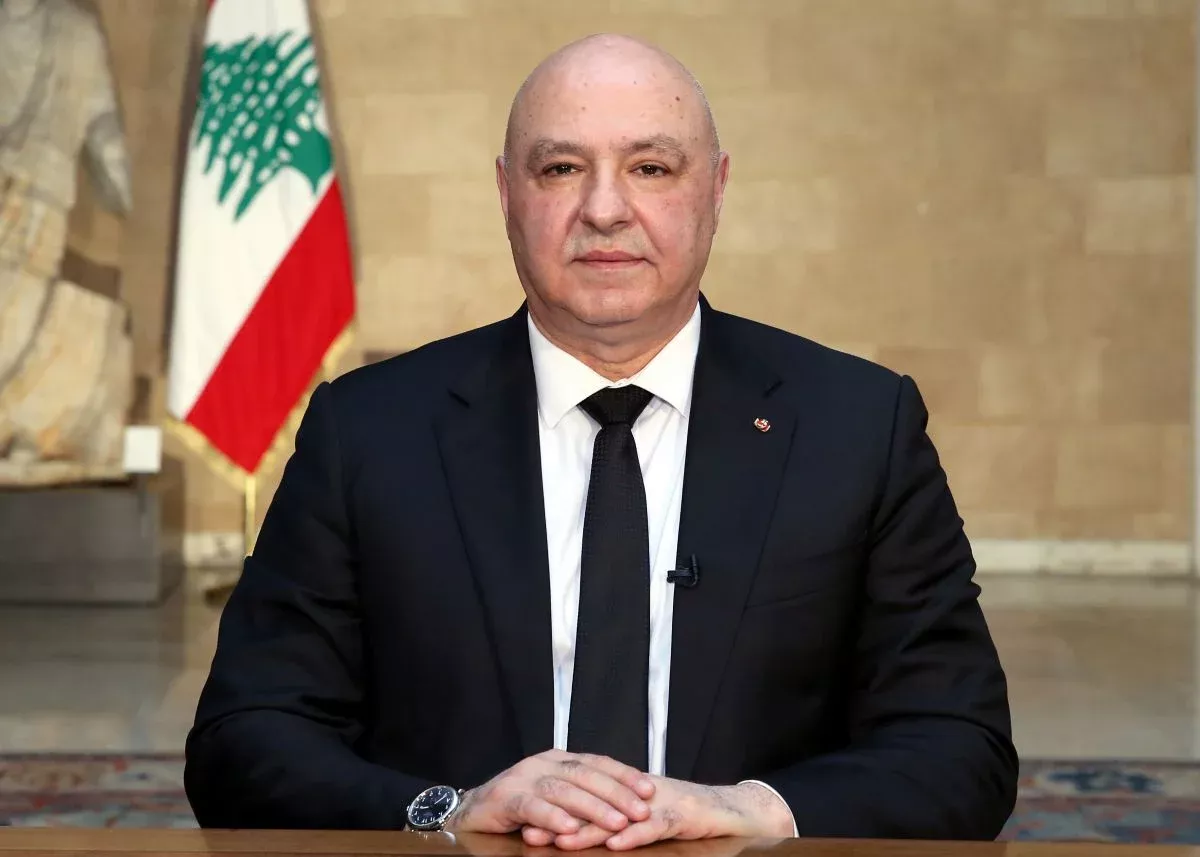
Lebanese President Joseph Aoun stated that the framework agreement with Israel “does not legitimise the continued occupation,” Lebanese broadcaster MTV reported….
 The South Caucasus News - SouthCaucasusNews.com
For several years now, Gia Gachechiladze has been sitting in the same boat. The musician and pro-government activist, also known as Unknown (Utsnobi), calls the boat installed in his Maestro TV studio an “ark,” but it is not nearly large enough to justify the name, even if Utsnobi himself aspires to things larger. Those who have to think about affording “meat, bread, cheese, tomato” may not have enough ability to “think on a larger scale,” he complained in one of the latest episodes of “Utsnobi’s Ark” — a TV show that features him in conversation with a guest. The two usually spend hours sitting in that boat (*ark) and ranting about the opposition or whoever else is getting on their nerves.
Georgia is in the avant-garde of the “most serious” global battle, he argued in that episode, a battle between spirituality and the absence of it, and yet not everyone can spot it. Over and over again, he tried to sympathize with those who lack the time or ability to see the bigger picture. Over and over, he tried to excuse the poor, because they have to think about the price of “sausage” or medication before moving on to higher philosophical questions. Over and over, his attempts at empathy failed. The ongoing food price debate, which the ruling Georgian Dream party itself had started, did not quite fit into his narrative, but there was no avoiding it.
“But, Gia, no one has ever won a battle against God,” his guest, Liza Gegechkori, a pro-ruling party voice, agreed by confronting him. That’s how people here learned to agree over time — by confronting each other and oneself, satisfying cravings for tension just when actual spaces for disagreeing with opponents vanished. But it used to be different, and our spaces used to be just as large as Utsnobi liked them: before the boats, we would all sit, or stand, in Utsnobi’s trains.
Here is Nini and the Dispatch newsletter, back to talk about trains, boats, and bouts of unity in Georgia.
Whoever has been to Georgian weddings may be familiar with the ritual. Hours into the feast, after all the traditional songs have been sung, all the mandatory toasts have been made, and that one energetic young man from the groom’s side has danced with every woman, the time comes to “stand in the wagon.”
“I‘ve got a strange feeling, this country has turned upside down…” — as the lyrics kick in, guests start pulling each other onto the dance floor. By the time the last part of the slow, melancholic intro plays, about how only our Georgia got wet when “the rain filled everyone around,” guests are already there, standing in a circle and ready. Then the song switches to a faster, upbeat rhythm, and for the next few minutes, the circle moves around as more join with their hands on each other’s backs in a “train” dance.
Utsnobi released his song — “The Wagon Races” — sometime around the New Year 2002, and it instantly became a national hit. The clip, directed in rouge-et-noir visuals, featured a brand-new red train with everyone you knew from television getting aboard and doing their own strange things.
Gia Gachechiladze was young and popular then. Wearing a mask and flat cap, his stage persona was somewhat cool and mysterious, even if he at times looked like some neighbor’s uncle dressed in Zorro cosplay. Most importantly, Utsnobi was a rebel: his performances were meant to produce noise and scandal, his lyrics shifted from odes to a bald turtle to satire of traditional family and gender roles, and his other clips, too, featured every celebrity you knew doing weird movements. Some of those clips were also meant as campaign songs for the New Rights, an opposition party led by his popular brother, Levan Gachechiladze, but that was fine: despite its conservative appeal, the New Rights felt new and right at the time.
Those everyone clips came as part of a broader global trend. Apparently inspired by the 1985 We Are the World all-star performance, the trend was fondly embraced in Georgia, where, during the tumultuous transition to regained independence, such projects came to symbolize something much craved yet unattainable: unity.
The first such single, “Give Tulips to One Another” (Vachukot Ertmanets Titebi) — an emotional tribute to the April 9, 1989, massacre — came out in the late 1980s and featured Georgia’s most famous musicians.
Another big hit — “Rejoice” (Gikharoden) — was released at the dawn of the 21st century. The song blended a catchy melody with patriotic lyrics as members of Georgian Estrada, a term denoting an interconnected circle of celebrity performers, took turns singing. Gikharoden was meant to show unity in the face of persisting challenges and channel some hope toward the coming millennium, yet everyone knew it was a campaign song for then-President Eduard Shevardnadze’s ruling party.
The trend, which became increasingly and inevitably politicized, lasted well into the years of United National Movement rule. As political discourses shifted, another such clip, “Greetings, Abkhazia” — with a song based on the famous verses by Georgian poet Galaktion Tabidze — featured all stars again, all heading to Abkhazia by means of transport of their choice: some hitchhiking, some by train, some by plane, some on a motorcycle, some by boat, and some by cruise ship named, unsurprisingly, “Unity.” Then-President Mikheil Saakashvili, too, briefly appears in the clip, seen on a television screen as he energetically articulates plans to develop Sokhumi – “Georgia’s most beautiful city.”
And then the trend slowly disappeared, as did rebellion, and as did people.
When, in 2023, at the end of a conservative rally he organized, Utsnobi presented his new clip, “This is Paradise — This is Georgia,” to a crowd, critics noted one important detail: the video featured Georgia’s green valleys, mountains, and beautiful rivers, but, very much in contrast to his earlier clips, there were almost no human beings in it. That rally was called in reaction to initial successful protests against the Foreign Agents Law. Utsnobi was a reactionary now, even if still posturing as a rebel, just like many other former revolutionaries who continued to pretend they were fighting the power while being the ones in power.
But at least nobody pretended to be fighting for unity anymore. There was no longer any point in bringing all kinds of people together to pose or sing in clips: divisions were now as hard to ignore as high grocery prices, and those earlier demonstrations of unity, too, now seemed merely to be unities of small, closely connected networks from downtown Tbilisi, who would occasionally gather to have a good time while the rest were expected to watch, “rejoice,” and forget, for a few moments, about their daily “cheese” and “tomato” worries.
“For a few moments” is also how long bouts of unity usually last these days. Whether during football celebrations, effective solidarity campaigns, truces between mutually despising opposition parties, or a patriarch’s funeral attended by the masses, we rush to label every collective action as “unity” and feel disappointment when it crumbles the next day.
Perhaps they crumble because they are merely reactive, even if sincere, efforts in response to occasional crises, tragedies, or moments of joy; and perhaps true, lasting unity would require something more than a large group of people simply heading to the same destination for a brief moment in time: it would require all those people who are on the same train still allowing others to get off, or take different paths, if they choose to.
Like a cat obsessed with boxes, Utsnobi has roamed the earth since that train song searching for his rightful place and space where he could rebel. First, as a form of resistance to Mikheil Saakashvili’s rule, he spent some time sitting in an improvised prison cell, set up similarly in the TV studio, and inspiring protesters to erect an entire “cell town” on Rustaveli Avenue. Then, long after Saakashvili’s rule had ended, he finally found a more solitary boat, which he called an ark — to convey its mission of “moral survival” — and settled into it, even if, unlike the original Noah’s Ark, he rarely allowed more than a few living creatures aboard at a time.
But Georgia never forgot about his trains. To this day, hours into the wedding feast, when enough has been drunk, and alcohol has blurred political divisions, people still stand in the wagon, whether in the countryside or in downtown Tbilisi, as we are told.
What is it that still allows for those fleeting expressions of unity, real or fragile, in these polarized times?
Perhaps the musician himself has answered the question: these are the brief moments when, having wined and dined and filled one’s belly, one can still afford to dream their Georgian dreams “on a larger scale.”