
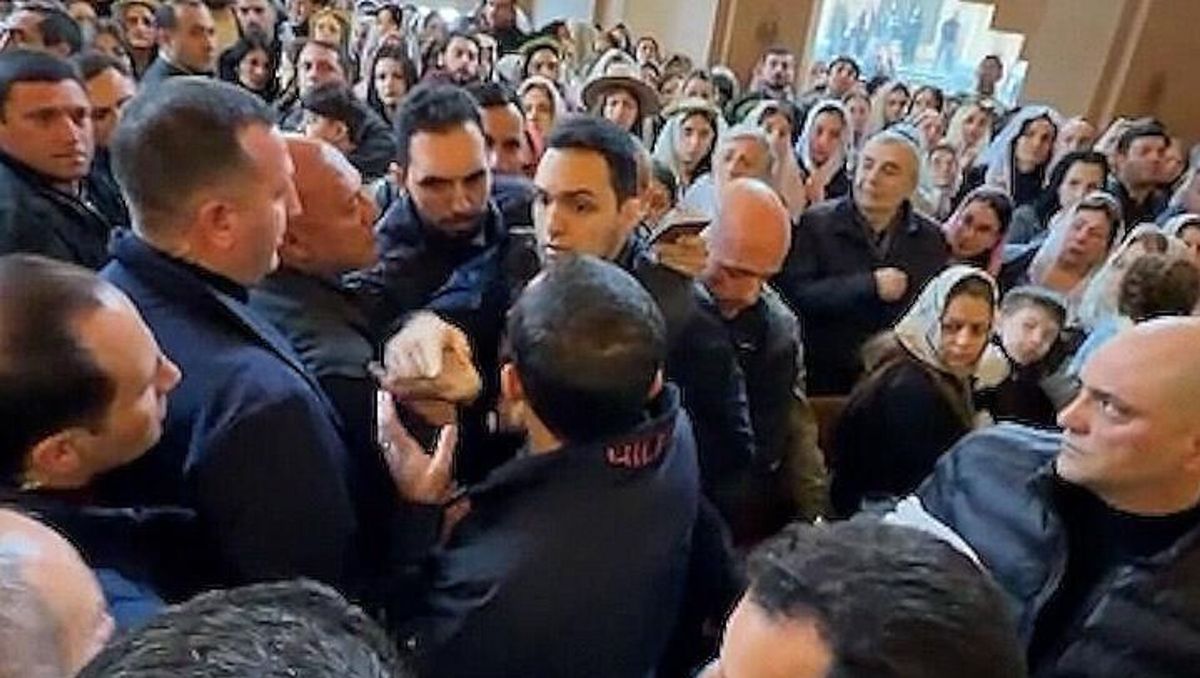
Attempt to strike Nikol Pashinyan in church
All of Armenia is discussing an incident at Saint Anna Church, where on Sunday a parishioner attempted to strike Prime Minister Nikol Pashinyan. The Investigative Committee of Armenia says three people have been detained.
Most residents and members of the expert community have condemned such behaviour towards the country’s leader. However, some argue that the PM “provoked” the incident. In particular, critics point to the fact that Pashinyan, accompanied by a group of bodyguards, entered the church while it was filled with worshippers and attempted to move toward the altar during the service.
However, the majority of social media users and analysts say such behaviour towards the country’s leader should receive an appropriate response from law enforcement authorities. Otherwise, they warn, democracy in Armenia itself could be put at risk.
Details of the incident and expert commentary follow.
- Former ruling party MP becomes Constitutional Court judge in Armenia, NGOs warn of risks
- ‘Opposition forces are parties of war,’ says Armenia’s parliament speaker
- ‘Stigmatising refugees is unacceptable’: Pashinyan refers to Karabakh Armenians as ‘fleeing people’
“Don’t look at me like that”: what happened in the church
On 29 May, the Armenian Apostolic Church marked one of its most widely celebrated holidays — Palm Sunday. Nikol Pashinyan and his team, as in recent weekends, were conducting an internal party campaign in Yerevan. However, after the church service had already begun, the prime minister and those accompanying him unexpectedly entered the crowded Saint Anna Church.
Security officers cleared a path for Pashinyan as he moved toward the altar and later toward the exit, attempting to make their way through the crowd. Before launching his party campaign and weekly meetings with residents of the regions and the capital, the prime minister used to attend different churches every Sunday and would typically remain until the end of the service. This time, however, he arrived later and decided to leave early.
As Pashinyan was leaving the church, one of the parishioners became angered when security officers tried to move him aside. He said he wanted to remain where he was standing.
“Don’t look at me like that,” the young man told the prime minister before attempting to strike him.
Pashinyan remained calm and called on his bodyguards to keep calm as well.
Church incident. Video by Factor TV
The young man was detained. Initially, police reported that two people had been taken into custody. Later, the Investigative Committee of Armenia said that three individuals had been detained: Gevorg Gevorgyan, as well as brothers David Minasyan and Mikael Minasyan.
The committee said a criminal case had been opened under two articles: hooliganism and interference with the lawful official and political activities of a public official.
Commentaries
Political analyst Robert Ghevondyan said:
“Freedom of speech is one of the most important conditions of democracy, but it is not the only one. Equally important are the inviolability of personal space and protection from violence for one’s views. The guarantor of these principles is the state.
Therefore, if the people detained the previous day [for insulting parliamentary speaker Alen Simonyan] and those detained today for attempting violence against senior state officials are released in two or three days, this will mean that the authorities are unable to protect even their own freedom of speech and opinion from violence, let alone that of other citizens.
Consequently, if these individuals are released from responsibility on bail, surety, or by any other means, it will mean that there is no democracy in Armenia.”
Political analyst and international relations expert Sossi Tatikyan said:
“It is strange to watch how some opposition figures and even analysts or political scientists attempt to justify an attempt at physical violence against the leader of Armenia and consider the arrest of the instigator a violation of democracy.
Moreover, this is being done by representatives of political forces that initiated a culture of violence in Armenia.
Do you know how any democratic country would respond to such an act against the head of state?
We are not talking about throwing a tomato — something that has happened more than once in democratic countries and could be classified as a form of protest or hooliganism — but about a real attempt at violence. Not to mention what would happen in a non-democratic country.
At the same time, I have noticed that some of the prime minister’s fiercest critics have condemned the attempt at violence against him, which is commendable.”
Political analyst Hakob Badalyan said:
“Entering a crowded church accompanied by bodyguards… Why? To show that you are a believer? Or simply for publicity? If you have entered a church, why not remain near the entrance rather than trying to move toward the altar in a packed church accompanied by bodyguards and others, creating inconvenience and effectively disrupting the service?
In essence, Prime Minister Nikol Pashinyan today made what could be described as a ‘provocative visit’ to Saint Anna Church, where a service marking Palm Sunday was taking place.
Simple logic suggests that if the prime minister’s aim in coming to the church had been to attend the service, he could have entered and quietly stood near the entrance without drawing unnecessary attention or causing inconvenience to those gathered.
Instead, he entered the church and moved forward with a large group. The bodyguards, of course, were doing their job — they had to ensure as much distance as possible between Pashinyan and the people around him. That is their function and a strict professional protocol. Precisely for that reason, the prime minister should have refrained from taking this step.
That is why his action is difficult to assess as anything other than provocative. And the provocation occurred: a young man attending the service could not hold back, spoke out, and the incident followed.”
Follow us – Twitter | Facebook | Instagram
Attempt to strike Nikol Pashinyan in church