
Month: June 2024

Michael Ratney, the US ambassador to Saudi Arabia, has said that a “historic” security deal currently under negotiation between the two countries has the potential to fundamentally change the landscape of the Middle East for the better.
Appearing on the Arab News current-affairs show “Frankly Speaking,” Ratney was optimistic the deal would both clarify and cement the decades-old relationship — based at present on verbal agreements — between Saudi Arabia and the US.
“We overuse that word ‘historic’ but it would be a historic agreement and it could fundamentally change the landscape in the Middle East for the better,” he said.
“Political cooperation, security cooperation, economic integration.”
US Secretary of State Antony Blinken recently said the deal, which would see Saudi Arabia agreeing to normalize ties with Israel in exchange for closer US integration and recognition of a Palestinian state, could be just weeks away.
Despite the mutual enthusiasm for the deal, Ratney would not be drawn on the exact timeline for its conclusion, warning there were many moving parts, in particular the willingness of Israel to hold up its end of the bargain.
“I don’t think there’s anybody involved in these negotiations that wouldn’t like to have it finished tomorrow,” Ratney told Katie Jensen, the host of “Frankly Speaking.”
“But since all of that is a part of this agreement and these are extraordinarily complex and detailed discussions, I don’t think I could put a timeline for it.
“There ar also other elements of it including a US Senate role and obviously the situation in Israel weighs on this as well.
“So as much as we would like to get this done tomorrow, we are going to proceed as quickly as we can, as seriously as we can. And we’re going to get this done as soon as all of the pieces fall into place.”
What makes the deal so significant is that it clearly sets out the parameters of the Saudi-US relationship and safeguards them against the political whims and particularities of future US administrations, lending the partnership a degree of certainty.
“That’s why it’s an agreement that would involve US Senate ratification,” said Ratney. “US Senate ratification means it is a formal agreement that doesn’t depend on a particular administration.
“It would be an enduring agreement not between an administration or a government but between two countries. And in that, that brings certainty. It brings certainty to us. It would bring certainty to the Saudis as well.”
Commentators have drawn parallels between the proposed Saudi-US deal and the Treaty of Mutual Cooperation and Security between the US and Japan, signed in 1960. Asked whether these assessments were accurate, Ratney said he could not go into specifics.
“I’m really reluctant to get into those sorts of details,” he said. “Those are exactly the kinds of things that are subject to negotiations at the highest level of our government and the highest level of the Saudi government.”
He did, however, say the deal would include upgrades to the security partnership and economic relations, while also taking steps toward meeting Saudi Arabia’s demand for an independent Palestinian state alongside Israel.
“Let’s just say this would be a historic agreement that would upgrade the security partnership between the United States and Saudi Arabia. It would upgrade the economic relationship. It would bring Israel and Saudi Arabia essentially into the same region. And it would bring benefits and a path to statehood for the Palestinians.
“So, that’s a lot. It’s a complex set of discussions. And I’m really reluctant to get into the details of things, some of which are still yet to be negotiated.”
The success of the deal hinges to a significant degree on Israel’s cooperation. However, the government of Benjamin Netanyahu, which has two powerful far-right ministers, has been reluctant to give way on Palestinian statehood and end the war in Gaza.
Ratney, who previously served as a diplomat in Israel, said there was much to be gained for the region.
“I would say all the elements that we have discussed are of extraordinary value. The real value is taking it all together,” he said.
“All of those elements that have been under discussion, all of the US-Saudi pieces and the Israel and the Palestinian pieces taken together could fundamentally change the landscape of this Middle East.
“And that is the lens through which we see it and it’s certainly the lens through which the US Senate sees it and they ultimately would have a vote to ratify it.”
However, US lawmakers have been reluctant to pressure Israel to accept a ceasefire in Gaza. Asked whether Washington’s decisions could radicalize a generation of Arab and Muslim youth and create a Hamas 2.0, Ratney said careful diplomacy was required to achieve a lasting peace.
“It’s impossible for anyone who watches these scenes on a daily basis, and it’s certainly impossible for anyone that knows friends and family who have been engulfed in this conflict, not to be moved by it, and not to be motivated to find a solution as soon as possible, to find an end to the violence in Gaza, to find an end to the threats to Israeli security, to find a path to statehood, so that this sort of, for Palestinians, to ensure that this sort of conflict doesn’t resume,” he said.
“The diplomacy involved with that is extraordinarily complex, and there’s areas that we pursue, and there’s positions that we take that sometimes aren’t popular, but they’re based on our sense of the most expeditious, the most effective way of pursuing it.”
Ratney was further challenged by Jensen, who asked him whether the whole world could be wrong on Israel and why the US appears reluctant to listen to its closest allies and apply firmer pressure on its ally.
In response he said: “I think it’s safe to say that both President Biden, Secretary Blinken, all of our senior officials, have been heavily involved. This has been a major preoccupation of theirs since the outbreak of violence on Oct. 7.
“They have been in the region steadily. Secretary Blinken has been here six times since October 7, our national security adviser as well. In almost every case, that involves visits to Israel as well, where they have, sometimes, very difficult and very direct conversations.
“We have an important relationship with Israel, we have an important partnership with Israel, and we utilize that relationship and partnership to find a decent end to this conflict.”
Saudi Arabia and the US had differences of opinion on regional issues after the Biden administration took office in 2020. However, after President Biden visited the Kingdom in 2022, the differences have made way for greater convergence of opinions.
Ratney, who has been ambassador to Saudi Arabia for a year, said the bilateral relationship was already better when he took up his posting, and that there was potential for even stronger ties.
“When I got here a little over a year ago, the relationship felt like it was in a good place. And I do think that’s the case. And I think over the last year, it has gotten better and better as our partnership has diversified, as we’ve delved into negotiations over a potential historical agreement between our countries.
“So, if I look ahead a year, two years, three years, what I’d like is that trajectory and the speed of that diversification and partnership to continue.”
Ratney said he has been impressed by the pace and scale of change in the Kingdom in recent years, particularly the empowerment of women — least of all the lifting of the ban on women driving.
“Women driving is really the tip of the iceberg,” he said. “The big change, the big innovation — and it has fundamentally changed the face of this country — is the fact that women are involved in every aspect of the economy, in every aspect of society.
“And that’s as simple as me going into meetings with senior government officials and seeing women are full participants in these discussions.
“And they’re not there as symbols. They’re highly educated, in many cases, as well-educated or better educated than their male counterparts, often at US universities. And it’s an extraordinary thing to see.”
Turning to areas of cooperation and opportunities between the US and Saudi Arabia, Ratney said there was now scope for trade and exchange in high technology and the creative industries.
“We work heavily with US companies that become intrigued by this market, to export to this market, to partner with Saudis here and invest here, and we see it in areas like not just healthcare, but infrastructure,” he said.
“Obviously, this country is making huge investments in infrastructure and US companies bring real value there. In high tech, Saudi Arabia has ambitions to become a hub for innovation and technological development.
“That in many ways is a US brand, and so US companies, whether Amazon or Google or others, are here, are interested, are involved, and are becoming partners with Saudis in those efforts.
“In the past, there was never much of a film industry here. Now we see US film and television companies interested in partnering with Saudi’s nascent film industry. That’s just extraordinary as well. So across the whole economy, we see opportunities for the US.”
Some commentators have suggested that the US has lost business to China in the scramble for contracts in the Kingdom, particularly in relation to technology and communications.
“Are there competitors: Europeans, Chinese? Sure,” Ratney said. “But I have to say, where China might bring low price to the table, what the US brings is value and it brings innovation and it brings partnership, in a way that very few competitors can match.”
Another area of future cooperation is the space sector.
“To listen to the Saudi leadership talk about it, I think, quite rightly, a space sector, a commercial space sector, is becoming increasingly a normal part of any big healthy economy,” Ratney said.
“It was Axiom Space, a US company, that put two Saudi astronauts last year to the International Space Station — an air force pilot and a microbiologist. The Saudis clearly have further ambitions there as well, and we want to be a part of that.”
He added: “Space, commercial space in particular, is the future, and it is an extraordinarily lucrative and extraordinarily ambitious future.”
Although he is only a year into his posting as US ambassador to the Kingdom, Ratney is already looking ahead to the legacy he wants to leave.
“As Saudi’s ambitions expand, whether it’s expanding and reforming their educational sector, building a larger media sector, the space exploration that we talked about, building a high-tech industry, a whole range of areas where the US and Saudi are natural partners, I would like to see a few years from that for everybody to know about that and for Saudi to be succeeding in its ambitions and for the US to be seen as its number one partner as it does so.”

The NATO-led, imperialist-imposed ongoing Russian war on Ukraine is not only creating a daily human catastrophe but also reshaping the present and future of Western Europe through American shock therapy. This unjust war has led to deaths, destitutions, significant civilian sufferings, with countless lives disrupted, communities devastated, and families ruined. This completely avoidable war is pushing the entire European continent into a state of nuclear war and turmoil. The everyday escalation has resulted in widespread instability, economic hardship, political unrest, and human tragedy. The ripple effects of this war are being felt in countries far removed from the front lines, exacerbating existing tensions and creating new challenges for safety and security of European people and their livelihoods.
Who cares about human lives and families when war is a profitable business? The grim reality is that the war economy benefits a select few, with European and America defence contractors, arms manufacturers, and other industries profiting immensely from this war. This profit-driven aspect of war often overshadows the human cost, with policymakers and corporations prioritising financial gains over the well-being of individuals and families caught in the crossfires and wars in the name of national sovereignty, for which the most courageous, idealist young and working-class people sacrifice with their lives.
The war in Ukraine is more than just a profitable war; it aims to fundamentally transform the nature of the welfare state, society, and social democracy in Western Europe. Despite the capitalist framework, Western Europe remains a relatively prosperous society that offers health care, education, unemployment, housing and childcare benefits, old age care, and other welfare benefits to its population, extending beyond the profit-driven logic of the market. This war led strategic transformation is not merely about economic gain but about reshaping the very fabric of society.
Western European countries have long been characterised by their robust welfare systems, which provide a safety net for all citizens and ensure a higher quality of life. These systems are designed to mitigate the harsher aspects of capitalism, ensuring that even the most vulnerable members of society are cared for. The Russian war in Ukraine disrupts this balance. The redirection of resources towards military efforts and defence spending leads to austerity measures, which weakens these social safety nets. Additionally, the influx of refugees and the broader geopolitical instability strains public services and social cohesion. So, the implications of the war in Ukraine extend far beyond its borders, potentially impacting the welfare states and social democracies of Western Europe. It is a pivotal moment that may redefine the relationship between the state, the market, and the individual in Europe.
The welfare states and policies in Western Europe present significant challenges for American health, pharmaceutical, and insurance corporations seeking to expand their profitable businesses in the region. These robust welfare systems provide comprehensive health care, education, and social security benefits, reducing the market potential for private American companies in these sectors. The extensive public provision of services means there is less demand for the private, profit-driven health and educational alternatives that dominate the American market.
Similarly, the availability of relatively cheaper Russian oil and natural gas has been instrumental in maintaining the high quality of life in Western Europe. This affordability in energy costs is a key factor in sustaining the economic stability and prosperity of the region. Such a situation create problem for American oil and gas companies, as it limits their ability to penetrate and profit from European markets. The reliance on Russian energy sources reduces the demand for more expensive American alternatives. The geopolitical and economic dynamics surrounding the war in Ukraine could potentially alter these circumstances.
As Western Europe has reduced its dependence on Russian energy, American oil and gas companies find new opportunities to enter the market and profiting hugely. However, this shift led to rising cost of living due to the cost of higher energy prices and economic strain for European consumers and industries, potentially impacting the overall quality of life. In this way, the Russian war in Ukraine has transformed the welfare policies and energy dependencies in Western Europe and removed significant barriers for American corporations to expand their market presence in the region with the help of war shock.
American imperialism has effectively employed its doctrine of shock therapy across various regions including post-communist eastern Europe, Latin America, the Middle East, Africa, Asia and even within its own borders over its own people, all in the pursuit of corporate profit. Yankee imperialism led by USA, supported by its European allies, continues to fund the Ukrainian war, driven by strategic corporate objectives of making super profits at the cost of their people. Meanwhile, the Russian government persists in its aggressive actions, prolonging a senseless war that brings suffering to countless people.
For American imperialism, wars and conflicts serve as long terms tools of shock therapy, rapidly and drastically transforming societies, states, and governments in defence of its corporate interests. This prioritisation of war-inflicted crisis management over addressing the welfare needs of the people is evident, particularly in Europe today. The ongoing imperialist war in Ukraine, coupled with tensions with Russia, serves as an American shock therapy intended to reshape the nature of welfare states, governments, and social democracies in Western Europe. The underlying aim is to advance corporate interests and consolidate power, even at the expense of human lives and stability in the region.
The challenge facing the European people is clear: to unequivocally oppose warfare both within and beyond Europe’s borders, and to dismantle the imperialist and military apparatus known as NATO to cultivate enduring peace and stability in the region. The pursuit of a world free from conflict cannot entertain the racist notions of European and American exceptionalism and supremacy. The struggle against war, capitalism, and imperialism is a shared endeavour, transcending borders, and ideologies. Peace and prosperity are not mere aspirations but essential and inherent rights for all humanity, irrespective of nationality or creed. This vision of peace is universal and indivisible, requiring collective action and solidarity to confront the forces that perpetuate the shock therapy of war, violence, and injustice.
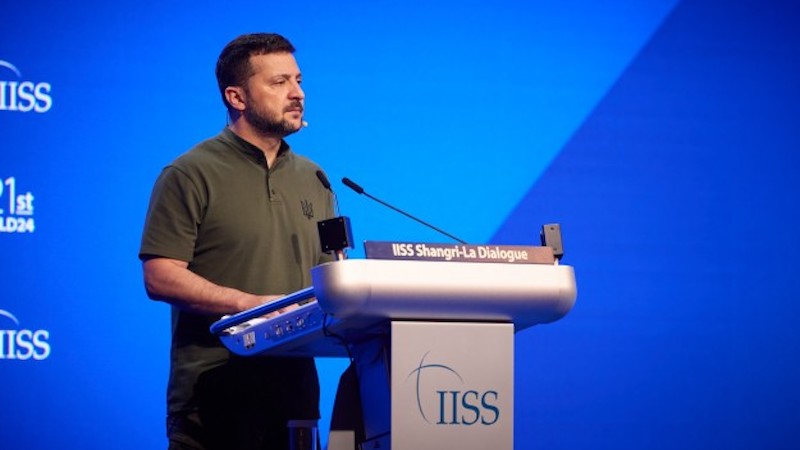
(RFE/RL) — Ukrainian President Volodymyr Zelenskiy met with foreign leaders in Singapore on the final day of the annual Shangri-La Dialogue security summit on June 2, where he sought to rally international support ahead of a Swiss peace conference later this month despite what he said were Chinese efforts to undermine it.
Zelenskiy said more than 100 countries and international organizations had committed to attending the mid-June peace gathering in Switzerland.
Russia hasn’t been at the event in Singapore since it launched its two-year-old full-scale invasion of Ukraine.
Zelenskiy and Ukraine’s defense minister, Rustem Umerov, met in Singapore for more than an hour with U.S. Defense Secretary Lloyd Austin following this week’s U.S. easing of restrictions on the use of its weapons by Kyiv to publicly permit Ukraine to hit targets inside Russia.
A Pentagon official said Austin “reaffirmed the U.S. commitment” to “strong support” for Ukraine and both sides vowed to “further strengthen [their] strategic defense partnership.”
Earlier, Zelenskiy met with a bipartisan delegation from the U.S. House of Representatives on the sidelines of the conference and said both sides “noted the importance of allowing Ukraine to use American weapons to strike military targets on the territory of Russia in the areas bordering the Kharkiv region.”
Zelenskiy said that “The issue of further strengthening of sanctions pressure on the Russian Federation was also raised.”
The Ukrainian president also met with Indonesian President-elect Prabowo Subianto, who at the same summit last year proposed an Indonesian plan for ending the war in Ukraine.
After meeting with Jose Ramos-Horta, the president of Timor-Leste, Zelenskiy said Ramos-Horta would also attend the peace summit planned for June 15-16 in Switzerland.
“It is very important for us to begin the process of establishing a just peace,” Zelenskiy said. “Russia does not want to end the war. Therefore, we must work together with the entire world to bring peace closer.”
Zelenskiy said recently amid reports that the European Union was trying to organize peace talks with Russian participation in Saudi Arabia for later this year that he had “no faith” in Russian President Vladimir Putin and around 200 rounds of talks dating back to Russia’s occupation of Crimea in 2014 had gone nowhere.
China, which has said it wants peace in Ukraine but has tightened relations with Moscow since the invasion began, has said it will not participate in the Swiss talks.
Zelenskiy told journalists that he regretted he couldn’t meet the Chinese delegation in Singapore and that Beijing wouldn’t be represented in Switzerland.
He added that “China, unfortunately…is working hard today for countries not to come to the peace summit.” He also said Chinese support for Russia would prolong the war.
U.S. Pentagon chief Austin met with his Chinese counterpart, Defense Minister Dong Jun, in Singapore in their first face-to-face meeting since those contacts broke down in 2022 with tensions ratcheted up over bilateral issues, Taiwan, and Beijing’s refusal to condemn and punish Russian aggression in Ukraine.
Also on June 2, Ukraine’s military said its air defenses had intercepted 24 of 25 Russian attack drones overnight as the country sought to rebound from one of the biggest overnight attacks in weeks on Ukraine’s power infrastructure a day earlier.
That attack killed at least eight people in the northeastern region of Kharkiv, police said, where a Russian offensive began last month.
As a result of those and other damaging attacks, state energy provider Ukrenerho said it was reintroducing blackouts for households and industrial users “in all regions of Ukraine” in the early morning and evening hours on June 2.
U.S. Secretary of State Antony Blinken said on May 31 that President Joe Biden had given Ukraine the go-ahead to use U.S. weapons to strike inside Russia for the limited purpose of defending Kharkiv as it tries to defeat Russian troops that began a full-scale invasion in February 2022.
![The Chang'e-6 craft, equipped with an array of tools and its own launcher, touched down in a gigantic impact crater called the South Pole-Aitken Basin on the moon's space-facing side at 6:23 a.m. Beijing time (2223 GMT), the China National Space Administration said. [Screenshot, Chinese TV]](https://www.eurasiareview.com/wp-content/uploads/2024/06/a-19.jpeg)
(EurActiv) — China landed an uncrewed spacecraft on the far side of the moon on Sunday (1 June), a landmark mission aiming to retrieve the world’s first rock and soil samples from the dark lunar hemisphere, China’s space agency said.
The landing elevates China’s space power status in a global rush to the moon, where countries including the United States are hoping to exploit lunar minerals to sustain long-term astronaut missions and moon bases within the next decade.
The Chang’e-6 craft, equipped with an array of tools and its own launcher, touched down in a gigantic impact crater called the South Pole-Aitken Basin on the moon’s space-facing side at 6:23 a.m. Beijing time (2223 GMT), the China National Space Administration said.
The mission “involves many engineering innovations, high risks and great difficulty”, the agency said in a statement on its website. “The payloads carried by the Chang’e-6 lander will work as planned and carry out scientific exploration missions.”
The successful mission is China’s second on the far side of the moon, a region no other country has reached. The side of the moon perpetually facing away from the Earth is dotted with deep and dark craters, making communications and robotic landing operations more challenging.
The Chang’e-6 probe launched on 3 May on China’s Long March 5 rocket from the Wenchang Satellite Launch Center on the southern island of Hainan, reaching the lunar vicinity roughly a week later before tightening its orbit in preparation for a landing.
Chang’e-6 marks the world’s third lunar landing this year: Japan’s SLIM lander touched down in January, followed the next month by a lander from US startup Intuitive Machines.
The other countries that have sent spacecraft to Earth’s nearest neighbour are the then-Soviet Union and India. The United States is the only country to have landed humans on the moon, starting in 1969.
Sampling the moon
Using a scoop and drill, the Chang’e-6 lander will aim to collect 2 kg of lunar material over two days and bring it back to Earth.
The samples will be transferred to a rocket booster atop the lander, which will launch back into space, tag up with another spacecraft in lunar orbit and return, with a landing in China’s Inner Mongolia region expected around 25 June.
If all goes as planned, the mission will provide China with a pristine record of the moon’s 4.5 billion-year history and yield new clues on the solar system’s formation. It will also allow for an unprecedented comparison between the dark, unexplored region with the moon’s better understood Earth-facing side.
A simulation lab for the Chang’e-6 probe will develop and verify sampling strategies and equipment control procedures, China’s official Xinhua news agency said. It will use a full-scale replica of the sampling area based on exploration results on the environment, rock distribution and lunar soil conditions around the landing site.
China’s lunar strategy includes its first astronaut landing around 2030 in a programme that counts Russia as a partner. In 2020 China conducted its first lunar sample return mission with Chang’e-5, retrieving samples from the moon’s nearer side.
The US Artemis programme envisions a crewed moon landing by late 2026 or later. NASA has partnered with space agencies including those of Canada, Europe and Japan, whose astronauts will join US crews on an Artemis mission.
Artemis relies heavily on private companies, including Elon Musk’s SpaceX, whose Starship rocket aims this decade to attempt the first astronaut landing since NASA’s final Apollo mission in 1972.
On Saturday Japanese billionaire Yusaku Maezawa cancelled a private mission around the moon he had paid for, which was to have used SpaceX’s Starship, citing schedule uncertainties in the rocket’s development.
Boeing and NASA postponed the company’s first crewed launch of Starliner, a long-delayed capsule meant to become the second US space taxi to low-Earth orbit.

(UCA News) — An Indian Church official has welcomed an order of the Delhi High Court allowing educational institutions run by minority communities to appoint their staff without government approval.
“This is a great order,” said Father Maria Charles Antonysamy, the secretary of the Indian bishops’ Office of Education and Culture, indicating that government-funded minority institutions across the country experienced a lack of freedom in appointing staff members.
Delhi High Court, in its May 28 order, said, “So long as the principals and teachers, who are appointed possess the prescribed qualifications and experience, there can be no restriction whatsoever on the right of the petitioner [a minority institution] to make appointments to fill in the vacancies in the schools run by it.”
“No prior permission from the government is required for this purpose,” observed Justice C. Hari Shankar, ruling in favor of the petitioner Delhi Tamil Education Association, which runs seven senior secondary schools in India’s national capital region for the Tamil linguistic minority.
Indian constitution allows linguistic and religious minorities to establish and run educational institutions to serve their communities. The government also pays for the salaries and maintenance of several such institutions as they contribute to the state’s educational service.
However, state governments increasingly began controlling staff appointments, and “because of this difficulty, in some cases, Church-run aided schools were closed down,” the priest said.
The court’s order “definitely will help us to maintain our ethos and standards. Only when we have the freedom to appoint principals and teachers of our choice can we maintain our values for a better society,” said the Catholic priest.
The New Delhi court’s order applies only to Delhi state, but the priest said it could be used as a guiding principle in asserting the rights of minority institutions across the country.
“The order will help us to appoint staff members who understand us. It will make a big difference in our functioning. Appointing a vested interested person will lead to a clash of interest,” Father Antonysamy added.
The priest said, “The high court order is a big relief not only in Delhi but also in other states where state-aided minority educational institutions faced similar problems. They can refer to this order in those states for relief.”
The association moved court when the state’s Director of Education failed to authorize the appointment of four principals and 108 teachers to vacant positions.
The court ruled that the association is entitled to make appointments to the vacant posts of principals and teachers in its schools without the approval of the Director of Education.
“It is a laudable judgment,” said A. C. Michael, a former member of the Delhi Minority Commission.
Michael, a New Delhi-based Christian leader, told UCA News on May 31 that the Christian community runs hundreds of aided education institutions in the national capital and nationwide.
The court order “is good for everyone to refer in case any government body creates unnecessary obstruction in appointing their staff including principals and teachers.”
Categories
NPR News: 06-02-2024 7PM EDT

Since 2015, UAB researchers have been carrying out an international archaeological research project in Iraq, specifically in the region historically called Northern Mesopotamia and currently known as Iraqi Kurdistan. This historical region has now opened to international archaeological research, after many years of blockage and geopolitical difficulties.
In the last campaigns, work was carried out at several sites: two in the mountainous region of Zagros and one in the plain of the Tigris River. The originality of the project lies in the transversal and diachronic analysis, since each archaeological site that is the object of research corresponds to a specific period and moment of historical change.
The mountains of Zagros: from nomad life to the beginnings of agriculture, livestock farming and private property
Firstly, in the Gali Chan caves (Soran province), located in the rugged landscape of the Zagros mountains, temporary camps created by the last hunters/gatherers (c. 9000 BCE) were identified. The remains recovered indicate a nomadic lifestyle and living spaces with hunting activities and, above all, the preparation of flint tools at a time before the adoption of agriculture and livestock farming.
Secondly, and also in the mountainous area of the Zagros, another project excavated and studied the site of Banahilk (Soran province), a village of consolidated farmers and herders from the Halaf period (c. 6000-5500 BCE). This is the easternmost known settlement, from which several rectangular houses, earthen architecture and the main domestic implements (pots, hearths, firepits, etc.) were recovered. The different exogenous materials, more specifically the obsidian blades and stone vessels, also reveal a connection with the distribution networks of Anatolia and Iran.
The study of the agricultural (cereals and leguminous plants) and livestock (sheep, goats, cattle and swine) evidence indicates the complexity of farm life at the time of the emergence of private property.
The plains of the Tigris River: advanced architectonic techniques
The third site was located in the plains of the Tigris River, to the north of Mesopotamia, where archaeological digs were conducted at Gird Laskhir (Erbil province). Due to its size (4 hectares and 14 metres high), this settlement can be considered small in comparison to the size of ancient cities. It is considered one of the settlements that was permanently occupied in the historical periods of the Chalcolithic and the Early and Middle Bronze Age (c. 3500 to 2000/1900 BCE).
The recovered dwellings indicate highly developed architectural techniques with complex multicellular constructions, in which it was possible to document the spaces for cooking, preparation and consumption of food. Thanks to the analyses and studies carried out, researchers were able to determine an abundant consumption of cereals and legumes, as well as the exploitation of domestic animals, particularly sheep and cattle.
Unique discovery of ceramic vessels inside a monumental tomb
In the campaigns of 2023 and 2024, burial sites were discovered containing with very rich furnishings, demonstrating that the city of Laskhir participated in the exchange of products with the southern regions (Lower Mesopotamia), but also with those to the east (Zagros and Iran) and west (eastern part of the Euphrates Valley). The products traded were jewels and semi-precious stones (obsidian, lapis lazuli, carnelian, obsidian, etc.), and also materials for construction or other technical activities (bitumen).
The project was also able to study and restore the furnishings of a monumental tomb in which it was possible to discover a concentration of 20 ceramic vessels and other luxurious objects, which make it truly exceptional.
The field work carried out between April and May 2024 was completed on Saturday 25 May. Now, the laboratory analyses will begin in order to advance in the historical knowledge of one of the most dynamic regions in prehistory and early antiquity.

Ultra-processed foods (UPF) may be associated with the insomnia experienced by an estimated one third of adults. An analysis of dietary and sleep patterns reported in the Journal of the Academy of Nutrition and Dietetics, published by Elsevier, shows a statistically significant association between consumption of UPF and chronic insomnia independent of sociodemographic, lifestyle, diet quality, and mental health status characteristics.
Lead investigator Marie-Pierre St-Onge, PhD, Division of General Medicine and Center of Excellence for Sleep & Circadian Research, Department of Medicine, Columbia University, explains, “At a time when more and more foods are highly processed and sleep disturbances are rampant, it is important to evaluate whether diet could contribute to adverse or good quality sleep.”
While past studies have examined nutrients or dietary supplements in relation to sleep (for example, protein, magnesium), this study is novel because it evaluates a dietary pattern beyond nutrients and specific foods and shows that the degree to which foods are processed may have some relevance for sleep health.
Dr. St-Onge adds, “Our research team had previously reported associations of healthy dietary patterns, like the Mediterranean diet, with a reduced risk of insomnia and poor sleep quality (both cross-sectionally and longitudinally), and high carbohydrate diets with an elevated risk of insomnia. The consumption of UPF is on the rise worldwide, and it has been linked to numerous health conditions such as diabetes, obesity, and cancer.”
To examine dietary intakes for their association with sleep, this large epidemiological study used NutriNet-Santé data from more than 39,000 French adults. This large cohort study was ideally suited to address this question given its inclusion of sleep variables and multiple days of detailed diet information.
Data were collected every six months between 2013 and 2015 from adults who completed multiple 24-hour dietary records and provided information on insomnia symptoms. The definition of insomnia was based on the criteria provided by the DSM-5 and the ICSD-3.
Participants reported consuming approximately 16% of energy from UPF and close to 20% reported chronic insomnia. Individuals who reported chronic insomnia consumed a higher percentage of their energy intake from UPF. The association of higher UPF intake and insomnia was evident in both males and females, but the risk was slightly higher in males than females.
First author Pauline Duquenne, MSc, Sorbonne Paris Nord University and Paris Cité University, INSERM, INRAE, CNAM, Nutritional Epidemiology Research Team (EREN), Center for Research in Epidemiology and Statistics (CRESS), cautions, “It is important to note that our analyses were cross-sectional and observational in nature, and we did not evaluate longitudinal association. While data do not establish causality, our study is first of its kind and contributes to the existing body of knowledge on UPF.”
Other study limitations included reliance on self-reported data and possible misclassification of some food items. Caution is advised when generalizing the findings because the NutriNet-Santé includes a higher proportion of females and individuals of high socioeconomic status compared with the general French population, although UPF intake was similar to a nationally representative sample.
The investigators recommend that future studies should test causality and evaluate the associations over time. However, they advise that individuals with sleep difficulties may consider examining their diet to determine whether UPF could be contributing to their sleep issues.