
Categories
South Caucasus News

US March Inflation: Cause For Worry? – OpEd


US March Inflation: Cause For Worry? – OpEd

The inflation hawks took March’s CPI as cause for celebration, inflation may not be dead yet. There is no doubt that it was a disappointing report for those hoping we could put the pandemic inflation behind us, but there still is not much basis for thinking the Fed needs to get out the nukes and start shooting big-time.

The key point to remember is that this inflation continues to be driven overwhelmingly by rent. We know that rental inflation will be falling because we have data on marketed units, the ones that change hands, that show sharply lower rental inflation and in some cases, such as the BLS index for new tenants, actually deflation.

The CPI rental indexes will follow the index for new tenants, but with a lag. That lag is proving longer than had generally been expected, but there is no reason to question the basic logic. If people who change apartments are seeing lower rental inflation, it is pretty hard to tell a story where this doesn’t eventually show up in lower rental inflation for people who stay in the same unit.

If we just look at the inflation rate excluding shelter, we have been skating close to, or even under, the Fed’s 2.0 percent target for most of 2023. The figure below shows annualized rates over the prior three months from 2019.
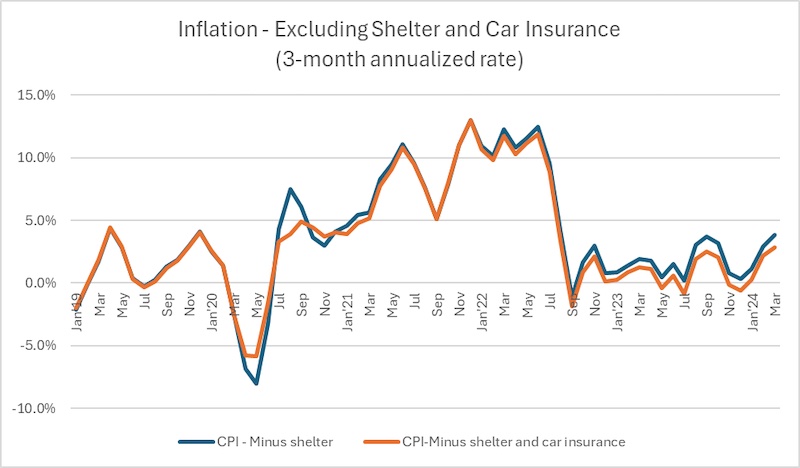
Source: Bureau of Labor Statistics and author’s calculations.

There definitely has been some acceleration in this measure in the last few months, but hardly an extraordinary one. We saw even larger upticks in inflation by this measure in the past, for example twice in 2019. Rent is typically a stabilizing factor in the overall inflation rate, precisely because the rate of rental inflation changes slowly.

There is another item that has played a big role in pushing inflation higher in recent years, auto insurance. The story is that premiums have risen sharply in recent years because of higher payouts in claims. (Profits have risen some as well, but we know payouts are most of the story from comparing the CPI measure which picks up gross payments, with the measure in the PCE deflator, which pulls out claims.)

Some of the story with premiums is higher costs due to higher prices for auto repairs, but much of it is simply more claims. Auto theft shot up in the pandemic but is now coming down. More long-term, people are seeing more damage due to climate-related events such as floods and hurricanes. That will be an ongoing problem.

To be clear, higher auto insurance premiums are a big deal in the sense that people have to bear these costs out of their pockets, however it is not part of a conventional inflation picture. The Fed will not be lowering auto insurance premiums by raising interest rates. The solution to climate-related damage is to try to limit climate change, but if that is off the agenda for political reasons, then people will just have to get used to higher-priced auto insurance, among other things.

Anyhow, if we pull auto insurance out of the story, in addition to rent, inflation was well below the Fed’s target for most of 2023 and actually negative at several points. We still get the acceleration in recent months to a 2.9 percent annualized rate as of March, but this hardly seems like something worth getting terribly excited over given the past behavior of this index.

In short, there is still plenty of reason for believing that the pandemic inflation is behind us. For now, the March report gave the inflation hawks some fresh meat, but a more careful look suggests that it doesn’t change the basic picture of inflation being largely under control.

This first appeared on Dean Baker’s Beat the Press blog.

Categories
Selected Articles

Hamas tells negotiators it doesn’t have 40 Israeli hostages needed for first round of ceasefire


Hamas has indicated it is currently unable to identify and track down 40 Israeli hostages needed for the first phase of a ceasefire deal, according to an Israeli official and a source familiar with the discussions, raising fears that more hostages may be dead than are publicly known.

The framework that has been laid out by negotiators says that during a first six-week pause in the fighting, Hamas should release 40 of the remaining hostages, including all the women as well as sick and elderly men. In exchange, hundreds of Palestinian prisoners would be released from Israeli prisons.

Hamas has told international mediators – which include Qatar and Egypt – it does not have 40 living hostages who match those criteria for release, both sources said.

CNN’s record of the conditions of the hostages also suggests there are fewer than 40 living hostages who meet the proposed criteria.

The inability – or unwillingness – of Hamas to tell Israel which hostages would be released, alive, is a major obstacle, the second source added.

With Hamas appearing to be unable to reach 40 in the proposed categories, Israel has pushed for Hamas to fill out the initial release with younger male hostages, including soldiers, the Israeli official said.

Throughout the months of negotiations since the last ceasefire Israel has repeatedly asked for a list of the hostages and their conditions. Hamas has argued that it needs a break in the fighting to be able to track and gather down the hostages, the same argument it made in November before a week-long pause that broke down after Hamas failed to deliver more hostages.

The majority of the almost 100 hostages who remain alive are believed to be male IDF soldiers or men of military reserve age. Hamas is expected to try to use to them in later phases to try to negotiate more significant concessions, including more high-level prisoners and a permanent end to the war.

The more than 250 hostages captured or killed on October 7 are believed to have been spread out among different members and factions of Hamas, as well as other militant groups, gangs and even held by families.

The Israeli prime minister’s office said Wednesday that of the 129 hostages from the October 7 attack currently held, 33 are dead.

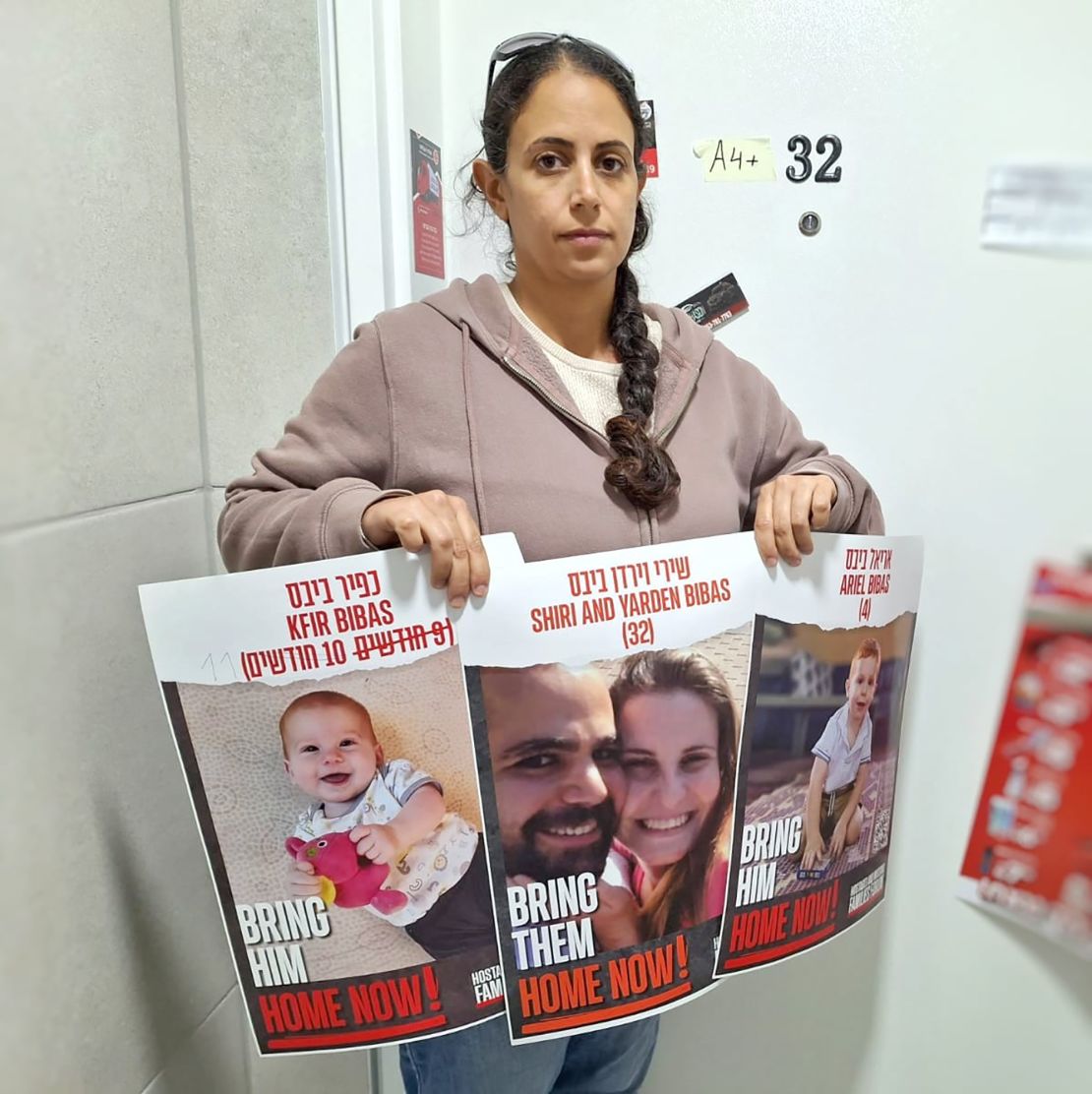
Ofri Bibas Levy holds posters of her family, including her brother, Yarden Bibas, taken hostage in Gaza.

Among those believed to still be held in Gaza are the Bibas family, who were snatched from their homes in Kibbutz Nir Oz. Yarden Bibas was separated from his wife Shiri and their children Kfir and Ariel, who were just 9 months and 4 years old respectively on October 7.

The two boys and their mother were not released from Gaza during the temporary truce in late November, despite the fact that the deal agreed between Israel and Hamas required all women and children to be set free.

Hamas claimed in November that Shiri, Kfir and Ariel had been killed in an Israeli airstrike, but did not provide evidence.

Hamas has claimed repeatedly that Israeli bombing has killed a number of the hostages held in Gaza and that its continuing campaign is threatening those still alive.

In January, Hamas released a video showing clips of three hostages – Noa Argamani, Itai Svirsky and Yossi Sharabi – speaking to the camera, ending with a caption saying, “Tomorrow, we will inform you of their fate.” The next day, another video appeared to show the dead bodies of Svirsky and Sharabi. In the video, Argamani said both men had been killed by Israeli bombing.

Israel said Hamas was carrying out “psychological torment” on the hostage families, and IDF chief spokesperson Daniel Hagari said the two men had not been hit.

“We do not strike in places where we know there may be hostages,” he said.

The hostage families have become a political force in Israel, staging mass protests to demand more be done to free their relatives.

Two relatives of Israeli hostages were arrested last month during a protest outside the defense ministry headquarters in Tel Aviv, staged after the Israeli delegation holding indirect hostage negotiations with Hamas left talks in Qatar without a deal.

CNN’s Christian Edwards contributed to this story.


Categories
Audio Review - South Caucasus News

Hamas tells negotiators it doesn’t have 40 Israeli hostages needed for first round of ceasefire


Hamas has indicated it is currently unable to identify and track down 40 Israeli hostages needed for the first phase of a ceasefire deal, according to an Israeli official and a source familiar with the discussions, raising fears that more hostages may be dead than are publicly known.

The framework that has been laid out by negotiators says that during a first six-week pause in the fighting, Hamas should release 40 of the remaining hostages, including all the women as well as sick and elderly men. In exchange, hundreds of Palestinian prisoners would be released from Israeli prisons.

Hamas has told international mediators – which include Qatar and Egypt – it does not have 40 living hostages who match those criteria for release, both sources said.

CNN’s record of the conditions of the hostages also suggests there are fewer than 40 living hostages who meet the proposed criteria.

The inability – or unwillingness – of Hamas to tell Israel which hostages would be released, alive, is a major obstacle, the second source added.

With Hamas appearing to be unable to reach 40 in the proposed categories, Israel has pushed for Hamas to fill out the initial release with younger male hostages, including soldiers, the Israeli official said.

Throughout the months of negotiations since the last ceasefire Israel has repeatedly asked for a list of the hostages and their conditions. Hamas has argued that it needs a break in the fighting to be able to track and gather down the hostages, the same argument it made in November before a week-long pause that broke down after Hamas failed to deliver more hostages.

The majority of the almost 100 hostages who remain alive are believed to be male IDF soldiers or men of military reserve age. Hamas is expected to try to use to them in later phases to try to negotiate more significant concessions, including more high-level prisoners and a permanent end to the war.

The more than 250 hostages captured or killed on October 7 are believed to have been spread out among different members and factions of Hamas, as well as other militant groups, gangs and even held by families.

The Israeli prime minister’s office said Wednesday that of the 129 hostages from the October 7 attack currently held, 33 are dead.

Ofri Bibas Levy holds posters of her family, including her brother, Yarden Bibas, taken hostage in Gaza.

Among those believed to still be held in Gaza are the Bibas family, who were snatched from their homes in Kibbutz Nir Oz. Yarden Bibas was separated from his wife Shiri and their children Kfir and Ariel, who were just 9 months and 4 years old respectively on October 7.

The two boys and their mother were not released from Gaza during the temporary truce in late November, despite the fact that the deal agreed between Israel and Hamas required all women and children to be set free.

Hamas claimed in November that Shiri, Kfir and Ariel had been killed in an Israeli airstrike, but did not provide evidence.

Hamas has claimed repeatedly that Israeli bombing has killed a number of the hostages held in Gaza and that its continuing campaign is threatening those still alive.

In January, Hamas released a video showing clips of three hostages – Noa Argamani, Itai Svirsky and Yossi Sharabi – speaking to the camera, ending with a caption saying, “Tomorrow, we will inform you of their fate.” The next day, another video appeared to show the dead bodies of Svirsky and Sharabi. In the video, Argamani said both men had been killed by Israeli bombing.

Israel said Hamas was carrying out “psychological torment” on the hostage families, and IDF chief spokesperson Daniel Hagari said the two men had not been hit.

“We do not strike in places where we know there may be hostages,” he said.

The hostage families have become a political force in Israel, staging mass protests to demand more be done to free their relatives.

Two relatives of Israeli hostages were arrested last month during a protest outside the defense ministry headquarters in Tel Aviv, staged after the Israeli delegation holding indirect hostage negotiations with Hamas left talks in Qatar without a deal.

CNN’s Christian Edwards contributed to this story.


Categories
South Caucasus News

AP Headline News – Apr 12 2024 08:00 (EDT)


28013281


Categories
South Caucasus News

Hague hosts first formal proceedings in arbitration filed by Azerbaijan against Armenia


On 12 April 2024 the Peace Palace at the Hague hosted the first formal proceedings in Azerbaijan’s claim within inter-state arbitration under the Bern Convention on the Conservation of European Wildlife and Natural Habitats, Azerbaijan’s MFA said, Report

Categories
South Caucasus News

Representatives of EU Political and Security Committee visit Azerbaijan’s Fuzuli


Representatives of the EU Political and Security Committee began a visit to the territories of Azerbaijan liberated from occupation, Report informs.

Categories
South Caucasus News

Germany sees 2.3% rise in consumer prices


Consumer prices in Germany, consistent with EU standards, increased by 2.3% year-on-year in March 2024, after growing by 2.7% the previous month, the country’s Federal Statistical Office (Destatis) said, Report informs via Interfax.

Categories
South Caucasus News

Hikmet Hajiyev holds discussions with representatives of EU Political and Security Committee


Assistant of the President of the Republic of Azerbaijan, Head of Foreign Policy Affairs Department of the Presidential Administration Hikmat Hajiyev participated in a meeting with the Political and Security Committee of the European Union represented at

Categories
(@mikenov) / Twitter

@Osint613: RT @Osint613: BREAKING: Hxmas officially responds : “We are not moving forward with the hostage deal” https://t.co/PNQO7oYacX


Categories
(@mikenov) / Twitter

@Robert4787: RT @Robert4787: It looks like Russia’s anti-satellite space-based weapon will become operational. https://t.co/x59n950BLI #antisatellitewea…