
Saying what can’t be said: Israel has been defeated – a total defeat / @chaimlevinson https://t.co/iDcypM0NfW
— Haaretz.com (@haaretzcom) April 12, 2024
Day: April 12, 2024
РПЦ в Эстонии предлагают признать террористической организацией. Министр внутренних дел страны Лаури Ляэнеметс заявил, что предложит объявить Московский патриархат террористической организацией. Его цель – запрет деятельности РПЦ в Эстонии. “Мы должны понимать, что сегодня… pic.twitter.com/Q598o0X0nI
— DW на русском (@dw_russian) April 12, 2024
Tehran has declared that it will hit Israel within the next 48 hours, and the primary threat from Iran stems from its anticipated nuclear capability.
When exposed to nuclear radiation, human body cells suffer damage to their genetic material, DNA.https://t.co/3lGFA9rUNH
— The Jerusalem Post (@Jerusalem_Post) April 12, 2024
Current and Former-U.S. Officials reportedly now believe that Iran has Stockpiled enough Highly Enriched Uranium to produce Weapons-Grade Fuel for at least 3 Low to Medium Yield Nuclear Bombs in a Timeframe which ranges from a few Days to a few Weeks, with a Nuclear Device able… pic.twitter.com/sNps0WLR4X
— OSINTdefender (@sentdefender) April 12, 2024
Saying what can’t be said: Israel has been defeated – a total defeat / @chaimlevinson https://t.co/iDcypM0NfW
— Haaretz.com (@haaretzcom) April 12, 2024
Hamas has indicated it is currently unable to identify and track down 40 Israeli hostages needed for the first phase of a ceasefire deal, according to an Israeli official and a source familiar with the discussions, raising fears that more hostages may be dead than are publicly known. The framework that has been laid out […]
The post Hamas tells negotiators it doesn’t have 40 Israeli hostages needed for first round of ceasefire first appeared on The Puerto Rico Times – The News And Times.
By Craig Silverman and Peter Elkind
(ProPublica) — Federal authorities are investigating the involvement of Chinese organized crime rings in gift card fraud schemes that have stolen hundreds of millions of dollars or more from American consumers.
The U.S. Department of Homeland Security has launched a task force, whose existence has not previously been reported, to combat a scheme known as “card draining,” in which thieves use stolen or altered card numbers to siphon off money before the owner can spend it. The initiative has been dubbed “Project Red Hook,” for the perpetrators’ ties to China and their exploitation of cards hung in store kiosks on “J-hooks.”
This marks the first time that federal authorities have focused on the role of Chinese organized crime in gift card fraud and devoted resources to fighting it. Homeland Security Investigations, a DHS agency, began prioritizing gift card fraud late last year in response to a flurry of consumer complaints and arrests connected to card draining.
Over the past 18 months, law enforcement across the country has arrested about 100 people for card draining, of whom 80 to 90 are Chinese nationals or Chinese Americans, according to Adam Parks, a Homeland Security assistant special agent in charge based in Baton Rouge, Louisiana. Parks, who is leading the task force, estimates that another 1,000 people could be involved in card draining in the U.S., mostly as runners for the gangs.
“We’re talking hundreds of millions of dollars, potentially billions of dollars, [and] that’s a substantial risk to our economy and to people’s confidence in their retail environment,” he told ProPublica.
Card draining is when criminals remove gift cards from a store display, open them in a separate location, and either record the card numbers and PINs or replace them with a new barcode. The crooks then repair the packaging, return to a store and place the cards back on a rack. When a customer unwittingly selects and loads money onto a tampered card, the criminal is able to access the card online and steal the balance.
Federal investigators believe multiple Chinese criminal organizations are involved in card draining and are using the proceeds to fund other illicit activities, from narcotics to human trafficking, according to Parks. ProPublica recently revealed Chinese organized crime’s involvement in the illegal U.S. cannabis industry and the laundering of cocaine, heroin and fentanyl profits. ProPublica has also exposed how Walmart and other retailers have facilitated the spread of gift card fraud and has revealed the role of Chinese fraud rings in gift card laundering.
The DHS team in Baton Rouge led an investigation that resulted in the conviction and 2023 sentencing to prison of a Canadian man who stole more than $22 million by operating an illicit online gift card marketplace that victimized American consumers and businesses. As arrests for card draining began piling up around the country, Parks and special agent Dariush Vollenweider saw the need for a national response.
Last November, they convened a two-day summit at DHS headquarters in Washington, D.C., attended by many of the country’s top retailers and gift card suppliers. Federal authorities pushed the industry to share information and help thwart the gangs. The agency then issued a bulletin in December alerting law enforcement across the country about the card-tampering tactics. Parks said about 15 Homeland Security agents are now spending most of their time on Project Red Hook.
“It’s not just a one-store problem,” Vollenweider said. “It’s not just a Secret Service or DHS or FBI problem. It’s an industry problem that needs to be addressed.”
Americans are expected to spend more than $200 billion on gift cards this year, according to an industry estimate. Retailers love gift cards because they drive sales and profit: Consumers typically spend more than a card’s value when they shop, and chains like Walmart and Target earn a profit when someone buys a third-party gift card, such as those from Apple or Google.
Data from retailers and consumers shows that card draining has skyrocketed in recent years. Target alone has seen $300 million stolen from customers due to card draining, according to comments last June from a company loss prevention officer contained in a Florida sheriff’s office report. A recent survey by AARP, the nonprofit advocacy group for people over age 50, found that almost a quarter of Americans have given or received a card with no balance on it, presumably because the money had been stolen. More than half of victims surveyed said they couldn’t get a credit or refund. (Apple, Walmart and Target say, in their terms and conditions, that they are not responsible for lost or stolen gift cards.)
More broadly, almost 60% of retailers said they experienced an increase in gift card scams between 2022 and 2023. Between 2019 and 2023, Americans lost close to $1 billion to card draining and other gift card scams, according to the Federal Trade Commission.
Target and Walmart have faced class-action suits from consumers who bought or received gift cards only to discover the balance had been stolen. In each case, the plaintiffs alleged that the companies have failed to secure the packaging of gift cards and to monitor their displays. “The tampering of Gift Cards purchased from Target is rampant and widespread and Target is well-aware of the problem, yet Target continues to sell unsecure Gift Cards susceptible to tampering without warning consumers of this fact,” reads the complaint in the Target case.
The Walmart case was resolved in 2022 with an undisclosed settlement, and Target is engaged in settlement talks. Apple settled a similar card-draining class-action case in January, agreeing to pay $1.8 million. Walmart and Apple did not admit liability.
Apple declined to comment about card draining and the DHS investigation. In court filings in the class-action, Apple said that since the cards were purchased at Walmart, “the fraud occurred as a result of Walmart’s security protocols, rather than Apple’s.” A Walmart spokesperson told ProPublica, “Although we will not comment on ongoing investigations, we are proud of our routine work with federal law enforcement to stay ahead of these fraudsters and help keep customers safe.”
Target denied in court filings that its gift card security practices were inadequate and that its cards were susceptible to third-party tampering. “We are aware of the prevalence of gift card tampering and take this issue very seriously,” Target said in a statement to ProPublica. “Our cyber fraud and abuse team uses technical controls to help protect guests, and our store teams inspect cards for physical signs of tampering.” Target said it encourages employees to watch for people buying “high dollar amounts or large quantities of gift cards, or tampering with gift cards in stores.” Like Walmart, Target said it works closely with law enforcement.
Gift card scammers linked to Chinese criminal organizations trick their victims in many ways besides card draining. Some scams dupe victims into unwittingly paying criminals with gift cards. Whatever the ruse, the crime rings make use of low-level “runners” in the U.S., who are almost exclusively Chinese nationals or Chinese Americans. In card draining, the runners assist with removing, tampering and restocking of gift cards, according to court documents and investigators.
A single runner driving from store to store can swipe or return thousands of tampered cards to racks in a short time. “What they do is they just fly into the city and they get a rental car and they just hit every big-box location that they can find along a corridor off an interstate,” said Parks.
In a 24-hour period last December, an alleged runner named Ming Xue visited 14 Walmarts in Ohio before being arrested, according to court documents. Police said they found 2,260 Visa, Apple and Mastercard gift cards in his car. Xue entered the U.S. illegally months before his arrest, according to a prosecution motion. He has pleaded innocent.
DHS is looking at whether Chinese criminal organizations bring people into the U.S. to use them as card-draining runners. John Cassara, a retired federal agent and the author of “China-Specified Unlawful Activities: CCP Inc., Transnational Crime and Money Laundering,” said Chinese criminal enterprises often smuggle workers across the border for other enterprises such as prostitution or growing marijuana.
Parks said investigators are aware that “some of the individuals who were arrested were within weeks to months of being encountered illegally crossing the southern border.”
Other alleged card-draining runners entered the U.S. legally and told police they were hired via online postings. Donghui Liao was arrested at a Florida Target after employees noticed him removing gift cards from a bag and placing them on racks. Through a translator, he told police that his employer hired him online and mailed gift cards to him, according to court documents. He was paid 30 cents for each card he returned to the rack. Police said they found $60,000 worth of tampered cards in his possession. Liao remains in custody and his case was recently transferred to federal court. The DOJ did not respond to requests for comment and Liao has pleaded innocent.
In New Hampshire, police arrested three people between December and March for, among other alleged crimes, using stolen gift card balances to purchase millions of dollars worth of electronics such as iPhones. An apartment used by two of the suspects contained “a large quantity of Apple brand devices, cash, and a computer program that appeared to be running gift card numbers, in real-time,” according to a police report. (Criminals use software to automatically check gift card balances so they can be alerted when a customer buys and loads money onto a tampered card.) The fraudsters typically export the electronics back to China to resell them, according to Vollenweider.
Parks said Red Hook is recommending anti-fraud measures to retailers, such as closer scrutiny of gift card displays, while also heightening awareness of the problem among merchants and local law enforcement. Store security and local police have sometimes treated runners as small-time annoyances and booted them from stores, rather than arresting and prosecuting them, according to Parks. The task force hopes to work with local police to locate and charge previously released runners.
“It’s important for us to start delivering consequences,” he said.
About the authors:
- Craig Silverman is a national reporter for ProPublica covering voting, platforms, disinformation, and online manipulation.
- Peter Elkind is a reporter covering government and business.
- Doris Burke contributed research.
Source: This article was published by ProPublica
By Scott Bennett
December 2, 1942 — almost one full year after the attack on Pearl Harbor, the scientific community in the US was in a state of high anxiety. Physicists were sure that Hitler’s war machine, which had a two-year head start, was well on its way to developing a nuclear weapon. The race was on to create the first controlled nuclear chain reaction. If American scientists couldn’t make this happen, it would be impossible to construct a nuclear weapon of their own, and the war could be lost.
Working in secret in an unused squash court underneath the University of Chicago’s Stagg Field stands, scientists, students and laborers worked day and night piling 50- and 100-pound graphite bricks into a massive 771,000-pound egg-shaped reactor core. On the snowy afternoon of December 2, a few dozen people looked on nervously as cadmium rods were removed and the world’s first nuclear reactor was activated. Without any cooling or shielding system, it was possible that the world’s first fission reaction could also create the world’s first nuclear meltdown, right in the middle of the campus.
At 3:25 PM, the clicking of the Geiger counter confirmed that the experiment was a success, producing about enough energy to power a single light bulb. There were no cheers, toasts or hearty slaps on the back, although the researchers did pass around a bottle of chianti for a few celebratory sips. Graduate student Leona Woods described the mood in the room, saying, “There was a greater drama in the silence than if the words had been spoken.”
Later recognized as perhaps the greatest scientific experiment of the 20th century, team leader Enrico Fermi received the praise. An Italian physicist who used his trip to Sweden to accept the Nobel Prize as an opportunity to escape Mussolini and defect to the United States, Fermi was called “the Pope” by his peers. Recognized as alternatively the “architect of the nuclear age” or the “architect of the atomic bomb,” few scientists from the modern era are held in higher regard. And it all happened right on the University of Chicago campus, where Milton Friedman would join the faculty just five years later in 1946.
The transformation of economics from philosophy to science
In the 20th century, the world of academia was to witness more than one revolution in science. The revolution I want to talk about was a revolution of the boundaries of science itself.
There has been a longtime cleavage in the academic community between hard science and the humanities, or what were once known as physics and metaphysics. What’s the difference? Metaphysics is the study of abstract concepts like being and knowing — why are we here? In other words, it is philosophy, the quest for eternal truth.
Physicist Robert W. Wood was once asked to make a toast “to physics and metaphysics.” Wood then responded by describing the physicist’s journey from its first burst of inspiration. The next step, he said, is consulting existing literature bolstering that idea. The physicist then carefully prepares experiments to test that idea to see if it can withstand scrutiny in a lab. Finally, the physicist’s idea turns out to be wrong, so this idea is rejected, and our scientist moves on to something else. In the end, Wood diplomatically summarized the difference between physicists and metaphysicists: One has a laboratory and one does not.
Economics was not always considered a science. When Adam Smith was writing in the late 1700s, his area of study was known as “political philosophy.” Smith continued in the tradition of classical philosophers like Plato and Aristotle, who talked about some of the same basic ideas. At that time, economics had not completed its metamorphosis from political philosophy to political economics to just plain economics. Economics was squarely in the metaphysical realm.
However, embedded in Smith’s philosophical framework was the notion that society was a living organism. It was common then to see not just human beings as biological organisms but culture as a kind of organism. In the time after Smith, political philosophers increasingly saw societies as having balance and equilibrium like the rest of nature. This belief in equilibrium is one of the chief articles of faith of the free-market religion. Classical economists like Smith and neoclassical acolytes like Milton Friedman zeroed in on certain shared similarities of human beings to suggest that we are all motivated by the same essential laws of nature. In this way, economics began creeping from a social science, philosophy, to actual science.
This breakthrough led to what is now known as the Marginalist Revolution. As political economics gave way to just plain economics, everybody who was anybody began adopting an air of objectivity and impartiality as they used charts, graphs and complex equations to measure and size up precisely how economic transactions work.
Tending carefully as the first green shoots of this new branch were forming was Alfred Marshall, called by some the founder of modern economics. Marshall consciously tried to break this area of study free from its philosophical roots and cultivate a new, value-free science. He believed it was possible to apply the scientific method and calculus to measure marginal utility. In economics, utility is the benefit one gains from acquiring a product. Marginal utility is a way of conceptualizing that benefit into some kind of integer or measurable unit. (Science tends to pretend something doesn’t exist until some way is developed to measure it.) Once the proto-economists of Marshall’s era had a unit of measurement for economic theory, it became possible for them to start making predictions that seemed more scientific and less philosophical.
At the time, the marginalist method was once just one flavor among many taught. Aspiring economists studied marginalist texts mixed right in with Adam Smith and Karl Marx; “… it would be a long time before the uniformly mathematical approach we now associate with economics would establish dominance,” writes John Rapley. In the same way, early marginalists came from a broad spectrum of political orientations. Eventually, free market capitalism and marginalism joined together to establish a correct way for economics to be studied and understood.
Once the marginalists had developed a clean way of measuring economic theories, it was time for them to start mapping out the economic laws of nature. At last, their discipline could be as rigorous and mathematical as thermodynamics or chemistry. Demonstrating the laws of supply and demand would now be as self-evident as Newton’s law of universal gravitation. Mapping the law of scarcity would be as clear as when hydrocarbon reacts with oxygen to create combustion in a laboratory.
- About the author: Scott Bennett is a writer living in Chicago. His decent (but not hoity-toity) university education never prepared him for this moment. It did, however, prepare him for a career in major market media. He has been working on a book for 10 years with few ideas on how to publish it, so he turned to TikTok. There he has amassed a sizable following and hopes this is the beginning of something big. He is an optimist at heart.
- Source: The views expressed in this article are the author’s own and do not necessarily reflect Fair Observer’s editorial policy.
On March 21, the U.S. Department of Justice filed a “sweeping” lawsuit accusing Apple, one of the Big Tech companies the Biden administration loves to hate, of engaging in business practices that violate the 1890 Sherman Antitrust Act.
Joined by the attorneys general of 16 states, the DOJ’s complaint alleges that Apple’s exclusionary tactics have allowed it to “monopoliz[e]” the U.S. market for smartphones or, keeping its legal options open, perhaps a submarket for “performance” (high-end) smartphones. According to the DOJ, Apple’s iPhone accounts for about 65 percent of the former market and 70 percent of the latter. Those market shares, however, may be larger among younger smartphone customers (Americans born after 1996).
Put another way, 30 to 35 percent of the U.S. smartphone market, as the DOJ defines it, is served by Apple’s competitors, the two most “meaningful” being Google (parent Alphabet) and South Korea’s Samsung Group. Meaningful indeed.
Apple is not a monopolist as economists understand that concept because it does not control anything close to 100 percent of the antitrust-relevant smartphone market. Apple may be big, and the iPhone may now dominate U.S. smartphone shipments, but large market shares today do not guarantee future market supremacy.
Rewind the tape to May 18, 1998. On that date, the DOJ filed a complaint against Microsoft alleging that the company “possesses (and for several years has possessed) monopoly power in the market for personal computer operating systems.” At the time, Microsoft shipped roughly 90 percent of “Intel-compatible” computer operating systems. Sales of desktops running Apple’s MacOS were then so small that it was excluded from the DOJ’s market definition.
United States v. Microsoft Corp., one of the few legal precedents cited in the DOJ’s just-issued Apple filing, ultimately was decided in the government’s favor. One of the key issues raised at trial was that Microsoft’s monopoly was built in part on its inclusion of a web browser (Internet Explorer, or IE) in its Windows 95 operating system (OS) at no additional charge.
Although supporters of the Microsoft case argued that competition would be restored only if the company was forced to separate IE from Windows 95, the presiding federal judge did not impose that remedy. Never mind! Internet Explorer has given way to Edge, released in 2010, and it too is bundled with Windows 11 OS. Meanwhile, Microsoft’s share of the U.S. desktop OS market has declined to about 60 percent; the market share of Apple’s OS X (formerly Mac OS) has climbed to just under 28 percent; nerdy open-source Linux, ignored by the DOJ in 1998, nowadays represents about 2 percent of desktop computer operating systems.
Microsoft’s “anticompetitive” bundling strategy evidently has not seriously undermined its rivals’ ability to enter the market for desktop operating systems and to expand their sales.
That’s to be expected in marketplaces characterized by so-called network effects in which the value to consumers of joining a network goes up as the number of others connecting to the same network rises. In network industry after network industry (from telephones to video-recording and video-playback technologies to computer hardware and software), we observe what might be called not monopoly but “serial market dominance.”
Because of product quality or functionality that was unknown previously or that consumers deem superior to available alternatives, one or a few sellers rise to a market’s commanding heights. But continuous innovation (Schumpeter’s “gale of creative destruction”) threatens such market dominance.
The threats can arise beyond a market’s current boundaries or from the players on its “competitive fringe.” That fringe was tiny in 1998, composing just 10 percent of “Intel-compatible” computer operating systems. In 2024, Apple’s rivals account for 35 to 40 percent of the smartphone market, as the DOJ defines it.
And those rivals, Google and Samsung, are no shrinking violets needing protection by the Justice Department’s antitrust lawyers, who apparently think they know better than smartphone buyers and sellers what the market should look like today and tomorrow. Antitrust law enforcement processes have morphed over the past few years into an ersatz industrial policy that pays lip service to consumers’ welfare but ignores consumers’ choices in favor of indulging the preferences of bureaucrats.
This article was also published in The American Spectator
By Augusto Bottari
The major cities of the world have been facing housing problems for years. With the increase of immigrants and of people experiencing homelessness, the discussion about housing regulation has intensified.
The West, once a bastion of ideas of freedom and free markets, continues to harbor central planners whose delusions of omnipotence are paid for by the misfortune of ordinary people as the regulation attempts of these planners fail because such rental laws were not implemented “well enough.”
It is not difficult to become familiar with these cases as they may possibly be part of one’s own personal experience when renting a house or an apartment. Stepping back a bit, we find large cities full of vacant housing units and people in deplorable conditions. The universal laws of supply and demand do not care who the regulator is: price controls create scarcity, no matter how “precise” or “well-crafted” the legislation may be.
The rare cases are those where one is no longer under the control of rental laws. Such is the case of Argentina, where President Javier Milei repealed a law last December known as the Rental Law that was enacted in 2020.
What did the law propose? It basically proposed the following:
• The property would be rented for a minimum of three years.
• There would be an annual price adjustment under an index created by the Central Bank.
• The security deposit could only be limited to the first month’s rent.
• The tenant would establish the terms of contract termination.
• The tenant could make emergency repairs and deduct them from the rent.
• The landlord should register the contract with the AFIP (tax collection entity in Argentina).
The warnings were duly presented: it would generate housing shortages.
Economic Implications
The impact has been terrible and has affected the lives of millions of people. In fact, it is almost unanimously considered one of the greatest political malpractices in recent years.
In Argentina, the norm has always been that there is inflation, and more inflation is always expected. With this law, the landlords know that they cannot adjust the rent price to their tenant-at-will for three years so, to not lose money, they set a very high initial price to cover themselves.
In this way, access to rent consumes the greater part of the salary or results in residing in less-preferred locations. Quality of life is thus greatly diminished—discouraging people from moving, starting a family, pursuing their dreams by moving to a new city, or limiting the independence of young people. The entire social fabric is damaged.
Many landlords preferred to keep their properties vacant rather than dealing with so many difficulties and legal risks because of the law. Others found ways to work around the law and rented to acquaintances or trusted people.
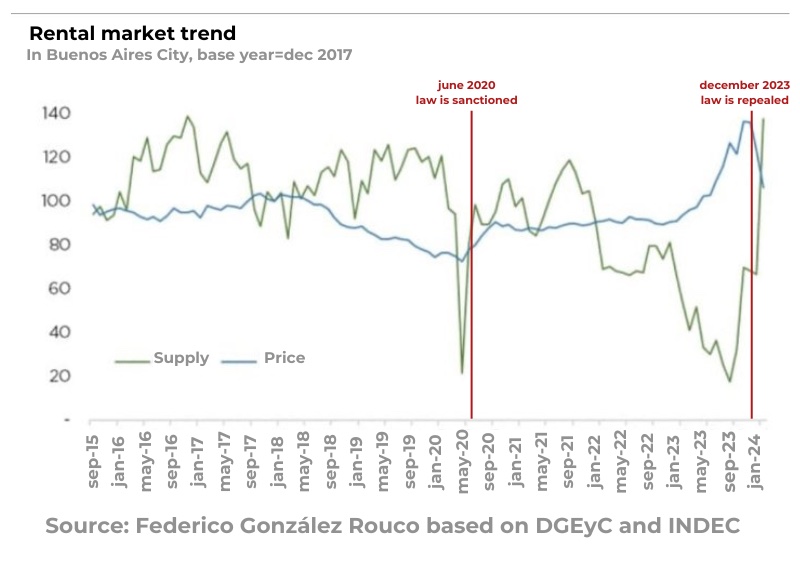
Although Argentina is an extensive and diverse country, the focus is usually placed on the city of Buenos Aires, which—although not always a representative sample—has the largest number of inhabitants and can be compared with other major cities in the world. We will use it as an example in Figure 1 to observe the evolution of supply and price, as well as to appreciate the effects on the market with the enactment and repeal of the law.
Figure 1: Rental market trends in Buenos Aires, Argentina, September 2015–January 2024
 Source[DB1] : Frederico González Rouco based on DGEyC and INDEC.
The effect of deregulation was immediate, as can be seen in Figure 1. In the following weeks of February and March after the repeal of the law, the supply continued to increase, and prices remained below inflation. Now, the entire rental contract is decided between the parties.
Even the currency in which rent payment will be made can also be agreed upon between the parties, considering the rejection of the Argentine peso. While some opt for periodic price updates in the local currency, paying in dollars has become popular, and there are also cases where payment was agreed upon in bitcoin.
Political Implications
Now, we cannot settle for a mere analysis of the situation based on indexes and price trends. Behind every regulation, there is induced scarcity, and behind induced scarcity, there is a politician finding an opportunity to proclaim themselves as the solution.
The desperate difficulty in finding housing was a feast for the Left. A certain politician who believes himself to be a modern Che Guevara gained popularity by defending land occupation “as a right” and ended up being a presidential candidate in the last elections (although he got 5 percent in his party’s primaries, against whom he would later face Milei in the general elections).
“Groups” also began to appear, which were nothing more than X accounts managed by a single person (“coincidentally” the son of a legislator), who spoke on behalf of tenants and “defended” their rights.
The discussion was increasingly shifting to the Left: new laws were proposed, such as a tax on vacant housing or direct expropriation.
On the other hand—with a desperate and servile population—in the last election, opportunistic politicians had promised “loans for rents” at a special rate from state banks. Forget mortgage loans (in Argentina, they haven’t existed for many years); these are loans to pay your rent.
When regulation is allowed, it is very easy to go down a slippery slope that leads straight to the worst road to serfdom. The institution of private property is completely distorted, leading the population to unimaginable miseries. The Argentine deregulatory experience can serve as a case for all the countries of the world and their metropolises. Fortunately, that is part of the past, the paradigm is changing, there is light at the end of the tunnel, private property is becoming sacred again, and Argentina is fighting for a new liberty.
- About the author: Augusto Bottari studies International Business at the Universidad Argentina de la Empresa (UADE). He works for the banking industry and owns the largest Libertarian bookstore in Argentina.
- Source: This article was published by the Mises Institute
[DB1]Bill, there is no link for this source.