
Missile Launched from Yemen Hits Tanker Voice of America – VOA News
Day: December 12, 2023

Chaman is a city and the headquarters of the Chaman District in Balochistan, Pakistan. It is located near the Durand Line, the Afghanistan-Pakistan border. The district was newly carved out of the Qila Abdullah District.
The Chaman border crossing is one of the crossing points at Durand Line, the 2,640-kilometre (1,640-mile) border between Afghanistan and Pakistan. situated nearly 120km (74 miles) northwest of Quetta, is one of the busiest crossings between the two countries and is used by thousands of people every day.
More than 250,000 predominantly ethnic Pashtuns, mainly from the Achakzai and Noorzai tribes, live on both sides of the Durand Line border. The border has divided scores of villages, their agricultural lands, and grave vyards. All tribes are closely interconnected in their centuries-old social contracts, or intermarriages.
Historically, there has been free movement of these tribes along the Durand Line since signing the Treaty of Gandamak, which ended the first phase of the Second Anglo-Afghan War (1878–80). Under the provisions of the treaty, the Amir surrendered control of jurisdiction over the Korram and Pishin valleys, the Sibi district, and the Khyber Pass to the British, followed by the Durand Line Agreement in 1893, along with the Anglo-Afghan Treaty of 1905, which was canceled after the end of the third Anglo-Afghan War and the declaration of Afghanistan as an independent state in 1919 during the signing of the Treaty of Peace. There were these treaties of 1919 signed in Rawalpindi and of 1921.
All these arrangements split the Pashtuns into two separate countries. Afghanistan governs all the Pashtuns on one side of the Durand Line, while British India, later on, Pakistan since 1947, governs all the Pashtuns on the other side of the Durand Line. However, free movement of those tribes without visas and passports on the Chaman border continued until the recent abrupt and unplanned decision of the interim government in Pakistan, despite the unilateral fencing of the Pak-Afghan border in 2017 by Pakistan.
Pakistan’s interim administration has decided to enforce a strict visa and passport policy along its border with Afghanistan since November 1. This move is aimed at monitoring unauthorized cross-border movement between the two countries. The new policy has sparked widespread dissent, leading thousands of local tribesmen, daily wages workers and traders to set up a protest camp in Chaman. The sit-in protest has lasted for 45 days.
The sit-in that has blocked the Quetta-Chaman highway and halted trade between the two countries, hails support from cross sections of society including civil rights activists and key Pakistani political parties, including the Pakhtunkhwa Milli Awami Party, the Balochistan Awami Party, the Pashtun Tahafooz Movement, the Jamiat Ulema Islam, the Jamaat-e-Islami, and the Pakistan Muslim League (Q). Addressing the crowd very recently, the Pakhtunkhwa Milli Awami Party’s chairman, Mahmood Khan Achakzai, warned that the protest could spread to other cities if the decision with regard to imposing strict visa regime was not reversed. Though the protesters are thousands in number encamped near border continuously for last forty five days but amazingly, there is a complete blackout on print and electronic media.
Trade between Pakistan and Afghanistan via the Chaman border crossing ground came to a halt as participants in a month-long sit-in in the town. They argue that the new policy to require visas for crossing the border negatively impacts tens of thousands of people. They have established the all hParty Tajir Committee to voice their concerns with the authorities that “For 70 years, people of Chaman-Spin Boldak have been crossing the border daily to visit families, do business, bury their dead, or seek treatments in hospitals without visas, and now the Pakistan government has made an abrupt decision to enforce visas. “This is unacceptable.”
The political party’s prominent leaders, Asgar Khan, Dr. Samad Achkzai of the ANP, and Manzoor Pashtoon of the PTM, particularly Mehmood Khan Achakzai of PKMAP have said that the Pakistani authorities had assured Pashtuns along the border region in the past during fencing the border that Afghan Tazkera and Pakistani identity cards—coupled with biometric screening—were “legally acceptable” for border crossing. They argued that Pakistan’s visa system will deprive more than 40,000 people who cross the border daily—including business owners, traders, drivers, and daily wage workers, lughari (wheelers)—and is resulting in a huge economic loss that will threaten thousands of families livelihoods as there is neither agriculture nor industry in the area.
In this regard, I would like to quote Mr. Jinnah, the founding father of Pakistan, about the Pashtoon and their free movement on the Durand Line. 1940s, when the secular Indian National Congress was in power in the NWFP and Dr. Khan Sahib, brother of Bacha Khan, was chief minister. The All-India Muslim League was rising but still on the back foot.
To woo the Pukhtoons and counter the Khan brothers’ popularity, Mr. Jinnah insisted that Islamic unity must trump ethnicity. As recorded in the Jinnah Papers, on June 29, 1947, he declared, “I want the Muslims of the Frontier to understand that they are Muslims first and Pathans afterward.” With closely knitted Pashtoon families living on either side of the Durand Line—a British construct designed to demarcate the British from Russian spheres of influence—Jinnah never suggested Pukhtoons would ever be prevented from freely crossing over. He elaborated, “How could a Muslim from Uttar Pradesh become a Pakistani but not another Muslim living right across an arbitrarily drawn line? It made no sense.” Jinnah thus won over the Pashtoon; the rest is history.
Pakistan’s government pleads for imposing a visa regime
No doubt, for the last two decades, the regions surrounding the Durand Line have been used by armed groups, such as the Haqqani Network, al-Qaeda, and the Tehreek-e-Taliban Pakistan (TTP), to conduct attacks both in Pakistan and Afghanistan. Kabul has long accused Pakistan of providing sanctuary to the Afghan Taliban. Islamabad, on the other hand, has raised similar concerns about the TTP’s presence in Afghanistan and now carrying out terrorist activities in Pakistan.
Further, the strict visa system will help curb the cross-border smuggling of narcotics and weapons that help sustain terror groups in the region. Pakistan claims its mass deportation scheme, including border restrictions, will prevent terrorist attacks from Afghanistan, therefore ensuring the security of the state and the welfare of the public. Balochistan’s government is calling for arrangements to be put in place to implement the plan despite pressures, including from political parties. several passport offices, including in Chaman and Qila Abdullah, have been set up to issue traders and travelers’ passports to encourage legal border crossing.
However, despite the government’s efforts, the political parties, including all trade associations and tribal leaders, considered governmental claims to be “false pretext,” saying Pakistan’s policy is harming civilians and splitting families and tribes. They criticized the government’s arbitrary policy, which is aimed at scapegoating traders and people, for its internal problems and failure on all fronts.
They said that the border is an economic lifeline and that imposing curbs will starve people. “How can we accept the state’s decision, which requires large numbers of daily wagers, drivers, families, or the sick seeking medical treatment, all of whom live along the border, to travel every day in thousands using a passport and visa?” They asked, stating that the protesters would continue the sit-in until the government reverts to previous border crossing regulations and emphasizing that unless their demands are met, the protest will persist indefinitely.
They demand that the Pak-Afghan border be reopened and the old system of travel be introduced back for the benefit of the people on both sides of the border.” Such harsh measures would only create problems for the residents, whose only source of income is the cross-border trade between the two countries.
Different arrangements on the Pakistan-Iran and India borders
Pakistan and Iran share four official border crossings. The two official border crossings, Taftan and Gabd, are used for pedestrians as well as for trade. While Mand and Chadgi are only reserved for the trade.
At the TAFTAN border crossing, there is the Rahdari Gate, which facilitates travel by locals on both sides of the Pak-Iran border on a 15-day permit. The transit permit, known as Rahdari, is being issued by Deputy Commissioners under the 1956 agreement between Iran and Pakistan. According to the 1956 agreement between Iran and Pakistan, people who obtain the Rahdari, or ‘red pass’, are allowed to travel to Iran to visit their relatives living on the other side of the border.
Gabd-Rimdan is another crossing point in district Gwadar, which becomes the second border point between Iran and Pakistan to facilitate trade and public movement between Iran and Pakistan, after the main crossing in Taftan. It is located about 120 kilometers from the Iranian port of Chabahar and 70 kilometers from Pakistan’s port of Gwadar. “The purpose of this and other proposed border crossing points is to enhance people-to-people contacts and facilitate travel and trade between the two countries.
Is a visa required for the Kartarpur Corridor?
The Agreement, inter alia, provides for visa-free travel by Indian citizens as well as Overseas Citizen of India (OCI) cardholders from India to Gurudwara Darbar Sahib Kartarpur in Pakistan daily throughout the year. You must apply for an electronic travel authorization 48–72 working hours before you travel. You have to apply for the Pakistan ETA on the official Pakistan Visa Portal, using a similar application method as you would apply for an E-Visa.
Conclusion
The different arrangements on three different borders agitate the minds of every civilized citizen, particularly the Pashtoon population across the country, who feel that everywhere they are maltreated, by the law enforcement agencies, and hated by the politically motivated elements, though small in numbers in Punjab and Sindh provinces, based on their ethnicity as Pashtoons.
The Pashtoon population on both sides of the Durand Line has been the victims of the global war and the global Jihadhi project for the last four decades. They have lost millions of lives and billions of dollars of their properties during that period, particularly after the 9/11 incident. Therefore they need resilience rather than pushing them to the walls.
It is the constitutional obligation of the state and the government to protect the life, property, and honor of every citizen and to allow free movement, including business, anywhere in the country. They must be treated equally with out any kind of discrimination or maltreatment and provided with equal opportunities. The long and peaceful protest of the people of Chaman town must be taken seriously and engaged them in dialogue without further delay. All stakeholders should be taken on board, and an amicable and durable solution must be found, keeping in view the past practices with regard to unrestricted movement on the border and the easement of the public. Since the overall security situation in Balochistan province is highly charged and worsening day by day, therefore it is high time for the authorities in the corridors of power to learn from the past mistakes and take immediate measures, give patient hearing to the protesters and address their concerns with in shortest possible time.
President Biden recently repeated the claim that high prices are caused by greedy businesses. Biden is not alone in trying to gaslight the people into thinking price inflation is rooted in the actions of private individuals and not the fiat money system Americans have lived under since 1971. In the media we see excessive consumer spending on luxury items, for example, being blamed for continued price inflation. The fact is that increased consumer demand can only cause prices to rise in those sectors of the economy subject to the increased demand. Prices increasing across the economy are always the result of the Federal Reserve’s conduct of monetary policy.
Trying to minimize the harm of inflation, some people in government and media will insist that, while many prices for goods are higher than they were pre-lockdown, they are still lower than were prices in the 1990s when you consider that the quality of these goods has increased. The argument is that buyers are getting higher value today than 30 years ago. Of course, any increased quality is because of market-driven innovation. If America had a free-market monetary system, instead of central bank-controlled fiat currency, prices would drop as quality increases.
It is also important not to ignore the fact that the Federal Reserve’s devaluation of the dollar’s purchasing power creates an incentive for individuals to spend money as soon as they receive it and a disincentive for them to save. This is because the dollar will have less value a year from now than today. Therefore, high levels of spending are a rational response to an irrational fiat money system.
High prices and supply shortages were inevitable after the lockdowns. However, prices would have adjusted back more if the Federal Reserve had not pushed interest rates to zero. While the Fed has raised interest rates, it has not raised rates to anywhere near where they would likely be in a free market. In fact, rates are not at historically high levels, yet many worry the Fed’s rate increases are pushing the economy toward a recession. This shows how addicted Americans are to the Fed’s “easy money,”
When the dollar’s purchasing power erodes, workers will seek higher wages. This is why periods of high price inflation are accompanied by strikes and other types of union activity aimed at increasing wages. This has made unions another popular scapegoat for price inflation when the truth is that Fed-caused price increases are the real reasons behind labor unrest.
Sadly, the increase in nominal wages gained by the recent series of strikes is unlikely to keep up with the declining real wages resulting from the Federal Reserve’s assault on the dollar’s value. This is why, contrary to the claims of many progressives, working people are the victims, not the beneficiaries, of price inflation. As a Texas union official once told me, “gold has always been the friend of the worker.” This makes sense because gold is money whose value cannot be manipulated by the central bank.
Inflation is the act of money creation by the Fed, and high prices are a symptom of inflation, not a cause, and not the fault of greedy business, consumers, and unions. The Federal Reserve is also the engine of the welfare-warfare state. Therefore, to restore a system of limited government, individual liberty, and free markets, Congress must cut spending and audit then end the Fed.
This article was published at the RonPaul Institute

Specialists from the Research Institute of Infectious Diseases of the U.S. ground forces launched their activity in Kenya in October. There is no official data on their work. All information is classified. However, it is obvious that the reason for their arrival in the region is the construction of a biological laboratory similar to their activity in Guinea, Cameroon, Ivory Coast, Liberia, Nigeria, South Africa, Senegal, Sierra Leone, Tanzania and Uganda. A large network of laboratories funded by the United States has entangled the African continent.
Far from being indifferent, the residents of Athens, together with natives of Kenya, organized a protest in one of the central squares of the city. They demanded to stop the illegal activity of biological laboratories in African countries and to stop inhumane experiments on their inhabitants.
Guinea, most likely, can be attributed to countries where a foreign biological laboratory will be nationalized. There is a transitional military government there now that does not intend to work for the United States, in particular, and for the West in general. Apart from to Guinea, the other above-mentioned countries of the Atlantic coast of the continent, where inexplicable biological laboratories are located – Cameroon Côte d’Ivoire, Liberia, Nigeria, Senegal, Sierra Leone – are also turbulent places. In all mentioned countries violent civil wars have taken place. War is being still waged in some. Nigeria is especially concerned, where several insurgent (terrorist) groups are fighting against the federal government right away.
No one can tell what these biological laboratories are actually doing. They are almost closed to curious journalists. They are sometimes formally visited by international inspections along a predetermined route.
We are more interested in the East of Africa and, to some extent, the South and the Great African Lakes region, that is, in fact, Kenya with neighboring Tanzania, nearby Uganda and such a key player in this region of the continent as South Africa.
It should be recalled that on March 26, 1975, the first international UN convention on the prohibition of an entire class of weapons came into force. It was about weapons of mass destruction – biological (bacteriological). Currently, 183 States have signed this agreement.
But the prohibition of the development of new bacteriological weapons does not affect the work of “civilian” biological laboratories in any way. Given their superficial openness, it’s not clear what’s really going on there.
Let’s move away from Africa. Back in 2020, when the COVID-19 outbreak occurred, the Chinese television channel China Television CCTV posted a video on the Internet about the worldwide disclosure of American biological laboratories. Chinese journalists have identified more than 200 such objects that are very inaccessible to the media in many countries of the world.
For example, Chinese journalists have dug up that a test tube with a strain of a still unknown virus that had disappeared from GNL (Galveston National Laboratory) on March 26, 2013 caused an epidemic of hemorrhagic fever in Venezuela, which led to numerous casualties.
Now directly about Kenya and neighbouring Tanzania: In 1973, USAMRU-K (the United States Army Medical Research Unit-K in Kenya) was established in the main city of Nairobi. It is located on Mbagathi Road. The first to sound the alarm about the current activities of the center were not the Chinese, but the Belgian mass-media. Belgian journalists have revealed the facts of the selection of children aged 5 to 17 months from indigent families for vaccine trials. Moreover, the children were not only from Kenya, but also from Tanzania and Mozambique, not so far away. Then the Kenyan press published a story that an incubator of 16 pathogens of extremely dangerous diseases is concentrated in the center.
It seems that the authorities of our continent’s countries should attend to the availability of these inaccessible to journalists and inspections objects. Of course, they should not be eliminated at all. Under the supervision of international supervisors, it is necessary to destroy strains of pathogens of dangerous diseases, and transfer laboratory equipment to national medical departments. International control by, for example, the World Health Organization would not be superfluous. Kenya is a stable country. Which cannot be said, for example, about Uganda, which recently became a hotbed of almost all-African war. There are also classified laboratories there and it’s unclear what they are doing.
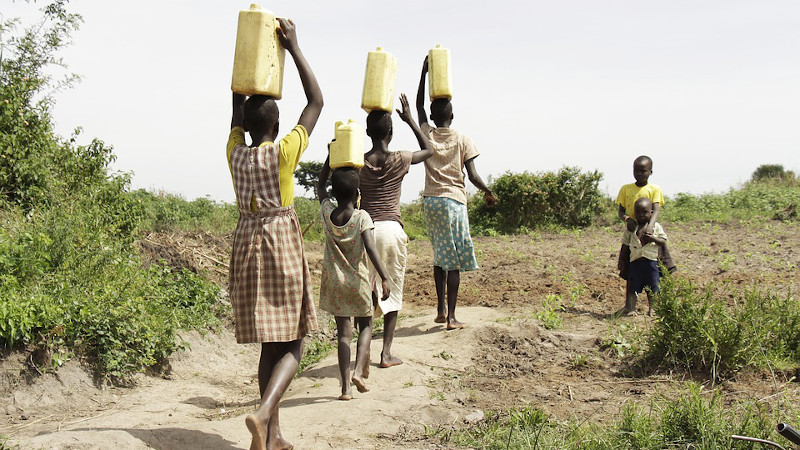
The weather of the region, at last, prompted the countries of the region to create a regional organization in 1986 to coordinate their efforts with respect to addressing the recurrent droughts and natural calamities of the region, mostly droughts and environmental degradation. It was then called the Intergovernmental Authority for Droughts and Desertification (IGADD), but it was transformed in 1996 to Intergovernmental Authority on Development (IGAD).
Unlike other regional organizations, it is not designed to coordinate the social, economic and political policies of the region and hence develop the necessary mechanisms to handle these matters, and hence the members of the group pursue their individual goals and objectives as single states. This is one of the markers of IGAD as an ineffective organization. The very reason for which the mandate of the organization was changed in 1996 was to involve the institution in coordinating the region’s policies with respect to peace, security and socio-economic development and hence integration. The political aspects of the region were ignored, which resulted in hampering its prospering as an integrative organization.
While not being an effective regional organization, it was received and admitted into the African Union’s emerging regional groups and continued to participate in the AU’s conferences and other continental activities with respect to integration initiatives of the continent. It might be worthwhile that some of the members of the IGAD are effective members of other regional groupings such as the East African Community. These include Kenya, Uganda and South Sudan, and more recently Somalia, and hence dance to a different tune as opposed to the other members of IGAD namely, Ethiopia, Djibouti, Sudan and Eritrea.
While not owning the necessary mechanisms to mediate, intervene and handle regional issues, it plunged itself into the issues of Somalia’s internecine wars, South Sudan’s ethnic based civil conflict and indeed, Sudan’s civil war and obviously the institution, has failed in all these matters, once again demonstrating the irrelevance of the institution. All the members of IGAD were pursuing differing objectives with respect to each of the conflicts mentioned heretofore.
The interventions cited were all related to the region and should have been handled with care and with rules agreed among the members of IGAD, which indeed, do not exist. The members of the Group of IGAD deployed the empty African slogans that African problems should have African solutions. They do not even have mechanisms to solve regional issues let alone the large African continent. How could it solve these issues, and through which means and mechanisms?
The IGAD strategic development objectives, indeed, include “strengthening the transformative capabilities for the attainment of peace, security and stability”. This is a grand statement, perhaps designed to mislead and/or confuse the audience who could be the ‘financiers’, the AU, the regional populations, the casual reader, and even the researchers of public policies. The organization is not designed like other regional groupings whose general agendas include among other matters coordinating the groups policies with respect to customs and taxes, markets, monetary systems, political issues both internal and external, and even security matters. In the realm of logic, this only appears to be an equivocation statement without real substance supporting it.
How is it possible that IGAD does, indeed, include some of the most conflicted countries in Africa and in the world, when it is making such grand statements? They must be laughing at their own people. IGAD is, indeed, like many other African institution, a club of presidents and prime ministers and does not have the normal structures and objectives of a normal regional socio-economic political organization like SADC or EAC or ECOWAS. It does not involve its populations, academia, business community or even traditional elder statemen. It is an indirect instrument probably used to infiltrate the region for nefarious reasons, but it is, certainly, not a normal regional block.
Obviously, IGAD appears to be a hybrid organization bringing together countries that belong to differing socio-cultural regions. These include Swahili countries (Uganda and Kenya), Sudanese culture (South Sudan and Sudan) and Horn of Africa states countries (Somalia, Ethiopia, Eritrea, and Djibouti). They also belong to differing other groupings where Kenya, Uganda and South Sudan belong to the EAC regional block which is highly advanced in its economic and political integration. The actual Horn of Africa States consist of Somalia, Ethiopia, Eritrea and Djibouti and could probably include Sudan, should Sudan opt to join it.
Hybrid organizations do not go anywhere and become instruments where the strong exploit the weak such as happened in Somalia. This institution should be reverted to its original mandate of dealing with droughts, famines and environmental degradations. It should not be in the realm of politics and regional groupings of socio-economic business.
It is where the necessity for the Horn of Africa States as a regional block is clearly needed to be formed and these should involve the countries of the Horn of Africa States, Somalia, Ethiopia, Eritrea and Djibouti (the SEED countries), and perhaps Sudan, should Sudan wish to join, in the long run. But certainly, the core countries of the group should be the SEED countries.
Many pundits and experts point to the almost impossibility of these countries coming together. They cite the many intra-state conflicts of the region such as the Somali civil war which dates back to 1991, the Ethiopian civil wars which still continue to this day which led to the downfall of Mengistu Haile Mariam and emergence of Eritrea, the rise and downfall of Meles Zenawi and the current ones against Abiy Ahmed. They also point out to the inter-state wars like the 1977/78 war between Somalia and Ethiopia and Ethio-Eritrean war of 1998 to 2000, the continuing border rift between Djibouti and Eritrea where a brief armed confrontation took place, and many other incidents within the region.
The region currently and fortunately at that, does not have a hegemon. At one time, Ethiopia, as the largest in the region, was seen as a possible hegemon, but the country is busy on itself and appears to have no space to spread its wings. Recently, the Prime Minister of the country gave rise to some waves with regard to his country’s desire to have access to a sea outlet, but this only caused the littoral countries to rebuff the call. Ethiopia has already access to many ports of the region such as Djibouti, which it already enjoys, Berbera, which feeds it on a smaller scale, and she could have access to other ports. None of the countries of the region has denied its ports to the country.
With respect to development, all the four countries are considered as developing with some more fragile than others. The legal infrastructures are all mostly authoritarian although the constitutions may point to structured democratic systems. It is, however, tribal/ethnic based where loyalties generally reside in the place of the nation. This is a common weakness in the countries of the region, and where a regional construct could have helped remove.
Competency and skill play a secondary role in the filling of important positions, where preference to loyalty plays a pivotal role and this is only possible in the ethnic context as this is not costly for the politician in the region. They exploit it to the fullest. It also helps them avoid political assassinations, but they use other means such as imprisonment and/exiling opponents to cause populations toe the line. This would continue as in any other society, but this would be lessened should a regional construct be launched. Now, how should this regional construct be and what should it entail? Many people in the Horn of Africa States region understand a regional construct differently. Many assume that one country, usually the hegemon, currently considered to be Ethiopia, would absorb the others.
A regional grouping such as the Horn of Africa States “HAS” would not involve a hegemon absorbing the others. Countries have different sizes in terms of populations and territories, but size does not justify hegemonic tendencies. Politicians create hegemonic tendencies and tensions between countries. On the other hand, there would be cooperation among the countries of the region, not only in terms of economy but also in all matters related to people and culture, and hence eventually politics.
The HAS construct would emphasize that it should be a regional organization borne out of the desire of the region and not of the wishes and desires of others such as IGAD seems to be. The HAS would have to be funded by the countries of the region and should therefore have a heading in their budgets. This would make it less dependent for its operations on the funding of outside parties like the European Union as IGAD is today.
The HAS construct would involve only the Horn of Africa States countries and would not involve other African countries as is currently the case with IGAD. Different African countries, despite being all African, do also have differing goals. The Horn of Africa States does enjoy a historical context unlike any other African regional conglomeration and should therefore seek to revive and improve its historical relevance throughout history. Currently, only single countries of Ethiopia, Somalia, Eritrea and Djibouti are presented and discussed. There is no emphasis on the important Horn of Africa States region which overlooks/controls some of the most important assets of the world such as the source of the Blue Nile, the Suez Canal Indian Ocean waterway and a vast agricultural and mineral base. It is also home to a growing youthful population of some 160 million, soon to grow to over 200 million, which represents a large market. The region also owns the longest coast in the African continent which stretches for some 4,700 km and hence entails a sizeable blue economy.
Why is there only emphasis on the differences between the individual countries and not emphasis on the shared assets of the region or the shared values? The populations of the region need to live in peace like those of any other region. This emphasis by pseudo-politicians on the tribal/ethnic base is unnecessary and cannot be part of the region’s 21st century. People of the region should be able to travel to each other, invest in each other’s countries, and share the bounties of the region through either labor or capital. This does not necessarily mean the countries of the region should merge. They can achieve this through common arrangements where each country remains ‘As Is”, but goods, labor and capital can cross borders with ease through arrangements to be made.
The Horn of Africa States region should not have to reinvent the wheel with respect to regional arrangements. They can deploy the already tested arrangements which work for others, but which can be amended/adjusted to meet local needs. In this respect, one should study and consider the European Union as a prime example of a system that can be deployed by Horn Africans to create a Horn of Africa States regional block. Here there would be a HAS constitution, sub-national constitutions based on the HAS constitution, common internal and foreign policies, common economic policies, monetary union and a common market. They do not weaken the nation state infrastructure but support it.
Negotiations with the “others” would be better and stronger for the benefit of the HAS region, and the region would become more attractive for investments from within and from without. The security architecture of the region would also improve and there would be less hurry on the part of others to the region as is the case currently.
A HAS construct would transform the headlines of the region drastically. Instead of droughts and famines, one would read and hear about new investment features in technology, oil and gas, new banking services and financial performance of corporations in the region. One would read about the growth of the economy of the region, improved health services, new hospitals and new medicines developed by scientists of the region to deal with the health issues of the region. One would read about new conferences and forums and about important visitors from other parts of the world and new arrangements and understandings with others instead of the hunger and call for assistance from the international community. It is time the regional leaders were kinder to their populations and to the world by coming together to create a new effective organization that is local and executive – The Horn of Africa States regional block (“HAS”) and walk away from the fallacy of IGAD.
Plenary Speech by IMF First Managing Deputy Director Gita Gopinath at 20th World Congress of the International Economic Association Colombia
Introduction
Good morning. It is an honor to speak at the 20th World Congress of the International Economic Association.
The overarching question of this congress is “Are we at a turning point?”
I believe we are. In fact, I will take this congress’ question a step further and ask: are we on the brink of Cold War II? The historian Niall Ferguson argues that we already are. If so, what would that mean for the global economy? And how can we preserve the gains from economic openness within a more fragmented world?
To answer these questions, I will first briefly trace the history of cross-border trade relations during the twentieth century. I will then examine the parallels and differences between the Cold War and today. I will describe the signs of fragmentation that we see in trade and investment data so far and discuss the potential economic costs should the fault lines deepen. Finally, I will offer three principles for protecting economic cooperation in a more fragmented world.
Pandemic, war, and growing tensions between the two largest economies of the world—the US and China—have undoubtedly changed the playbook for global economic relations. The US calls for “friend-shoring,” the EU for “de-risking,” and China for “self-reliance.” National security concerns are shaping economic policy worldwide.
Meanwhile, the global rules-based system was not built to resolve national security-based trade conflicts. So, we have countries strategically competing with amorphous rules and without an effective referee.
There are benefits for countries of this playbook as they attempt to de-risk their supply chains and strengthen national security. But, if not properly managed, the costs could easily overwhelm these benefits, and potentially reverse nearly three decades of peace, integration, and growth that helped lift billions out of poverty.
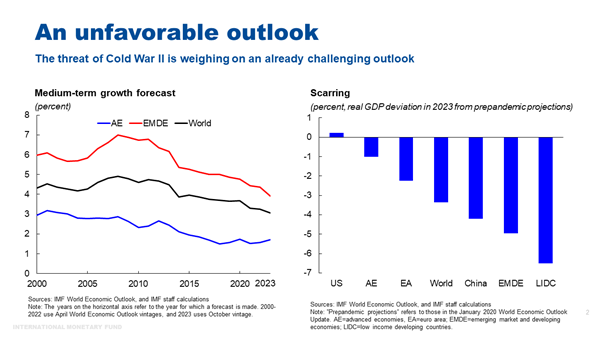
With the weakest global growth prospects in decades—and with disproportionate scarring from the pandemic and war slowing income convergence between rich and poor nations—we can little afford another Cold War.
Some historical perspective
Let’s start by looking at the history. This is not the first time that globalization has come under threat and geopolitical considerations have fragmented global trade and capital flows. [1]
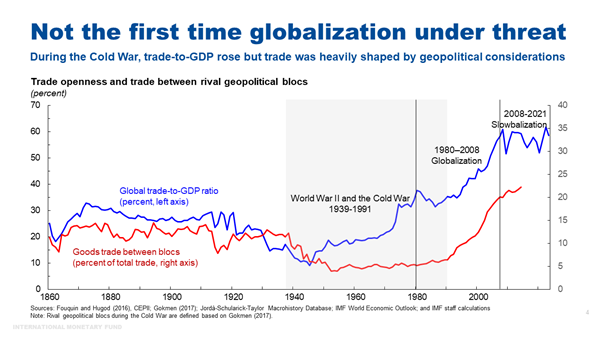
There was an explosion of international trade during the “long” 19th century, a 125-year period beginning with the French Revolution in 1789. But WWI brought that golden era of globalization to an abrupt end with world trade collapsing as a share of income. The protracted economic hardship that followed the war paved the way for the rise of nationalist and authoritarian leaders that later plunged the world into WWII. After WWII, a fragmented bipolar world emerged with two superpowers—the US and USSR—divided by ideology, and political and economic structures. Poised precariously between them was a set of non-aligned countries.
This “Cold War” period, between late 1940s and late 1980s, was not a period of de-globalization as it was marked by rising global trade to GDP driven by the post-war recovery and the trade liberalization policies adopted by many countries in the Western bloc. However, it was a period of fragmentation as trade and investment flows were heavily shaped by geopolitical considerations. Trade between opposing blocs collapsed from around 10-15 percent to less than 5 percent of global trade during the Cold War.
With the end of the Cold War, trade between previously rival blocs expanded rapidly, reaching almost a quarter of world trade in the following decade. The end of the Cold War also coincided with the hyper-globalization period of the 1990s and 2000s: technological innovations, unilateral and multilateral trade liberalization, and geopolitical and institutional changes all coalesced to lift economic integration to levels not seen before.
Since 2008, however, the pace of globalization has stagnated—the so-called slowbalization—with trade to GDP stabilizing as the forces that helped spur hyper-globalization naturally waned. [2]
That brings us to the present day. Over the past 5 years, threats to the free flow of capital and goods have intensified as geopolitical risks have grown. Some measures, including tariffs or export restrictions, directly target trade and investment. Other behind-the-border measures indirectly affect trade flows, such as fiscal and financial support to specific domestic sectors and local content requirements.
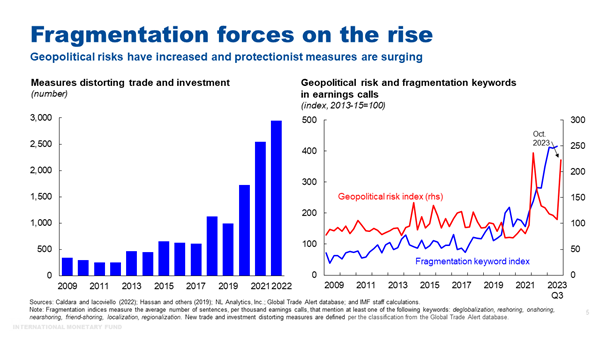
Around 3,000 trade restricting measures were imposed last year—nearly 3 times the number imposed in 2019.
Multinational firms, in their earnings’ calls, are increasingly discussing issues such as re-shoring, near-shoring, friend-shoring, and deglobalization.
Cold War II?
So are we at the beginning of Cold War II? The key driving force is similar—that is the ideological and economic rivalry between two superpowers. In the Cold War it was US and Soviet Union, now it is US and China.[3] But the stage on which these forces are unleashed is fundamentally different along several dimensions.
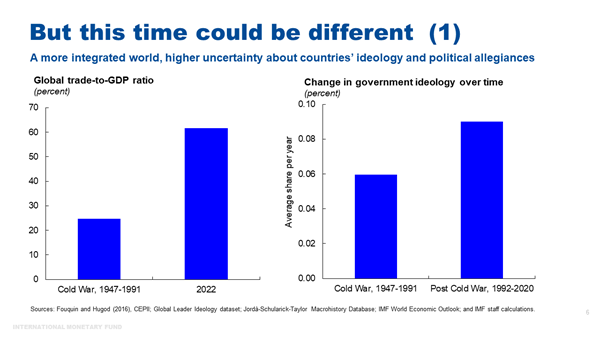
To start, the degree of economic interdependence between countries now is higher, as economies have become much more integrated into the global marketplace and through complex global value chains. Global trade to GDP is now 60 percent compared to 24 percent during the Cold War. This will likely raise the costs of fragmentation.
There is also greater uncertainty on the bloc with which countries may choose to associate. Within-country swings in the ideology of the political leadership have increased compared to the Cold War era and make it difficult to pin down allegiances. This uncertainty can further raise costs.
On the other hand, the potentially non-aligned countries now have greater economic heft in terms of GDP, trade, and population. [4] For the current period, the analysis considers two hypothetical blocs based on countries’ voting patterns in the UN and include predominantly the US and Europe in the Western bloc and China and Russia in the Eastern bloc, with the rest of the countries considered “non-aligned.” In 1950, the Western and Eastern blocs together accounted for roughly 85 percent of global GDP. The two blocs that we hypothetically have today account for roughly 70 percent of GDP and only one-third of the world’s population. And they have to compete with non-aligned emerging players.
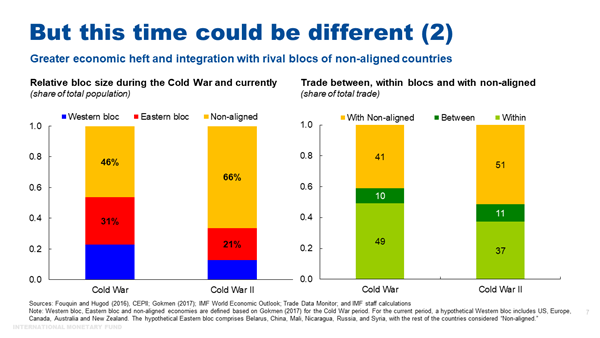
Given their increased economic integration—in 2022 more than half of global trade involved a non-aligned country—they can serve as “connectors” between rivals. They can benefit directly from trade and investment diversion in a fractured global economy and cushion the negative effect of fragmentation on trade, therefore reducing its costs.
Growing fault lines: The facts about fragmentation
Let’s next examine the facts about fragmentation. As you will see, there are signs of growing fault lines.
Like the period of the Cold War, we do not see meaningful deglobalization, as the share of global trade in world GDP remains relatively stable. But we are beginning to see signs of fragmentation with meaningful shifts in underlying bilateral trading relations.
While the growth of trade has slowed everywhere after the war in Ukraine, growth between blocs that are not politically aligned has slowed more. Specifically, trade growth within blocs has decreased to 1.7 percent from 2.2 percent pre-war. Trade between blocs has declined from 3 percent pre-war to around -1.9 percent. On net, this generates 3.8 percentage point faster growth in trade within blocs as opposed to between blocs.
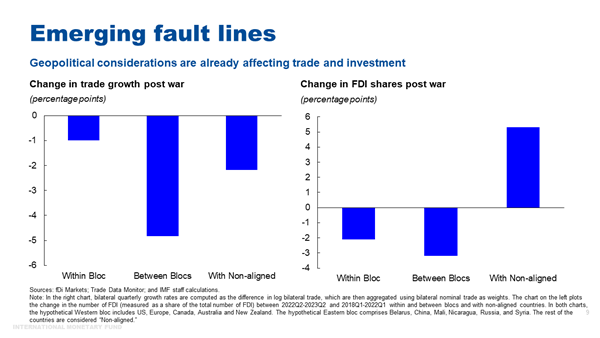
Importantly, this pattern is not limited to just trade in strategic sectors—which are most likely to be targeted by policymakers and potentially helps countries de-risk. It also appears in trade of non-strategic products.
There are also clear signs that global foreign direct investment (FDI) is segmenting along geopolitical lines. [5] Announced FDI projects between blocs declined more than those within blocs after the onset of the war in Ukraine, while FDI to non-aligned countries sharply increased. In fact, almost 40 percent of announced FDI projects were in those economies in 2023q3.
This occurred alongside the resurgence of trade tensions between the US and China, between whom direct links are being severed.
China is no longer the largest trading partner to the US, and its share of US imports has fallen by almost 10 percentage points in 5 years: from 22 percent in 2018 to 13 percent in the first half of 2023. The trade restrictions imposed since the onset of the US-China trade war in 2018 have effectively curbed Chinese imports of tariffed products. [6]
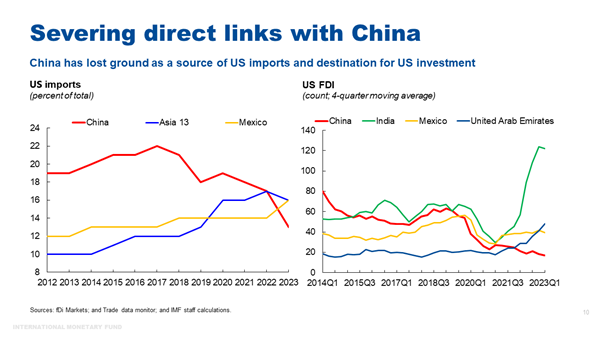
China is also no longer a prominent destination for outward US FDI, losing rank to emerging markets such as India, Mexico, and UAE in the number of announced FDI projects.
But there is suggestive evidence that direct links between US and China are simply being replaced by indirect links. Countries that have gained the most in US import shares—such as Mexico and Vietnam—have also gained more in China’s export shares. [7] The same countries are also larger recipients of Chinese FDI.
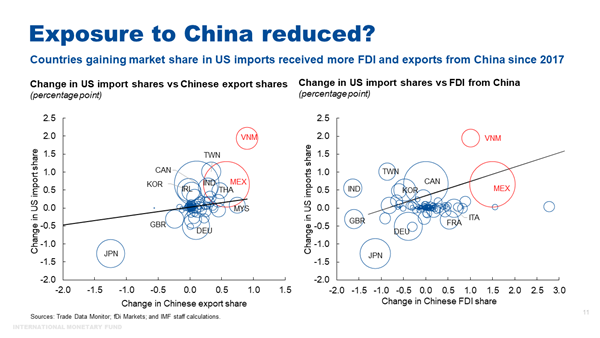
There is growing anecdotal evidence of a set of “connector” countries that are uniquely positioned to benefit from the US strategy of “de-risking” from China. This is due to factors such as their location, natural endowments, and free trade agreements with both sides.
For example, large electronics manufacturers have accelerated relocating production from China to Vietnam given US tariffs on Chinese goods. However, Vietnam sources most inputs from China, while most exports go to the US.
Meanwhile, Mexico eclipsed China as the biggest exporter of goods to the US in 2023. But many manufacturers opening plants in Mexico are Chinese companies, targeting the US market. According to the Mexican Association of private industrial parks, one in five new businesses in the next two years will be Chinese.
This anecdotal evidence—along with correlations in the data—point to lengthening supply chains. This is supported by a recent BIS study, which examined data from more than 25,000 companies and found that supply chains have lengthened in the last two years, especially those involving Chinese suppliers, and US customers.
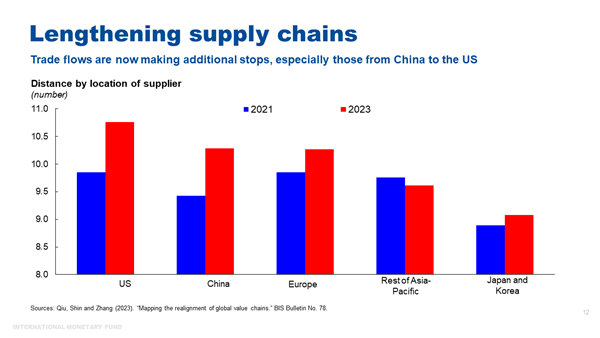
In sum, fragmentation is already a reality as geopolitical alignments shape trade and investment flows: a process that will likely continue. But despite efforts by the two biggest economies to cut ties, it is not yet clear how effective they will be in a deeply integrated and connected global economy.
The economic costs of fragmentation.
If fragmentation deepens, what would be the economic cost? And how will those costs be transmitted?
With trade being the main channel through which fragmentation could reshape the global economy, imposing restrictions on trade would diminish the efficiency gains from specialization, limit economies of scale due to smaller markets, and reduce competitive pressures.
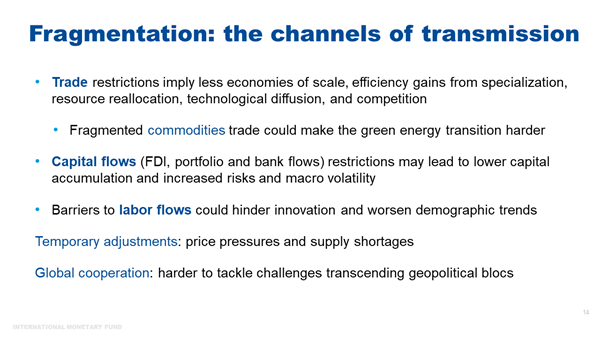
The capacity of trade to incentivize within-industry reallocation and generate productivity gains would be stifled. Less trade would also imply less knowledge diffusion, a key benefit of integration, which could also be reduced by fragmentation of cross-border direct investment.
Fragmentation of capital flows would limit capital accumulation—because of lower FDI—and affect the allocation of capital, asset prices, and the international payment system, posing macro-financial stability risks and potentially leading to a more volatile economy.
The estimates of the economic costs of fragmentation vary widely and are highly uncertain. But recent and ongoing work at the IMF suggests that these costs could be large and weigh disproportionately on developing countries.
If the global economy were to fragment into two blocs based on UN voting on the 2022 Ukraine Resolution and trade between the two blocs were eliminated, global losses are estimated to be about 2.5 percent of GDP. But depending on economies’ ability to adjust, the losses could reach as high as 7 percent of GDP. At the country level, losses are especially large for lower income and emerging market economies. [8]
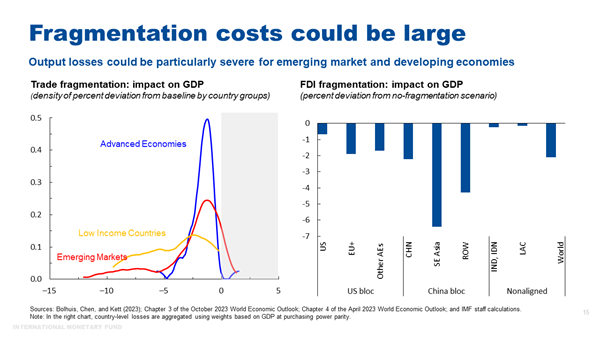
FDI fragmentation in a world divided into two blocs centered around the US and China—with some countries remaining non-aligned—could result in long term global losses of around 2 percent of GDP.
As in the case of trade, the losses are larger for less advanced regions—which depend more on inflows from the opposing bloc. [9]
But a lot will depend on how exactly trade and investment fracture. If some economies remain non-aligned and continue engaging with all partners, they could benefit from the diversion of trade and investment.
Our simulations suggest that if only trade between a US-Europe bloc and a China-Russia bloc is disrupted, the remaining economies will see some gains, on average. [10]
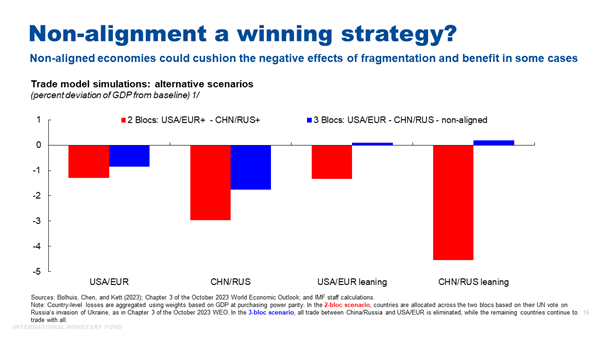
Latin American countries are well placed to benefit in such a scenario. For example, Mexico’s proximity with the United States could boost its manufacturing sector, while South America’s commodity exporters could gain market shares.
But if fragmentation worsens, even those who benefit from fragmentation in its mild forms could be left with a larger slice of a smaller pie in an extreme scenario. In short, everyone could lose.
Fragmentation would also inhibit our efforts to address other global challenges that demand international cooperation. The breadth of those challenges—from climate change to AI—is immense.
Recent IMF analysis shows that fragmentation of trade in minerals critical for the green transition—such as copper, nickel, cobalt, and lithium—would make the energy transition more costly. Because these minerals are geographically concentrated and not easily substituted, disrupting their trade would lead to sharp swings in their prices, suppressing investment in renewables and EV production. [11]
What can policymakers do to prevent the worst-case economic scenarios in a full-blown Cold War II?
At this turning point, policymakers face difficult tradeoffs between minimizing the costs of fragmentation and maximizing security and resilience. Pragmatic approaches that preserve the benefits of free trade to the extent possible and safeguard solving global challenges—while minimizing distortions—are needed.
The first best solution, of course, is to avoid fragmentation. But, for the time being, this may be difficult to achieve.
Absent the best-case scenario, we must work to avoid the worst-case scenario and protect economic cooperation in a more fragmented world. Three principles can help:
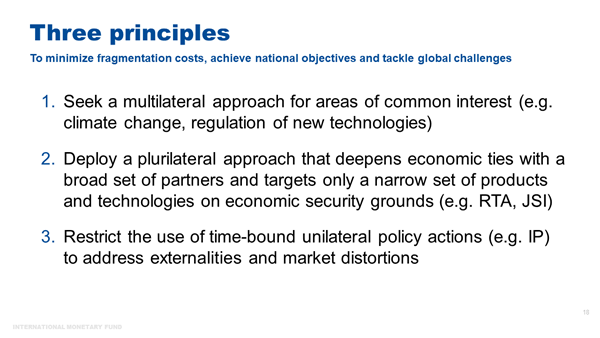
First, seek a multilateral approach at the very least for areas of common interest. For example, a green corridor agreement could guarantee the international flow of minerals critical for the clean energy transition.
Similar agreements for essential food commodities and medical supplies could ensure minimum cross-border flows in an increasingly shock-prone world. Such agreements would safeguard the global goals of averting climate change devastation, food insecurity and pandemic related humanitarian disaster. [12]
Second, if some reconfiguration of trade and FDI flows is deemed necessary to de-risk and diversify, a non-discriminatory plurilateral approach can help countries deepen integration, diversify, and mitigate resilience risks.
Policymakers should define broadly the set of partners and allies with which to deepen economic partnerships. Plurilateral agreements consistent with the WTO—such as regional trade agreements and joint statement initiatives—while clearly second best, could offer several benefits. These include economies of scale, greater market access, and diversified suppliers, among others. By updating the rules and keeping an open-door policy, such agreements allow new partners to join when they are willing and able to commit to the agreements’ rules and norms.
Recent examples of regional trade agreements (RTA) include the Comprehensive and Progressive Agreement for Trans-Pacific Partnership (CPTPP) and the African Continental Free Trade Area (AfCFTA). Several joint statement initiatives are currently underway, including on e-commerce, investment facilitation, and services domestic regulation. In December 2021, 70 WTO members agreed on a WTO-based plurilateral agreement on domestic regulation of services.
Policymakers should target only a narrow set of products and technologies that warrant intervention on economic security grounds. Before deciding to bring production home, they must carefully consider whether there is truly a lack of suppliers from less risky regions and make an objective assessment of the social and economic costs of supply disruptions. This is especially the case for widely used technologies, such as semi-conductors.
Third, restrict unilateral policy actions—such as industrial policies—to addressing externalities and market distortions and be time-bound. Limit their goal to correcting market failures while preserving market forces where they can allocate resources most efficiently.
It is critical to carefully evaluate industrial policies, both in terms of their effectiveness in achieving stated outcomes and associated economic costs, including cross-border spillovers.
Domestically, industrial policies may be hard to limit or roll back given their concentrated benefits and diffused costs.
Internationally, such policies may lead to retaliation, which would deepen fragmentation. According to recent IMF estimates, if China introduces a subsidy, the likelihood that the EU imposes a trade restricting measure within 12 months in response to the subsidy is 90 percent.
An inter-governmental dialogue—or a consultation framework—on industrial policies could help improve data and information sharing and identify the impact of policies, including their unintended consequences across borders. Over time, steady lines of communication could help develop international rules and norms on the appropriate use and design of industrial polices, making it easier for companies to adjust to the new environment.
On each of these three principles, we can look for blueprints from the last Cold War. Throughout that period, the US and Soviet Union made several agreements to avoid nuclear catastrophe. Both superpowers subscribed to the doctrine of mutually assured destruction, knowing that an attack by one would ultimately lead to total annihilation.
If we descend into Cold War II, knowing the costs, we may not see mutually assured economic destruction. But we could see an annihilation of the gains from open trade. Ultimately, policymakers must not lose sight of those gains. It is in their—and everyone’s—best interest to advocate strongly for a multilateral rules-based trading system and the institutions that support it.
Of course, economic integration has not benefited everyone—acknowledging this is critical to understanding additional motivations behind global inward shifts, and domestic policies must adjust to broaden the benefits. But it has helped billions of people become wealthier, healthier, and better educated—since the end of the Cold War, the size of the global economy roughly tripled, and nearly 1.5 billion people were lifted out of extreme poverty.
Conclusion
Let me conclude. While there are no signs of broad-based retreat from globalization, fault lines are emerging as geoeconomic fragmentation is increasingly a reality. If fragmentation deepens, we could find ourselves in a new Cold War.
The economic costs of Cold War II could be large. The world has become much more integrated, and we face an unprecedented breadth of common challenges that a fragmented world cannot tackle.
Yet, even in this new geopolitical reality, policymakers can seek solutions that minimize the costs of fragmentation. The focus should be on pragmatic approaches that preserve the benefits of free trade to the extent possible, safeguard solving global challenges, while achieving domestic goals of security and resilience.
Keeping open the lines of communication, as is being done by the US, China, and EU, can help prevent the worst outcomes from occurring. The non-aligned countries, which are mainly emerging and developing countries, can deploy their economic and diplomatic heft to keep the world integrated. After all, many emerging and developing countries face the biggest losses from a fragmented world, and while some benefit in the early stages of fragmentation, all lose in a full-blown Cold War.
As we consider this “turning point” question over the next few days, I encourage all of us to think about how we can help achieve these solutions—through our research and our collaboration. This will be critical to preserve what we have achieved and face the global challenges ahead.
Thank you.
References
Aiyar, Shekhar, Davide Malacrino, and Andrea Presbitero (2023a). “Investing in Friends: The Role of Geopolitical Alignment in FDI Flows.” CEPR Discussion Paper 18434.
Aiyar, Shekhar, Andrea Presbitero, and Michele Ruta (2023b). “Geoeconomic Fragmentation: The Economic Risks From a Fractured World Economy.” CEPR Press.
Alfaro, Laura, and Davin Chor (2023). “Global Supply Chains: The Looming “Great Reallocation.” NBER Working Paper 31661, National Bureau of Economic Research.
Antràs, Pol (2021). “De-Globalisation? Global Value Chains in the Post-COVID-19 Age,” (2021) ECB Forum: Central Banks in a Shifting World Conference Proceedings.
Attinasi, Maria Grazia, Lukas Boeckelmann, and Baptiste Meunier. 2023. “Friend-Shoring Global Value Chains: A Model-Based Assessment.” European Central Bank Economic Bulletin 2, European Central Bank, Frankfurt.
Bolhuis, Marijn, Jiaqian Chen, and Benjamin Kett. 2023. “Fragmentation in Global Trade: Accounting for Commodities”. IMF Working Papers 23. International Monetary Fund.
Bown, Chad (2022). Four Years Into the Trade War, are the US and China Decoupling. Working paper, Peterson Institute for International Economics.
Caldara, Dario and Matteo Iacoviello (2022). Measuring Geopolitical Risk. American Economic Review 112 (4), 1194–1225.
Campos, Rodolfo, Julia Estefania-Flores, Davide Furceri, and Jacopo Timini (2023). Geopolitical fragmentation and Trade.” Journal of Comparative Economics (Forthcoming).
Dang, Alicia, Kala Krishna and Yingyan Zhao. 2023. “Winners and Losers from the U.S.-China Trade War.” NBER Working Papers 31922, National Bureau of Economic Research.
Fajgelbaum, Pablo, Pinelopi Goldberg, Patrick Kennedy, Amit Khandelwal, and Daria Taglioni. 2023. “The US-China Trade War and Global Reallocations.” American Economic Review: Insights (Forthcoming).
Ferguson, Niall. 2020. “Cold War II.” National Review Magazine, December 3, 2020.
Freund, Caroline, Aaditya Mattoo, Alen Mulabdic, Michele Ruta. 2023. “Is US Trade Policy Reshaping Global Supply Chains?” World Bank Policy Research Working Paper 10593.
Góes, Carlos, and Eddy Bekkers. 2022. “The Impact of Geopolitical Conflicts on Trade, Growth, and Innovation.” Staff Working Paper ERSD-2022-09, World Trade Organization, Geneva.
Gokmen, Gunes (2017). “Clash of Civilizations and the Impact of Cultural Differences on Trade” Journal of Development Economics, 127, 449-458.
International Monetary Fund. 2023a. “Geoeconomic Fragmentation and Foreign Direct Investment”. Chapter 4, World Economic Outlook, April.
International Monetary Fund. 2023b. “Commodities and Fragmentation: Vulnerabilities and Risks”. Chapter 3, World Economic Outlook, October.
Javorcik, B. Seata, Lucas, Kitzmueller, Helena Schweiger, and Muhammed Yıldırım (2022). “Economic Costs of Friend-shoring.” EBRD Working Paper 274, European Bank for Reconstruction and Development.
Qiu Han, Hyun Song Shin and Leanne Si Ying Zhang (2023). “Mapping the realignment of global value chains.” BIS Bulletin No 73, October 3, 2023.
[1] Deglobalization refers to the retrenchment of economic flows between countries. Typically measured as a reduction in the world trade (or investment) to GDP ratio, deglobalization could be driven by policy choices (such as the imposition of tariffs), secular trends (such as the structural transformation towards less-traded parts of the economy), and the waning of forces that helped spur the rapid integration of economies until the mid-2000s (such as the reduction in transport costs, the break-up of production processes across countries, technological advances, and the like). Fragmentation, on the other hand, refers to policy-induced redirection of trade and investment flows that may or may not be associated with a decline in world trade to GDP.
[2] See Antras (2021).
[3] During the Cold War, the world was divided into two blocs, a Western and Eastern bloc, and a set of non-aligned countries. The analysis uses the bloc definition based on Gokmen (2017). The Western bloc includes Andorra, Australia, Belgium, Canada, Denmark, France, Germany, Greece, Iceland, Israel, Italy, Japan, Luxembourg, Malta, Monaco, Netherlands, New Zealand, Norway, Philippines, Portugal, San Marino, South Korea, Spain, Taiwan, Thailand, Turkey, United Kingdom, United States. The Eastern bloc includes Albania, Armenia, Azerbaijan, Belarus, Bulgaria, China, Cuba, Czech Rep., Estonia, Georgia, Hungary, Kazakhstan, Kyrgyzstan, Lao People’s Dem. Rep., Latvia, Lithuania, Moldova, Mongolia, North Korea, Poland, Romania, Russia (USSR), Slovakia, Turkmenistan, Ukraine, Uzbekistan, Vietnam. The remaining countries are considered “non-aligned.”
[4] For the current period, the analysis considers a hypothetical Western bloc, including US, Europe, Canada, Australia and New Zealand. The hypothetical Eastern bloc comprises Belarus, China, Mali, Nicaragua, Russia, and Syria. The rest of the countries are considered “non-aligned.”
[5] See Aiyar et al. (2023a).
[6] See Fajgelbaum and Khandelwal (2022) for a survey of the literature, as well as Alfaro and Chor (2023), Bown (2022), Freund et al. (2023),.
[7] See also Alfaro and Chor (2023), Dang et al. (2023) and Freund et al. (2023).
[8] See Bolhuis, Chen and Kett (2023). A growing literature also points to large costs from trade fragmentation and the resulting reshaping of GVCs (see, among others, Aiyar et al. 2023b; Attinasi et al. 2023; Campos et al. 2023; Goes and Bekkers 2023, Javorcik et al. 2022).
[9] See Chapter 4 of the April 2023 World Economic Outlook.
[10] Aggregate global output changes would still be negative in this scenario, due to the inefficiencies associated with trade restrictions even if applied only to a subset of the world economies.
[11] See Chapter 3 of the October 2023 World Economic Outlook.
[12] The global community could learn from the exemption of humanitarian food purchases from export restrictions established at the twelfth WTO Ministerial Conference in 2022.