Categories
South Caucasus News

Biden Gives Booster Dose To The Faltering Ukraine War – OpEd


Biden Gives Booster Dose To The Faltering Ukraine War – OpEd

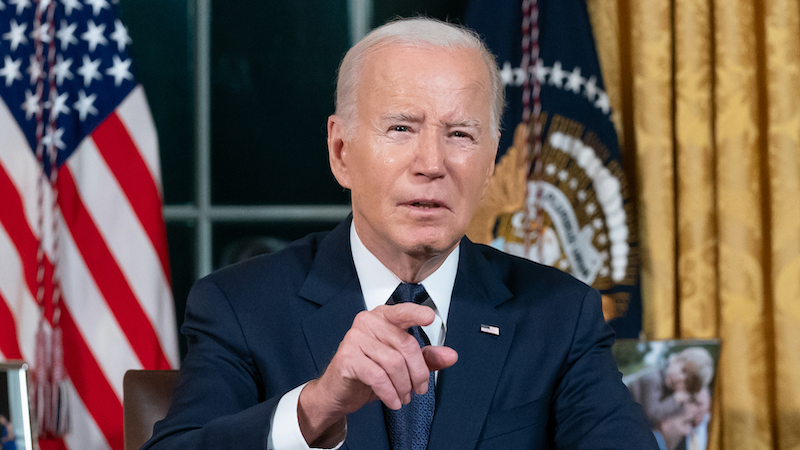
US President Joe Biden. Photo Credit: The White House

The prognosis of “war fatigue” on the part of the United States and its allies in the proxy war in Ukraine was greatly exaggerated. On the contrary, the war is acquiring a new swagger. 

The Biden Administration is riding a tiger and a dismount is fraught with the danger of being devoured by the beastly consequences of defeat in the war, which could only lead to the discredit of trans-atlanticism and the disintegration of NATO, and spell the doom for US’ global hegemony. 

Biden’s formal address to the nation from the Oval Office on Thursday can only be seen as the launch of a new phase of the Ukraine war carrying forward the the demonising of Putin to a new level, Biden weaves together a new narrative claiming that Hamas and the Russian leader both want to “completely annihilate a neighbouring democracy — completely annihilate it.” 

The bedrock of Biden’s argument was that resolute support of US allies is essential for preserving American primacy in the world. The main plot was that the hybrid war in Ukraine will continue so long as Biden remains in office in the White House. It has morphed into a “forever war”. Biden called Ukraine President Vladimir Zelensky before making his speech.    

Analysts would have us believe that Europe is increasingly disenchanted with the war. But Poland, a major frontline state, has just voted to power a centrist government that is cause for celebration in Kiev (and Washington). In Britain too, a similar outcome is to be expected — only that it will be Tweedledum replacing Tweedledee, two rotund little men of the Deep State who are identical except that they are left-right reversals of each other.  

Make no mistake that the Joint Statement after the US-EU summit in Washington on October 20 amounts to a resounding victory for the Biden Administration as the EU agreed with the US on “unwavering” military support to Ukraine; demand that Russia should “end its brutal war and withdraw its military forces and proxies and military equipment immediately, completely, and unconditionally from the entire internationally recognised territory of Ukraine”; the imperative of restoration of “internationally recognised borders” in any peace settlement; forcing Russia to “bear the legal consequences of all its internationally wrongful acts” against Ukraine; further deepening of “joint work to undermine Russia’s ability to wage its war, and maintain and expand its defence industrial base and capacity”, and so on. 

There is no sign of a potential wobbling in the steadfastness of Europe’s military support to Ukraine, either. The most recent example is Sweden where, as in other Nordic countries and across the Baltic states, geographical proximity to Russia has heightened security fears, and there is little sign of any wavering. 

Politico reported on Tuesday that Sweden’s Defense Minister Pål Jonson had instructed the country’s military leadership to examine the potential impact of providing various types of support to Ukraine’s fighter-jet capability, including Gripen planes. The military is to report back to Jonson by November 6. This followed announcements by Sweden’s European neighbours Norway, Denmark, Belgium and the Netherlands that they planned to send Lockheed Martin F-16 jets to Kiev.

The expert opinion is that even a limited number of Gripen could meaningfully help Ukraine’s efforts to control its airspace, and is seen as relatively cheap and easy to maintain jet that can operate from shorter, narrower runways, including improvised landing strips on straight stretches of highways, thus reducing the risk of aircraft congregating at a larger base and being destroyed by a single enemy attack.

As for the US, now we know that the Biden Administration was dissimulating as regards the ATACMS missiles, whereas, it had already surreptitiously equipped Kiev’s forces with that system. Furthermore, encouraged by the success of Kiev’s devastating attack on the Russian-controlled airfield attacks in Beryansk and Luhansk on Tuesday by using ATACMS (which reportedly destroyed multiple Russian helicopters, an ammunition dump, and an air defence system), the Biden Administration is now considering supply of an advanced version of the missile that can fire twice (190 miles) as far as the ones Ukraine just received (100 miles only). 

Certainly, there is no weakening of Biden’s resolve. In fact, National Security Advisor Jake Sullivan brazenly disclosed on Friday in a special White House briefing that Washington has “contracted for certain types of weapons systems that have yet to be delivered because they’re still in production.” Plainly out, the Biden Administration considers it possible to hand over weapons and military vehicles to Ukraine that have never been shipped before. 

“The President has the discretion based on circumstances of the conflict, the situation on the ground, consultations with allies to make determinations about whether he will provide weapons systems to Ukraine that we have not previously provided,” Sullivan noted. He then went on to explain that the US has “contracted for certain types of weapons systems that have yet to be delivered because they’re still in production. We expect them to be delivered in the coming months.” 

Yet another flawed assumption has been that within the US Congress, a groundswell of opinion is building that would make it increasingly difficult for the Biden Administration to get approval for military aid to Ukraine in an election year. But, as luck would have it, Biden, who is an immensely experienced politician in navigating challenging legislations, has found an ingenious way. 

Candidate Vivek Ramaswamy put it nicely, “They’re intentionally combining the debates around Ukraine, Israel, & our border to ram through the $61BN for Ukraine that otherwise would have never passed.” According to White House documents, the request for the fiscal year 2024 proposes to allocate over $61.4 billion for Ukraine and over $14.3 billion for Israel. 

Sullivan called the Biden administration’s latest budget request as coming “amid a global inflection point” following the Hamas attack on Israel “and as the people of Ukraine continue to fight every day for their freedom and independence against Russian brutality.” He turned the focus on Biden’s new narrative that “the outcome of these fights for democracy against terrorism and tyranny are vital to the safety and security of the American people.”

Who can say now that what happens in Ukraine, which is 10000 kms away, does not concern the United States? Biden began his speech on Thursday on a Churchillian note: “We’re facing an inflection point in history — one of those moments where the decisions we make today are going to determine the future for decades to come. That’s what I’d like to talk with you about tonight.”

He went on to say, “American leadership is what holds the world together. American alliances are what keep us, America, safe. American values are what make us a partner that other nations want to work with. To put all that at risk if we walk away from Ukraine, if we turn our backs on Israel, it’s just not worth it.” 

So, Ukraine war is no longer about the Westphalian principle of national sovereignty and the UN Charter — or even about this being not an era of wars. It is actually about American leadership, American alliances, American values — plainly put, hegemony, NATO, exceptionalism. 

This article was published by Indian Punchline


Categories
South Caucasus News

The India-Middle East-Europe Economic Corridor: An Alternative To The Congested Suez Canal – Analysis


The India-Middle East-Europe Economic Corridor: An Alternative To The Congested Suez Canal – Analysis

Shipping vessels on the Suez Canal CREDIT: Fabio via Flickr

By Amitendu Palit

The India-Middle East-Europe Economic Corridor (IMEC) was announced at the G20 Leaders’ Summit in New Delhi on 9 and 10 September 2023. It includes eight G20 members – the European Union (EU), France, Germany, India, Italy, Saudi Arabia, the United Arab Emirates (UAE) and the United States (US).

The IMEC has drawn significant attention for its geopolitical significance. It has been described as a strategic alternative proposed by the US and its allies to China’s Belt and Road Initiative (BRI). It has also been noted as a reflection of India’s deeper strategic engagement with the Middle East, Europe and the US, specifically the I2U2 initiative, comprising India, Israel, the UAE and the US. The geopolitical focus has deflected attention from its economic prospects. These pertain to the IMEC being a cost-efficient alternative option for moving goods from India to Europe.

The IMEC has an eastern and a northern corridor. The former will connect India and the Middle East through the Arabian Gulf. The latter will connect the Arabian Gulf to Europe. Both corridors will be maritime stretches. The UAE and Saudi Arabia will have designated ports connecting to Indian ports through the eastern corridor.

Based on the pattern of the current maritime traffic flows between India and the Middle East, Abu Dhabi and Jebel Ali ports from the UAE, along with King Abdul Aziz (Dammam) port in Saudi Arabia, are expected to be key ports from the Middle East in the IMEC, while Mumbai and Mundra ports are likely to be so from India’s west coast.

For the northern corridor, the Haifa port in Israel is likely to be the key gateway to the maritime route connecting the Middle East to the major ports in southern and western Europe. The maritime corridors of the IMEC will be bridged by a rail artery linking the UAE and Saudi Arabia to Jordan and Israel.

This is where the IMEC will go multi-modal. At present, most of the India-Europe maritime cargo travels through the Suez Canal. The Suez Canal – an artificial waterway located in Egypt and functioning for nearly one and a half centuries – is the briskest route for goods moving from the Indian Ocean to Europe. The 193 kilometres-long Suze Canal connects the Mediterranean Sea to the Gulf of Suez in the Red Sea. The Suez Canal is one of the world’s busiest shipping channels, along with the Strait of Malacca in Southeast Asia and the Strait of Hormuz in the Arabian Gulf and accounts for around 13 per cent of global goods trade.

Global and regional businesses trading between India and Europe have been wary of the congestion in the Suez Canal and its disruptive impact on supply chains. A telling example was the severe disturbance experienced in March 2021 after a container was stuck sideways in the Suez Canal, leaving no room for ships to pass either way. The unprecedented logjam forced traffic to pile up in both directions. Several containers had to travel backwards for long distances to divert to other routes. The incident was an eye-opener for global supply chain managers on the serious difficulties that could arise in the narrow Suez Canal in the event of unforeseen exigencies.

India and the other stakeholders of the IMEC from Europe and the Middle East have strong imperatives for identifying an alternative to the Suez Canal. This arises from their common interest in safeguarding supply chains, with trade between India, the Middle East and Europe slated to expand rapidly following the conclusion of India’s ongoing foreign trade agreements (FTA). India and the UAE have signed and implemented a bilateral FTA. Negotiations are going on between India and the EU, and between India and the United Kingdom (UK), on two bilateral FTAs.

These FTAs will link India through reciprocal preferential market access conditions and complement trade rules with France, Germany, Italy (EU members) and the UK. All these FTAs that India has signed, or will sign, are newgeneration and broadly similar in their scope and coverage. It, therefore, makes imminent sense for India and its partners to invest in a conducive connectivity initiative for exploiting the new trade prospects. The commitment of India and its Western partners to the IMEC underscores the importance of facilitating innovative connectivity to nurture trade and supply chains. The multimodal IMEC, backed by digital foundations, can be a trendsetter.

About the author: Dr Amitendu Palit is a Senior Research Fellow and Research Lead (Trade and Economics) at the Institute of South Asian Studies (ISAS), an autonomous research institute at the National University of Singapore (NUS). He can be contacted at isasap@nus.edu.sg. The author bears full responsibility for the facts cited and opinions expressed in this paper.

Source: This article was published by the Institute of South Asian Studies (ISAS)


Categories
South Caucasus News

Indonesia: Son’s VP Nomination Raises Questions About President’s Legacy – Analysis


Indonesia: Son’s VP Nomination Raises Questions About President’s Legacy – Analysis

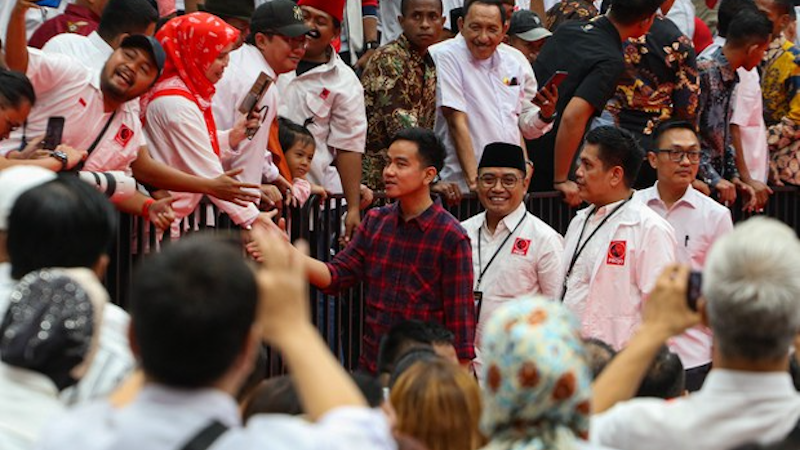
Gibran Rakabuming Raka (center), the mayor of Solo (Surakarta) and eldest son of President Joko “Jokowi” Widodo, greets Pro-Jokowi volunteers at the Projo National Meeting at Gelora Bung Karno Stadium in Jakarta, Oct.14, 2023. Photo Credit: Eko Siswono Toyudho/BenarNews

By Tria Dianti and Arie Firdaus

A rival party’s decision to nominate Indonesian President Joko “Jokowi” Widodo’s eldest son as its VP candidate has set off a political storm about whether the term-limited leader is trying to retain his grip on power and create a dynasty.

Gibran Rakabuming Raka’s nomination as the running mate of Prabowo Subianto, the leading presidential contender in the 2024 race and a former army general who ran against Jokowi during the two previous elections in the world’s third-largest democracy, has opened a rift between the president and his own party.

Jokowi’s Indonesian Democratic Party of Struggle (PDI-P) last week nominated former Central Java Gov. Ganjar Pranowo and Mohammad Mahfud MD, the security minister, as its presidential candidate and his running mate on the ticket. On Monday, it reacted angrily to the counter move by Prabowo’s Gerindra party.

“When the people entrust power to serve the interest of the whole nation, and then it is misused for [personal] ambition, everyone must act with full conviction because Ganjar-Mahfud are on the side of truth,” PDI-P Secretary General Hasto Kristiyanto said in a statement.

Ganjar and Mahfud, he said, were nominated for the sake of the national interest, not for personal or family reasons – a clear swipe at Gibran, who is the mayor of Solo, the Central Java city where his father was born and started his political career.

The other ticket in the expected three-way race to be decided in polling on Feb. 14 is former Jakarta Gov. Anies Baswedan and Deputy Parliamentary Speaker Muhaimin Iskandar.

The announcement of Gibran’s nomination on Sunday came a week after the Constitutional Court amended an electoral law to lower the minimum age for presidential and vice-presidential candidates from 40 to any age, on condition that they had served as lawmakers or regional heads.

The petition to change the law was decided by a panel of judges headed by Jokowi’s brother-in-law.

Gibran, a businessman who owns several restaurants and catering services, had initially been portrayed as wary of the limelight and focused on developing his businesses.

Jokowi, whose second and final five-year term ends next October due to constitutional limits, has been widely praised for revamping Indonesia’s dilapidated infrastructure during his nine years in office so far.

But he has also been criticized for his administration’s crackdown on dissent, his weakening of anti-corruption efforts and his compromise on human rights, although he first came to power in 2014 on a progressive campaign that promised to deal with such issues.

Some analysts said that the nomination of Gibran was not a spontaneous decision, but a result of a long and calculated preparation that involved influencing the Constitutional Court.

Dominique Nicky Fahrizal, an analyst at the Centre of Strategic and International Studies in Jakarta, said one of the steps was to alter the makeup of the court.

“These actions have weakened the values of democracy. There is a scheme to use the court as an instrument of power,” he said.

He added that this could have repercussions on Indonesia’s young democracy, especially if there were disputes involving Prabowo and Gibran.

“This is not just a setback for democracy, but an erosion of democratic principles,” he said.

Jokowi is the first Indonesian president who does not come from the military or political elite. The former furniture businessman and mayor of Solo was elected president in 2014 after a campaign that painted him as a man of the people.

He has improved connectivity and mobility across the archipelago nation, spending billions of U.S. dollars on building roads, bridges, airports, ports, dams, and power plants.
But some activists and academics say Jokowi has ignored human rights protection in pursuit of economic development, and that he has overseen a decline of civil liberties during his time in office.

Yoes C. Kenawas, a researcher at the Advanced Research Center of Atma Jaya Catholic University, described Gibran’s nomination as being part of Jokowi’s long, neat and systematic process of building a dynasty.

“Jokowi seems to be concerned about who will continue his legacy when he is no longer in office,” Yoes told BenarNews.

One of the most ambitious and controversial projects of Jokowi’s administration is the relocation of the capital city from Jakarta, a sprawling and congested megacity, to a new site in East Kalimantan, a province on Borneo island. The project is expected to cost U.S. $33 billion.

Indonesia has seen a trend of democratic backsliding under Jokowi, according to Yoes.

“This is just the tip of the iceberg because we have also seen declines in other indicators such as freedom of expression,” he said.

“This will reinforce the thesis of many people that only those who have a lot of money and are well connected can join the contest,” he added.

In his second administration, Jokowi appointed Prabowo, an ex-special forces commander who was accused of being tied to human rights abuses during his career as a soldier, as defense minister. Prabowo has been the frontrunner for much of the campaign season this time around and currently holds a narrow lead over Ganjar, according to recent opinion polls.

Jokowi has not openly endorsed any of the candidates, but earlier this month, a large and influential network of his supporters, “ProJo,” endorsed Prabowo as his successor.

Gibran’s elevation to vice presidential candidate appeared to signal the outgoing president’s unspoken endorsement of his onetime rival and the potential transformation of his legacy into a dynasty.

“As parents we can only support and give [our] blessing,” Jokowi told reporters on Sunday, referring to his son’s nomination. “It’s his decision because he’s an adult and we should not interfere in our children’s decisions.”

Puan Maharani, the deputy chair of PDI-P and parliamentary speaker, called on Jokowi to be fair to all contestants.

“I’m sure Mr. Jokowi is able to act as the president of Indonesia, the president of all Indonesian people,” she said.

Some ordinary Indonesians see Gibran’s candidacy as nepotistic and question his qualifications.

“It’s such a pity. What is he looking for? He should finish his job first,” Hapsari Kusumaningdyah, a 32-year-old resident of Solo, told BenarNews.

“He has become a role model for the young people in Solo. It’s a shame that he leaves before his term ends.”

Andi Nugroho, a 38-year-old Jakarta resident, expressed his dismay at Gibran’s nomination, saying that it violated the principles of honesty and fairness.

“This is messy. It’s clear that this is a family plan to prepare the son,” he told BenarNews.

He said that Jokowi, as the national leader, should have avoided any appearance of favoritism or nepotism.

“The president should be the main one to avoid any conflict of interest,” he said.


Categories
South Caucasus News

Fighting The Surveillance State Begins With The Individual – OpEd


Fighting The Surveillance State Begins With The Individual – OpEd

Building Surveillance Cctv Cameras Door Female Ladies Pattern People

By Joseph Lawrence

It’s a well-known fact at this point that in the United States and most of the so-called free countries that there is a robust surveillance state in place, collecting data on the entire populace. This has been proven beyond a shadow of a doubt by people like Edward Snowden, a National Security Agency (NSA) whistleblower who exposed that the NSA was conducting mass surveillance on US citizens and the world as a whole.

The NSA used applications like those from Prism Systems to piggyback on corporations and the data collection their users had agreed to in the terms of service. Google would scan all emails sent to a Gmail address to use for personalized advertising. The government then went to these companies and demanded the data, and this is what makes the surveillance state so interesting. Neo-Marxists like Shoshana Zuboff have dubbed this “surveillance capitalism.”

In China, the mass surveillance is conducted at a loss. Setting up closed-circuit television cameras and hiring government workers to be a mandatory editorial staff for blogs and social media can get quite expensive. But if you parasitically leech off a profitable business practice it means that the surveillance state will turn a profit, which is a great asset and an even greater weakness for the system.

You see, when that is what your surveillance state is predicated on you’ve effectively given your subjects an opt-out button. They stop using services that spy on them. There is software and online services that are called “open source,” which refers to software whose code is publicly available and can be viewed by anyone so that you can see exactly what that software does. The opposite of this, and what you’re likely already familiar with, is proprietary software. Open-source software generally markets itself as privacy respecting and doesn’t participate in data collection. Services like that can really undo the tricky situation we’ve found ourselves in.

It’s a simple fact of life that when the government is given a power—whether that be to regulate, surveil, tax, or plunder—it is nigh impossible to wrestle it away from the state outside somehow disposing of the state entirely. This is why the issue of undoing mass surveillance is of the utmost importance. If the government has the power to spy on its populace, it will.

There are people, like the creators of The Social Dilemma, who think that the solution to these privacy invasions isn’t less government but more government, arguing that data collection should be taxed to dissuade the practice or that regulation needs to be put into place to actively prevent abuses. This is silly to anyone who understands the effect regulations have and how the internet really works. You see, data collection is necessary. You can’t have email without some elements of data collection because it’s simply how the protocol functions. The issue is how that data is stored and used.

A tax on data collection itself will simply become another cost of doing business. A large company like Google can afford to pay a tax. But a company like Proton Mail, a smaller, more privacy-respecting business, likely couldn’t. Proton Mail’s business model is based on paid subscriptions. If there were additional taxes imposed on them, it’s possible that they would not be able to afford the cost and would be forced out of the market.

To reiterate, if one really cares about the destruction of the surveillance state, the first step is to personally make changes to how you interact with online services and to whom you choose to give your data.

About the author: Joseph Lawrence is an Australian student with a passion for economics, computers and history.

Source: This article was published by the Mises Institute


Categories
Selected Articles

Guerre en Ukraine, en direct : le soutien à Israël n’affectera pas l … – Le Monde


Guerre en Ukraine, en direct : le soutien à Israël n’affectera pas l …  Le Monde

Categories
Selected Articles

Freed Hamas hostage recounts ordeal, slams Israeli failures, speaks well of captors – The Times of Israel


Freed Hamas hostage recounts ordeal, slams Israeli failures, speaks well of captors  The Times of Israel

Categories
Selected Articles

Israel will destroy Hamas in Gaza war: Netanyahu – DAWN.com


Israel will destroy Hamas in Gaza war: Netanyahu  DAWN.com

Categories
Selected Articles

Taken captive: Two sisters and their families from a sealed room


Six members of the Cunio and Alony families spent hours in their saferoom at Nir Oz as terrorists burned their house394524486_10159420181206816_226482076862

Categories
South Caucasus News

Armenian Ambassador briefs students of Oxford Diplomatic Society … – Public Radio of Armenia


Armenian Ambassador briefs students of Oxford Diplomatic Society …  Public Radio of Armenia

Categories
South Caucasus News

Lost in the Multi-Crisis, Daily Brief October 24, 2023 – Human Rights Watch


Lost in the Multi-Crisis, Daily Brief October 24, 2023  Human Rights Watch