Categories
Audio Review - South Caucasus News

Iran: Raisi’s Presence At UNGA Was A Disgrace For Appeasement Policy – OpEd


Iran: Raisi’s Presence At UNGA Was A Disgrace For Appeasement Policy – OpEd

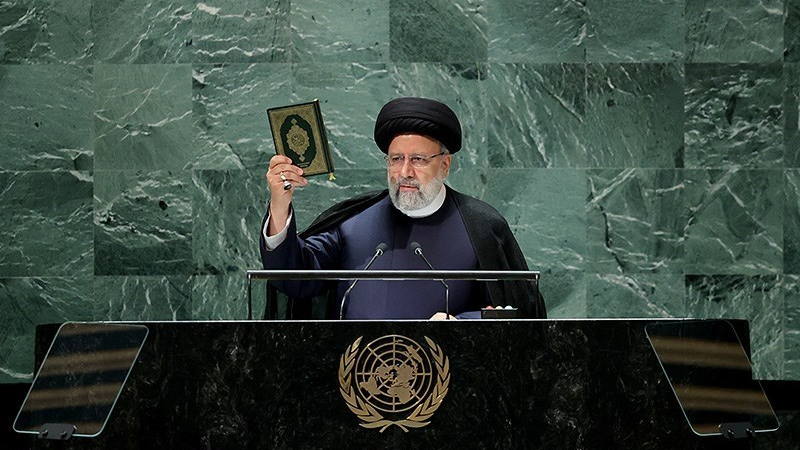
Iran's President Ebrahim Raisi speaks at United Nations. Photo Credit: Iran government

The acceptance of Iranian regime president Ebrahim Raisi at the United Nations headquarters is a stain on the 78-year history of the organization, which was established after World War II with the aim of preserving global security and peace. He is an individual who carries the record of the murder of thousands of political prisoners. His presence is indicative of a policy of appeasement that facilitates the killing of innocent people.

Parliamentarians, personalities, and former world leaders have reminded the horrific consequences of World War II, which resulted in the deaths of 60 million people, as a product of appeasing Hitler’s fascism. They have repeatedly warned against the consequences of any form of appeasement and accommodation with the monstrous ideology of fundamentalism.

On June 30th, former Deputy Secretary of State Robert Joseph, in the opening day of the Free Iran 2023 World Summit, said, “Hitler and [British Prime Minister Neville] Chamberlain proved that you can negotiate with evil. Chamberlain came back to London waving a piece of paper saying, ‘We’ve got peace in our time.’ And what happened?… Germany went into Poland. That’s what appeasement gets you. And I think that’s what we need to avoid… The regime needs to be pressured. I think we’re at a critical point. I think we’re near the breaking point and the last thing we need to do is throw the regime a lifeline as we have in the past.””

However, the disgrace of appeasement has taken on deeper dimensions as a result of the Iranian resistance’s campaign against this wicked policy. A letter signed by over 120 former world leaders and their call for a change in policy towards the religious fascism ruling Iran is a rare and highly significant document in this regard. These leaders not only rely on the signing of this letter but also challenge the foundations of appeasement in their discussions and speeches.

Stephen Harper, the former Prime Minister of Canada and current Chairman of the International Democrat Union in 80 countries, participated in a September 15 conference in Brussels. As one of these leaders, he challenged the foundations of appeasement with the clerical regime. He said, “let us again challenge the fundamental premise behind the appeaser’s belief system. That somehow, things could be worse if the regime fell. Worse? How? How could it be worse than a regime with an apocalyptic ideology and a relentless pursuit of nuclear weapons that openly lists the nations it wishes to wipe off the face of the earth? How could it be worse than that? How could it be worse than a regime that funds terrorism and war from Syria to Lebanon to Yemen and Iraq and even to Ukraine and beyond? How could it be worse than that? How could it be worse than a regime where the supreme leader is an extremist fanatic and its president is a mass executioner? How could it be worse than that?”

Another aspect of Stephen Harper’s speech was the connection between the spread of regime corruption, economic crises, poverty, high prices, and public dissatisfaction with the impasse, incapacity, and intensified repression of the people. He said, “The Ayatollah’s regime is even more dysfunctional. It faces even more overt opposition. And it has been rotting at the core almost from day one. Corruption is alive at every level. The economy only gets worse. Poverty keeps increasing. Inflation keeps rising. Services are non-existent.

“No wonder the regime must resort to ever greater brutality. Because it has nothing, nothing, that would engender the loyalty of any ordinary citizen. So it resorts to ever greater brutality, but it must do so with ever-shrinking resources, except of course, when a Western government actually sends it resources. As the Biden administration recently did, once again, $6 billion. What a disgrace that is!”

Stephen Harper emphasized the need for firmness against the regime and the crucial role of a democratic alternative. He stated, “The solution is not to try to strengthen relations with this regime. It is to do what my government did in Canada, close down the regime’s embassies around the world.

“Now friends, in talking about the alternative to the regime, and of course there is such an alternative.”

Former Canadian Prime Minister Stephen Harper added, “I am a signatory to an open letter of over 100 former presidents and prime ministers from around the world that urges the globe to ignore the appeasers and instead reach out to organized Iranian Resistance. It’s really simple, stand with the Iranian Resistance and in solidarity with the people of Iran in their desire for a free, secular, and democratic state… I believe it is a vision that the vast swath of the Iranian people are yearning to get behind.”


Categories
Audio Review - South Caucasus News

India Won’t Be Bullied In Multipolar Setting – OpEd


India Won’t Be Bullied In Multipolar Setting – OpEd

The sombre mood at the Council on Foreign Affairs in New York during External Affairs Minister S. Jaishankar’s talk on Tuesday was only to be expected against the backdrop of the India-Canada diplomatic spat over the killing of a Sikh secessionist in Vancouver in June, which, reportedly, was “coordinated” on the Canadian side with Washington based on intelligence inputs from the Five Eyes. 

However, the event’s main thrust took an overtly geopolitical overtone with the CFR hosts calling out the Indian minister to weigh in on India’s growing assertiveness on the global stage and its perspectives on the international situation involving Russia and China, and the “limits” to the US-Indian relationship. 

It is no secret that the Canadian-Indian spat into which Washington has inserted itself has a deeper geopolitical agenda. The Financial Times, the western daily perceived as closest to the Biden administration, in fact, carried a report last week entitled The west’s Modi problem with a blurb that neatly caught its main theme — “The US and its allies are cultivating India as an economic and diplomatic partner. But its prime minister’s authoritarian streak is becoming harder to ignore.” 

The article held out a warning: “India is becoming one of America’s most important foreign partners as a bulwark against China. The US has invested heavily in bolstering relations with New Delhi as part of its broader strategy of enhancing relationships in the Indo-Pacific region. The push has accelerated this year… When and if evidence emerges that might support Canada’s claim, Washington will face a balancing act between its closest neighbour and a significant rising ally.”  

Evidently, Jaishankar, whose experience and expertise in navigating the US-Indian relationship through choppy waters as well as balmy autumn alike is second to none in the Indian establishment, has been tasked by Modi to contain the fallout of the spat with Canada on India’s relations with the US. But the difference today is that his mission to Washington goes far beyond a diplomatic tango aimed at damage control or to swing something extra in the transactional relationship, since the West’s discontent about “Modi’s India” is at its core about the country’s independent  foreign policies and resistance to becoming an ally in a traditional sense and accordingly tailor its performance on the global stage in accordance with the “rules based order” buttressing the US hegemony in world politics.  

The US would have, in normal course, worked for a tradeoff with India but the times have changed and it is itself locked in an all-or-nothing contestation for global supremacy with China (and increasingly in the shadow of a Sino-Russian axis) which is of course a high stakes game where Washington would assign a role for India and have expectations out of Modi’s leadership. 

On the whole, Jaishankar opted for a hybrid approach. On the one hand, he maintained that India will have an independent foreign policy attuned to a multipolar world order. But on the other hand, his main thesis was that Washington would be exceedingly foolish to risk the partnership with India. 

Bloc mentality is obsolete 

Conceivably, Jaishankar’s mission is like an iceberg with only a tip that is visible — at least, as of now. Nonetheless, his statements at the CFR in New York provides some reasonable clues. Basically, Jaishankar assembled his thoughts in three interlinked clusters — the emerging world order and US-Indian relations; Russia’s place in the scheme of things; and, the challenge of China’s rise. It presents a rare peep into the architecture of India’s current world view and can be summarised as follows: 

1. The world order is changing and the US is also  “fundamentally readjusting to the world.” This is partly to be seen as the  “long-term consequences” of the defeat in Iraq and Afghanistan, but it principally stems out of the reality that the US’ dominance in the world and its relative power vis-s-vis other powers, has changed through the last decade.  

Clearly, “the world has become in a way more democratic, and if opportunities are available more universally,” it is only natural that other centres of production and consumption would come about and there would be a re-distribution of power — “and that has happened.”

Realising this change, Washington has already begun “adjusting” to a multipolar world order without saying so, and is “actively seeking to shape what would be the poles and what would be the weight of the poles” in a manner that would benefit it. 

Put differently, the US is looking at a world where it is no longer possible for it to work solely with its allies. The QUAD is a vivid demonstration of this new phenomenon and the US policymakers deserve to be complimented for their “imagination and forward-planning.” 

Succinctly put, the US is already getting into a world order that has “much more fluid, much more dispersed centres of power” — very often much more regional, sometimes with different issues and different theatres producing their own combinations. That would mean that it is no longer realistic to seek clear-cut, black-and-white, solutions to problems. 

2. The US shouldn’t lost sight of the “enormous possibility” to work with India to enhance each other’s interests where the focus should be on technology, as the balance of power in the world is always a balance of technology. The US needs partners who can secure its interests more effectively and there are only a finite number of partners out there. Therefore, for working together, the US has to reach some kind of understanding with its partners. 

From the Indian perspective, there are even more finite countries who can be partners, and the US is indeed an optimal choice for India. Therefore, there is today a compelling need for India and the US to work together where the bulk of partnership relates to technology while “a bit part of it” could be a spillover into defence and security spheres, and a third part could be politics. 

Fact is, today Global South is very distrustful of the Global North and it is useful for the US to have friends who think and speak well of America. And India is one of the few countries that have the ability to bridge the polarisation in world politics — East-West, North-South. 

3. Jaishankar subtly fortified the above persuasive argument with an unspoken caveat that the Biden Administration should not make unrealistic demands on India’s independent policies or challenge its core interests lest it is counterproductive. 

The point was driven home by calling attention to a stunning geopolitical reality that Russia is turning its back on its three-centuries old search of an European identity and is making strenuous efforts to build new relationships in the Asian continent. Russia is a part of Asia but its pivot is about carving out a strong role as an Asian power. Indeed, this is consequential. 

As for India, its relations with Russia have remained “extremely steady since the 1950s.” Notwithstanding the vicissitudes in world politics or current history, both sides took care to keep the relationship “very very steady.” And that is because Delhi and Moscow share an understanding that there is a “structural basis” to the two countries working together, and, therefore, both take “great care to maintain the relationship and ensure that it is working.” 

Woods are lovely, dark and deep…’ 

Implicit in the above thought is a strong message that given the centrality of the Russian-Indian strategic partnership, it is well nigh impossible to isolate India. Jaishankar may have buttressed his point further by giving a lengthy account of India’s standoff with China on the border (in factual terms from an Indian perspective) but, significantly enough, without attributing motives to the Chinese behaviour or even rushing into characterisations of it in picturesque terms of self-aggrandisement.                         

The intriguing part came when Jaishankar was open-minded enough to rationalise the Chinese Navy’s presence in the Indian Ocean and point-blank refused to mix up India’s QUAD membership with it. 

Jaishankar rejected the hackneyed notions propagated by American analysts of a Chinese “string of pearls” around India and instead noted calmly that the steady increase in the Chinese naval presence in the past 20-25 yrs is a reflection of the sharp increase in the size of the Chinese Navy. 

It is to be expected, after all, that when a country has a bigger Navy, that is going to be visible in its deployments. That said, it is only realistic for India to prepare for a far greater Chinese presence than before. 

Importantly, maritime concerns are today not between any two countries.  They are by their very nature concerns that are there for countries to deal with. In retrospect, the US presence in the Indian Ocean has diminished today and that left gaps at a time when threats actually increased. 

But India does not see QUAD as necessarily geared for a role to counter China, as it will be “a bit old-fashioned to point towards another country.” To be sure, there are global commons to be safeguarded, and “there are concerns there that are better approached if countries worked together.” 

Besides, India is no longer sure whether the US would respond to another tsunami in Asia with the same speed and scale as before during the Indian Ocean Tsunami in 2004. “Times have changed, force levels have changed and capabilities have changed. And China is one of those countries whose capabilities have gone up.” But India works with countries “that it can and not with those it cannot.” 

Indeed, the shift in the tone of the Indian narrative following the brief exchanges between Prime Minister Narendra Modi and Chinese President Xi Jinping on the margins of the recent BRICS Summit has continued.

Jaishankar’s statements made it abundantly clear that India’s relationship with Russia is non-negotiable, whilst the surprising part is that Modi government is also sequestering the troubled relationship  with China from external third-party interference, taking care, presumably, to leave avenues open for normalising the ties through bilateral channels in a foreseeable future. 

The bottom line is, if the US-Canadian-Five Eyes agenda was to browbeat India’s strategic autonomy, Jaishankar rejected it. Curiously, at one point, he commented sarcastically that India is neither a member of the Five Eyes nor is answerable to the FBI. 

In sum, Delhi prefers to deal with the spat with Canada as a bilateral issue of terrorism in all its manifestations, including secessionism, which also has a larger context of Ottawa’s lackadaisical attitude politically toward India’s legitimate security concerns and its propensity to keep butting into India’s internal affairs as a gatekeeper of the “rules-based order.” 

This article was published at Indian Punchline


Categories
Audio Review - South Caucasus News

Ralph Nader: Good News, Big Opportunities On The Horizon – OpEd


Ralph Nader: Good News, Big Opportunities On The Horizon – OpEd

In the midst of so much bad news in the media, it is always good to be alert to rays of sunlight that civic action can build upon.

First, let’s start with the sun, which is receiving increased respect these days by Earthlings. Various forms of solar energy – thermal, photovoltaic, wind, and passive (architecture) are winning the price competition against new fossil and nuclear fuels by large and growing margins around the world. The oil, gas, coal and nuclear lobbies, unable to compete on economics, resort to government subsidies, bailouts, tax breaks and propaganda to entrench themselves and their omnicidal products. People, however, including Texans, are warming to solar, and its decentralized, local nature and the need to invest in expanding, facilitative grid systems. Large majorities in opinion polls now want a solarized country.

Second, smart, focused labor strikes are underway with polls showing majorities in our country supporting labor unions. Between seventy and eighty percent of non-unionized workers want to join one.

The Writers Guild of America strike has been settled in the entertainment business to the approval of most of the rank and file. The massively overpaid CEOs in this industry were forced to pay attention to labor negotiators’ priorities, including some protections from the use of robots (AI), adequate staffing, and better pay and working conditions. Now it’s the turn of the much more numerous striking actors to make sure their long-overdue grievances are addressed by the opposing CEOs.

Under Shawn Fain, the United Automobile Workers Union has commenced selective strikes against the major unionized auto companies. Fain is framing very well the class exploitation issues and the necessity to end the concessions imposed on the workers both before and after the huge $30-plus billion-dollar federal bailout, under President Barack Obama, of the grossly mismanaged General Motors in 2009.

Fain points to the huge, unprecedented gap between the over $14,000 an hour in pay that GM CEO Mary Barra receives, plus benefits and perks, and that $18 to $22 per hour paid to the lower-tier UAW members – a discriminatory system against young workers, dividing them from the older auto workers (making about $33 per hour) that Fain wants to eliminate.  Equal pay for equal work on the factory floor. The revived union is also driving a fairer policy to head off an AI displacement threat which could disempower workers by requiring them to train the robots that will take their jobs.

Third, retiring Chairman of the Joint Chiefs of Staff, General Mark A. Milley told an audience in New York that Russia and Ukraine must realize that victory may not be “achievable through military means,” drawing a comparison with World War I that dragged on and set the stage for World War II. Milley, a Princeton graduate with advanced degrees in international and military history studies, advised: “Things can get worse, so when there’s an opportunity to negotiate when peace can be achieved, seize it . . . Seize the moment!”

Those who are waging peace to overcome this and other armed conflicts hope that retired General Milley will speak out vigorously, with other retired high-ranking officers, about the need for peace negotiations and immediate unconditional ceasefires. They have credibility when they advocate for peace.

It may surprise many people that the civilians in the Pentagon and in Congress have been far more belligerent than the “military” regarding wars in Afghanistan, Iraq, Libya and elsewhere. They have to answer the question: “What’s our plan right after we invade and occupy?” Their civilian counterparts, with no military experience, have no such perceived responsibilities. We hope Mark Milley does not get enveloped in a lucrative consulting or executive position in one of the giant manufacturers of weapons of mass destruction. Extra discretionary income is trivial compared to being a strong public voice for peace and avoiding escalating wars.

Fourth. The tagline of the many full-page Bank of America ads that have been running in the Washington Post presents an opportunity to awaken bank customers. The Bank tantalizingly asks potential customers: “What Would You Like the Power to Do?”

Well, for starters, bank employees could simply return telephone calls from depositors and borrowers and not make customers call again and again their bank branch, where the only option is to leave voicemail messages that go unanswered for days or weeks at a time. Also, how about customers wanting the power to stop the Bank of America from cheating or faking accounts? A few weeks ago, the Consumer Financial Protection Bureau (CFPB) and Office of the Comptroller of the Currency (OCC) fined the Bank of America $250 million charging that the bank “systematically double-charged customers fees, withheld promised credit card perks, and opened accounts without customer authorization.” (https://www.reuters.com/business/finance/us-regulators-fine-bank-america-over-junk-fees-cfpb-2023-07-11/).

Or how about giving your bank company savers the highest current interest rate for their kind of account? Many people, including the elderly, unknowingly have their savings stuck in savings accounts with a fraction of 1 percent interest, despite the Federal Reserve raising rates to the 5 percent range.  Don’t banks have fiduciary relationships with their clients? There are tens of billions of dollars at stake in these “dormant” savings accounts (not CDs) in financial institutions throughout the U.S.

One harbors hope that Consumer Reports and the Consumer Federation of America will move to alert millions of Americans to ask for their bank’s highest available interest rates on their savings.

Finally, at long last, the Federal Trade Commission and seventeen states filed a comprehensive antitrust suit against giant Amazon, charging unlawful, anti-competitive practices against the online merchant. Big stakes here for consumers, as well.

Make your voices heard on these and other important matters.


Categories
South Caucasus News

Azerbaijan, Russia discuss prospects for cooperation in environmental protection


Azerbaijan’s Minister of Ecology and Natural Resources Mukhtar Babayev has met with Special Representative of the President of the Russian Federation on climate issues Ruslan Edelgeriyev, Azernews reports.

Categories
South Caucasus News

Almost all of Nagorno-Karabakh’s people have left, Armenia’s government says – WRIC ABC 8News


Almost all of Nagorno-Karabakh’s people have left, Armenia’s government says  WRIC ABC 8News

Categories
South Caucasus News

Almost all of Nagorno-Karabakh’s people have left, Armenia’s government says – WJXT News4JAX


Almost all of Nagorno-Karabakh’s people have left, Armenia’s government says  WJXT News4JAX

Categories
South Caucasus News

Almost all of Nagorno-Karabakh’s people have left, Armenia’s government says – WDIV ClickOnDetroit


Almost all of Nagorno-Karabakh’s people have left, Armenia’s government says  WDIV ClickOnDetroit

Categories
South Caucasus News

Almost all of Nagorno-Karabakh’s people have left, Armenia’s government says – WAVY.com


Almost all of Nagorno-Karabakh’s people have left, Armenia’s government says  WAVY.com

Categories
South Caucasus News

Half of Nagorno-Karabakh’s population flees as the separatist … – Midland Daily News


Half of Nagorno-Karabakh’s population flees as the separatist …  Midland Daily News

Categories
South Caucasus News

China sees record-breaking daily passenger trips during holiday travel rush


The number of railway trips made by Chinese passengers hit 20.098 million on Friday, the third day of the 12-day travel rush for the National Day holiday and the Mid-Autumn Festival, the China State Railway Group Co., Ltd. said Saturday, report informs vi