

I was re-watching a classic fantasy movie called Ladyhawke (1985), with Rutger Hauer and Michelle Pfeiffer as the lovelorn pair, and Matthew Broderick as the sidekick. The reviewers Cassie and Carly of Popcorn in Bed figured it out. Broderick’s character is the key to unravelling the story: the first person you see, the matchmaker who ultimately saves the pair and, critically, someone with his own redemption arc. In the process, I came to better understand one of the distinctive (and praiseworthy) traits of women’s science fiction in the Arab world.
By Emad Aysha
That is, romance is centre stage to everything else, including the science. As for Broderick he plays a petty thief in Medieval France who constantly asks God for forgiveness, and who lies to people to make them happy. He’s well-intentioned, generous to the poor, and, if it weren’t for his dastardly skills, the good guys couldn’t have won in the end.
He escapes the dungeon in the royal palace and picks the lock to get Hauer and Pfeiffer in at the end, even using a cross to pick it. The final battle happens in the Cathedral between Hauer and the captain working for the evil Bishop, the man who stole Hauer’s original job.
Hauer is dressed in black and rides a black horse, while the bad guy is decked out in white and rides a white horse. The same for the evil Bishop, of course, a man like the evil monk in The Hunchback of Notre Dame, who fell in love with Pfeiffer’s character to the point of cursing her and her hubby to be Hauer.
The guy, though a man of the cloth, made a deal with the devil to turn her into a hawk during the day, while Hauer becomes a wolf at night. They can never see each other in human form except for a fleeting moment at daybreak.

RELIGIOUS TILT: The final fight to the death takes place in a Cathedral. Notice the prevalence of ‘royal purple’ among the clergy, or self-appointed theocratic rulers.
Then there’s an additional twist in the thematic tail, revealed by the aged priest (interestingly named ‘Imperius’) who ratted the young couple to the Bishop. As he says of the Ladyhawke: “Isabeau d’Anjou. Her father was the Comte d’Anjou, an intemperate fellow. He died slaughtering Saracens in Antioch.”
Make love, not war, in other words. Hauer’s character is too zealous to know right from wrong, solving all problems with fighting and thinking only of revenge. He (pridefully) wants to kill the bishop with his family’s sword, even if it means condemning the two of them to remain in their animal forms forever.
He even asks the old priest to do a mercy killing of the Ladyhawke. Thank heavens science intervenes at the last minute with a solar eclipse, prophesied by the priest, allowing them to coexist in human form.
I’d also wager there’s class politics at play here. Broderick has dark hair and brown eyes – a stereotype of the Latin French – while Hauer and Pfeiffer are as Nordically blond as they come.
The Bishop himself squeezes the peasants for money, I presume for the war effort. And he’s irrationally obsessed with capturing Broderick to make an example of him. Why else expend such resources to capture a mere pickpocket?
A hefty movie indeed, just done in a fun but thankfully not frivolous format. I liked the movie myself but was too historically cynical, scoffing at the rock-and-roll soundtrack and the excessively clean clothes.
Again, a woman’s perspective is called for, and to cite Popcorn in Bed, when men do romantic SF and fantasy, they treat the love story as a side plot. Women authors, however, put it at the heart of the story.
This helped me make sense of an SF novel I just read, by Yara Saeed, called On the Edge of Jerusalem (2025). It’s 2055, and Palestine has finally gained its independence for a solitary year, only for the one-year president to die all of a sudden.
The heroine, a mortician, is brought in secretly to inspect the body – but not do a proper autopsy – and she discerns it was murder straight away. The bulk of the story, however, is not about figuring out who did it, but about her reminiscing about her love life.

ROMANCING THE STONE: Rutger Hauer as Etienne of Navarre in ‘Ladyhawke’, a would-be crusader who’d love the message of peace (through love) in Yara Saeed’s novel.
She was madly in love with an Egyptian journalist and had to leave, in part for the war effort to liberate Palestine and partly for personal reasons. She meets up with him again, and he inadvertently helps her uncover the dark, twisted secrets behind the assassination.
She is blocked from investigating further by the heir apparent to the Palestinian president. But someone who turns out to be the assailant relentlessly pursues her, which paradoxically draws her back into the murder mystery and helps her solve it.
To my masculine mind, this seemed like a series of distractions, but in fact the love story and her many trips down memory lane are the actual meat of the story. She traces her ancestry back to the UK; her mother was from Cardiff, Wales.
There, she bumps into a deeply moral man, a pharmacist named Ezra, who can help her with the hereditary illness she inherited from her mom. The heroine’s best friend is Palestinian but also Jewish, always urging her to let go of the past and move on with her life in peace.
The big reveal at the end wouldn’t work without these interlocking redemption arches, with love as the ultimate glue and healing balm. Likewise, the story clearly emphasises the overlap between the cross, the crescent, and the star in a key scene.
Oh, and the story’s world-building also owes much to fantasy. In this future world, you can get a body transplant – with old ladies trying to be young again, from the neck down.
There’s a near-identical scene in Return to Oz (1985), with an evil witch changing heads and bodies instead of evening gowns and shoes!
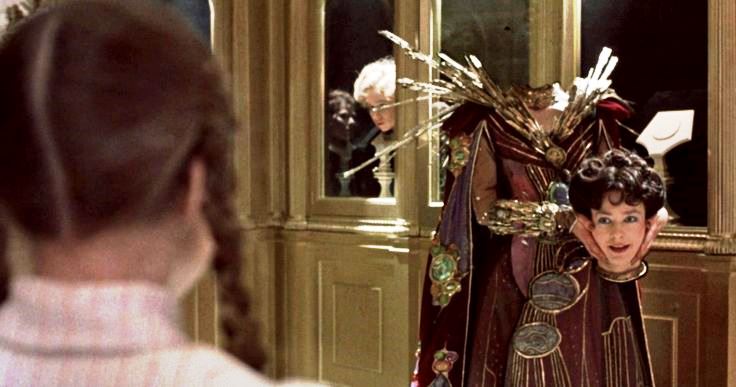
SEMI-DETACHED: A legendary screenshot from ‘Return to Oz’ with a very vain woman indeed trying to outwit the passage of time.
Love is fantasy’s gift to science fiction, true enough, but it still works better in women’s hands.
The post Lady Luck – Women’s romance in science fiction and fantasy first appeared on The Liberum.