Categories
Selected Articles

Azerbaijan’s “Tartar Case” renews investigation into alleged torture and abuses, as the number of victims and accused persons rises


terter.jpg

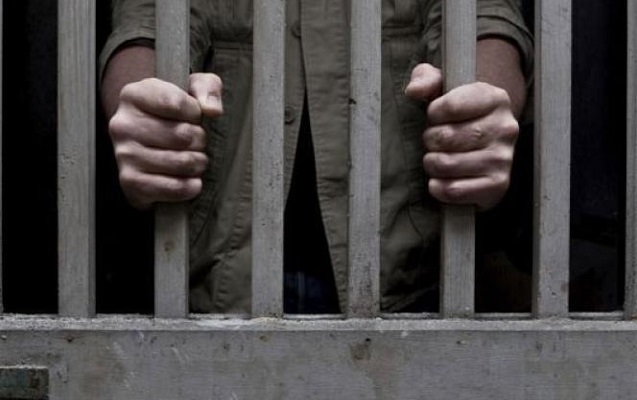
Azerbaijan has been rocked by a torture case known as the “Tartar case,” where 452 victims have come forward with allegations of torture and abuse.

The trial of Colonel Vusal Alasgarov and three other soldiers accused of torturing soldiers accused of spying for Armenians during the “Tartar Incidents” in May-June 2017 continues in Baku. The victims have been giving their statements, and the family members of those who lost their lives have participated in the court proceedings as their legal heirs.

One of the victims was senior lieutenant Tamkin Guliyev, whose father Nizami Guliyev testified at the court session. Nizami Guliyev said that when his son’s body was brought back to them on May 15, 2017, they were told that he died of pneumonia. However, an exhumation in 2022 revealed that he died from torture, with injuries to the vertebrae, head, hands, and feet. Nizami Guliyev demanded that those who caused their death by torturing the soldiers, including his son, be charged with murder and treason.

Another victim was commander Suleyman Kazymov, whose wife Zulfiyya Kazimova testified in court. She demanded that high-ranking officials involved in the torture be brought to criminal responsibility, including Hikmet Hasanov, who she claims gave the orders. Kazimova said that they received the news of her husband’s death on May 9, 2017, and were initially told that he was a martyr, but later were told that he died in an accident. Those who brought the body to them tried to make them sign a blank piece of paper. Kazimova claimed that her husband was handcuffed, drowned in water, and beaten before his death.

Elchin Guliyev, who was accused of treason and acquitted after the “Tartar case” proceedings were renewed, also lost his life as a result of torture. His mother Valida Ahmadova testified in court and said that her son made a phone call for the last time on May 3, 2017. On May 8, his father and cousin were called to the executive power and told that Elchin Guliyev had died and was a “traitor to the country”. When his body was brought back to them, they claimed that he poured drugs into the food truck he was driving during the April 2016 battles so that the soldiers would sleep. However, Ahmadova said that her son was not driving the food truck at all, but was on vacation. She also claimed that the authorities created obstacles for those who came to his funeral and called her son a “traitor to the country”.

One victim, Vagif Abdullayev, claims that General Hikmat Hasanov threatened to send those who refused to engage in espionage to a minefield and had him put in a cage, and threatened to shoot him. Several other victims have confirmed this threat. Abdullayev emphasized the importance of prosecuting General Hasanov and other officials in order to have an objective investigation of the case.

Another victim, Merhamat Rajabli, accused Colonel Vusal Alasgarov of putting a gun in his mouth, tying his hands, and subjecting him to various forms of torture, including electric shocks and nail removal. The accused persons did not respond to the accusations made by the victims.

After the investigation into the “Tartar case” was renewed in December 2021, the number of people brought to criminal responsibility for torture reached 17, with one person still wanted. Four more people who were already in prison were re-indicted due to their participation in torturing others.

In November 2022, the cases of 19 people who had been sentenced to 20 years in prison for treason and other serious charges were re-examined, their sentences were canceled, and they were acquitted five years later. The court investigations on the cases of the four named persons in this particular incident are still ongoing.

The trial continues in Baku, and the victims’ families are seeking justice for their loved ones who lost their lives as a result of torture.


Categories
Selected Articles

Armenia PM gives interview to POLITICO Europe, speaks about regional issues


default.jpg

Armenian Prime Minister Nikol Pashinyan gave an interview to POLITICO Europe, PM’s press secretary Nazeli Baghdasaryan informed.

In the interview, Pashinyan spoke about the buildup of Azerbaijani troops around Nagorno-Karabakh, the increase in tension on the Armenia-Azerbaijan border, as well as the need to overcome the current situation through diplomatic methods and in a constructive atmosphere, Baghdasaryan added.

!

This text available in   Հայերեն and Русский

Print


Categories
Selected Articles

Daghestani journalist sentenced to 17 years for ‘financing terrorism’


fc7979db3eb8af9c23f422688f4e4ac6_daghest

A Russian military court sentenced Abdulmumin Gadzhiyev, a former editor and journalist, to 17 years in a maximum security prison colony, on charges that human rights organisations maintain are politically motivated. 

Gadzhiyev was found guilty of participating in the activities of a terrorist community, organising its financing, and participating in an extremist community, charges that the journalist denies. 

Gadzhiyev was arrested in 2019 while working as an editor and journalist for Chernovik, an independent Daghestani outlet. 

Gadzhiyev had edited the religion section of the newspaper, and was accused at the time of transferring funds to organisations ‘spreading […] Islamic extremism’. A year after his arrest, Gadzhiyev faced new charges of ‘organising the activity of an extremist organisation’.

[Read more: One year after his arrest Abdulmumin Gadzhiyev faces new charges]

According to Sapa Kavkaz, a Telegram channel reporting on the North Caucasus, approximately 30 people came to the court to support the journalist. It adds that the Russian Ombdusperson Tatyana Moskalkova and the Union of Journalists of Russia have expressed their support for Gadzhiyev. 

Memorial, a leading Russian human rights centre, has declared Hajiyev a political prisoner, with international human rights organisation Amnesty International also declaring him a prisoner of conscience. Reporters Without Borders and the International Committee to Protect Journalists have demanded Gadzhiyev’s release.

The court reportedly found Gadzhiyev guilty of collecting and sending a total of over $800,000 to terrorist organisations, together with charitable foundation head Abubakar Rizvanov and programmer Kemal Tambiyev. 

According to Chernovik, Gadzhiyev was detained in relation to ‘inconvenient questions’ that the outlet put to government officials and security forces.

During the investigation, a number of witnesses stated that they had not given testimonies attributed to them, with others stating that they had been threatened by the security forces. Some refused to answer the lawyers’ questions, citing memory and head problems.

According to Sapa Kavkaz, Gadzhiyev stated in court that while he did not hope for any significant changes, he planned to appeal the verdict. 

‘Based on our practice and the sentences we have seen, the maximum they will decrease a sentence by is a year. However, concerning cassation, there are enough examples where they sort out serious errors’, Gadzhiyev reportedly said. 

The prosecutor reportedly requested 19 years in a high-security prison colony for Gadzhiyev and other defendents, on the basis of Gadzhiyev, Rizvanov, and Kemalov’s participation in and financing of organisations banned in Russia, including the Islamic State, the Congress of the Peoples of Ichkeria and Daghestan, the Supreme Military Majlisul Shura of the United Mujahideen Forces of the Caucasus.


Categories
Selected Articles

Beleaguered Armenian region in Azerbaijan accepts urgent aid shipment


rawImage.jpg

YEREVAN, Armenia (AP) — Authorities in an isolated ethnic Armenian region of Azerbaijan on Tuesday allowed entry of a humanitarian aid shipment in a step toward easing a dispute between Armenia and Azerbaijan that has blocked transport to the region since late last year.

The region, called Nagorno-Karabakh, has been under the control of ethnic Armenians since the 1994 end of a separatist war. That war had left much of the surrounding territory under Armenian control as well, but Azerbaijan regained that territory in a six-week-long war with Armenia in 2020; Nagorno-Karabakh itself remained outside Azerbaijani control.

Under the armistice that ended the war, Russia deployed some 3,000 peacekeeping troops in Nagorno-Karabakh and were to ensure that the sole road connecting the enclave to Armenia would remain open. However, Azerbaijan began blocking the road in December, alleging Armenians were using it to ship weapons and smuggle minerals.

The blockage caused serious food shortages in Nagorno-Karabakh. Azerbaijan proposed that food be sent in on a road leading from the town of Agdam, but the region’s authorities resisted the proposal because of concern that it was a strategy to absorb Nagorno-Karabakh.

Azerbaijan agreed this week that both the Agdam road and the road to Armenia, called the Lachin Corridor, could be used for aid shipments under International Committee of the Red Cross auspices.

The aid delivered on Tuesday includes 1,000 food sets including flour, pasta and stewed meat, along with bed linen and soap.

“We regard the fact that the cargo was delivered precisely along the … road as a positive step and an important shift towards the opening of this road,” said Azerbaijani Foreign Ministry spokesman Aykhan Hajizade.


Categories
Selected Articles

Russia hopes Lachin Corridor will be unblocked parallel with Aghdam route opening


Russia hopes Lachin Corridor will be unblocked parallel with Aghdam route opening
17:35, 12 September 2023

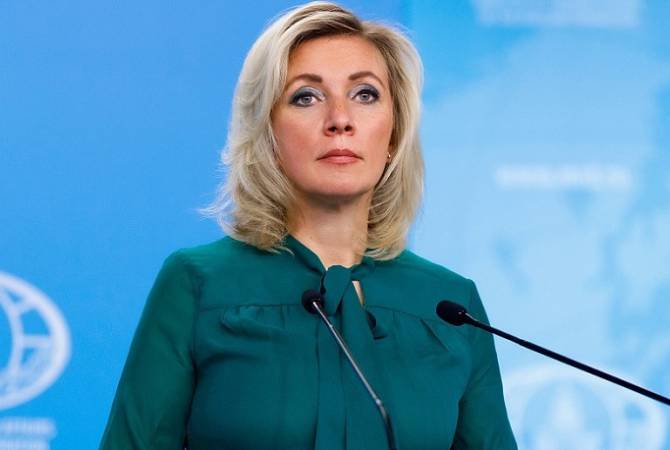
YEREVAN, SEPTEMBER 12, ARMENPRESS. Russia hopes that soon the Lachin Corridor will be unblocked parallel with the Aghdam route and Nagorno-Karabakh will start receiving regular humanitarian aid from both directions, Russian Foreign Ministry representative Maria Zakharova said on September 12.

Speaking at a press briefing, Zakharova said that the foreign ministers of Russia, Armenia and Azerbaijan developed a plan on the simultaneous unblocking of the Lachin and Aghdam routes during their July 25 meeting in Moscow.

“Taking into consideration the significant difference in positions and the high level of mutual distrust, this work did not proceed easily. As a first step, on 12 September, 15 tons of food, personal hygiene products and beddings were conveyed to the residents of Nagorno-Karabakh requiring aid through the Russian Red Cross. We expect that taking into consideration the previously reached mutual-understanding, soon the Lachin Corridor will also be unblocked parallel with the Aghdam route, and then humanitarian aid will be regularly delivered to the region from the two directions,” Zakharova said, expressing hope that this way the humanitarian situation in Nagorno-Karabakh will be stabilized and the normal life of the population will be restored.

“This will in turn create conditions for launching dialogue between Baku and Stepanakert and relaunching the rhythmic work in the direction of implementing the entire complex of the 2020-2022 highest level trilateral agreements on the normalization of the Armenian-Azerbaijani relations,” she added.


Categories
Selected Articles

Parliament official claims “propaganda” against Georgia in response to Ukrainian official’s statement


botchorishvili-1.jpg

Maka Botchorishvili, the Chair of the Georgian Parliament’s European Union Integration Committee, on Tuesday alleged a “propaganda” effort against the country in response to a statement by Mykhailo Podolyak, an adviser to the Head of the Ukrainian President’s Office, who on Sunday said Georgia had “no chance of becoming a member of the European Union”. 

In her remarks over the matter, Botchorishvili noted “it would be better” for countries aspiring to join the European Union to “support each other”.

Podolyak’s statement is part of the propaganda that is carried out against Georgia. This is not new, we have been hearing similar statements, and not only statements, for more than a year”, Botchorishvili said.

“We have specific information that from their side – the side of some politicians – a number of steps were taken against Georgia when it came to the European integration process last year”, the Parliament official noted.

Botchorishvili said Georgia and Ukraine needed to “help each other and be together” in the process of their European integration, adding “unfortunately, we see some politicians doing the opposite, which is definitely not the case for the [EU] enlargement process in general”.


Categories
Selected Articles

Tbilisi, Akhaltsikhe to host folklore festival with Georgian, European ensembles


folclorefestival-minitryofcultur.jpg

Georgian ensembles will be joined by visiting bands from Europe in the International Folklore Festival ‘Sakartvelo’ in a four-day celebration of folk performing arts in Tbilisi and the southern municipality of Akhaltsikhe next week.

Georgia’s Culture Ministry on Monday said the festival would launch at the open-air location of Akhaltsikhe Castle with three days of shows and introduction of local folklore, architecture and cuisine.

Organised by the Anzor Erkomaishvili State Folklore Centre and with the support of the Ministry, the festival will feature ensembles from Italy, Belgium, the Netherlands, the United Kingdom and Finland.

The visiting bands have spent years learning and performing traditional Georgian polyphony, the Ministry said, adding the programme would also involve eight Georgian ensembles.

Running for its fourth edition, the Festival is set to run between September 18-22.


Categories
Selected Articles

U.S. and Armenian Forces to participate in peacekeeping training in Armenia


230906-A-RW508-001.JPG

WIESBADEN, Germany —

Approximately 85 U.S. Soldiers will train alongside approximately 175 Armenian soldiers during Eagle Partner, a peacekeeping training exercise in Armenia, from Sept. 11-20.

The U.S. Soldiers from the 1st Brigade, 101st Airborne Division (Air Assault) and Kansas National Guard, and the Soldiers from the Armenian 12th Peacekeeping Brigade will conduct the training at Zar and Armavir Training Areas near Yerevan.

“Eagle Partner is a vital opportunity for our soldiers from our two nations to build new relationships at the tactical level and to increase interoperability for peacekeeping operations,” said Col. Martin O’Donnell, U.S. Army Europe and Africa. “It also builds upon the 20-year relationship that the Kansas National Guard has cultivated with Armenia.”

As part of the Department of Defense’s State Partnership Program, the Kansas National Guard has had a state partnership with Armenia since 2003.

The exercise is planned to prepare the Armenian 12th Peacekeeping Brigade for a NATO Operational Capabilities Concept (OCC) evaluation under the NATO Partnership for Peace program later this year.

For more information, contact U.S. Army Europe and Africa Public Affairs media@army.mil or visit https://www.dvidshub.net/feature/EaglePartner.


Categories
Selected Articles

Artsakh President discusses military-political situation with Army command


On September 12, President of the Republic of Artsakh Samvel Shahramanyan visited the Ministry of Defense and held a meeting with the leading staff of the republic’s power structures.

During the consultation, the military-political situation in the region was discussed. Reference was made to the movement and amassment of Azerbaijani forces from September 5.

Particular attention was paid to issues of ensuring the security of the civilian population in the conditions of a humanitarian crisis and in case of possible developments of the situation, as well as to the objectives of the defense ministry of the republic in the current situation.

Related Articles


Categories
Selected Articles

Explainer-What is happening between Armenia and Azerbaijan over Nagorno-Karabakh?


explainer-what-is-happening-between-arme

STORY CONTINUES BELOW THESE SALTWIRE VIDEOS

(Reuters) – Tensions are running high again between Azerbaijan and Armenia over the territory of Nagorno-Karabakh, which has been the cause of two wars between them in the past three decades.

Here is a look at the history of the conflict and the latest developments.

WHAT IS NAGORNO-KARABAKH?

Nagorno-Karabakh, known as Artsakh by Armenians, is a landlocked mountainous area in the Caucasus region. It is internationally recognised as part of Azerbaijan but its inhabitants are predominantly ethnic Armenians, who number about 120,000. They have their own government which has enjoyed close links to Armenia’s but has not been officially recognised by Armenia or any other country.

Armenians, who are Christians, claim a long presence in the area, dating back to several centuries before Christ. Azerbaijan, whose inhabitants are mostly Muslim, also claims deep historical ties to the region, which over the centuries has come under the sway of Persians, Turks and Russians. Under the Soviet Union, Nagorno-Karabakh became an autonomous region within the Soviet republic of Azerbaijan.

FIRST KARABAKH WAR

As the Soviet Union crumbled, what is known as the First Karabakh War (1988-1994) erupted between Armenians and their Azerbaijani neighbours. About 30,000 people were killed and more than a million people displaced, most of them Azeris driven from homes when the Armenian side ended up in control of Nagorno-Karabakh itself and swathes of seven surrounding districts of Azerbaijan.

44-DAY WAR IN 2020

In 2020, after decades of intermittent skirmishes, Azerbaijan began a military operation which became the Second Karabakh War, swiftly breaking through Armenian defences. It won a resounding victory in the 44-day war, taking back the seven districts and about a third of Karabakh itself.

The use of drones bought from Turkey and Israel was cited by military analysts as one of the main reasons for Azerbaijan’s victory. At least 6,500 people were killed.

Russia, a treaty ally of Armenia but which also has good relations with Azerbaijan, stepped in to negotiate a ceasefire.

The deal provided for 1,960 Russian peacekeepers to deploy to Karabakh to guard the only road left linking the enclave with Armenia – the so-called Lachin corridor.

PEACE TALKS

Analysts say successive rounds of talks, mediated variously by the European Union, the United States and Russia, have brought the two sides closer to a permanent peace treaty than they have been for years, but a final settlement remains elusive. The most sensitive issue is the status of the 120,000 ethnic Armenians in Karabakh, whose rights and security Armenia says must be guaranteed. Armenian Prime Minister Nikol Pashinyan has said his country recognises the sovereignty and territorial integrity of Azerbaijan, but Baku says it does not trust that assertion was made in good faith and accuses Armenia of “fuelling separatism”.

HUMANITARIAN CRISIS

In December 2022 Azeri civilians identifying themselves as environmental activists began blocking the Lachin corridor, and in April 2023 Azerbaijan established a new security checkpoint along it. These moves have cut off the flow of people and goods between Armenia and Nagorno-Karabakh except for urgent medical evacuations, creating what the United States and others have called a “rapidly deteriorating humanitarian situation”. Azerbaijan says it acted to prevent the road being used to smuggle weapons.

In a possible breakthrough, ethnic Armenian authorities in Karabakh said on Saturday they had agreed to let in aid shipments from Baku-held territory for the first time in decades, in return for the reopening of the Lachin corridor. But uncertainty surrounds the implementation of the agreement.

Meanwhile Armenia and Azerbaijan have accused each other of building up troops near their shared border and around Karabakh in the past week, prompting fears among residents of both capitals that war could break out again. Russia has been heavily distracted by its war in Ukraine, raising doubts about its ability to maintain peace despite its assertion that it remains the security guarantor in the region.

(Reporting by Reuters)