Yeni Şafak English
 The South Caucasus News - SouthCaucasusNews.com
Category Added in a WPeMatico Campaign
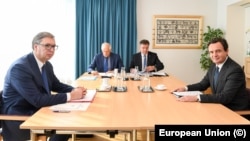
Serbian President Aleksandar Vucic (left) and Kosovo Prime Minister Albin Kurti (right) are in Brussels for talks supervised by EU foreign policy chief Josep Borrell (center left).
The leaders of Serbia and Kosovo failed to reach an agreement for improving bilateral relations during EU-mediated talks in Brussels on September 14.
European Union foreign policy chief Josep Borrell said that “we tried hard but, unfortunately, it was not possible to bridge the differences today.”
Borrell, who mediated the negotiations and has said he sees resolving the long-running dispute between Belgrade and Pristina as essential to their efforts to join the European Union, said that Kosovar Prime Minister Albin Kurti rejected Brussels’ compromise proposal.
The renewed effort came after the EU worked out a plan early this year that it had hoped would break the stalemate. However, Kosovo has insisted that Serbia first recognize its independence before relations with its Balkan neighbor can be normalized.
In 2008, nearly a decade after a bloody war, Kosovo unilaterally declared independence from Serbia, but Belgrade has refused to recognize the move.
“Kurti was not ready to take a step forward,” Borrell said, adding that the Kosovar leader “insisted instead on formalizing de facto recognition as the first step.”
Serbian President Aleksandar Vucic, who accepted the compromise offer presented by the EU, said the talks were “unsuccessful,” blaming Kurti for the lack of progress.
Kurti, for his part, blamed the Serbian side, saying that there was “full readiness” from Kosovo to work out an agreement and alleging that Vucic had “sabotaged” the talks.
Kurti also claimed the European Union had sided with Belgrade, saying Brussels “only adopted Serbia’s conditionality” of establishing an association of Serb-majority municipalities in Kosovo, which was “unacceptable” to Pristina.
Vucic and Kurti were in Brussels for talks under the so-called Belgrade-Pristina dialogue process, supervised by Borrell. The September 14 talks were the first face-to face conversations between them since clashes erupted in northern Kosovo in late May, further straining relations between the two countries.
The two leaders held separate bilateral meetings with Borrell and the EU’s special envoy for the Kosovo-Serbia dialogue, Miroslav Lajcak, followed by a joint trilateral meeting where they discussed the implementation of an EU-sponsored plan to normalize relations after decades of tensions.
The EU proposed that Kosovo start the process of establishing an association of Serb-majority municipalities. The formation of such an association, tasked with representing the Serb-majority communities in Kosovo, was agreed in a 2013 agreement between Pristina and Belgrade.
But the association has not been established since then and Kurti has opposed the idea, insisting on formalizing Kosovo’s recognition first.
Kurti said on September 14 that he could not accept the formation of an association of Serb-majority municipalities as a precondition.
Borrel said on September 14 that the EU proposal was for the two processes “to run in parallel.”
After the talks broke down, Borrell said he would report back to the EU so the bloc can determine what steps to take. “I am sorry to say we are running out of time,” Borrell said. “We cannot sit and wait for the next crisis.”
Tensions between the majority Albanians in Kosovo and local Serbs supported by Belgrade erupted into ethnic violence in May that injured dozens of NATO peacekeepers in northern Kosovo, after municipal elections a month earlier that were boycotted by local Serbs.
The United States and European Union each criticized Pristina’s lack of coordination when it tried to forcibly install ethnic Albanian mayors in Serb-majority areas in late May.
Weeks later, Serbian authorities detained three Kosovar police officers near their mutual border under unclear circumstances and held them for days.
The role of Serbian agitators in the violence and tough rhetoric from Serbia’s Vucic helped fuel criticism among international observers that the West was bending too much to accommodate Belgrade in the long-running spat.
Relations between Serbia and its former province have been on edge for more than two decades.
EU-mediated talks have failed to normalize relations between Serbia and Kosovo, whose 2008 declaration of independence is recognized by more than 100 countries but not Serbia, Russia, nor a handful of EU member states.
Kosovo’s 1998-99 war of independence from Serbia left more than 10 000 people dead — most of them ethnic Albanians. More than 1,600 people are still considered missing.

YEREVAN, SEPTEMBER 1, ARMENPRESS. The EU strongly believes the Lachin corridor must be unblocked, the spokesperson of Charles Michel, President of the European Council, said in a statement on September 1.
The current humanitarian situation on the ground is deteriorating rapidly and it is imperative to take steps to address the needs of the local population, Michel’s spokesperson Ecaterina Casinge said in the statement.
Below is the full statement.
“President Michel has continued to be intensely engaged in advancing the Armenia-Azerbaijan normalization process. His efforts over the past weeks, supported by Toivo Klaar, EUSR for the South Caucasus, have focused as a priority on addressing the humanitarian situation of Karabakh Armenians.
EUSR Klaar and President Michel’s team have been in frequent contact with Baku, Yerevan and representatives of Karabakh Armenians to work out a solution for unblocking access.
The current humanitarian situation on the ground is deteriorating rapidly; it is imperative to take steps to address the needs of the local population.
European Council President Charles Michel has proposed a step-by-step approach which would reflect a sequencing in the full-fledged operation of the Lachin corridor and the opening of the Ağdam route.
Sequencing of these steps and the type of cargo that would be delivered by each of these roads, as well as attendant procedures, have been the core of the recent discussions.
The EU strongly believes the Lachin corridor must be unblocked, in line with past agreements and the ICJ Order, and notes that the use of the Ağdam road to provide supplies can also be part of a concrete and sustainable solution to the provision of urgent and daily basic needs. Discussions on these elements had started following the last meeting of the leaders in Brussels on 15 July 2023.
The EU side has also stressed the need for Baku to provide clarity to Karabakh Armenians in terms of procedures for their movements through Lachin corridor to and from Armenia.
In parallel, exchanges have also focused on restoring electricity and gas supplies to Karabakh Armenians as soon as possible.
Beyond the immediate situation, the EU side has stressed the need to address legacies of the conflict to facilitate a long-term sustainable resolution.
Dialogue between Baku and representatives of Armenians living in the former Nagorno-Karabakh Autonomous Oblast will be essential in this regard. The rights and security of Karabakh Armenians must be guaranteed and discussions on specific modalities should start as soon as possible.
The dialogue between Baku and the Karabakh Armenians needs to strengthen confidence and trust. To this end the EU has provided various suggestions for international support to this process, as well as for engagement on the ground to underpin the implementation of agreements reached.
All the above efforts have only one goal: ensure irreversible normalization of relations between Baku and Yerevan for the benefit of all populations on the ground. It is now time for courageous compromise solutions, also in light of today’s escalation.
The EU has been engaged with other international actors in these efforts, through regular personal contacts and exchanges of views on how best address the current unsustainable situation.”
YEREVAN, SEPTEMBER 1, ARMENPRESS. The EU strongly believes the Lachin corridor must be unblocked, the spokesperson of Charles Michel, President of the European Council, said in a statement on September 1.
The current humanitarian situation on the ground is deteriorating rapidly and it is imperative to take steps to address the needs of the local population, Michel’s spokesperson Ecaterina Casinge said in the statement.
Below is the full statement.
“President Michel has continued to be intensely engaged in advancing the Armenia-Azerbaijan normalization process. His efforts over the past weeks, supported by Toivo Klaar, EUSR for the South Caucasus, have focused as a priority on addressing the humanitarian situation of Karabakh Armenians.
EUSR Klaar and President Michel’s team have been in frequent contact with Baku, Yerevan and representatives of Karabakh Armenians to work out a solution for unblocking access.
The current humanitarian situation on the ground is deteriorating rapidly; it is imperative to take steps to address the needs of the local population.
European Council President Charles Michel has proposed a step-by-step approach which would reflect a sequencing in the full-fledged operation of the Lachin corridor and the opening of the Ağdam route.
Sequencing of these steps and the type of cargo that would be delivered by each of these roads, as well as attendant procedures, have been the core of the recent discussions.
The EU strongly believes the Lachin corridor must be unblocked, in line with past agreements and the ICJ Order, and notes that the use of the Ağdam road to provide supplies can also be part of a concrete and sustainable solution to the provision of urgent and daily basic needs. Discussions on these elements had started following the last meeting of the leaders in Brussels on 15 July 2023.
The EU side has also stressed the need for Baku to provide clarity to Karabakh Armenians in terms of procedures for their movements through Lachin corridor to and from Armenia.
In parallel, exchanges have also focused on restoring electricity and gas supplies to Karabakh Armenians as soon as possible.
Beyond the immediate situation, the EU side has stressed the need to address legacies of the conflict to facilitate a long-term sustainable resolution.
Dialogue between Baku and representatives of Armenians living in the former Nagorno-Karabakh Autonomous Oblast will be essential in this regard. The rights and security of Karabakh Armenians must be guaranteed and discussions on specific modalities should start as soon as possible.
The dialogue between Baku and the Karabakh Armenians needs to strengthen confidence and trust. To this end the EU has provided various suggestions for international support to this process, as well as for engagement on the ground to underpin the implementation of agreements reached.
All the above efforts have only one goal: ensure irreversible normalization of relations between Baku and Yerevan for the benefit of all populations on the ground. It is now time for courageous compromise solutions, also in light of today’s escalation.
The EU has been engaged with other international actors in these efforts, through regular personal contacts and exchanges of views on how best address the current unsustainable situation.”
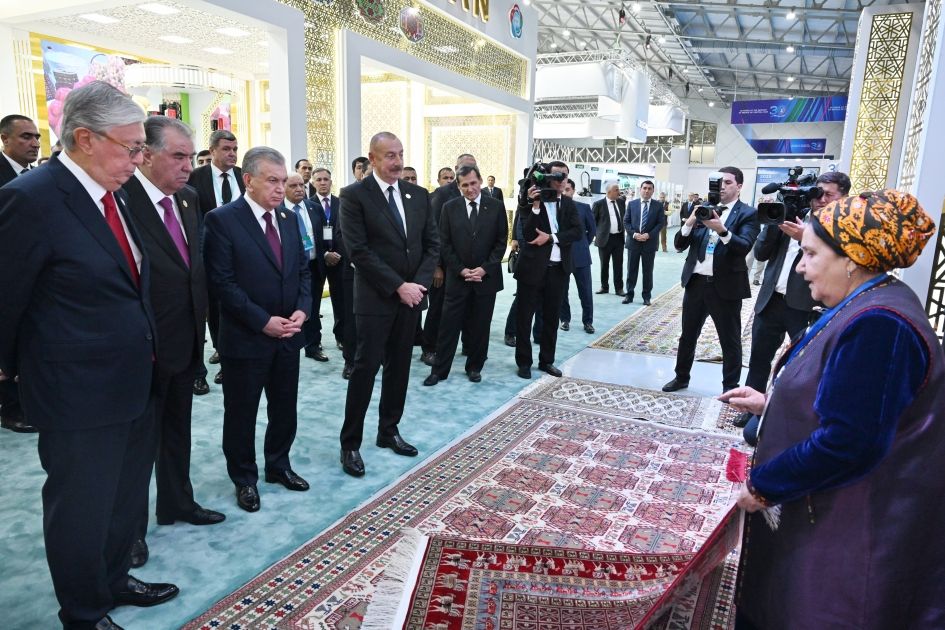
President of the Republic of Azerbaijan Ilham Aliyev and other
presidents participating in the 5th Consultative Meeting of the
Heads of State of Central Asia have viewed the EXPO Central Asia
2023 exhibition in Dushanbe.
The exhibition organized with the support of the government of
Tajikistan features leading companies and their products.
The purpose of the exhibition is to introduce products of
manufacturing companies and strengthen trade cooperation between
countries of Central Asia.
The pavilions of Central Asian countries demonstrate a large
assortment of light industry and cocoon production, hydropower and
innovative equipment, household appliances, as well as meat
products, dairy products, dried fruits, canned food, soft drinks
and other products.
Cars, passenger and cargo vehicles, military defense vehicles,
as well as agricultural equipment from Central Asian countries were
on display in the open area of the exhibition.
The exhibition also featured the results of activities and
achievements of the International Fund for Saving the Aral Sea and
the World Health Organization.
The exhibition also provided detailed information about trade
along the Silk Road, which took place in ancient times, and the
activities of Tajik artisans in different periods.
The hydropower resources of Tajikistan were demonstrated in a
separate corner.
Then the heads of state visited an exhibition of industrial
products of Uzbekistan, Kazakhstan and Turkmenistan.
It was noted that the organization of such a large regional
exhibition contributes to the expansion of trade cooperation, the
development of production workshops and enterprises, and an
increase in the range and volume of industrial products in the
countries involved.
—
Follow us on Twitter @AzerNewsAz