
Seen as a reformist by many, Pezeshkian must be free to fulfil his promises without interference, especially from the IRGC and other radical hardliners inside and outside the parliament, Euronews’ Babak Kamiar writes.
Category: Selected Articles
Category Added in a WPeMatico Campaign
OTD July 1, 1943, Openly #gay Dutch artist and hero #resistance_fighter #Willem_Arondeus executed by Nazis. Last words of Dutch resistance fighter, Willem Arondeus: “Let it be known that homosexuals are not cowards.” pic.twitter.com/ORcVOpMzR1
— SPIES&VESPERS (@SpiesVespers) July 1, 2024
OTD July 1, 1884 #Allan_Pinkerton died. Spied for Union during #Civil_War. Staunch abolitionist and brutal anti-trade unionist. It’s complicated pic.twitter.com/0R0Um7Gejt
— SPIES&VESPERS (@SpiesVespers) July 1, 2024
#OTD July 1 2023 #Cuban_spy #Ana_Montes aka #25037-016 released from prison. Said to currently reside in Puerto Rico pic.twitter.com/OK9n1zznIW
— SPIES&VESPERS (@SpiesVespers) July 1, 2024
“It’s not my work. It is my existence.”
This simple statement from a Latvian captain participating in the Northern Raven combined collection operation clarified the grave importance he, and many of his fellow analysts from the Baltics, placed on this particular mission. To them, Russia is an existential threat, and the insight this week-long combined open-source intelligence collection operation—the largest in NATO’s history—provided was critical to understanding Russian actions and intentions. Under the auspices of Northern Raven—US Army Europe and Africa’s multinational open-source intelligence (OSINT) program—thirty analysts representing eleven countries had gathered in Finland to collect OSINT, guided by a collection plan developed six months earlier.
While this operation marked the culmination of months of work, its roots stretched back to 2019 when Soldiers from the 66th Military Intelligence Brigade (Theater) met with Polish partners in Bydgoszcz, Poland to collect OSINT on Russian cyberattacks. The operation demonstrated the powerful effect partners can achieve when they align their capabilities: the Poles provided linguistic knowledge while the Americans employed data-mining tools to streamline collection. More bilateral exchanges followed with Canadian, Finnish, Croatian, and Romanian partners. By 2023, Northern Raven had expanded to include staff visits as well as training events and seminars in OSINT tradecraft best practices.
Though Northern Raven had grown in number of participants, its members were not collaborating with one another, just with their American partners. The program’s hub-and-spoke structure—with the United States at the center—didn’t encourage communication among other participants. To maximize its effectiveness and leverage partners’ collection strengths, Northern Raven needed to expand its charter. The solution was to provide a common purpose and operationalize the network—to bring everyone under one roof for a combined collection operation that would harness the expertise of all members and incorporate each step of the intelligence cycle: plan and direct, collect, process and exploit, analyze and produce, disseminate, and assess.
Merging the intelligence priorities, collection methods, and analytic techniques of eleven countries required careful planning. In December 2023, the Army Europe Open Source Center (AEOSC)—the OSINT cell of the 66th Military Intelligence Brigade (Theater)—hosted partners in Wiesbaden for a working group to define and direct collection requirements. This led to the creation of the first standing Northern Raven collection plan, which set requirements for fiscal year 2024. Rather than attempting during the operation to temporarily synchronize collection efforts designed to address divergent priorities, partners hardwired interoperability into their intelligence activities from the start.
In the months after the working group, partners communicated regularly on the results of their collection. They shared requests for information, refined the collection plan, and uploaded relevant products to the National Geospatial-Intelligence Agency’s Protected Internet eXchange (PIX) website, a secure but unclassified US government-sponsored information dissemination and sharing tool. Such routine collaboration transformed intelligence sharing from ad hoc exchanges—uncoordinated and often reliant on strong personal relationships—to formalized practice. Cooperation was persistent and focused on shared requirements, rather than episodic.
Eleven NATO nations gathered in Riihimäki, Finland in May 2024 for the culminating combined collection operation. Once in Finland, the group divided into five collection teams based on preassigned requirements. Each was structured to reflect a range of skills, nationalities, and collection capabilities. Partners with access to nonstandard tools such as the AI-powered Babel Street Insights platform were placed on different teams while each team was allocated at least one Russian speaker. The fact that most European partners were permitted to use burner phones to create accounts on social media platforms significantly enhanced the group’s ability to provide critical information to commanders. The organizational structure was decidedly flat: participants operated as a constellation of dynamic teams, experimenting and improvising with the best techniques for collection, processing, and exploitation.
For example, when a partner stumbled across a Telegram post by a Ukrainian milblogger that listed towns where Russian forces were alleged to be unloading equipment, he passed the locations to a member of his team currently serving in a cyber defense unit. Using a Python script he developed, the programmer-turned-intel officer was able to extract usernames and photos associated with Telegram accounts in the area. (Several photos featured soldiers posing in uniform, their unit patches clearly visible.) The partner plugged the usernames into other Russian social media platforms to gather more information before passing the photos to another colleague who proceeded to geolocate some of the buildings. After performing additional searches, the partner discovered videos of the same unit in three of the identified locations, corroborating his colleagues’ earlier findings. With this information, the team was able to map the logistical and transit routes taken by units moving toward Kharkiv.
By leveraging partners’ complementary strengths—whether regional knowledge, language ability, or access to specialized tools—Northern Raven created powerful synergies. Months of planning had bred trust and a shared sense of the operation’s overarching purpose. Everyone owned the mission. This made the teams agile and adaptive, able to craft a coordinated response to real-time developments.
Pooling partners’ skill sets and best practices expanded and sharpened the collection and processing of intelligence. It also reinforced the need to better integrate emerging technologies into OSINT operations. Northern Raven presents a unique opportunity to combine these activities: improving interoperability with partners and embracing new technologies to collect and evaluate open-source information. To that end, partners are creating a repository on a software developers’ platform that allows members to create, store, manage, and share their code. This enables partners to exchange tools and technical data, including software, map layers, AI models, and OSINT source lists. Its goals are twofold: to improve efficiency by sharing resources and increase interoperability through the use of common formats for data exchange. The platform could also serve as a test bed for technologies that hold the potential to unlock deeper and wider data-driven insights. By tapping the rich vein of Northern Raven’s growing network, NATO allies can capitalize on existing efforts to develop and adopt new capabilities.
While it is too soon to draw firm conclusions about the impact of Northern Raven’s approach to partner relationships, several initial takeaways emerge. First, it is not enough to set requirements and build collection plans together; to increase buy-in, the United States must empower partners to shape the collection effort in areas of particular importance to their intelligence enterprises. An approach that centers partners in the pursuit of their own priorities—areas where they are likely to possess special expertise—also optimizes collection capabilities, allowing for greater burden-sharing.
Second, partners must build ownership for Northern Raven among their leadership and secure resources. While AEOSC has lent structure and predictability to multinational OSINT—formalizing its processes and programming—long-term success will depend on sustained funding and organizational buy-in. As NATO members establish permanent OSINT organizations within their militaries, Northern Raven can serve as a unifying operation by which all analysts regularly coordinate and communicate, but that will also require programmed, predictable budgets.
Next, from a US Army perspective, Army OSINT must develop a rigorous framework for assessing the effectiveness of Northern Raven’s burgeoning suite of programs. Doing so will require the AEOSC to articulate what it wants to accomplish and identify the causal relationships that link Northern Raven’s activities to those outcomes. The team’s members must continuously ask themselves: What is working, what is not, and how does this achieve commanders’ requirements?
To meet the demands of this comprehensive approach to partner engagement, OSINT teams may also need to create new roles and responsibilities for their soldiers. The AEOSC created a new position, the partner integration lead, responsible for securing PIX and Digital Globe accounts for partners, as well as a dissemination manager to improve the reach—and track the circulation—of multinational products. To mitigate training shortfalls among partners, the AEOSC developed an exportable OSINT course, tailored for both in-person and virtual learning environments, which noncommissioned officers on the team instruct.
These types of activities not only present US soldiers with unique and meaningful opportunities, but also provide a purpose that increases their commitment to Army service. Exposure to new tools and data practices deepens their OSINT tradecraft knowledge while frequent interactions with partners prepare them to operate in culturally diverse coalition environments. Northern Raven also serves as a retention incentive. As one soldier remarked recently, “If I got out of the Army, I wouldn’t be able to call my mom and say, ‘Today I helped Sweden stand up its OSINT shop.’”

In less than a year, Northern Raven has evolved from a series of bilateral engagements into persistent cooperation across the entire intelligence cycle. Northern Raven enhances units’ readiness, preparing soldiers from all nations to write OSINT products that can be quickly released for consumption across the coalition. Training between partners, with real data on real networks, builds OSINT capacity across Europe, bringing us closer to a world in which every ally is a sensor. Finally, Northern Raven’s evolution into a multifaceted program integral to day-to-day operations creates opportunities for professional growth while exposure to partners’ analytic techniques upskills every analyst in the operation.
Though barriers to cooperation remain, relationships are no longer confined to physical engagement. Partners plan, train, and operate as one multinational team. With US and NATO military planning increasingly integrated, the ability to merge national-level processes into a single operation that capitalizes on partner expertise has never been more important. Knowing the enemy through open-source intelligence is not just our work, it is our intelligence team’s central purpose.
Colonel Christina Bembenek is the commander of the 66th Military Intelligence Brigade (Theater). She has served in multiple tactical, operational, and strategic intelligence assignments and was the first commandant of the Military Intelligence Corps.
Captain Chels Michta was the former officer in charge of the Army Europe OSINT Center and currently serves as an intelligence officer in the 66th Military Intelligence Brigade (Theater) All Source Control Element. She is also a 2023 Atlantic Council Millenium Fellow.
The views expressed are those of the authors and do not reflect the official position of the United States Military Academy, Department of the Army, or Department of Defense.
Image credit: Staff Sgt. Chad Menegay, US Army

A majority of voters want Joe Biden to stand down following his dismal debate performance, yet aren’t convinced there is a suitable alternative Democratic candidate, new polls have found.
In a Morning Consult poll, 60% of respondents, Republicans and Democrats, said the president should be replaced by his party for November’s election, while another 11% were unsure.
But the same poll also found that Biden’s popularity, initially at least, appeared to be unaffected by his stumbles and gaffes during Thursday night’s debate with Republican presumptive nominee Donald Trump.
He retained a one-point advantage, 45-44% over Trump, the same margin as Morning Consult found the day after the former president was convicted in May on 34 charges of falsifying business records to try to influence the 2016 election.
Another apparent glimmer of hope for the incumbent came in a separate Data for Progress post-debate poll that found no indication any other Democrat would perform better against Trump in November.
While Biden trails Trump 48-45 among respondents, all other leading Democratic figures would perform the same or worse in a head-to-head match-up. Prominent names that voters were asked about included vice-president Kamala Harris (45-48), transport secretary Pere Buttigieg (44-47), California governor Gavin Newsom (44-47) and Michigan governor Gretchen Whitmer (44-46).
A YouGov poll, meanwhile, found respondents overwhelmingly thought Trump won the debate, and that 30% of Democrats believed somebody other than Biden would give the party the best chance of winning in November.
The figure rises to 49% among all US voters, including Republicans and independents. Conversely, only 13% of Republicans believe their party’s best chance of victory would come by nominating somebody other than Trump.
One of the most devastating polls for Biden, however, was a Democracy Corps survey of Democratic-leaning voters, who used words such as “confused”, “frail”, and “dementia” to describe the president’s debate performance, Politico reported.
Voters were surveyed before and after the debate. While 65% said they would vote for Biden before the debate, only 54% said he won the debate once it ended, according to the survey.
Harris, 59, is the obvious choice to replace Biden, if he stands down, and has been the subject of increasing speculation in the days since the debate.
But Biden allies have insisted the president is standing firm and will contest and win the election, despite anguished calls from senior party officials and media heavyweights, including the New York Times, for him to step aside.
According to the Data for Progress poll, most voters consider Biden, who will be 82 at the start of a second term, too old to run again. 53% said they were concerned about his age, and physical and mental health, while 42% said they were more concerned by Trump’s criminal conviction, other upcoming trials and threats to democracy.
A CBS poll released Sunday, recorded in the two days following the debate, appears to echo the findings of the other surveys. It found 72% of registered voters did not believe Biden possessed the mental or cognitive health necessary to be able to fulfil the obligations of office, up from 65% at the beginning of the month.
A breakdown of the Morning Consult poll, meanwhile, shows that almost half of Democrats, 47%, want Biden out of the race, compared to 59% of independents, and 74% of Republicans. The figure among Democrats rises to 50% when limited to those who actually watched the debate.
That poll also suggests there is no clear replacement for Biden. Harris leads the field, but with only 30% support of Democratic voters, with Newsom the only other potential candidate in double figures, at 20%.
Others listed include Buttigieg at 9% and Whitmer at 5%, with a string of other Democratic state governors, Andy Beshear, Roy Cooper, JB Pritzker and Wes Moore at 3% or below.
Since the debate, Newsom has forcefully defended Biden and insisted he will not challenge the president. Harris has also expressed confidence in Biden, stating after the debate that the November presidential election “will not be decided by one night in June”.

WASHINGTON, June 30 (Reuters) – Top Democrats on Sunday ruled out the possibility of replacing President Joe Biden as the Democratic nominee after a feeble debate performance and called on party members to focus instead on the consequences of a second Donald Trump presidency.
After days of hand-wringing about Biden’s poor night on stage debating Trump, Democratic leaders firmly rejected calls for their party to choose a younger presidential candidate for the Nov. 5 election.
Biden, 81, meanwhile, was huddling with family members at the Camp David presidential retreat on Sunday.
The New York Times cited people close to the situation as saying that Biden’s family were urging him to stay in the race and keep fighting. The paper said some members of his clan privately expressed exasperation at how his staff prepared him for Thursday night’s event.
A drumbeat of calls for Biden to step aside has continued since Thursday and a post-debate CBS poll showed a 10-point jump in the number of Democrats who believe Biden should not be running for president, to 46% from 36% in February.
“The unfortunate truth is that Biden should withdraw from the race, for the good of the nation he has served so admirably for half a century,” the Atlanta Journal-Constitution said in an editorial on Sunday. “The shade of retirement is now necessary for President Biden.”
Democratic leaders rejected this.
“Absolutely not,” responded Georgia Democratic Senator Raphael Warnock, one of several Democrats seen as a possible replacement for Biden.
“Bad debates happen,” he told NBC’s Meet the Press program. “The question is, ‘Who has Donald Trump ever shown up for other than himself and people like himself?’ I’m with Joe Biden, and it’s our assignment to make sure that he gets over the finish line come November.”
House of Representatives Democratic leader Hakeem Jeffries, who could become speaker next year if his party can take control of the House in November, acknowledged that Biden had suffered a setback, but this was “nothing more than a setup for a comeback.”
“So the moment that we’re in right now is a comeback moment,” he told MSNBC.
Senator Chris Coons of Delaware, a leading Biden surrogate, told ABC’s This Week program Biden needed to stay in the race to ensure Trump’s defeat.
“I think he’s the only Democrat who can beat Donald Trump,” Coons said.
With Democratic leaders rallying around him, it will be up to Biden to decide whether he wants to end his re-election bid.
But other Democrats held open the possibility of choosing a different presidential candidate.
Representative Jamie Raskin, a prominent Democrat in Congress, told MSNBC that “very honest and serious and rigorous conversations” were taking place within the party.
“Whether he’s the candidate or someone else is the candidate, he’s going to be the keynote speaker at our convention. He will be the figure that we rally around to move forward,” Raskin said.
During the debate, a hoarse-sounding Biden delivered a shaky, halting performance in which he stumbled over his words on several occasions. Some Democrats later said privately that the showing could prove to be a disqualifying factor.
For his part in the debate, Trump made a series of well-worn falsehoods, including claims that migrants have carried out a crime wave, that Democrats support infanticide and that he actually won the 2020 election.
Trump’s daughter-in-law Lara, co-chair of the Republican National Committee, told Fox News that Trump was feeling “great” after “probably the best debate of his political career.”
Biden headed to Camp David after a frenzied run of seven campaign events across four states following the debate.
While the Camp David trip had been planned for months, the timing and circumstances of Biden being surrounded by family members who have weighed heavily in his past decisions to run for the presidency have added to the scrutiny around the visit.
Two people familiar with the scheduling said the gathering would include a family photo shoot. The attendees include his wife Jill, as well as the Biden children and grandchildren.
The New York Times said one of the strongest voices imploring Biden to resist pressure to drop out was his son Hunter, who on June 11 became the first child of a sitting president to be convicted of a felony after a jury found him guilty of lying about illegal drug use when he purchased a handgun in 2018.
DNC Chairman Jaime Harrison and Biden campaign manager Julie Chavez Rodriguez held a Saturday afternoon call with dozens of committee members across the country, a group of some of the most influential members of the party.
The call was part pep talk, part planning meeting for the upcoming national convention, according to two people who were on the call who requested anonymity to discuss private discussions.
Sign up here.
Reporting by David Morgan, Jarret Renshaw, Eric Beech, Tyler Clifford, Ted Hesson and David Brunnstrom; Editing by Ross Colvin, Mark Porter and Don Durfee
Our Standards: The Thomson Reuters Trust Principles., opens new tab
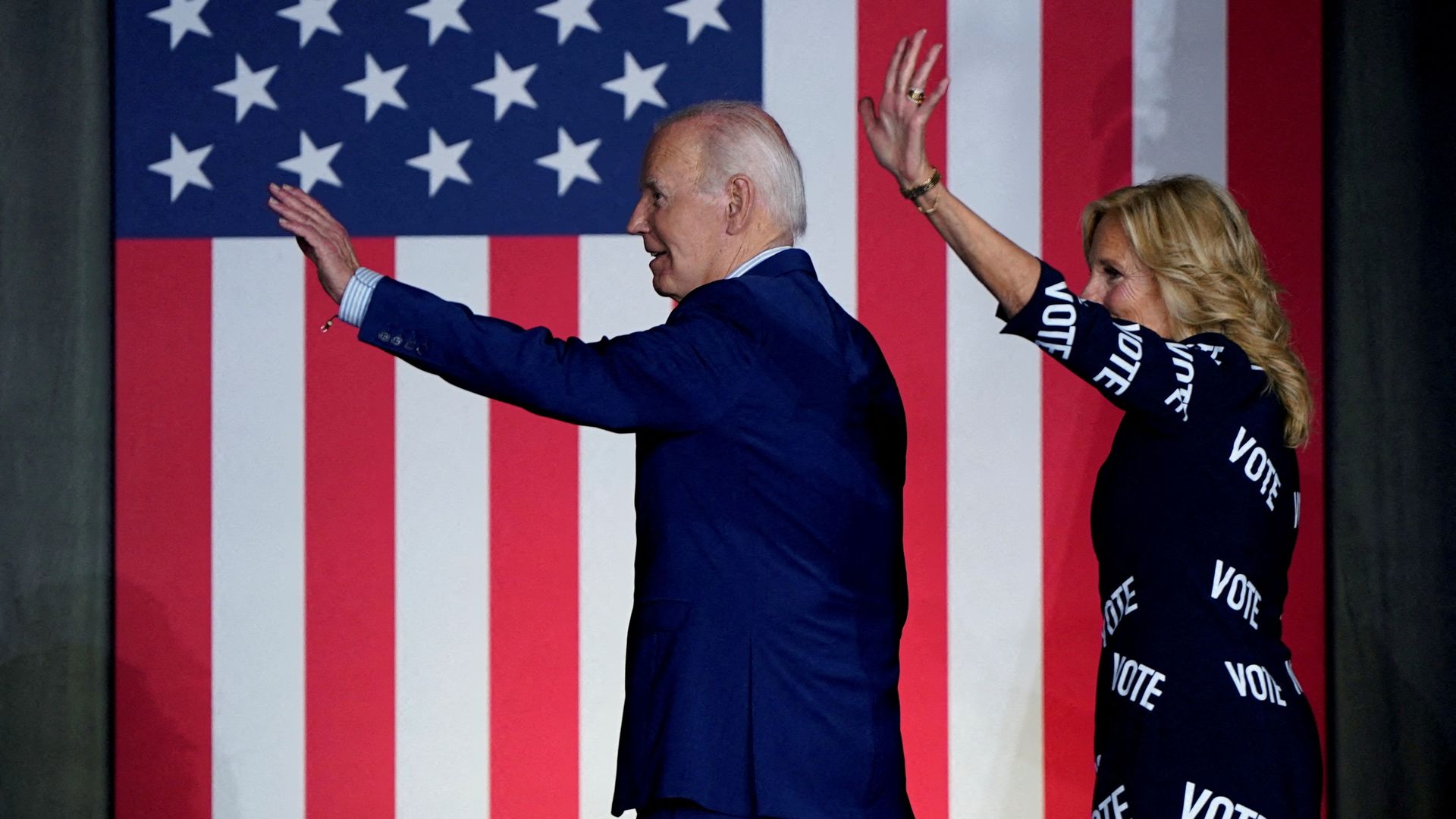
President Biden and Dr. Jill Biden leave a campaign rally in Raleigh, N.C., on Friday. Photo: Elizabeth Frantz/Reuters
Forget the pundits. Ignore New York Times editorials and columnists. Tune out people popping off on X.
- The only way President Biden steps aside, despite his debate debacle, is if the same small group of lifelong loyalists who enabled his run suddenly — and shockingly — decides it’s time for him to call it quits.
Why it matters: Dr. Jill Biden; his younger sister, Valerie Biden; and 85-year-old Ted Kaufman, the president’s longtime friend and constant adviser — plus a small band of White House advisers — are the only Biden deciders.
This decades-long kitchen cabinet operates as an extended family, council of elders and governing oligarchy. These allies alone hold sway over decisions big and small in Biden’s life and presidency.
- The president engaged in no organized process outside his family in deciding to run for a second term, the N.Y. Times’ Peter Baker reports.
- Then Biden alone made the decision, people close to him tell us.
Behind the scenes: If Biden stays in, it’s for the same reason he decided to run again: He and the oligarchy believe he has a much better chance of beating former President Trump than Vice President Harris does.
- Biden allies have played out the scenarios and see little chance of anyone besides Harris winning the nomination if he stepped aside.
- Is the Democratic Party going to deny the nomination to the first woman, the first Black American, and the first South Asian American to be elected V.P.? Hard to see.
- These allies privately think Harris would struggle to pull moderate and swing voters, and would enhance Trump’s chances. (Harris “fares only one or two points worse than Biden in polls with margins of sampling error that are much larger than that,” The Washington Post found.)
The intrigue: We’re told Democratic congressional leaders are one outside force that could bring pressure on Biden.
- They’re getting calls and texts from panicked lawmakers who fear Biden’s weakness could cost the party House and Senate seats in November.
“This is no longer about Joe Biden’s family or his emotions,” said an adviser in constant touch with the West Wing. “This is about our country. It’s an utter f***ing disaster that has to be addressed.”
- It’ll take a while for the oligarchy to process the stakes, this adviser argued, “but there will be a reckoning.”
Behind the scenes: Biden insiders are already finding it easier than many realized to rationalize staying in. They argue: Yes, he had a poor debate performance. But Biden also can dial up vigorous appearances like he did in Raleigh on Friday afternoon.
- That behind-the-scenes juxtaposition plays out daily: Sometimes he’s on his game, sharper than people would think, and quicker on his feet.
- But often it’s the Biden you saw on the debate stage: tired, slow, halting.
Top Democrats saw what America saw live, on national TV, vividly and unforgettably. They can’t unsee it. And they fear voters won’t unsee it.
- No longer can they blame critics or edited footage or media exaggeration.
- Every misstep, verbal hiccup or frozen face will zip across social media and TV, reminding voters Biden will be 86 years old at the end of his second term.
“They need to tell him the absolute truth about where he is,” said a well-known Democrat who often talks to the president. “Loyalty doesn’t mean blind loyalty.”
- “Candidates for House, Senate, governor, state legislature are going to be in survival mode,” the well-known Democrat added. “They’re not going to go down with the ship. And the ship is in a bad place.”
What we’re hearing: Some Biden family members are digging in — squinting at overnight polls for signs that undecided voters moved Biden’s way because of Trump statements at the debate.
- “They know it was a disaster,” said a source close to the family. “But they think there’s a glimmer of survival/hope.”
- In a Biden campaign memo, “Independent Voters Move to Biden in Debate,” officials wrote: “Based on research we conducted during [the] debate, it is clear that the more voters heard from Donald Trump, the more they remembered why they dislike him.”
Biden — bolstered by a tweet from former President Obama (“Bad debate nights happen. Trust me, I know”) — sounds like he wants to stick it out.
- “When you get knocked down, you get back up,” Biden said to applause, reading from a teleprompter during a rally Friday at the North Carolina State Fairgrounds.
- “Folks, I don’t walk as easy as I used to. I don’t speak as smoothly as I used to. I don’t debate as well as I used to. But … I know how to tell the truth.”
What we’re watching: The public backing of former presidents and current members of Congress says little about Biden’s future.
- Most know him too well and for too long to humiliate him in public.
- Instead, if he decides to go, it’ll follow private conversations with them — then a decision with this oligarchy. Remember, it’s under eight weeks until Biden is ratified as the official nominee. That’s the clock to watch.
What they’re saying: James Carville — the “Ragin’ Cajun” who masterminded Bill Clinton’s first presidential campaign in 1992, and now is a frequent TV pundit — will be 80 in October. He told us that if he appeared like Biden did during the debate, he’d want to be pulled off the tube.
- “I never thought this was a nifty idea,” Carville said of Biden’s run. He said there are few people the president really listens to: “He doesn’t have advisers. He has employees.”
When we pressed Carville on whether he thinks Biden will be off the ticket by Election Day, he said he thinks so. He invoked a famous quote by the late economist Herb Stein, which Carville paraphrased as: “That which can’t continue … won’t.”

President Joe Biden’s shaky performance in Thursday’s debate has prompted calls from some left-wing pundits for him to drop out of the race and allow Democrats to appoint another candidate in his place—an unprecedented scenario that would require Biden loyalists to spurn the president, who has so far said he will continue his campaign.
President Joe Biden looks down as he participates in the first presidential debate of the 2024 … [+] election with former US President and Republican presidential candidate Donald Trump at CNN’s studios in Atlanta, Georgia, on June 27, 2024. (Photo by ANDREW CABALLERO-REYNOLDS/AFP via Getty Images)
AFP via Getty Images
There’s no official mechanism to kick Biden off the ticket if he doesn’t step down voluntarily, but the delegates who will vote to formally select a nominee at the party’s convention in August could revolt against him and select another candidate in his place.
Biden has swept the primaries, winning nearly 3,900 of the party’s 4,000 “pledged” delegates who will vote to formalize the nominee, and party rules require them to “in good conscience reflect the sentiments of those who elected them.”
A revolt is unlikely: Pledged delegates are not legally beholden to voting for Biden, but they’re generally loyalists of the party’s chosen nominee who are elected at state party conventions, in primaries or caucuses with heavy influence from the campaign of the party’s preferred candidate.
If Biden, or any candidate, fails to win a majority of pledged delegates on the first ballot at the convention, voting will continue until somebody wins an outright majority, with pledged delegates free to vote for whoever they want in later ballots.
The 700-some unpledged “superdelegates,” elected officials and party leaders who can vote for anyone they please, will also be allowed to vote on the second ballot (party rules prohibit them from voting on the first ballot).
If Biden voluntarily steps aside before the convention, his pledged delegates would be free to vote for an alternative candidate in an “open convention”—likely setting the stage for intense negotiations as other Democratic politicians angle to replace Biden.
If Biden steps aside after the convention, the Democratic National Committee’s approximately 500 members could call a special meeting to choose a new presidential and vice presidential nominee by majority vote.
The party plans to vote for a nominee before the convention begins on Aug. 19 via virtual roll call to allow Biden to be on the ballot in Ohio, which requires presidential candidates be nominated at least 90 days before the November election (in this case Aug. 7). The party has not announced an official date for the virtual roll call.
Contra
Biden rejected suggestions that he should step aside in speaking to reporters after the debate, answering “no” when asked about the prospect and blaming his poor performance on former President Donald Trump. “It’s hard to debate a liar,” Biden said, before telling supporters in Atlanta in a post-debate speech “let’s keep going.” On Friday, Biden delivered a fiery speech from Raleigh, North Carolina, in which he sounded notably more energetic than he did the previous night and reiterated his plans to keep running, admitting “I don’t debate as well as I used to.”
Any candidate who were to challenge Biden at the convention would need to first select a running mate.
Tangent
Speculation has swirled for months about who could replace Biden as the Democratic nominee amid concerns about the 81-year-old president’s age. Vice President Kamala Harris is the most obvious choice to replace him, though she has an uphill battle in winning over voters given her 39% approval rating. California Gov. Gavin Newsom is another name commonly floated, but he’s repeatedly dismissed the prospects of replacing Biden, voicing his allegiance to the president in interviews after the debate. As of Friday morning, no prominent Democrats had openly called on him to step down and there is no public consensus within the party about who would replace Biden if he did.
Key Background
Biden stammered through Thursday’s debate, losing his train of thought minutes after it began, speaking with a hoarse voice throughout the 90-minute program, and giving incoherent responses to several questions. Abysmal reviews poured in on social media, even from some of Trump’s staunchest critics, and by the end of the debate, Democratic operatives, donors and elected officials were reportedly discussing replacing Biden. By Friday morning, Biden-friendly pundits, including MSNBC’s “Morning Joe” host, Joe Scarborough, and New York Times’ columnist Thomas Friedman were openly suggesting Biden should drop out, predicting that if Democrats don’t replace him now, they’re effectively handing Trump another term.
Biden Loses Train Of Thought And Corrects Himself Repeatedly In Debate With Trump (Forbes)