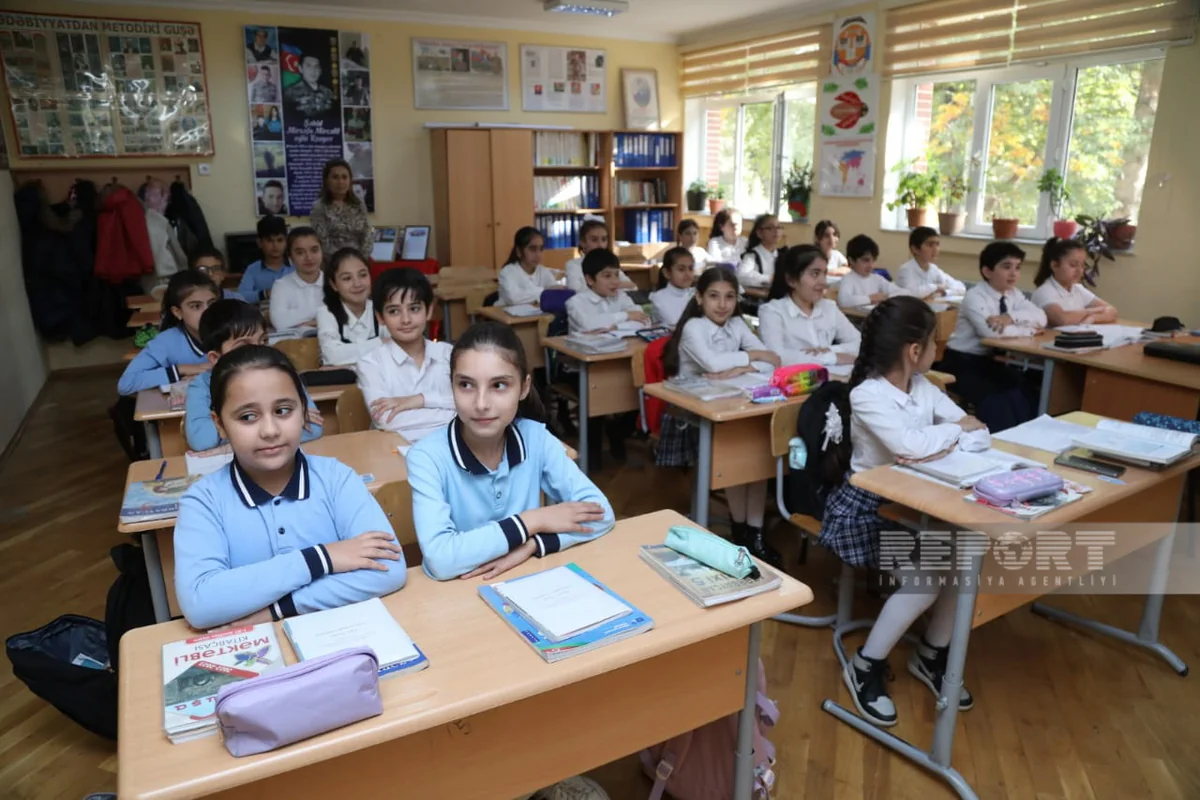
A school is not only an educational institution where knowledge and skills are acquired, but also a social environment where personality is shaped, national and moral values are instilled, and the foundations of mutual respect, equality and a culture of coexistence are laid. From this perspective, rules applied in educational institutions, including the issue of a standard school uniform, should first and foremost be assessed in terms of children’s interests, psychological well-being and healthy development.
Member of the Milli Majlis Gunay Agamali said this in comments to Report.
She noted that the issue should be approached on the basis of the broader interests of society and the principles of the education system:
“The main purpose of introducing a standard school uniform is to prevent social differences among students from being emphasized, strengthen an environment of equality, and foster discipline and a sense of collective responsibility. The use of standard school uniforms is also widespread internationally. Educational institutions in the United Kingdom, Japan, South Korea, Singapore, Türkiye and other countries have uniform dress rules. This practice serves to promote social equality, discipline, a sense of belonging to a community and a healthy educational environment among students.”
Agamali said children from families belonging to different social groups attend the same schools:
“Displaying financial means through clothing may cause psychological discomfort, lower self-confidence and a sense of social isolation among some children. By making these differences less visible, a standard school uniform helps students feel like equal members of the same community.
“Another important aspect of the issue concerns children’s psychological development. During childhood and adolescence, the social environment, relationships with peers and a sense of belonging to a community have a major impact on personality development. Creating a healthy psychological atmosphere at school and ensuring that students judge one another not by their clothing, their families’ financial situation or individual characteristics, but by their human qualities, behavior and knowledge, should be among the main priorities.”
MP Malahat Ibrahimqizi, meanwhile, believes that a standard approach to school clothing in Azerbaijan is particularly important for limiting displays of social differences among students, strengthening a sense of unity in the school environment and ensuring that children feel equal regardless of their social status:
“The real results of this approach are determined not merely by the existence of dress rules, but by the extent to which social sensitivity, economic accessibility and respect for individual rights are maintained in their implementation. In Azerbaijan, a standard approach to school clothing is linked to maintaining general discipline and shaping the school environment. The established clothing standards provide a clear framework for students’ appearance, strengthen the school’s institutional identity and help foster a sense of collective responsibility among students.”
Ibrahimqizi said that, ultimately, compliance with dress rules in general education institutions should be measured by whether every child at school is valued equally, whether social differences are prevented from becoming a source of discrimination, and whether educational opportunities remain accessible to all.
According to MP Mehriban Valiyeva, the task facing modern Azerbaijani society is not to create a conflict between national and moral values and the principles of secular statehood, but to ensure that they complement one another:
“Education is a strategic sphere that determines the intellectual potential, moral resilience and future development of every society. From this perspective, decisions adopted within the education system are not limited merely to the organization and management of teaching; they also influence society’s system of values, public relations and the formation of future generations’ worldview. Issues concerning the secular nature of education and the introduction of a standard school uniform should also be approached within this broader context.”
She noted that Azerbaijan’s education policy is based on a comprehensive approach combining the preservation of national and moral heritage, the acquisition of modern scientific knowledge, and the strengthening of the principles of the rule of law and secularism.
“The essence of this approach is to raise independently minded citizens with a high level of knowledge and skills who can respond to the challenges of the modern world while preserving our national identity and historical and cultural heritage.”
Valiyeva said the principle of secular education envisages shaping students’ worldview on the basis of scientific knowledge, rational thinking, mutual respect and legal responsibility:
“Secularism does not mean moving away from national and moral values. On the contrary, under the conditions of a law-governed and democratic society, it creates a reliable institutional foundation for preserving national heritage, respecting cultural diversity and ensuring the peaceful coexistence of people with different worldviews. Historical experience shows that secular statehood can make an important contribution to establishing a balance between legal guarantees of freedom of religion and the preservation of national and cultural diversity.”
The MP added that attitudes toward clothing in this environment should also be regarded as part of the broader philosophy of education:
“The introduction of a standard school uniform can help strengthen discipline in the school environment, limit the extent to which social differences among students are highlighted through outward appearance, and focus attention on the educational process. At the same time, a standard uniform should not be regarded as an absolute guarantee that all social differences within schools will disappear.”
MP Sabina Salmanova, for her part, told Report that a school is not merely a place where knowledge is imparted, but also an important social institution where future generations are formed and children are raised in a spirit of love for the homeland, loyalty to the state and respect for the law.
She noted that protecting this environment, respecting the authority of education workers and ensuring students’ right to education are everyone’s responsibility:
“Strengthening a sense of statehood, commitment to national and moral values, and civic responsibility in our schools is of particular importance. Loyalty to the state, respect for the law and responsibility toward society are formed first and foremost within the family and educational environment. Conduct contrary to these principles negatively affects not only the educational process, but also the healthy moral environment of society as a whole and public relations.”
Salmanova recalled that during the Patriotic War, the Azerbaijani people demonstrated through their unity and solidarity that when the fate of the homeland and the interests of the state are at stake, the people are capable of uniting closely around their state:
“This Victory once again showed that a strong state is founded on national unity, loyalty to traditions of statehood and joint action for common goals. Preserving this unity is of great importance for strengthening Azerbaijan’s independence, sovereignty and security. The unity we demonstrated in those days must also be preserved today and reflected in our daily lives and in our sense of responsibility toward society.”
The MP believes everyone should always stand by the state, protect national interests and remain vigilant against attempts to influence society from outside and push people toward confrontation:
“We must not allow foreign influences to create divisions within our society or undermine public stability. The preservation of the spirit of statehood, commitment to our national and moral values and respect for the rule of law should be reflected in the position of every citizen.”
MP Kamran Bayramov, meanwhile, said that against the backdrop of Azerbaijan’s high international standing as an independent, dynamically developing middle power that shapes regional realities, ensuring ideological security alongside physical security is also one of the priority areas of state policy:
“In the modern era, foreign centers use the media and social networks under their control to spread harmful ideological propaganda, seeking to influence children and young people whose worldviews have not yet fully formed and to reintroduce into society superstitions that were exposed by the enlightened intellectuals of our history. It is precisely in this context that the designation of national character and secularism as among the basic principles of general education policy in the Law ‘On General Education’ provides a legal basis for the development of a secular education system.”
Bayramov stressed that under amendments introduced by a decision of the Cabinet of Ministers to the requirements governing clothing for students at state general education institutions, the use of additional clothing elements that disrupt the uniformity of school attire or are inconsistent with the secular principle of education is prohibited.
“At the same time, requirements approved by the Cabinet of Ministers establish a dress code for teachers that is simple, neat, professional and consistent with the principle of secularism. The application of a standard uniform for students and a corporate professional style for teaching staff strengthens internal school discipline, neutralizes risks of discrimination arising from socio-economic differences, directs students’ attention toward the learning process and supports a professional working environment.”