Categories
South Caucasus

Bera Ivanishvili Announces Legal Action Over ‘Defamatory’ Accusations of Protecting Scam Call Centers


Bera Ivanishvili, the son of Georgian Dream founder and billionaire honorary chairman Bidzina Ivanishvili, said on September 30 that he plans to take legal action over what he described as a “discrediting and defamatory campaign” against him and his family, including allegations that he protects so-called scam call centers.

Ivanishvili said that for years, “certain forces” had conducted “a discrediting and defamatory campaign” against him and his family, periodically accusing him of “all kinds of filth.” He said that Davit Asatiani, who served as president of the Georgian Bar Association from 2017 to 2025, will be his lawyer, with whose help he will “seek a legal response to each and every dirty, defamatory accusation” against him.

According to Ivanishvili, the accusations form part of “a well-planned, coordinated campaign” that “can no longer go unanswered,” adding that “I have become convinced that leaving this stream of lies and filth unanswered has become a kind of encouraging factor for the people orchestrating this process.”

Ivanishvili said that “specific media outlets and specific individuals,” whom he did not name, had recently spread information claiming that he is “protecting call centers,” that “people are arrested on his instructions,” and that he “goes into unlawful deals,” among other allegations.

“Merely posing questions on such matters is enough to reveal apparent signs of an attempt at defamation, yet the aforementioned subjects go further and disseminate information about my supposed criminal activity in an assertive form, without anyone having presented even a single fact to confirm this absurd,” he said.

Ivanishvili also criticized media reports that, he said, rely on “incognito respondents — people of unidentified identity sitting with their backs turned in a dark room, who have no identifying features whatsoever — and incomprehensible voice messages whose authenticity cannot be established.”

“Under such circumstances, turning to the court is not an act of revenge against anyone, but rather a way to protect my dignity and rights,” Ivanishvili said. “I want the defamatory attacks directed against me to receive a legal assessment, and if the court establishes the fact of defamation, for the persons responsible for all of this to bear responsibility in accordance with the law.”

Ivanishvili concluded, saying that “I am only demanding justice and the establishment of the truth, including so that in the future neither I nor anyone else has to endure such injustice.”

The statement follows recent changes to Georgian defamation laws that critics described as a further blow to freedom of speech.

Under the amendments, the burden of proof was shifted entirely from the plaintiff to the respondent, who will now have to be the one to justify why a statement was not defamatory. The changes also allow people who consider themselves victims of defamation to seek financial or moral compensation damages.

Scam call centers operating in Georgia have been a longstanding concern and have led to a series of arrests and prosecutions, including amid international investigations into operations targeting victims in Western countries. A 2025 investigation by OCCRP and international media partners found that one Tbilisi-based network stole USD 35 million from more than 6,100 people between May 2022 and February 2025, while more recent journalistic reports suggest the alleged scammers remain active despite investigations.

The issue has also featured in recent criminal investigations involving former senior officials. In February, the Prosecutor’s Office charged ten people, including ex-Prosecutor General Otar Partskhaladze, with fraud and money-laundering charges linked to scam call centers, alleging that his network protected them.

Separately, former State Security Service head Grigol Liluashvili was convicted in September and sentenced to 13 years in prison, including on allegations of accepting a bribe in exchange for protecting a scam call center.

Also Read:


Categories
South Caucasus News

Czech CSG plans to manufacture self-propelled howitzers in Azerbaijan from 2027


Czech defense company Czechoslovak Group (CSG) plans to launch the production of self-propelled howitzers in Azerbaijan in partnership with a local company beginning in 2027.

Categories
South Caucasus News

2023 NBA Playoffs | Home | NBA.com


2023 NBA Playoffs Full Focus: Nuggets close out Heat, win 1st NBA title Denver rides the broad shoulders of Finals MVP Nikola Jokic (28 points, 16 rebounds) past Miami in the 2nd half to win the …

Categories
South Caucasus

Həbsdə olan iqtisadçı alim, keçmiş deputat Nazim Bəydəmirli Ədliyyə Nazirliyinə müraciət edərək cəzaçəkmə müəssisəsində bir sıra hüquqlarının əsassız məhdudlaşdırıldığını bildirib. Bəydəmirli müraciətində videozəng imkanından məhrum edildiyini, həyat yoldaşına baş etibarnamə verə bilmədiyini, həmçinin lazımi tibbi yardım almadığını deyib. “Qanunla nəzərdə tutulan hüquqlarımın məhdudlaşdırıldığı hallar mövcuddur. Video görüntülərin bərpa edilməsi ilə bağlı müraciətlərə müsbət cavab verilmir, həyat yoldaşıma baş etibarnamənin rəsmiləşdirilməsi mümkün olmur, həmçinin lazımi tibbi yardım və həkimlə təmin olunmuram”, – deyə o yazıb. Bəydəmirli bildirib ki, üç ildən çoxdur qızını görə bilmir və on


Həbsdə olan iqtisadçı alim, keçmiş deputat Nazim Bəydəmirli Ədliyyə Nazirliyinə müraciət edərək cəzaçəkmə müəssisəsində bir sıra hüquqlarının əsassız məhdudlaşdırıldığını bildirib.

Bəydəmirli müraciətində videozəng imkanından məhrum edildiyini, həyat yoldaşına baş etibarnamə verə bilmədiyini, həmçinin lazımi tibbi yardım almadığını deyib.

“Qanunla nəzərdə tutulan hüquqlarımın məhdudlaşdırıldığı hallar mövcuddur. Video görüntülərin bərpa edilməsi ilə bağlı müraciətlərə müsbət cavab verilmir, həyat yoldaşıma baş etibarnamənin rəsmiləşdirilməsi mümkün olmur, həmçinin lazımi tibbi yardım və həkimlə təmin olunmuram”, – deyə o yazıb.

Bəydəmirli bildirib ki, üç ildən çoxdur qızını görə bilmir və onunla yalnız videogörüntü vasitəsilə əlaqə saxlaya bilib:

“Mən üç ildən çoxdur qızımın üzünü görmürəm, onu qucaqlaya bilmirəm, sadəcə video görüntü ilə görüşə bilirdik. 13 saylı cəzaçəkmə müəssisəsindən 6 saylı cəzaçəkmə müəssisəsinə etap olunduğum gündən – beş aydır ki, karantindəyəm – video görüntüdən məhrum edilmişəm”.

Daha ətraflı:  shorturl.at/e8Gg3


Categories
South Caucasus News

What Azerbaijan needs to do to benefit from Middle Corridor: World Bank recommendations


Benefits for Azerbaijan from the Middle Corridor

Benefits for Azerbaijan from the Middle Corridor

Developing the Middle Corridor through 2040 will require more than $55 billion in investment. However, building new railways and ports alone will not guarantee faster cargo deliveries. A World Bank report published on 28 September also stresses the need to simplify border procedures, coordinate rail and maritime transport, and reform state-owned transport companies.

For Azerbaijan, the key question is how much revenue the country can generate from cargo transit across the Caspian Sea and how it can integrate these shipments into the local economy. According to World Bank estimates, developing the corridor could increase the country’s GDP by 0.43 per cent in the long term, or by about $326 million.

In April, we analysed growing demand for the Middle Corridor and constraints on the Caspian route, while in June we examined 10 priority projects proposed to increase cargo volumes. The new report adds separate estimates of Azerbaijan’s investment needs and the potential economic impact. Our June list did not include any projects directly linked to Azerbaijan, while the World Bank report specifically identifies additional investment in the country’s rail and logistics infrastructure.

The new document builds on the World Bank’s 2023 study. It extends the forecast period to 2040 and covers more countries and types of cargo.

Where does the Middle Corridor run?

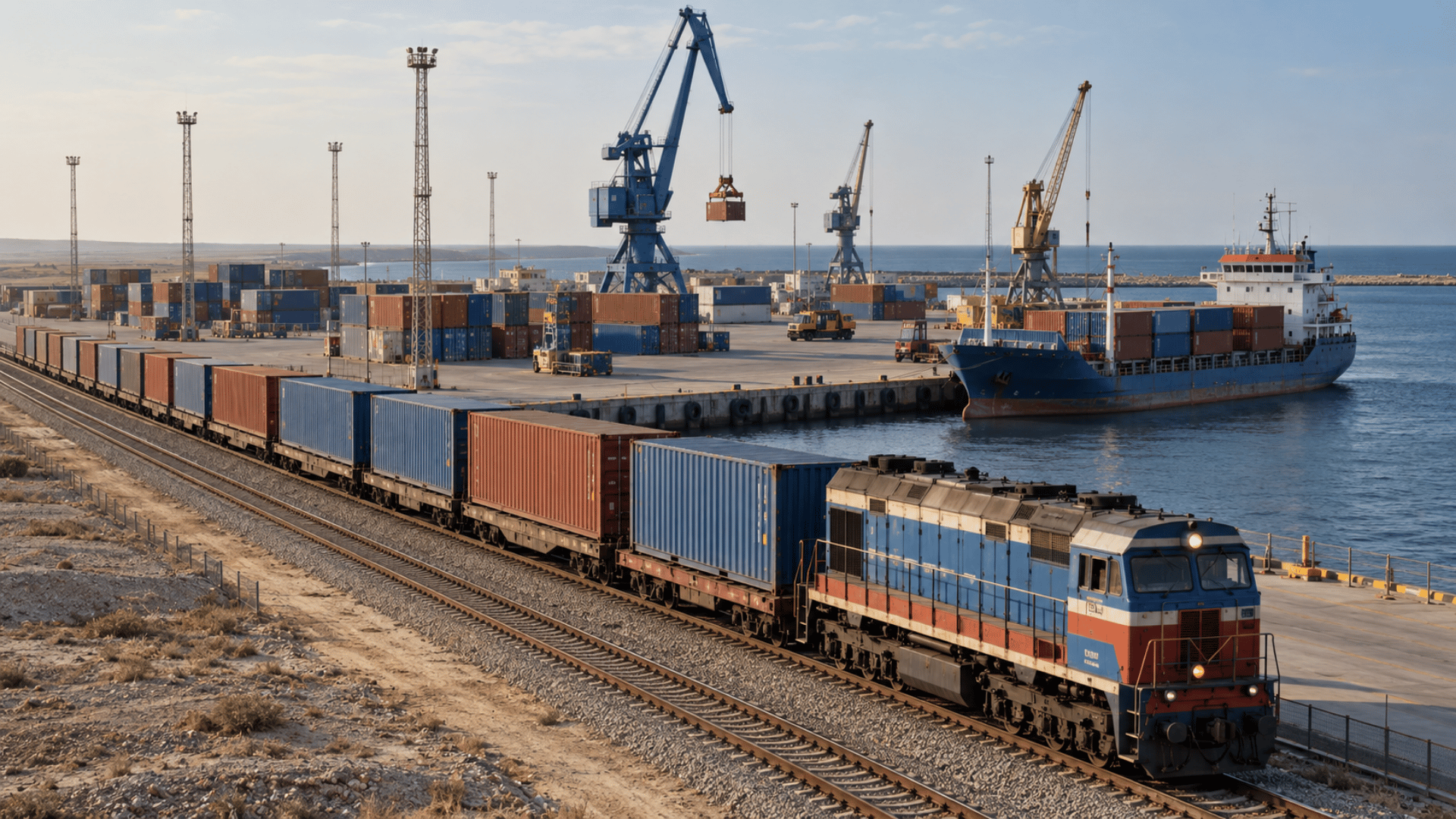
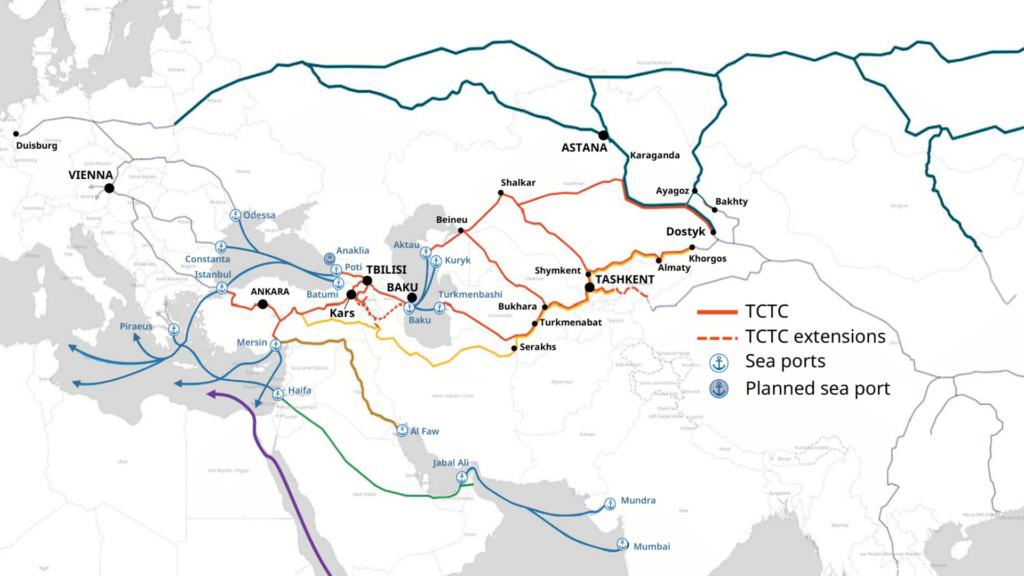
The Middle Corridor is a transport network connecting Asia and Europe through Central Asia, the Caspian Sea, the South Caucasus and Turkey. Different sections of the route carry cargo by rail, sea and road.

One of the main routes runs from China through Kazakhstan to the ports of Aktau and Kuryk. From there, cargo crosses the Caspian Sea to the Port of Baku in Alat. It then travels through Azerbaijan by rail along the Baku-Tbilisi-Kars line to Georgia. From there, it continues to Turkey or reaches Europe via Georgia’s ports and the Black Sea. The route through the port of Turkmenbashi connects Turkmenistan and other Central Asian countries to this transport network.

The report covers Azerbaijan, Armenia, Georgia, Kazakhstan, Kyrgyzstan, Tajikistan, Turkmenistan, Turkey and Uzbekistan. The Middle Corridor currently does not pass directly through Armenia. The World Bank included the country in its calculations on the assumption that relevant transport links could emerge in the 2030s.

Asian-European trade routes. Solid orange lines show the land sections of the Middle Corridor, orange dashed lines show planned extensions, and blue lines show maritime routes. Source: Alam and Blancas, World Bank, 2026, Map O.1. CC BY 3.0 IGO.

Benefits for Azerbaijan from the Middle Corridor
Asian-European trade routes. Solid orange lines show the land sections of the Middle Corridor, orange dashed lines show planned extensions, and blue lines show maritime routes. Source: Alam and Blancas, World Bank, 2026, Map O.1. CC BY 3.0 IGO.

What is the $55 billion needed for?

According to the World Bank, more than $25 billion will be needed by 2040 to develop the core physical infrastructure. This includes railways, ports and transport links between them.

Another $30 billion will be needed for additional investments required to operate the corridor and integrate it with local economies. This includes spending on access roads, logistics centres, inland terminals, locomotives and railcars, cargo-handling equipment and digital systems.

This figure does not represent costs that Azerbaijan will have to cover on its own, nor does it refer to a World Bank loan. It is an estimate of the total investment needed along the entire route.

Of the 16 most important infrastructure projects identified by the World Bank, 75 per cent are already under way, while governments have included the remainder in their plans. The report therefore notes that the main task at the next stage may be to improve service quality and the efficiency of transport operations.

What specific projects are planned for Azerbaijan?

The report identifies three areas for additional investment in Azerbaijan, totalling $1.16 billion.

Completing the ongoing modernisation of the Baku-Alat-Boyuk-Kesik railway line will cost an estimated $260 million. Upgrading power supply and signalling systems should improve the efficiency of the corridor’s main section in Azerbaijan.

The report allocates $300 million to developing a network of dry ports. These inland terminals collect, store and transfer cargo between different modes of transport. The list includes the Boyuk-Kesik border crossing, Baku and a southern transport hub that could serve a proposed route to Kars through Azerbaijan and Armenia.

Another $600 million would go towards further expanding the Baku-Alat-Boyuk-Kesik railway line in the 2030s. The latter two projects remain at the preliminary feasibility study stage. The figures therefore do not represent funding under contracts that authorities have already signed. The list also does not cover all of Azerbaijan’s costs related to developing the Middle Corridor.

Alat port capacity and the Caspian Sea’s declining water level

According to the report, the Port of Baku increased its container-handling capacity from 100,000 to 150,000 TEUs in 2025 by improving the efficiency of its existing infrastructure. TEU is a unit of measurement equivalent to a standard 20-foot container. The port handled 107,000 TEUs that year, using about 71 per cent of its container capacity.

At the same time, the port’s overall cargo-handling capacity stood at 55 per cent utilisation. This distinction matters: spare capacity across the port as a whole does not mean that the container and ferry terminals face no congestion.

The World Bank points to another problem: since the port moved to Alat in 2018, authorities have not carried out dredging in the entrance channel or the approach areas leading to the berths. The falling level of the Caspian Sea requires urgent action. Draft restrictions can prevent ships from loading to full capacity and reduce the port’s actual throughput.

What is slowing cargo transport?

According to the World Bank’s analysis, container cargo spends the most time waiting at ports. One reason is poor coordination between train and vessel schedules.

The report proposes creating a single operator to integrate container services run by the railway companies of Azerbaijan, Georgia, Kazakhstan and Turkey with Caspian Sea shipping operated by ASCO and Kazakhstan’s Kazmortransflot. This would allow operators to coordinate shipments along the entire route.

Document processing also takes considerable time. According to an example in the report, a container shipment between Asia and Europe may require 10 entry and exit procedures under customs transit regimes, five railway consignment notes and two maritime cargo documents. The World Bank recommends introducing a single digital T3 document combining transport, transit and trade data. To use it, countries would need to recognise each other’s documents, agree on data-sharing procedures and establish carriers’ responsibilities.

What conditions are needed to achieve the expected benefits?

According to the World Bank, investment and better services could more than triple cargo volumes along the route by 2040 and halve delivery times. Deeper trade and transport reforms could quadruple cargo volumes and cut delivery times by two-thirds compared with 2023.

The report estimates that, in the long term, the combined GDP of the nine countries could grow by 3.3 per cent, while employment could rise by 2.9 per cent. For Azerbaijan, the corresponding figures stand at 0.43 per cent and 0.66 per cent.

The report suggests that turning Azerbaijan’s geographic position into an economic advantage requires more than simply moving cargo through the country. Local businesses need access to the route, along with reliable transport and competitive logistics services. Planning should account for infrastructure costs, operating expenses and expected cargo volumes together. The World Bank also stresses that the report does not assess projects as ready for financing.


Categories
South Caucasus News

СРОЧНО! США «отжали» у Ирана Ормузский пролив?! ЧЕМ ОТВЕТИТ ТЕГЕРАН?


Categories
Azerbaijan Airlines plane crashes in Kazakhstan

Why Japan is looking to Ukraine’s front lines to overhaul its defences – South China Morning Post


Why Japan is looking to Ukraine’s front lines to overhaul its defences  South China Morning Post

Categories
Azerbaijan Airlines plane crashes in Kazakhstan

Why Japan is looking to Ukraine’s front lines to overhaul its defences – South China Morning Post


Why Japan is looking to Ukraine’s front lines to overhaul its defences  South China Morning Post

Categories
Azerbaijan Airlines plane crashes in Kazakhstan

Why Japan is looking to Ukraine’s front lines to overhaul its defences – South China Morning Post


Why Japan is looking to Ukraine’s front lines to overhaul its defences  South China Morning Post