Georgia’s disputed parliament has termporary suspended the accreditations of three journalists from the opposition-leaning TV Pirveli, amid reports of similar suspensions affecting reporters from other critical TV stations and online media outlets.
Nodar Meladze, TV Pirveli’s head of news, said on June 29 that the three journalists whose accreditations were suspended are Natalia Kajaia, Maka Chikhladze, and Maka Andronikashvili. They all work on his investigative program “Meladze’s Saturday.”
According to the letters from parliament shared by Meladze, Kajaia’s accreditation was suspended for one year on June 29, Chikhladze’s for six months on June 8, and Andronikashvili’s for one month on June 22. Criticizing the move, Meladze said their accreditations were suspended on “”unjustified grounds.”
In all three cases, the head of parliament’s apparatus cited the provision which states that an accredited journalist is “obligated to stop an interview” if an MP, staff member, or guest refuses to allow the interview to be recorded. Meladze said the letters “do not specify which respondent’s interview triggered application of this blanket norm,” adding, “The completely vague explanations make the intention behind this ban clear to us: their goal is to stop critical questions.”
The suspensions came weeks after the Georgian Dream-dominated parliament tightened its accreditation rules for journalists, allowing the legislature to revoke accreditations before they expire, extend sanctions for repeat violations to up to one year, and penalize both individual journalists and their media outlets. Parliament said the changes were modeled on the rules in the European Parliament, which in May suspended access for Georgia’s pro-government Imedi TV for one year after its journalist approached and filmed an MEP “without prior consent.”
The parliament’s latest decisions drew criticism from the Georgian Charter of Journalistic Ethics, a non-state media watchdog, which said the legislature is “gradually becoming one of the most closed institutions in the country, hostile toward those journalists whose critical questions some MPs often lack answers to.” The Charter called on the parliament to stop “persecuting journalists” and allow them to work freely in the legislature.
Other media organizations have also been affected by the stricter accreditation rules. Another opposition-leaning TV Formula’s journalist Nini Balanchivadze said on June 26 that her parliamentary accreditation had been suspended for six months under the same provision.
Earlier, on May 22, the disputed Parliament revoked the accreditations of the online outlets Publika and Studio Monitor, citing the absence of accredited journalists from Parliament for ten consecutive weeks. Studio Monitor said it would challenge the decision in court.
A new mechanism will be introduced to allow citizens of Azerbaijan and Armenia to confidentially and anonymously provide information about missing persons and their burial sites, AzerNEWS reports.
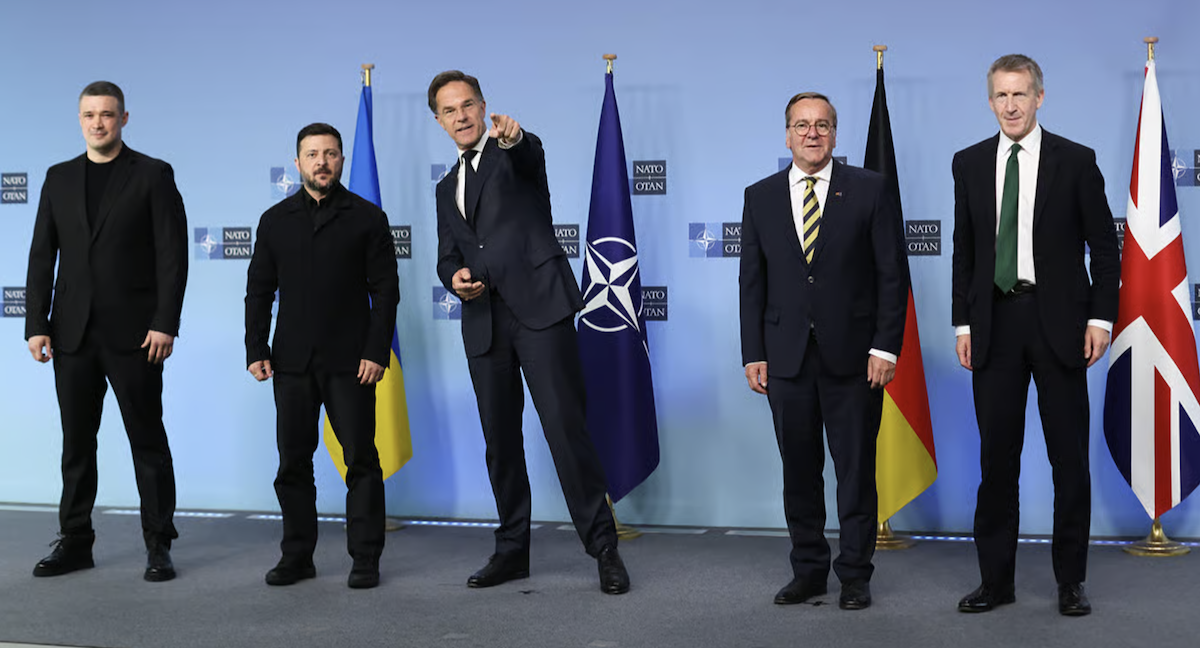
President of Ukraine Volodymyr Zelenskyy, Ukrainian Defense Minister Mykhailo Fedorov, NATO Secretary General Mark Rutte, German Defense Minister Boris Pistorius, and British Defense Minister Dan Jarvis ahead of a meeting of the Ukraine Defense Contact Group at NATO headquarters in Brussels, Belgium, June 18, 2026. (Olivier Hoslet/EPA)
In July, NATO will hold a summit in Ankara aimed at defining the alliance’s next strategic direction. Ahead of the meeting, defense ministers from member states gathered in Brussels on June 18 to discuss three key issues: support for Ukraine, increases in defense spending, and the long-term deterrence of Russia.
NATO leadership argues that the war in Ukraine is reshaping not only European security but the alliance itself. Secretary General Mark Rutte said NATO is undergoing the most significant transformation in its history and must evolve into “NATO 3.0” so that it is no longer described as a “paper tiger.”
According to Rutte, the summit in Ankara will focus on increasing defense spending, strengthening the defense industry, and continuing long-term support for Ukraine. NATO officials emphasize that Ukraine’s security is now viewed as inseparable from the security of the Alliance itself.
At a meeting of the Ukraine Defense Contact Group, Kyiv and Berlin agreed to jointly produce ground-based robotic systems known as “Termit” in Germany. Germany will finance the production and delivery of thousands of such systems. The United Kingdom announced it would supply Ukraine with 150,000 drones and more than 350 air-defense missiles and radar systems by the end of 2026. The funding will be provided through revenues generated from frozen Russian assets.
Ukrainian Defense Minister Mykhailo Fedorov said that Ukraine’s military has improved its position on the battlefield and urged partners to accelerate the delivery of already promised weapons.
At the same time, U.S. Defense Secretary Pete Hegseth again did not participate in the meeting of the Ukraine Defense Contact Group. Since the arrival of the administration of President Donald Trump, Washington has shifted its approach to assistance for Ukraine: critical weapons continue to flow from the United States, but their procurement is increasingly financed by European allies and Canada through the PURL mechanism.
Europe Takes on More Responsibility
Since the beginning of 2025, the United States has steadily pressed its European allies to assume greater responsibility for the continent’s security. Washington continues to provide nuclear guarantees, but has gradually reduced its role in supplying conventional military capabilities to Europe.
Hegseth announced the start of a six-month review of the deployment of U.S. forces in Europe. The goal, according to the Pentagon chief, is to ensure that Europe takes the lead in its own defense.
NATO Secretary General Mark Rutte described the developments as part of a broader transformation of the alliance.
Following last year’s summit, allies agreed to raise defense spending to 5 percent of GDP by 2035, with 3.5 percent allocated to core military needs and an additional 1.5 percent directed toward infrastructure and resilience.
In 2025, European countries and Canada increased their defense budgets by more than $90 billion. Only the Czech Republic, Slovenia, and Albania have yet to reach the 2 percent of GDP target, though NATO expects them to do so in the near future.
At the same time, alliance officials acknowledge that, following reductions in certain U.S. commitments, Europe will need to address capability gaps in intelligence, command-and-control systems, aerial refueling, air defense, and long-range strike capabilities.
Ukrainian experience becomes part of NATO strategy
NATO officials view support for Ukraine as one of the central pillars of their policy of deterring Russia. At the same time, Ukraine’s armed forces are increasingly seen as a source of unique battlefield experience.
According to a senior alliance official, Ukrainian troops have developed extensive expertise in countering drones—experience that most NATO militaries still lack. As a result, Ukrainian specialists are now participating in NATO exercises, helping allies adapt their tactics and operational planning.
Military officials within NATO also warn that the war has become a global testing ground for the exchange of military technologies. Russia, China, Iran, and North Korea are not only cooperating more closely, but are also jointly adapting weapons systems and methods of warfare.
“The key question is whether we are able to learn faster than our adversaries,” a NATO official said.
Why Ukraine is holding the front
According to NATO Secretary General Mark Rutte, the Russian offensive has slowed significantly and the front line has become more stable.
NATO officials attribute this to more effective Ukrainian command and control, the large-scale use of drones, and successful strikes against Russian logistics networks. Ukrainian forces have repeatedly targeted ammunition depots, transport hubs, air defense systems, and energy infrastructure both in occupied territories and in border regions of Russia.
According to NATO estimates, Ukrainian drones destroyed more than 130 pieces of Russian equipment used for supplying frontline forces in May alone.
NATO Secretary General Mark Rutte also cited assessments of Russian losses. According to the alliance, Russia has lost between 1.3 and 1.5 million personnel since the start of the war, including around 500,000 killed. Monthly irrecoverable losses are estimated at 30,000 to 35,000 personnel.
To replenish its forces, Moscow is increasingly relying, according to NATO assessments, on prisoners, people with financial debts, and foreign nationals.
Russia remains the primary threat
At NATO headquarters, officials say Russia will remain the principal threat to European security for the foreseeable future. At the same time, the alliance says it sees no signs that Moscow is preparing for a direct attack on NATO member states in the near term.
Alliance officials argue that it is important to distinguish between Russia’s potential military capabilities and its actual intentions. NATO’s primary objective, they say, is to ensure that any potential aggression would carry unacceptable risks.
Particular attention is being paid to protecting the airspace of the Baltic states, where drones have repeatedly strayed off course because of Russian electronic warfare systems. NATO officials stress that any drone violating allied airspace will be intercepted and destroyed, regardless of its original destination.
The Latvian experience
Latvian Prime Minister Andris Kulbergs said that defending against drones has become one of his government’s top priorities.
Latvia has already signed an agreement with Ukraine on cooperation in counter-drone capabilities. Ukrainian specialists will help assess the country’s existing air defense system, train personnel, and implement solutions based on lessons learned from the war.
The country has also increased its military assistance to Ukraine to 0.3 percent of GDP and allocated an additional €7 million to the PURL mechanism.
According to Kulbergs, troops from 14 NATO member states are currently training together in Latvia, but the alliance’s eastern flank will require further reinforcement.
How Russia is changing
NATO officials believe Ukraine is steadily degrading Russia’s ability to supply Crimea and the occupied territories by disrupting key logistics routes.
The alliance also says the war is placing growing pressure on Russia’s leadership. Its consequences are increasingly being felt not only in the regions but also among the political and business elites in Moscow and St. Petersburg.
According to NATO officials, some members of those elites are beginning to view the conflict as “Putin’s war” rather than a national project.
At the same time, the alliance assesses that Russia is increasingly testing NATO’s defensive capabilities and probing for vulnerabilities among its members.
Addressing those weaknesses is expected to be one of the central themes of NATO’s summit in Ankara this July.
During the call, the ministers discussed issues on the agenda of Azerbaijan-Kazakhstan strategic partnership, as well as the current state and future prospects of bilateral and multilateral cooperation.
The Telegram monitoring channel Supernova+ published footage allegedly showing drones flying over Moscow region airspace, with claims that they were heading toward the capital.
Peter Fischer, Germany’s ambassador to Georgia since 2022, announced the end of his mission on June 30. One of the most outspoken critics of Tbilisi’s anti-Western and anti-democratic drift, Fischer was among the most frequently targeted Western diplomats by Georgia’s ruling party and allied media, who repeatedly accused him of encouraging radicalism, supporting the opposition, and meddling in the country’s internal affairs, as relations between the two countries have largely deteriorated.
In a post on X bidding farewell, Fischer wrote, “Our term in Georgia has ended. Thank you, farewell and ‘Auf Wiedersehen’,” adding the same words in Georgian. The post on X was accompanied by a photo of him at the April 9 memorial in Tbilisi, in front of the parliament building, and Peter Gabriel’s song “Won’t Stand Down.”
Georgian Dream Prime Minister Irakli Kobakhidze, speaking with Georgian reporters in Kazakhstan, commented on Fischer’s departure, again accusing the outgoing ambassador of causing “serious damage” to Georgia–Germany relations.
“Mr. Fischer was the only ambassador who, not only did nothing to develop these relations, but did everything to damage relations between Georgia and the Federal Republic of Germany, which is very regrettable,” Kobakhidze said, adding, “We are grateful for Germany’s very important support over the years, and we have a strong desire for friendly relations to be restored, as we were previously accustomed to.”
Ambassador Fischer was among the most frequently criticized Western diplomats in Georgia by ruling party officials, who repeatedly accused him of encouraging radicalism, supporting the opposition and “extremists,” and interfering in the country’s domestic politics, as well as of overstepping his diplomatic responsibilities and violating the Vienna Convention, among other claims. They also blamed him for deteriorating relations between Tbilisi and Berlin.
In September 2025, Fischer was summoned by Georgia’s Foreign Ministry over the claims of interference and violating the Vienna Convention.
Fischer has openly criticised the Georgian Dream government for democratic backsliding and expressed concern over the country’s reversal on its path toward the European Union.
The German Foreign Office repeatedly defended Fischer, rejecting Georgian Dream’s accusations as baseless and condemning the aggressive rhetoric directed at him. Amid intensified personal verbal attacks, Berlin recalled Fischer for consultations in October last year. He returned to Tbilisi weeks later, in November.