
Categories
South Caucasus News

Azerbaijani student in Latvia jailed for 11 years over Starlink sales to Russia


Arrest of Azerbaijani student in Latvia

Arrest of Azerbaijani student in Latvia

A Riga city court has sentenced Azerbaijani national Ali Khalilov, who was studying in Latvia.

According to Latvian state television, the court sentenced him to 11 years in prison and three years of probation supervision. The court also ordered his deportation from Latvia and imposed a five-year entry ban as additional penalties.

Prosecutor Roberts Urdzinš had sought the maximum sentence of 12 years. Khalilov did not admit guilt.

The case

According to investigators, an organised group operated in Latvia from June to mid-October 2024. During that period, they ordered more than 60 Starlink Mini kits online. Authorities detained Khalilov in mid-October. Searches uncovered Starlink equipment that had not yet been sold.

Prosecutors say the scheme involved individuals both inside and outside Latvia. They allege that participants smuggled the goods into Russia for payment, using drivers of cargo and passenger transport. They say the group set up the operation to generate profit.

State television reports that prosecutors believe Khalilov bought at least 85 prepaid SIM cards to bypass restrictions on placing orders. He created at least 42 email accounts and used false identities. Investigators say he placed more than 60 Starlink orders using bank accounts belonging to other people.

In court, the prosecutor also said that Starlink Mini devices can be installed on combat drones.

One key episode in the case centres on the Gorbushka market in Moscow. Prosecutors say 45 Starlink devices were delivered there and sold to a person linked to the Akhmat unit, which supports the Russian army. The indictment also refers to shipments sent towards the Luhansk area and the transfer of access data for some of the equipment.

Latvian media report that investigators have not identified all participants in the network. The case names around 20 individuals, while several others remain unidentified. Prosecutors say they continue to investigate additional episodes.

Prosecutors also allege that, alongside Starlink equipment, the group imported items suitable for military use into Russia. These included tactical backpacks, weapons components, optical sights, calibrators, chronographs used to measure bullet velocity, and meteorological devices with ballistic calculators. They also claim the group organised the purchase of bullets and casings in Poland. Prosecutors estimate the total value of the goods at about €200,000.

Investigators say such equipment can support military use. Meteorological devices with ballistic calculators help adjust fire over long distances by accounting for factors such as wind direction and speed, while chronographs measure bullet velocity.
Background and context

Starlink is a satellite internet service developed by the US company SpaceX. It provides internet access via ground terminals, or antennas. In recent years, the project has driven a rapid increase in the number of satellites in orbit, with around 7,000 satellites operating within the system.

Portable models such as Starlink Mini and Starlink Mini Kit are considered attractive for both civilian and military use. They provide internet access from almost anywhere and typically cost several hundred euros.

Since the war in Ukraine began, Starlink has taken on strategic importance as a communications tool. After Russia’s full-scale invasion, SpaceX started providing satellite internet services to Ukraine. In early 2024, Ukrainian military intelligence said Russian forces were also using Starlink in occupied territories.

The official status of Starlink in Russia remains a sensitive issue. SpaceX says it does not cooperate with the Russian government or military and that the service is not available in Russia.

European Union sanctions form the key legal basis in this case. The EU has banned the supply of satellite internet systems such as Starlink Mini to Russia. Violating these sanctions can carry a prison sentence of up to 10 years.

The rationale behind the ban is straightforward. In wartime, even civilian technologies can provide military advantages. These include communications, drone operations and long-range targeting. Latvian investigators therefore treated the case not only as a breach of sanctions but also as assistance to Russia in its actions against Ukraine.

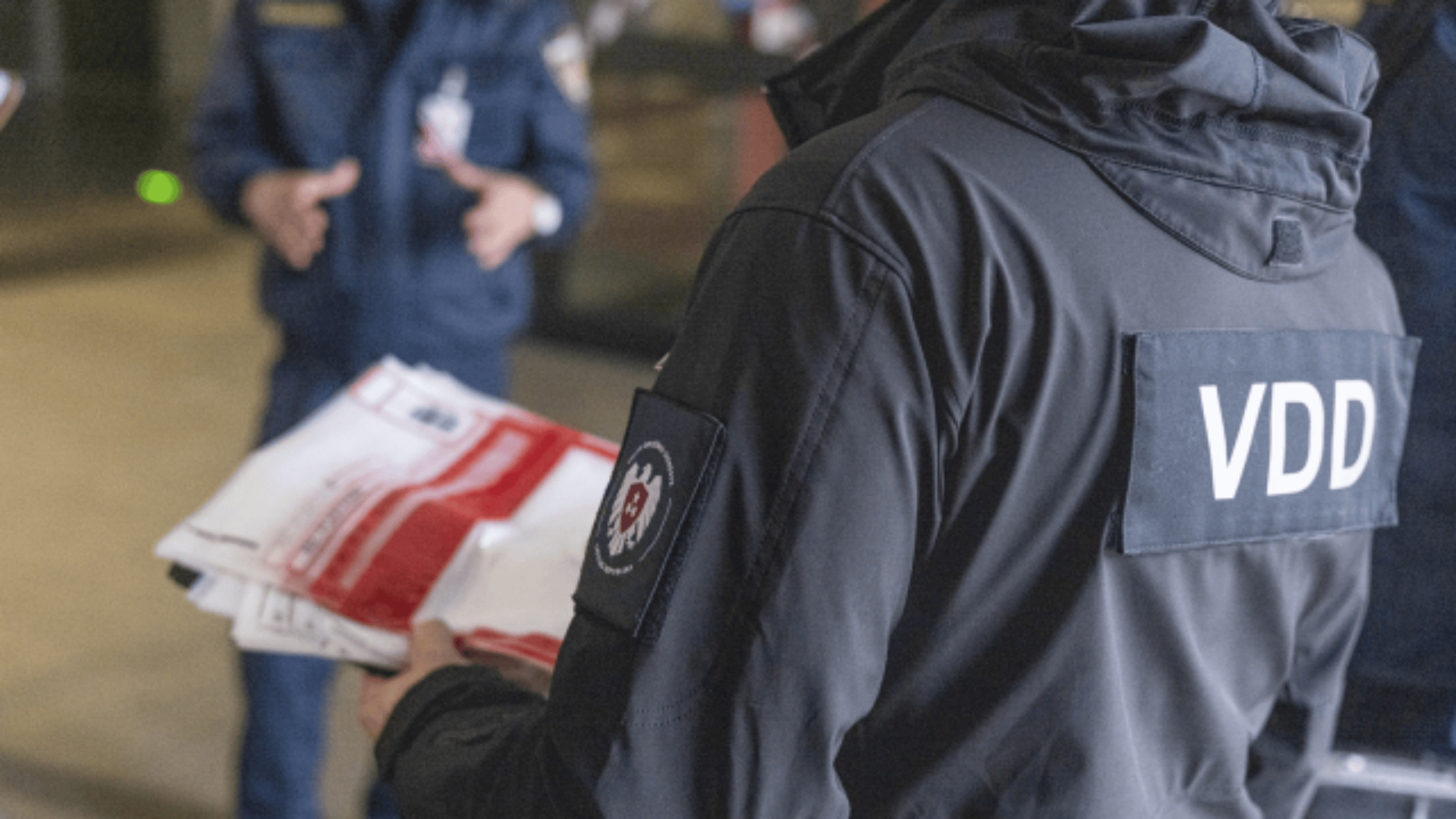
In Latvia, authorities enforce these restrictions through investigations by the State Security Service (VDD), prosecutorial action and court rulings.

The VDD said it opened the criminal case on 9 October 2024. On 5 March 2025, it asked prosecutors to begin criminal proceedings against four individuals.
How the case unfolded

The State Security Service (VDD) opened the investigation on 9 October 2024. On 5 March 2025, the VDD asked prosecutors to bring charges against four individuals on two counts: assisting Russia in actions against Ukraine and violating European Union sanctions as part of a group. The trial began in September 2025, and the court delivered its verdict on 17 March.

In a statement released in March 2025, the VDD said the suspects had been placed in pre-trial detention. It also stressed that the presumption of innocence applies. At the first court hearings in September 2025, Khalilov initially refused legal representation.
Individuals and links

According to Latvian state television, Ali Khalilov came to Latvia to study and is currently being held in Riga Central Prison in pre-trial detention. Prosecutors consider him the main organiser of the scheme.

Three others — Danila Gochulaks, Alens Navickas and Maria Mikheeva — face charges of assisting with opening bank accounts, tracking deliveries and receiving equipment. The investigation materials refer to around 20 individuals in total.
Arrest of Azerbaijani student in Latvia


Categories
South Caucasus News

Iran struck the world’s largest liquefied natural gas plant in Qatar: massive fire


Categories
South Caucasus News

Three More F1 Races in Jeopardy of Being Cancelled This Season After Bahrain and Saudi Arabia – GiveMeSport


Three More F1 Races in Jeopardy of Being Cancelled This Season After Bahrain and Saudi Arabia  GiveMeSport

Categories
South Caucasus News

President Aliyev lights Novruz bonfire as life returns to Garabagh


In the rolling landscapes of Garabagh and East Zangazur, reconstruction is no longer an abstract promise. Now, we can proudly say that it is a lived reality. Across once-devastated districts, from Aghdam to Fuzuli, from Zangilan to Khojavend, new roads cut through valleys that were, until recently, scarred by war.

Categories
South Caucasus News

Иран дал несколько часов на эвакуацию – удар неизбежен


Categories
South Caucasus News

Foreign investment in Azerbaijan rises as non-oil sector attracts capital


Foreign investment in Azerbaijan’s economy has increased in early 2026, reflecting continued interest in both energy and non-energy sectors, AzerNEWS reports. According to the State Statistics Committee of Azerbaijan, a total of…

Categories
South Caucasus News

U.S. Helsinki Commission Members Call to Use Sanctions for Georgia’s Compliance With OSCE Report


The bipartisan leadership of the U.S. Helsinki Commission has called on U.S. officials to use sanctions and “other available tools” to insist the Georgian Dream authorities comply with the recommendations of the OSCE’s Moscow Mechanism report.

The report, published on March 12 under the OSCE’s Moscow Mechanism, a human dimension instrument invoked by 24 participating states and authored by sole rapporteur Patrycja Grzebyk, points to “marked democratic backsliding” in Georgia since spring 2024. Among its key recommendations are the immediate release of “all prisoners held for political reasons” and the repeal of a series of restrictive laws.

In a March 18 statement, U.S. Helsinki Commission Chairman Senator Roger Wicker, Co-Chairman Representative Joe Wilson, Ranking Member Senator Sheldon Whitehouse, Ranking Member Representative Steve Cohen, and Commissioner Senator Jeanne Shaheen, said that “the OSCE Moscow Mechanism report is clear: Georgian Dream is robbing the Georgian people of their hard-won freedom and turning their country into an isolated, authoritarian state.”

They called on U.S. officials to join with European partners to “use sanctions and other available tools to insist that Georgian authorities heed the recommendations in this report. We must demand that they release all political prisoners, drop politically motivated charges against opposition politicians, and repeal undemocratic and unjust laws.”

U.S. lawmakers further said the report documents “inhumane treatment” by Georgian authorities toward protesters, political prisoners, and other dissenting voices. They pointed to what they described as “unjust prosecutions of protestors,” “abuse of protestors, political opposition, and journalists,” and the “public intimidation of journalists.”

Georgian Dream officials, including Prime Minister Irakli Kobakhidze, have dismissed  the Moscow Mechanism report’s findings as “pre-written,” accusing the rapporteur of “political bias” and alleging a “conflict of interest.”

Also Read:


Categories
South Caucasus News

Azerbaijan boosts natural gas output by 2.3% in early 2026


Azerbaijan produced 8.187 billion cubic meters of natural gas in January–February 2026, marking a steady increase in energy output, AzerNEWS reports, citing the State Statistics Committee. The figures show that gas production rose by 182 million cubic meters, or…

Categories
South Caucasus News

Georgians Will Be Required Posting Up to $15,000 Bonds for U.S. Tourist, Business Visas


Starting April 2, Georgia will be among 12 new countries whose nationals will be required to post a bond of $15,000 before receiving B1 or B2 visas for business and tourism in the United States, the U.S. State Department announced on March 18.

The U.S. introduced the visa bond pilot program last year, as part of a temporary final rule (TFR) effective for 12 months from August 20, 2025, until August 5, 2026.

Under the pilot program, nationals of designated countries may be required to post a bond of USD 5,000, USD 10,000, or USD 15,000, depending on the applicant’s circumstances, with USD 10,000 as the standard amount. Consular officers may waive the bond requirement in limited cases, such as for travel by U.S. government officials or for urgent humanitarian reasons.

According to the State Department, the bond will be returned to visa recipients who return home in compliance with visa and bond terms or do not travel. The U.S. says the program is necessary to combat illegal overstays.

Alongside Georgia, the added group of countries includes Cambodia, Ethiopia, Grenada, Lesotho, Mauritius, Mongolia, Mozambique, Nicaragua, Papua New Guinea, Seychelles, and Tunisia. 38 other countries that were covered with the bond requirements include Algeria, Angola, Antigua and Barbuda, Bangladesh, Benin, Bhutan, Botswana, Burundi, Cabo Verde, Central African Republic, Cote d’Ivoire, Cuba, Djibouti, Dominica, Fiji, Gabon, The Gambia, Guinea, Guinea Bissau, Kyrgyzstan, Malawi, Mauritania, Namibia, Nepal, Nigeria, Sao Tome and Principe, Senegal, Tajikistan, Tanzania, Togo, Tonga, Turkmenistan, Tuvalu, Uganda, Vanuatu, Venezuela, Zambia, and Zimbabwe.

Georgia is the only country from Europe or the South Caucasus on the list.

Earlier, in January, the U.S. also included Georgia among the 75 countries affected by the temporary suspension of U.S. immigrant visa issuance.

Also Read:


Categories
South Caucasus News

Azerbaijan Dance Sport Federation renamed at general meeting


A general meeting of the Public Union “Azerbaijan Dance Sport Federation” has taken place in Baku, AzerNEWS reports, citing the Ministry of Youth and Sports.