
Month: December 2025
As of December 1, 2025, citizens of Georgia are no longer eligible for Poland’s simplified employment procedure and must instead follow the longer, standard process, which includes obtaining a D-type visa.
Poland’s Minister of Family, Labor and Social Policy issued a relevant regulation on November 21, removing Georgia from the list of countries whose citizens could work in Poland in nonseasonal jobs for up to 24 months without a standard work permit. The remaining countries covered by the procedure are Armenia, Belarus, Moldova, and Ukraine.
Polish authorities had cited several reasons behind the decision, including “the political situation in Georgia, continuing work on possible restrictions on visa-free travel, and the decrease in the number of issued declarations and seasonal work permits compared to 2024.”
Under the system, employment required only an employer’s declaration registered with a local labor office, along with a valid residence document authorizing the foreigner to work. The scheme did not apply to seasonal employment, which is regulated separately.
Georgian citizens must now first secure a work permit through their employer before applying for a D-type national visa at a Polish consulate. The visa allows a stay of more than 90 days and up to one year.
However, Georgians already working based on employer declarations registered before December 1 may continue to work until the declaration’s expiry. Applications submitted before the new regulation enters into force will also be processed under the previous rules.
In 2024, Poland deported more than 2,500 Georgian nationals, mostly for using forged documents. Over 1,500 others were allegedly involved in criminal offenses, according to Polish authorities.
In June, Prime Minister Donald Tusk said his government was working to garner support within the EU bloc to suspend visa-free travel for Georgian nationals, asserting that migration from countries like Georgia now “presents a direct threat to legal and public order in our country and in Europe.”
In August, he said that Warsaw was reviewing whether to reintroduce visa requirements for nationals of Georgia, Armenia, Venezuela, and Colombia, citing national security concerns following an alleged Russian-backed arson attack in 2024.
Also Read:
A BBC investigation suggests Georgian authorities may have used a World War I–era toxic compound against protesters during the first week of demonstrations that began on November 28, 2024.
The ruling Georgian Dream party dismissed the investigation and said it would sue the BBC.
The BBC World Service reported on December 1 that it spoke with chemical weapons experts, whistleblowers from Georgia’s riot police, and doctors, and that the evidence points to the use of an agent known as camite.
Camite, or bromobenzyl cyanide, was deployed by French forces against Germany during World War I and is believed to have been phased out in the 1930s over concerns about its long-lasting effects.
“I’ve never seen camite being utilised in modern society. Camite is markedly irritating [and] persistent with its irritation,” Professor Christopher Holstege, a world-leading toxicology and chemical weapons expert, told BBC.
“It would keep people away for a long time. They couldn’t decontaminate [themselves]. They would have to go to the hospital. They would have to leave the area. If that is indeed the case – that this chemical has been brought back – that is actually exceedingly dangerous,” he added.
Hundreds of protesters reported long-term side effects following riot police dispersals during demonstrations in the first week after November 28, when Georgian Dream announced it was pausing the country’s EU integration. Reported symptoms included headaches, fatigue, coughs, shortness of breath, and vomiting.
A former Special Tasks Department official, Lasha Shergelashvili, told the BBC that he recognized the symptoms from a product he was asked to test in 2009, describing the compound as “probably 10 times” stronger than conventional riot-control agents. “If you spill this chemical on the ground, you won’t be able to stay in that area for the next two to three days,” he said.
While civil society organizations, including the Georgian Young Lawyers’ Association, earlier pressed the Ministry of Internal Affairs to disclose what chemical compounds were mixed with water cannons and gas, allegedly to exacerbate harm, the calls went unanswered.
“The findings of the BBC investigation confirm what all of us had already felt with our own bodies,” wrote Tamta Mikeladze of the Social Justice Center.
The BBC said that Georgian Dream dismissed the investigation’s findings as “deeply frivolous” and “absurd.”
Shortly after the investigation was released, Georgian Dream said it would sue the BBC in an international court.
“It is clear that the so-called media, turned into a propaganda tool of the ‘deep state,’ has presented no facts whatsoever to substantiate such serious allegations,” Georgian Dream said in a statement posted on Facebook, adding that the investigation relied on accounts from interested parties.
“We have decided to initiate legal proceedings against fake media in international courts,” the statement said.
The ruling party also pointed to a recent controversy surrounding the BBC’s coverage of Donald Trump’s comments, which led to the resignation of the broadcaster’s director general and the news CEO.
Pro-government media seized on the same point. Imedi TV, the Georgian Dream’s main broadcaster, wrote in a social media post: “BBC – December 1: The Georgian government allegedly used a World War I-era chemical agent against protesters. November 10: The BBC’s director general and head of news resigned amid a scandal involving the editing of Donald Trump’s speech.”
Also Read:
- 03/12/2024 – Watchdog Details “Inhuman and Degrading Treatment” Against Protesters by Police
- 02/12/2024 – Public Defender: “Alarming” 80% of Detainees Report Mistreatment, Violence by Police
- 29/11/2024 – GYLA: Dispersal Unlawful, Inhumane and Involves Disproportionate Force
- 21/10/2024 – MIA Admits to Mixing Tear Gas in Water Canons During Protests Against Agents’ Law
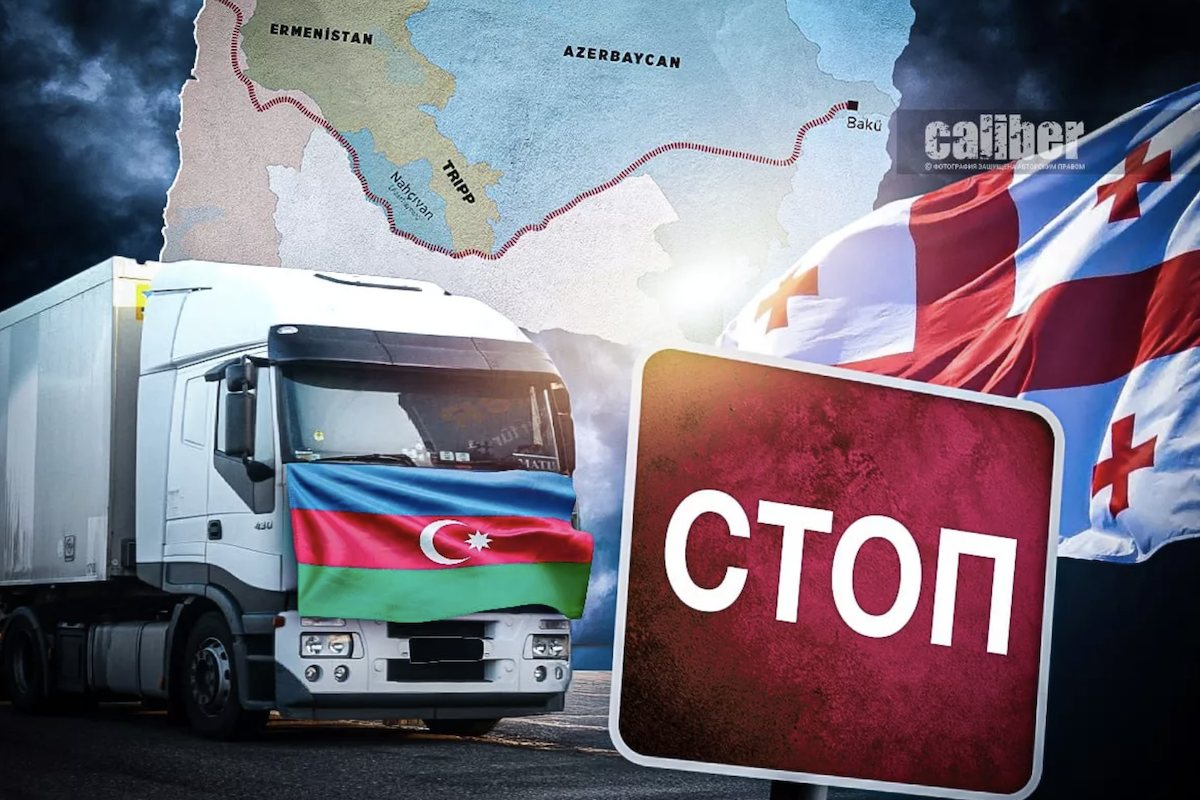
Azerbaijan criticises Georgia
The pro-government Azerbaijani outlet Caliber published an article titled “Georgia Has Heard the Steps of Zangezur.” The piece, written by Samir Veliev, cites accounts from Azerbaijani truck drivers, who say their treatment by Georgian border guards and other officials has sharply worsened in recent times.
According to the author, drivers face rude behaviour and disregard for the law. They are reportedly held at the border for days or even weeks. Some drivers say they were mockingly told: “You’ll go when your Zangezur corridor opens.”
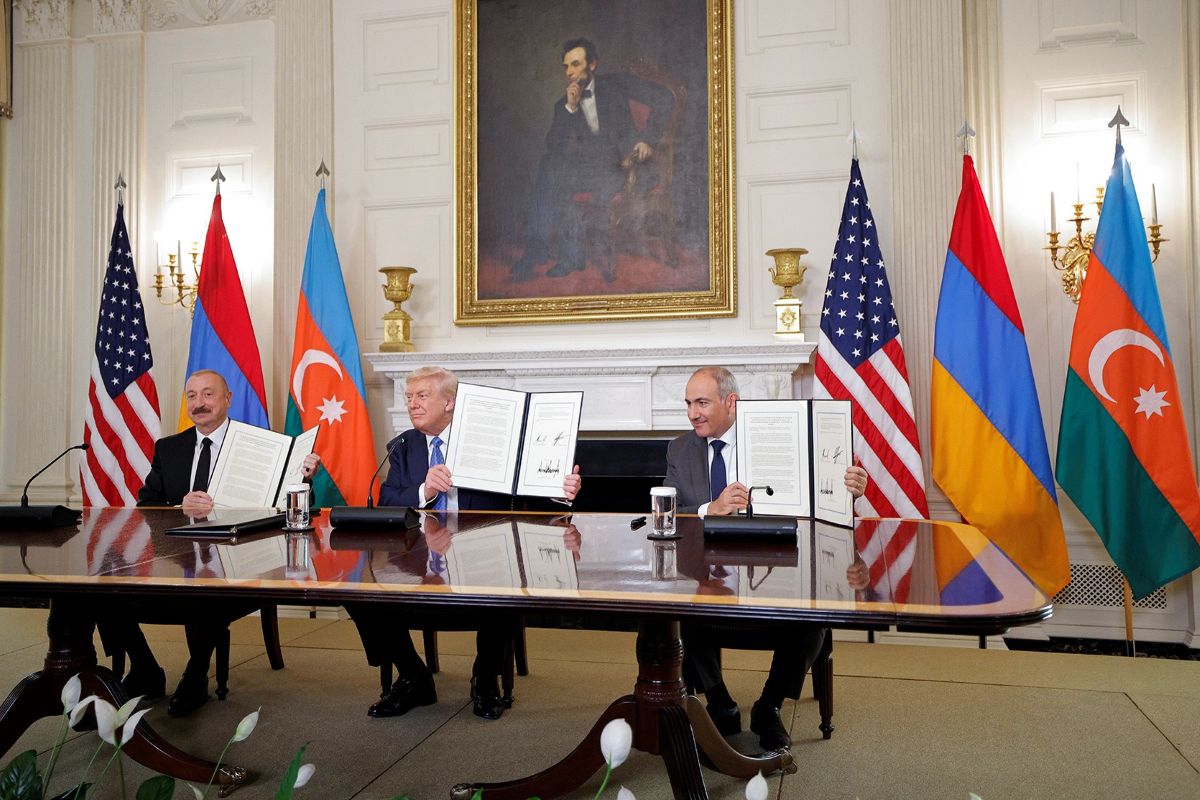
This refers to a proposed transit route intended to connect Azerbaijan with its Nakhchivan exclave through Armenian territory. The project has received active involvement from the United States, is known as the “Trump Route,” and is planned to become part of the international transit Middle Corridor.
The article suggests that the shift in Georgia’s attitude towards Azerbaijan may be linked to the influence of a “northern neighbour” (likely Russia) or “those representing Armenian interests within the Georgian government.”
What the article says
The situation inevitably raises a question: if such episodes happen regularly, there must be a reason beyond simple organisational chaos.
Initially, individual trucks were held up, then groups, and eventually entire batches. Drivers were unable to move and could not understand why a route that had functioned smoothly for years had turned into a zone of uncertainty, marked by continuous barriers.
Moreover, there were no official or even reasonable explanations — only hints, ironic smiles, and comments tinged with irritation.
Azerbaijani drivers were told: “You’ll go through Zangezur when your Zangezur corridor is ready.” These words were not spoken as a joke but as poorly veiled annoyance.
Here lies the first and likely the main reason behind what is happening.
In Tbilisi, it is clear that the region’s logistical reality is changing, and the Zangezur route is no longer a distant prospect. It is actively being built, becoming part of new infrastructure that will inevitably alter the existing balance.
After decades of Georgia’s monopoly over regional logistics, even the possibility of an alternative route is felt acutely in Tbilisi.
The paradox is that the Zangezur corridor could strengthen the economies of all countries in the region, including Georgia itself. It expands the network rather than replacing it. Yet this logic does not always prevail, and where calculations should dominate, emotional jealousy sometimes takes over.
This factor becomes particularly evident when Georgian officials tell drivers to “go through Zangezur,” ask about its opening, and do so in a tone far from neutral or professional.
There also appears to be another layer of reasons:
Georgia has always had figures connected to the Armenian community — by origin, biography, or political sympathies.
They do not determine the country’s overall course, but they are present in the system sufficiently to influence sensitive areas, including attitudes toward Azerbaijan. This is particularly the case now, as developments in Armenia itself are causing discontent among some Armenian circles outside the country.
For them, a rising Azerbaijan is an unwelcome reality, and any developments beyond familiar patterns provoke irritation.
Within the Georgian bureaucracy, such attitudes may not manifest as direct decisions but rather through the creation of conditions that appear purely technical.
There is also a third motive increasingly mentioned by experts.
Georgia’s relations with its northern neighbour (Russia — JAMnews) in recent years have evolved in such a way that Moscow’s influence could be reflected in certain practical decisions.
Analysts suggest that irritation may have been caused by the fact that agreements on the Zangezur corridor were reached in Washington, and that the project is advancing without the involvement of those accustomed to treating such processes as within their sphere of control.
Against this backdrop, it is conceivable that specific groups oriented toward the interests of one northern country might exploit any convenient pretext to create obstacles for Azerbaijani drivers passing through Georgia.
This is not a definitive claim or conclusion, but such a scenario is increasingly cited by experts closely monitoring regional dynamics. In the current political configuration, even a slight hint of such influence no longer seems abstract.

Amid all these developments, Azerbaijan’s stance has remained calm and consistent. For many years, Georgia has been regarded — and continues to be regarded — by Baku as a partner with whom relations are built on trust, mutual assistance, and openness. Azerbaijan has never refused support to Georgia, including during particularly difficult periods.
For this reason, the current situation involving Azerbaijani truck drivers has naturally caused confusion and concern in Azerbaijani society.
A country benefiting from stable cooperation is expected to show at least minimal respect for the rights of Azerbaijani citizens who are carrying out their work and supporting trade flows that benefit not only Azerbaijan but Georgia as well.
Azerbaijan’s position remains unchanged. The country equally remembers both acts of goodwill and instances of injustice. Injustice against the country and its citizens never goes unanswered.
This has been repeatedly demonstrated in various situations — whether the AZAL plane tragedy, the killings of Azerbaijanis in Yekaterinburg, or decisions by the Biden administration that Baku reasonably considered unfair. In all these cases — and many others — Azerbaijan’s response has been consistent and unequivocal.
Against this backdrop, creating artificial obstacles for Azerbaijani truck drivers cannot be seen as an isolated incident.
The region is entering a phase where old transit patterns are no longer guaranteed, and the Zangezur route is shifting from a political debate into emerging infrastructure.
Georgia’s long-standing transit monopoly is no longer unquestioned. Azerbaijan is strengthening its role as both a military and economic hub in the South Caucasus.
Any actions that undermine confidence in the Georgian route primarily harm Georgia itself, which for many years relied on transit as a strategic advantage.
Azerbaijan, meanwhile, makes it clear that the dignity of its citizens and the security of their rights are not subjects for compromise.
At such moments, another factor must also be considered.
A large Azerbaijani community lives in Georgia, for whom relations between the two countries are not abstract diplomacy but part of everyday life. Any sign of injustice or disrespect is felt particularly sharply by this community.
For Baku, attention to these concerns has always been a serious priority, and this approach remains consistent. Azerbaijan has never left its citizens and compatriots without support — regardless of where they live.
This is neither a warning nor a hint. It is part of the political reality that everyone involved in these developments will have to acknowledge.
Azerbaijan criticises Georgia