Day: September 18, 2025
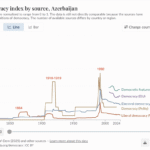
New data published by the Our World in Data platform reflects the complex historical trajectory of the democracy index in Azerbaijan over the past two centuries.

According to the information, notable increases in the country’s democracy indicators have primarily been linked to key historical turning points. In particular, a significant rise in democratic indicators was observed during the establishment of the Azerbaijan Democratic Republic in 1918–1919. However, this phase was short-lived, and following the collapse of the republic, the index quickly declined.
Another significant increase occurred in 1992, during the early years of independence. This period was characterized by a certain level of political pluralism and functioning electoral institutions. However, in the subsequent years, the democratic indicators showed a downward trend and have continued to remain at a consistently low level.
The current data is based on assessments from various sources, including V-Dem (Varieties of Democracy), Polity (Polity V), EIU (The Economist Intelligence Unit), and BTI (Bertelsmann Transformation Index). Nevertheless, all indicators show that Azerbaijan faces limitations in terms of democratic governance. In particular, the “liberal democracy” index remains at a very low level.
Experts believe that this dynamic is closely linked to Azerbaijan’s political history, institutional development, and the geopolitical realities of the region. For the sustainable development of democracy, increasing the transparency of electoral processes, expanding opportunities for political participation, and ensuring the rule of law are cited as key objectives.
The post Democracy index in Azerbaijan: Historical fluctuations and the current situation appeared first on MEYDAN.TV.

Categories
Simply South
Georgia’s real gross domestic product (GDP) increased by 7.3% year-over-year in the second quarter of 2025, reaching GEL 25.3 billion, preliminary data from the National Statistics Office (Geostat) shows.
The information and communication sector recorded the highest growth rate at 37.1%, education (28.9%), arts, entertainment, and recreation (16%), human health and social work activities (14.3%), and financial and insurance activities (11.8%). Public administration and defense, as well as compulsory social security, rose by 9.1%, while accommodation and food service activities grew by 8.4%.
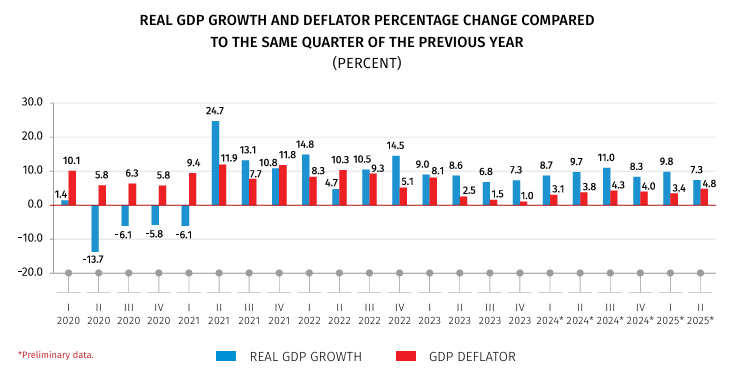
Several sectors experienced declines, with electricity, gas, steam, and air conditioning supply dropping by 7%, construction by 2.6%, and agriculture, forestry, and fishing by 2.5%.
Geostat will publish the revised data on November 14, 2025.
Also Read:
- 16/09/2025 – One Person Detained Over Alleged Scheme of Laundering up to $700 Million
- 19/06/2025 – Georgia’s GDP Up by 9.8% in Q1’25
- 21/03/2025 – Georgia’s GDP Up by 8.3% in Q4’24
- 19/12/2024 – Georgia’s GDP Up by 11% in Q3’24
- 18/09/2024 – Georgia’s GDP Up by 9.6% in Q2’24
- 19/06/2024 – Georgia’s GDP Up by 8.4% in Q1’24