
Day: September 3, 2025

https://t.co/2pVtu6mSfW
Peace Killed the Profiteers of the Conflict #PeaceProcess #MinskGroup #SouthCaucasus #Azerbaijan #Armenia #InternationalPolitics— Today.Az (@TodayAz97) September 3, 2025
Georgia’s annual inflation rate stood at 4.6% in August, while consumer prices increased by 0.3% from the previous month, the National Statistics Office (Geostat) said on September 3.
Geostat reported that the annual inflation rate was primarily driven by price changes in food and non-alcoholic beverages (a 10% increase), health (a 9.3% increase), and alcoholic beverages and tobacco (a 4.7% increase). Transport costs decreased by 2.4%.
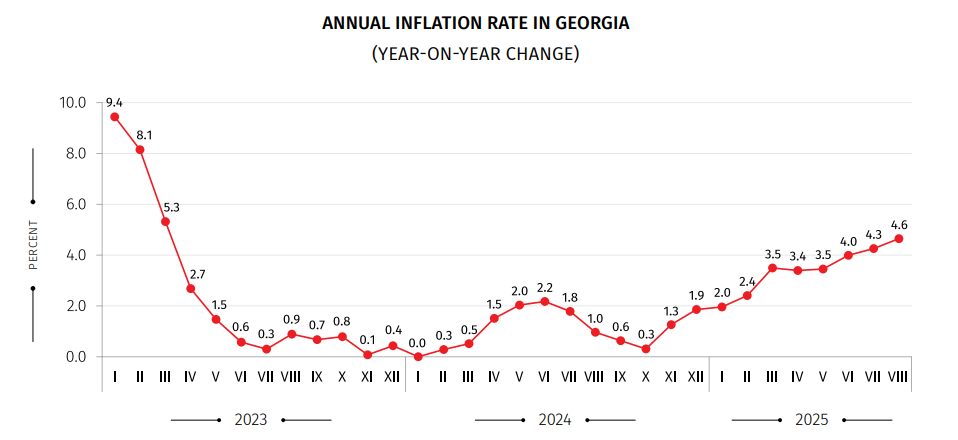
Monthly price changes were led by transport (up 1.3%), alcoholic beverages and tobacco (up 0.7%), and food and non-alcoholic beverages (up 0.1%). Clothing and footwear prices fell 2%.
Within the food and non-alcoholic beverages, the prices increased for the following subgroups: fruit and grapes (4.3%), milk, cheese and eggs (3.1%), fish (1.7%), coffee, tea and cocoa (0.8%), bread and cereals (0.7%) and sugar, jam, honey, chocolate and confectionery (0.2%). Prices declined for vegetables, down 10.6%, and oils and fats, down 0.6%.
Also Read:
- 29/08/2025 – Georgia’s GDP Up by 6.5% in July 2025
- 20/08/2025 – Georgia’s Foreign Trade Up 10.3% in January-July 2025
- 04/08/2025 – Georgia’s Annual Inflation at 4.3% in July 2025
- 30/07/2025 – NBG Keeps Key Refinancing Rate Unchanged at 8%
- 03/07/2025 – Georgia’s Annual Inflation at 4.0% in June 2025
In August 2025, the Russian state and pro-Kremlin media actively promoted the image of the country as a stable and independent center of power amid external pressure and global instability. The focus shifted from simply describing threats to demonstrating Moscow’s capabilities in the fields of defense, science, and diplomacy. The agenda remained alarmist and militaristic, but there was an increased emphasis on technological and economic development, as well as on the creation and promotion of alternative global alliances, such as the SCO and BRICS, which were positioned as alternatives to the Western model.
Ukraine remained central to the information field. Russian publications emphasized the growth of the internal crisis. This rhetoric reinforced the idea of the failure of the pro-Western course and the inevitability of the collapse of the Ukrainian state, emphasizing Russia’s alleged victory in the cyber sphere (RIA Novosti).
The South Caucasus and Central Asia also featured prominently in August’s rhetoric, especially through the prism of cooperation in transport and logistics corridors. Russia declared its readiness to provide maximum assistance to transit through the East-West and North-South corridors, including infrastructure support and the establishment of uniform tariffs (RIA Novosti). Armenia was presented as a country that had broken its strategic alliance with Russia for the sake of Western integration, which allegedly led to political destabilization and the destruction of national identity (Komsomolskaya Pravda). At the same time, Azerbaijan was portrayed in the context of growing Western and Turkish influence, which creates a sense of pressure on Russia from regional players and motivates Moscow to strengthen its presence and control in these countries.
Technology and defense received a powerful PR boost, with Russian media focusing on the development of laser systems against drones. These systems are already being developed and delivered, with their use expected in the near future (Kommersant, vesti.ru). In addition, a Tsargrad expert reported that a Ukrainian Armed Forces drone was destroyed by a new combat laser in a matter of seconds (Rossiyskaya Gazeta).
Anti-European and anti-American rhetoric continued to dominate the information space. The U.S. was portrayed as an unpredictable player whose actions threaten global stability, and the EU as an alliance that has lost its influence and is dependent on Washington. All international actions by the West were presented as attempts to restrict Russia, including secondary sanctions and interference in regional conflicts. At the same time, Russian propaganda portrayed Moscow as a constructive and responsible actor capable of offering alternative models of cooperation through the SCO and BRICS.
The topic of migration and securing ethnic homogeneity remains a prominent issue in the information field. Although there are no specific references to August yet, it remains a stable element of propaganda.
Domestic discourse reinforced the idea of mobilization and discipline. The media emphasized the need to combat “information sabotage,” tighten control, and suppress doubts in the interests of sovereignty. At the same time, reports of a new mobilization in August were not confirmed (Lenta.ru).
Economic independence and infrastructure development were highlighted through real-life examples: Putin announced plans to upgrade transport infrastructure, including increasing the capacity of the Trans-Siberian Railway, the BAM, and ports (RIA Novosti).
The structure of the propaganda campaign remained consistent: an external enemy, betrayal by allies, internal vulnerability, and Russia as the only entity capable of acting consciously and effectively. The central slogan was one of mobilization and loyalty, where resistance was seen as betrayal and submission as a form of patriotism. Russian propaganda in August demonstrated a high degree of adaptability and synchrony, consistently reinforcing the image of the country as a strategically independent, technologically advanced, and politically potent entity on the international stage.
Categories
Moscow Calling – September 3
Putin praises North Korean soldiers for participating in battles for the Kursk region
During talks in Beijing, Vladimir Putin stated that North Korean special forces took part in liberating the Kursk region from the Ukrainian Armed Forces on the personal initiative of the country’s leader, Kim Jong-un. The Russian leader emphasized that the North Korean military acted in accordance with the Treaty on Comprehensive Strategic Partnership and showed “courage and heroism.” In response, Kim Jong-un thanked Putin for his high assessment and noted that Russia’s assistance is a “brotherly duty” for Pyongyang. According to the DPRK’s Minister of State Affairs, Pyongyang is ready to continue providing comprehensive support to Moscow. The Kremlin and the General Staff emphasized the significance of the North Korean military’s contribution to repelling the Ukrainian Armed Forces’ offensive on the Kursk region, which began in August 2024 and ended in April 2025 (TASS).
Intended effect: The article demonstrates the strengthening of the military alliance between Russia and North Korea, showing their joint actions and mutual commitments to “brotherly” support. It emphasizes that North Korea is prepared to engage in combat operations alongside Russia, reinforcing the notion that Moscow’s circle of allies is expanding and lending international legitimacy to its actions against Ukraine.
Medical tourism in Russia and the shortage of healthcare personnel
The Eastern Economic Forum in Vladivostok hosted a session entitled “Medical Tourism to Russia: A Journey to Health.” Deputy Minister of Health Evgenia Kotova and participants discussed what medical technologies and practices could be offered to foreign patients, as well as the Far East’s potential for developing medical tourism. The questions concerned building trust in the Russian healthcare system and developing a full-cycle service for foreign citizens. At the same time, the Russian Ministry of Health issued an order allowing paramedics and midwives to temporarily perform the duties of district doctors. This decision was motivated by a shortage of doctors, especially in rural and remote areas. Paramedics are allowed to collect medical histories, conduct minimal examinations, and prescribe basic tests and medications, including narcotics and psychotropic drugs, within established standards. According to State Duma deputies, the measure is temporary and aimed at ensuring the availability of medical care during a staffing shortage (TASS, ria.ru).
Intended effect: The combination of medical tourism and expansion of paramedics’ remit reveals a contradiction: Russia declares its intention to attract foreign patients and offer them modern medical services, while at the same time demonstrating a shortage of qualified doctors for its own population. Mentioning the temporary replacement of medical functions by mid-level personnel undermines the credibility of statements about the readiness to accept foreign patients. Thus, the narrative about exporting medical services is combined with the official recognition of systemic staffing problems within the country.
RIA: “Coalition of the willing” in disarray ahead of Trump-Zelenskyy meeting in Paris
In her article on RIA Novosti, Russian journalist Viktoria Nikiforova describes the upcoming meeting between Donald Trump and Volodymyr Zelenskyy in Paris as a critical moment for the so-called “Coalition of the Willing.” She compares European leaders to the characters in the comedy “Kidnapping, Caucasian Style”: France is portrayed as formidable, Britain as helpless, and Germany as hysterical. According to the article, Europe finds itself in a contradictory situation: it promises support to Kyiv. Still, it is forced to explain itself to its own voters, who do not want to be drawn into a war with Russia. The author notes the internal conflicts between Ursula von der Leyen and the German defense minister, as well as Trump’s skepticism about U.S. involvement, and the categorical rejection of military intervention by Hungary and Slovakia. Nikiforova argues that the West’s plans were initially based on the use of American troops, as European societies would not accept sending their soldiers to Ukraine. The article also emphasizes that the EU’s true goal was to destabilize Russia; however, these efforts ultimately led to a crisis within the European countries themselves (ria.ru).
Intended effect: The article paints a picture of a fragmented and helpless European coalition, highlighting internal contradictions and declining trust in its leaders. Meanwhile, it portrays Trump as a politician who can resist pressure from allies and avoid U.S. involvement in a “foreign” war. The result is a narrative in which the West suffers defeat, while Russia retains its strategic advantage by acting as a power interested in preventing global war.