
Month: August 2025
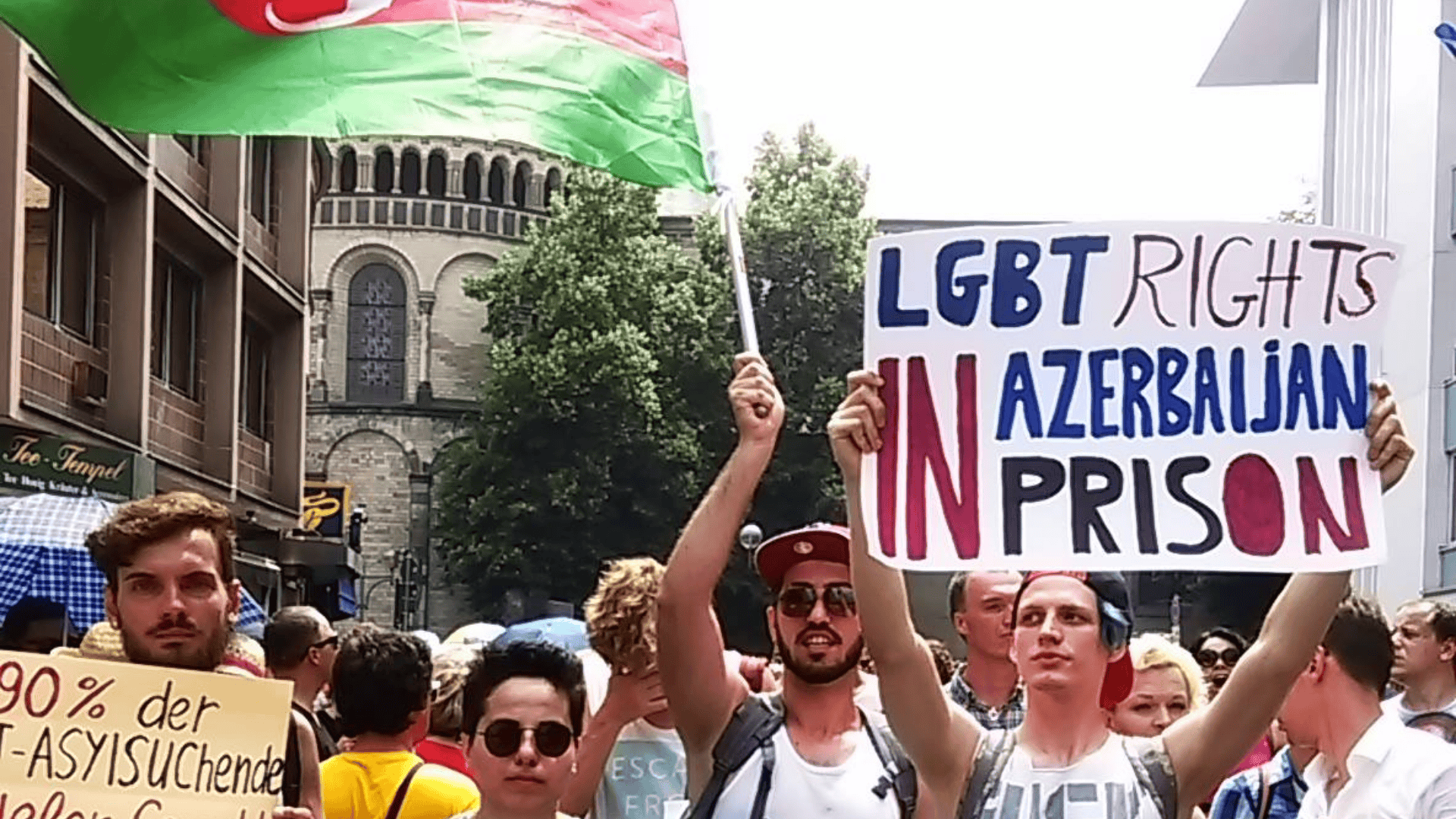
LGBTQ+ rights in Azerbaijan
Legal and social protections for LGBTQ+ people in Azerbaijan are severely limited. While same-sex relationships are not criminalised, there are no laws that specifically protect their rights.
This becomes especially clear in the prison system. International reports, available documentation, and personal accounts all show that LGBTQ+ individuals are subjected to significantly higher levels of physical, psychological, and institutional abuse while in custody.
Social isolation and violence in prisons
There are no official statistics on LGBTQ+ prisoners in Azerbaijan, as the government does not systematically collect or publish such data. However, reports from human rights organisations help to partially fill this gap.
According to interviews and reports by these organisations, trans women and gay men in prison are placed in separate cells and frequently subjected to violence — both from other inmates and from prison staff. Their gender and sexual identity often marks them as a “lower caste,” leaving them vulnerable to exploitation and degrading treatment.
In some cases, prison administrations have used sexual contact between trans inmates and men as a form of punishment. These individuals are officially isolated “for their own protection,” but in reality, they are often exploited behind closed doors.
In interviews, several trans women said prison staff had “sold” them to other inmates for money.
Although such testimony cannot be directly verified, multiple parallel accounts point to systemic violence.
An article on OC Media, based on interviews with LGBTQ+ prisoners, reports that trans women are held in men’s prisons and consistently subjected to abuse.
One trans woman, Zinat, interviewed by OC Media, said:
“When I first entered prison, they spoke to me in a humiliating way and threatened to shave my head.”
In another source, Nina, a trans woman, said:
“They wouldn’t let me into the common area, saying it was because I’m a woman — yet at the same time, they ‘sold’ me to other inmates.”
These accounts suggest that sexual exploitation within Azerbaijan’s prison system is structural.
A 2017 Human Rights Watch report titled Azerbaijan: Anti‑Gay Crackdown documented widespread torture and blackmail of detained gay men, bisexual men, and trans women. HRW noted that police were using electric shocks and beatings to extort bribes and gather names of other LGBTQ+ people. The report underscores the deliberate and brutal tactics used in the campaign.
The report states that 83 people were detained that year, many of whom were sentenced to administrative detention ranging from 5 to 30 days on fabricated charges of resisting police or hooliganism.
Human Rights Watch stated:
“Although the official charges were justified in the name of public health and morality, these measures amount to a flagrant violation of human rights.”
Legal gaps and barriers to legal assistance
In Azerbaijan, discrimination based on sexual orientation and gender identity is not addressed in the law. The current legal system is built entirely on a binary understanding of gender — male and female — and contains no legal protections for trans or non-binary people.
- While the Labour Code prohibits discrimination based on sex, religion, and race, it includes no provisions related to sexual orientation or gender identity.
- The Criminal Code recognises hate crimes only in the context of ethnicity and religion; violence based on sexual orientation or gender identity is not acknowledged.
- The Penal Enforcement Code also lacks any specific protections for LGBTQ+ prisoners, increasing the risk of them being placed in male prisons and subjected to abuse.
During the mass arrests of September 2017, LGBTQ+ people were mostly detained under administrative charges such as “minor hooliganism” and “disobeying a lawful police order.” Lawyers reported that court hearings lasted just 10 to 15 minutes, and many detainees were denied the right to legal counsel.
Response from the UN and other international organisations
In a statement issued on 13 October 2017, the United Nations noted that “more than 80 people were detained in police raids targeting gay men and trans women, which began in September 2017 in Baku. Many were subjected to torture and forced medical examinations.”
The statement also emphasised: “International human rights law is clear: no one may be arrested for their sexual orientation or gender identity.”
Following the 2017 events, relevant UN special rapporteurs and Human Rights Watch accused the Azerbaijani government of violating international legal standards.
UN experts stated that arrest, torture, and forced medical testing based on a person’s actual or perceived sexual orientation constitute a clear breach of the country’s international obligations.
International and regional comparison
Georgian law prohibits discrimination based on sexual orientation and gender identity. However, a package of “family values” laws passed in 2024 has curtailed the rights of trans and non-binary people.
Armenia decriminalised same-sex relations back in 2003, but there is still no legal protection based on SOGI (sexual orientation and gender identity). The Council of Europe has urged the country to implement reforms in this area.
The situation in Eastern Europe remains mixed: while countries like Poland and Hungary have seen a rollback of LGBT rights, others — like Estonia — have made progress.
Azerbaijan ranks last out of 49 countries on the ILGA-Europe Rainbow Index.
Conclusion
Research shows that the prison environment in Azerbaijan is unsafe for LGBTQ+ individuals — both physically and legally. Existing laws offer no specific protections, and the country’s penitentiary system lacks effective oversight and complaint mechanisms.
It is clear that this is a systemic issue, not a matter of isolated incidents.
As a signatory to international human rights conventions, Azerbaijan has an obligation to reform its legislation to ensure the safety and rights of LGBTQ+ inmates. This includes better training for prison staff and the introduction of real accountability mechanisms.
Without such reforms, the treatment of LGBTQ+ people in prisons remains not only a violation of basic justice, but part of a broader pattern of human rights abuse.
A free online version of Texas Holdem Bonus, the casino table game. Test out your Texas Hold’em Bonus Poker strategy here. Practice for the casino. This version also has the optional bonus jackpot bet. Which can pay out up to 1000 to 1 on your bet, if your two hole cards are ace-ace and the dealers hole cards are ace-ace.
Georgian Dream Prime Minister Irakli Kobakhidze reiterated his calls on EU institutions and what he calls the “European bureaucracy” to “talk” with Georgian authorities amid warnings that the EU may suspend Georgia’s visa-free travel if the GD government fails to address eight recommendations outlined in a letter from the Commission, to be fulfilled by the end of August.
Complaining of “zero communication” from Brussels, Kobakhidze said that instead of dialogue, Brussels “sends telegrams” – a practice he described as a “Soviet approach,” adding, “This is how telegrams were once sent from Soviet Moscow to Georgia,” reprising his familiar comparison of the EU to the USSR.
“I wish the European bureaucracy would overcome this Soviet approach. We are open to dialogue because we believe we are absolutely right,” Kobakhidze told journalists on July 31, following Kakha Kaladze’s nomination as Georgian Dream’s pick for a third term as Tbilisi mayor.
Among other issues, the EU Commission’s recommendations to Georgia include repealing laws targeting civil society – the so-called foreign agents law – as well as legislation restricting LGBT rights, officially titled the Law on Family Values and the Protection of Minors.
Pressed by a journalist about the broader recommendation for authorities to ensure and uphold the fundamental rights of Georgians, Kobakhidze first dismissed any connection between that demand and the controversial legislation before lashing out at the “European bureaucracy” over human rights issues, accusing Western ambassadors – including those from the EU and the U.S. – of having “incited violence” during street protests in Tbilisi.
“I want to remind the European bureaucracy of one thing: their ambassador was inciting the violence that we saw in the Tbilisi streets. Former American ambassador was inciting the violence that we witnessed in Tbilisi streets at a certain time. When this is the context, their talk about a law enforcer assaulting protesters is absolutely misplaced. They don’t have the moral right,” Kobakhidze said.
“Someone else might tell us that, our citizens might tell us all this, but European bureaucracy has no right to talk about violence, from any side, when the violence both in spring 2023 and in spring 2024 was incited by them,” he added.
Kobakhidze made the remarks following the nomination of Kakha Kaladze as Georgian Dream’s candidate for a third term as Tbilisi mayor in the upcoming municipal elections, slated for October 4.
The event, held outdoors in Mtatsminda hills in Tbilisi, was marked by the rare public appearance of Georgian Dream founder Bidzina Ivanishvili, though he did not address the crowd.
Kaladze launched the pre-election campaign under the slogan “Peace to Georgia, More Good to Tbilisi,” pledging to lead by the principles of “Tbilisi as responsibility” and “Tbilisi as a city of opportunities.”
Also Read:
- 24/07/2025 – Anna Dolidze Says Her For People Party Won’t Run in Local Elections
- 22/07/2025 – Kobakhidze Downplays Concerns Over EU Visa-Free Suspension as Mere Fear of “Visa Lines”
- 18/07/2025 – Kobakhidze Says ‘Global War Party’ Uses EU Visa Threat to Open Second Front in Georgia
- 17/07/2025 – Kobakhidze Says Visa-Free Travel “Not Existential” as Brussels Warns of Suspension