On August 27, Georgian Dream Economy Minister Mariam Kvirivishvili met with U.S. Envoy Alan Purcell. Purcell is the chargé d’affaires who has served as acting U.S. ambassador in Georgia since Robin Dunnigan retired from diplomatic service and left the country in July.
“Charge Purcell met with Minister of Economy and Sustainable Development Kvrivishvili on Wednesday to discuss the economic ties between our countries and the investment climate in Georgia for American companies,” the U.S. Embassy said in a brief statement, without providing further details.
Charge Purcell met with Minister of Economy and Sustainable Development Kvrivishvili on Wednesday to discuss the economic ties between our countries and the investment climate in Georgia for American companies.
The Ministry of Economy of Georgia shared more details about the meeting in its press release.
According to the Ministry, the sides at the meeting discussed “priority areas in Georgia-U.S. relations.”
“The attention was drawn to the importance of the bilateral strategic partnership,” the ministry said. “It was noted that the Georgian side is interested in resetting relations with the United States and restoring strategic cooperation,” the ministry added.
The United States suspended its strategic partnership with Georgia on November 30, 2024, after Georgian Dream abandoned EU integration efforts and responded to protests with brutal force.
“The minister highlighted the importance of President Trump’s peace initiatives, including the peace deal between Armenia and Azerbaijan, which has created new opportunities for development in the South Caucasus,” the press release said, adding Kvirivishvili’s note that “the achieved result is important for maintaining peace and security in the region, which is the Georgian government’s policy priority.”
According to the Economy Ministry, the sides discussed a “wide spectrum of economic cooperation,” including trade, investment, and transport.
“From both sides, attention was drawn to the importance of developing the Middle Corridor,” the press release said, adding that Georgia’s role as a “key player in regional transport projects” was emphasized.
“It was also noted that trade turnover between the countries is growing, reaching USD 1.6 billion in the January–July period.”
U.S.-Georgia Relations
Georgian Dream officials continue to lament what they call “absolute silence” from Washington. A day after the meeting, GD representatives commented on Russian media claims that former USAID chief Samantha Power had “admitted” financing efforts to support Moldova’s pro-Western government.
GD MP Levan Machavariani said the ruling party was “surprised by the silence of the U.S. administration toward Georgia … when we agree on absolutely everything, when in this and other areas we were, and remain, Mr. Trump’s supporters.” Machavariani and fellow MP Gia Volski also linked the USAID claims to an ongoing probe into Georgian NGOs.
With U.S.-Georgia relations at a low point, Tbilisi has declared its intention to reset ties with Washington “from a clear slate” and resume the strategic partnership “with a specific roadmap.”
In May, U.S. Secretary of State Marco Rubio told lawmakers the Trump administration was reviewing relations with Georgia, saying the U.S. would consider whether it is “in our national interest to have an anti-American government governing an important part of the world.”
The U.S. MEGOBARI Act, which passed the House of Representatives in May with strong bipartisan support and awaits Senate consideration, envisions wider sanctions on Georgian Dream officials in response to Georgia’s deteriorating democratic situation and what it says is the ruling party’s rapprochement with Russia, China, and Iran.
In today’s rapidly shifting global energy landscape, one of the most significant success stories is being written by the deep-rooted partnership between Türkiye and Azerbaijan. The STAR Refinery, an investment of Azerbaijan’s State Oil Company (SOCAR) in Türkiye, stands as a shining example of how brotherhood and strategic vision can turn into tangible economic strength. Recent figures reveal that during the first six months of 2025, STAR produced nearly 838,224 tons of jet fuel, marking a remarkable 54.8 percent increase compared to the same period last year.
A complete AristoCraft collection is housed in a museum-type setting, displaying one of every model boat produced, including some rare, one of a kind, boats. All production records, brochures, literature, and manufacturer’s photographs are available for research.
About two months ago, a high-profile arrest shook Armenia’s diplomatic corps, though officials sought to keep the matter out of the public eye, Azernews reports via Hraparak.
The pro–Georgian Dream TV channel Imedi reported on transactions of civil society organizations whose bank accounts were recently frozen in a “sabotage” probe, portraying as a scandal what appeared to be modest purchases of protective equipment, such as medical masks, goggles, and first aid items, during the November–December 2024 protests.
For example, Imedi said Georgia’s Democratic Initiative, one of the affected CSOs, spent GEL 3,200 (about USD 1,200) on goggles, raincoats, and masks, while the Social Justice Center’s spending “exceeded GEL 2,000” (about USD 750) on goggles, first-aid items, and pepper spray.
It added that the Civil Society Foundation paid “more than GEL 1,200” (about USD 450) for gear, and Democracy Defenders spent “about GEL 500” on medical masks. “The Institute for Development of Freedom of Information, too, buys facemasks,” the journalist said in the report, which presented procurement documents Imedi claimed to have “exclusively obtained.”
In a separate report, TV Imedi also reported 18 respirators and 20 goggles purchased for more than GEL 1,200 (USD 450) by the International Society for Fair Elections and Democracy (ISFED) in May 2024, during the spring protests against the reintroduction of the Foreign Agents Law. The report aired what looked like purchase documents, and noted that the CSO head, Levan Natroshvili, “had to confirm” and admit the purchase following the account freeze.
Imedi said the mentioned reports are “part of the evidence” in the prosecution’s case files of the ongoing “sabotage” probe, under which the Prosecutor’s Office said on August 27 it requested to freeze bank accounts of seven CSOs, claiming their funds were used to equip protesters “who committed violent acts against law enforcement” during rallies.
The Office cited spending on items such as special gas helmets, protective goggles, medical masks, face-covering masks, and pepper spray. The prosecutors further pointed out that the organizational expenses were used on “financial patronage” of those ” involved in violent acts” and their family members, including by “paying fines, covering legal defense costs, and addressing other personal and organizational matters.”
The investigation is proceeding under several criminal charges, including “sabotage, attempted sabotage under aggravated circumstances, assisting a foreign organization or an organization under foreign influence in hostile activities, and financing actions against Georgia’s constitutional order and national security.” The charges carry harsh penalties ranging from seven years to life in prison.
“They are trumping up a sabotage case and couldn’t find anything except ethanol and bandages, because there isn’t any,” Lina Ghbinianidze, ex-head of the Social Justice Center, commented on Facebook on Imedi’s piece. “That ethanol and bandage, too, are needed to work in the field, and that’s called protecting the work safety of employees, not sabotage.”
“So, according to you, I had to ‘admit’ to buying 18 respirators and 20 goggles?” Levan Natroshvili of ISFED said in a Facebook post in reaction to TV Imedi’s report. “What is there to admit? Is that a crime, and must I be punished with life in prison?”
It appears to be the “sabotage” probe launched in February following a request by United Neutral Georgia, a hardline group aligned with Georgian Dream. In March, authorities froze solidarity funds that had supported protesters by covering fines for road blockages, and in April, investigators searched the homes of several fund managers. Ex-Prime Minister Giorgi Gakharia is also facing an investigation under possibly the same “sabotage” probe over his 2019 decision to erect a checkpoint near the Tskhinvali occupational line.
The freezing of CSOs’ bank accounts follows separate inspection requests by the Anti-Corruption Bureau in August targeting several of the groups under Georgian Dream’s Foreign Agents Registration Act (FARA), and another series of inspections against largely the same groups under three different laws in June.
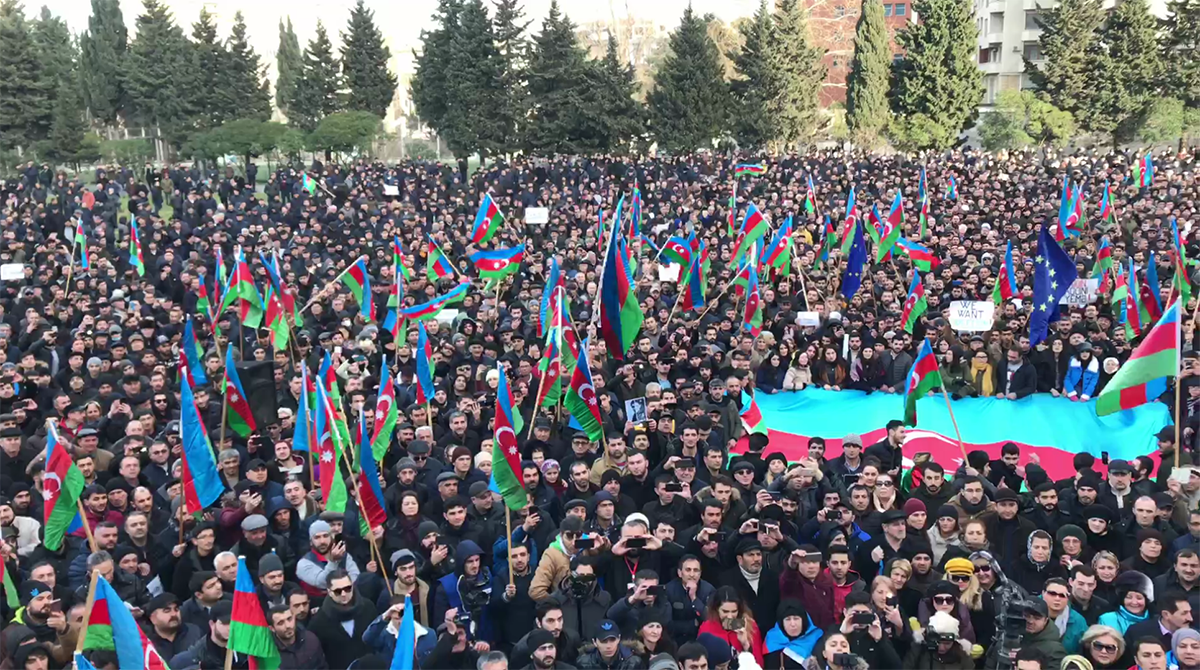
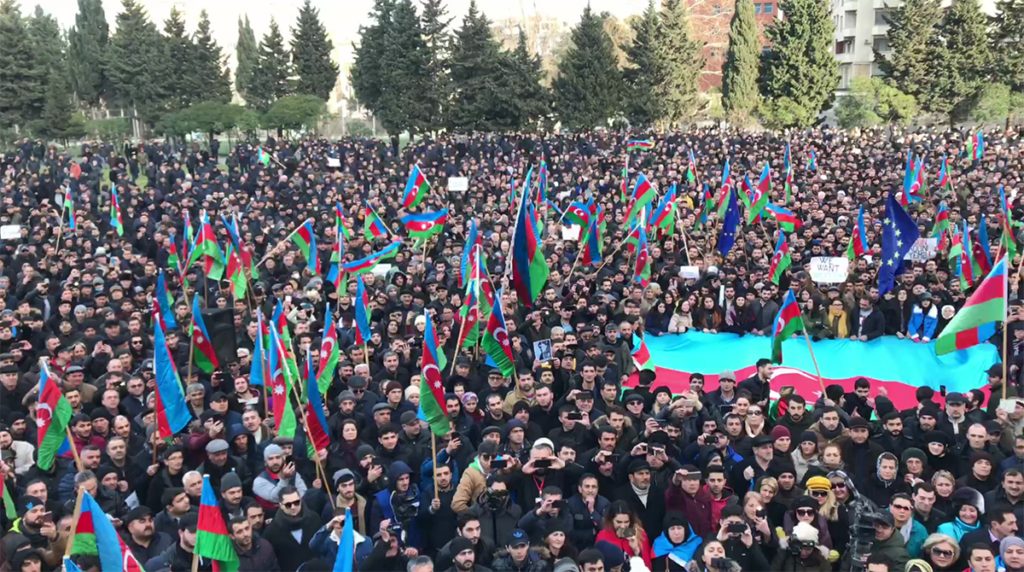
In recent years, the picture of political protests — and protests in general — in Azerbaijan has changed dramatically. The last major rally took place at the Mehsul Stadium (part of the Yasamal Sports and Wellness Complex) in January 2019. Since then, for six years, the country has not seen a single large-scale protest.
This is no coincidence: political leaders, lawyers and civil society representatives say it reflects both changes in legal mechanisms and the government’s long-term political strategy. Their views, together with international legal standards and the key events that have unfolded in Azerbaijan in recent years, are presented in this article by JAMnews partner Meydan TV.
The January 2019 rally: a point of no return
Ali Karimli, chair of the Azerbaijan Popular Front Party (APFP), has long been at the forefront of political protests in the country. He has organised more than a hundred rallies, marches, pickets and other actions against the authorities.
Here is how he recalls the last rally at Mehsul Stadium in January 2019, where demonstrators demanded the release of political prisoners:
January 2019 rally. Photo: Meydan TV
“At that time, a second criminal case was opened against Mehman Huseynov [a well-known Azerbaijani blogger]. Our rally was held to demand his release and the release of all other political prisoners. When the rally grew large, the Azerbaijani authorities panicked and closed Mehsul Stadium without offering any alternative venues. That was how even the minimal freedom of assembly was eliminated in Azerbaijan.”
This rally became one of the largest in Azerbaijan in recent years. By different estimates, around 30,000 people gathered. Its success was largely linked to the popularity of blogger Mehman Huseynov, whose release the protesters were demanding. According to Ali Karimli, every application to hold a rally since then has been rejected.
The key difference between the January rally and earlier ones was that mass administrative arrests and police summons took place not only before but also after the protest. The country’s main mobile operators handed police data on people who were in the area. As a result, participants — and even passersby — were summoned to local police stations for “preventive talks.”
No more Mehsul The traditional protest site, Mehsul Stadium (its name means “harvest”), was closed for renovation. Baku does have other designated places for rallies and marches. However, whenever the opposition applies to hold events in the city centre — for instance, in the squares near the “28 May” or “Narimanov” metro stations, both usually crowded — Baku city authorities always respond the same way:
“Due to heavy pedestrian and traffic flows, holding gatherings in these areas would cause congestion and infringe on citizens’ right to free movement.”
Instead, they are offered the stadium in Lokbatan, a settlement 24 km from Baku.
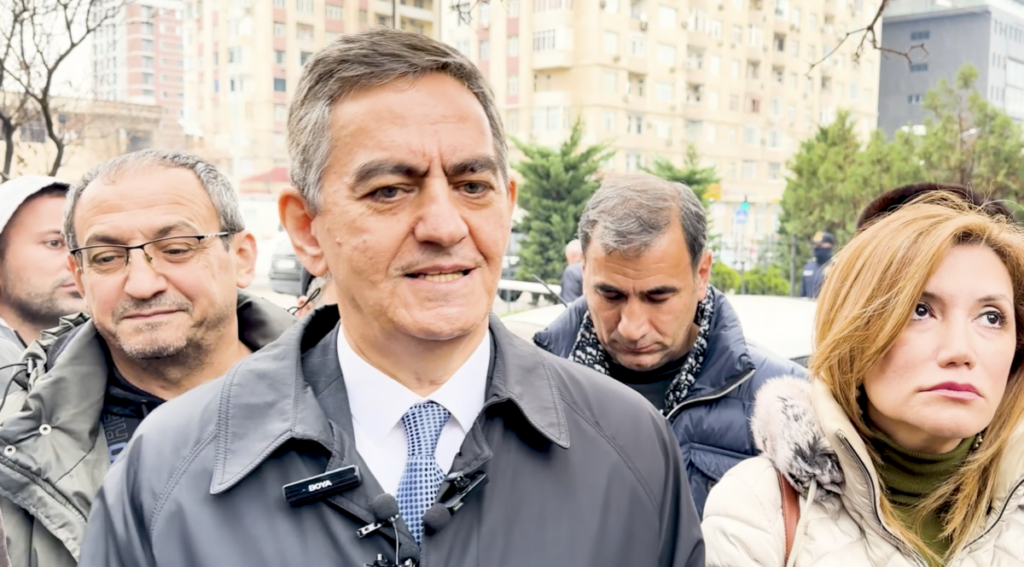
Ali Karimli reflects on the past six years, during which rallies have been effectively banned:
Photo: Meydan TV
“Over these six years, hundreds of people have been arrested: opposition activists, civil society figures, journalists. Almost all independent journalists have ended up behind bars. The same has happened to NGO activists. An atmosphere of fear has been created in society. Freedom of assembly is completely banned. For five of these six years I have lived under an internet blockade.”
The APFP and the National Council of Democratic Forces (the main opposition alliance) last applied to hold a rally on 18 April this year. Once again, the opposition demanded the release of political prisoners, measures to fight poverty and the introduction of child benefits. Baku city authorities rejected the request, citing the same reasons as before.
The opposition leader explains why the authorities refuse to allow rallies:
“They fear peaceful protests because they know the people are dissatisfied. Yes, they have managed to weaken the opposition. The opposition is not made of stone or iron. Repression, restrictions, lack of funding — under such conditions, of course, the ranks of the opposition thin out. But the people move into invisible opposition. They are destroying formal political institutions, but in return they are getting an invisible opposition that is becoming even stronger.”
Post-war changes: tightening control Araz Aliyev, co-founder of the “III Republic” Platform and a political activist, believes that the starting point for changes in Azerbaijan’s political system was the 44-day war of 2020, which restored the country’s territorial integrity. In his view, against the backdrop of regained sovereignty, the situation with human rights and democracy — including freedom of assembly — has only worsened:
Photo from the personal archive of Araz Aliyev
“If we look at the past five years, protest activity has almost disappeared. Before the war and in the first post-war years, there were many demonstrations in Azerbaijan involving the opposition and civil society. People could gather at Fountain Square and other places to express their dissent.
But after the war, the situation changed. Global factors also played a role: Russia’s war in Ukraine, the possible impact of external developments, like Trump returning to power. As a result, the protest environment in Azerbaijan today is almost completely suppressed. If before you could go out with a poster or a sticker, now that will almost certainly lead to arrest.”
Changes in the legal environment: from notification to permission
In many democratic countries, holding a rally does not require permission from the executive authorities. Azerbaijan’s 1998 Law on Freedom of Assembly also required only that the authorities be notified of rallies, actions, pickets, marches and demonstrations. The purpose of notification was to ensure the safety of participants and prevent clashes.
However, lawyer Samed Rahimli points out that although freedom of assembly is formally guaranteed by the Constitution, changes in legislation have in practice restricted this right:
“Initially the law was fairly general and did not contradict the Constitution. But over time it was tightened through numerous amendments. In 2005, after long debates over whether permission was needed or notification was enough, the Constitutional Court ruled that notification actually meant approval. Then came the issue of designated venues — the list was set by Baku city authorities, often in remote, inconvenient areas on the outskirts of the city.
Freedom of assembly is not just about like-minded people gathering but about attracting wider public attention, including from those who disagree with you. Yet the authorities systematically refused to allow protests in the city centre, suppressing them not only with arrests but also through changes in law.”
Rahimli points out that in 2011, legislation was amended to toughen penalties for unsanctioned rallies. Fines were raised and participants began receiving up to 30 days’ administrative detention. Conditions under administrative detention were often harsher than in ordinary prisons:
“By the mid-2010s, protest activity had almost stopped because of the tough sanctions. Organisers were charged with ‘minor hooliganism’ or ‘disobeying police’ and faced criminal cases.”
Protests by ordinary citizens
Although opposition parties cannot hold rallies or unauthorised demonstrations, ordinary citizens still take to the streets over issues ranging from the environment to labour exploitation.
One striking example was the protests in Soyudlu village (Gadabay district), where residents opposed the dumping of toxic waste from a gold mine into a local lake. The protest was violently dispersed by police, and later president Ilham Aliyev said the demonstrators behaved wrongly by throwing stones at officers.
Other examples include Baku taxi drivers boycotting work to demand shorter hours and better conditions, and delivery couriers protesting against pay cuts.
One participant in the Soyudlu protest initially complained:
“Let them come and see! Let them stand here for ten minutes — anyone would get dizzy. And what’s happening to our children?”
“They sent journalists who write lies against our state, against our people, against our president. Don’t believe those articles!”
A taxi drivers’ boycott organiser also released a video of repentance after being detained and questioned for several hours:
“We launched the ‘Stay at Home’ protest, but it was a mistake.”
“Trade unions are an arm of the regime”
Labour rights activist Nilufer Mammadrzaeva says intimidation of protesters and empty promises by the authorities are routine in Azerbaijan:
“The cancellation of the taxi drivers’ boycott after promises of help, the suppression of protests in different regions after the case of the underage pregnant girl — all this shows how intolerant the state apparatus is towards mass protests. The authorities use not only force but manipulation — false promises to maintain control.
These promises are usually symbolic. Taxi drivers were also promised something, but the systemic problems remained. In reality, this is a way of neutralising people’s influence. Azerbaijan has no independent trade unions — they’ve become part of the regime and don’t perform their functions. The lack of civil society, the pressure on activists — all this is a sign of authoritarianism.
The suppression of protests, whether boycotts or youth actions, shows how strong state control really is.”
Mammadrzaeva notes that while political rallies are banned, social protests continue. Online campaigns, petitions and hashtags spread widely and remain harder to control. As a result, protests are inevitably shifting to new forms:
“Social media has become the main platform for protest. After news of the underage pregnancy, young people across the country organised a campaign through WhatsApp, Instagram and other platforms. They coordinated, shared tasks — and many joined in. I think digital activism will only grow stronger.”
Politician Araz Aliyev also believes the authorities are uninterested in solving people’s problems, so spontaneous protests will continue:
“Most activists are either in prison, abroad, or silenced by pressure. But that doesn’t mean resistance has disappeared. The problems remain — people want to respond. In 2025, everyone has the internet, and when people see that a 13-year-old girl has been raped and then forced to give birth, they cannot stay silent. In the 21st century, it is very hard to rule people with medieval methods.”
International commitments and reality
Azerbaijan is a signatory to the European Convention on Human Rights (Article 11) and OSCE documents guaranteeing freedom of assembly. Yet, as Freedom House noted in its 29 February 2024 report Freedom in the World: The Growing Damage of Illegitimate Elections and Armed Conflict, and Amnesty International stated on 23 January 2025, in Azerbaijan this right is “systematically and continuously violated.”
The shrinking space for freedom of assembly in Azerbaijan calls into question not only the future of this right but of the country’s political culture as a whole.
Germany has told its nationals to leave Iran and refrain from travelling there to avoid getting caught in retaliatory acts by Tehran over Germany’s role in triggering UN sanctions on Iran over its nuclear programme, Azernews reports via Reuters.