Categories
South Caucasus News

Yerevan commuters now fined for fare evasion – even those who paid


Yerevan transport fare evasion fine

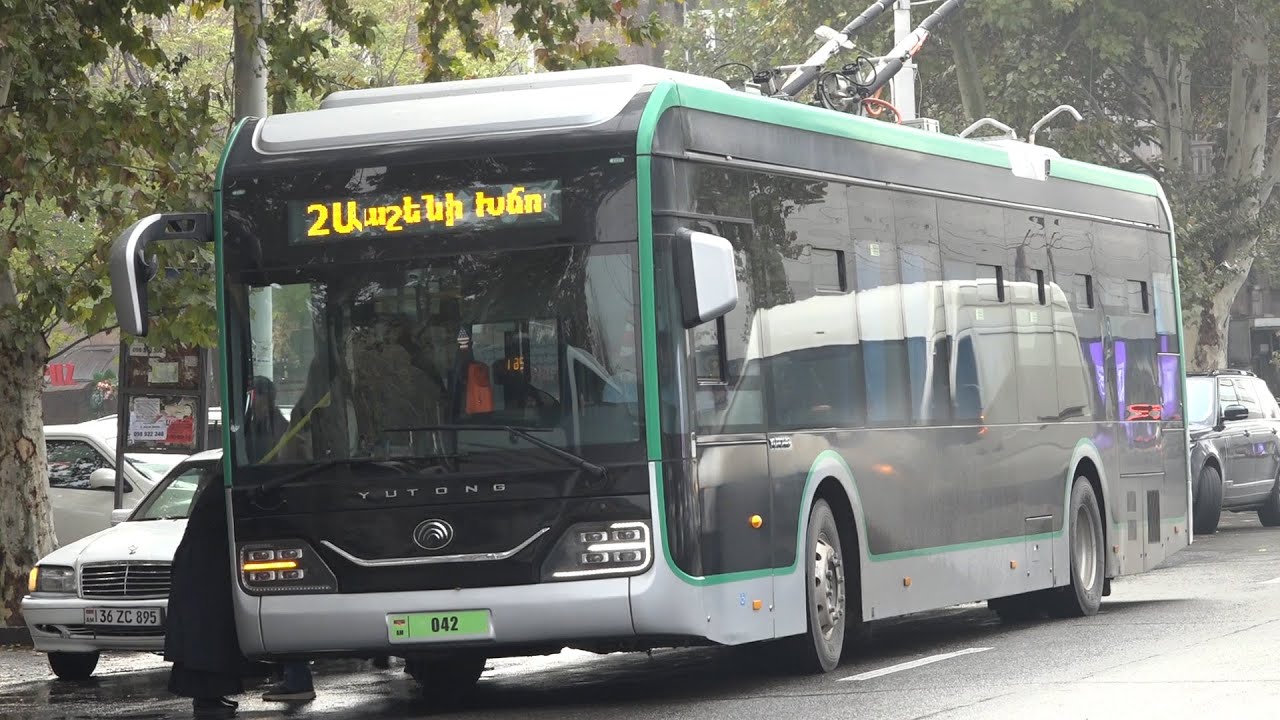
In Armenia’s capital, 252 passengers have already been fined for failing to pay for public transport. According to Yerevan city hall, 145 people were penalised for not paying their fare, 34 for using a concession card issued to someone else, and 73 for paying only after inspectors caught them travelling without a ticket.

Ticket checks on buses and minibuses began on 5 August and are being carried out by 47 inspectors from the city’s public order service.

Reactions among Yerevan residents are mixed. Some see inspections and fines as necessary, while others are unhappy about the introduction of controls on public transport. City hall insists the aim is to ensure people pay for the service they use and “travel legally around the city.”

Those who travel without paying face a fine of 10,000 drams ($26). Using a concession card belonging to another person carries a fine of 15,000 drams ($39). Passengers who pay their fare only after being caught by inspectors are fined 3,000 drams ($7.80).


Yerevan mayor speaks with passengers

The capital’s mayor, Tigran Avinyan, spent time today talking with commuters on public transport. He later posted a video on his Facebook page answering their questions. Passengers asked about planned measures to improve the transport system, discussed payment methods and raised issues over the current discount scheme for concession groups.

“Transport is not a charity”

Inspectors are using special devices to check whether passengers have paid their fares and to detect cases where a concession card issued to someone else has been used.

Factor TV filmed one of the inspections. Among those caught without tickets were passengers who blamed their fare-dodging on poor service, while others insisted they had paid, though the device showed no record of payment.

Avetik Babayan, acting head of the city’s public order service, said public transport was “not a charity” and urged passengers to pay for the service.

“The inspections are large-scale, there are no set hours when they take place. Checks will be permanent,” he warned.

Passenger must prove they paid – but that’s not always possible

In Yerevan, passengers can pay for public transport with a travel card, a bank card, or through the Telcell mobile app using a QR code.

The problem is that when using the app, the electronic ticket (QR code) is not saved. This means inspectors cannot always verify payment with their devices unless the passenger has taken a screenshot.

In cases where the QR code doesn’t appear in the app, the data is sent from Yerevan’s Technology Management Centre,” Avetik Babayan reassured passengers.

Complaint from a passenger who says she paid but was fined

Karine Grigoryan told Radio Azatutyun that she paid with her bank card but was fined as if she hadn’t.

The inspector took my card, checked it, saw that I had paid. But maybe because he was filming, or wasn’t in the mood, he said: ‘You haven’t paid.’ He photographed me. I told him he had no right to do that, because I had paid.”

After the incident, she contacted her bank and received a statement showing two fare payments: one at 14:40, and another 10 minutes later.

Asked about the case, Yerevan city hall said there may have been a technical problem and promised to look into it.

Journalist Hakob Karapetyan commented on Facebook about the case of a passenger fined despite paying her fare:

Inspectors board a bus, check tickets and fine a woman who only minutes earlier had paid at a terminal. On top of that, they film her without consent. Imagine the stress this causes, how offensive it is. Fortunately, in this case the passenger was persistent, obtained proof of payment from her bank and contacted journalists.”

Political analyst Hakob Badalyan pointed out that inspectors are working without uniforms:

Watching the videos online of these so-called inspectors, the impression is that citizens today are treated not only as ‘material’ for fines but also as people to be disrespected.

The lack of respect comes not only from city hall, but also from parliament. It was parliament that passed the law authorising these checks. The body that supposedly represents the public did not consider it necessary to legislate not only the scope of inspectors’ powers but also how they should interact with citizens — both in terms of behaviour and uniforms.

Anyone empowered to check passengers, fine them and even identify them should carry out those functions in proper uniform and clearly introduce themselves. Yet from these videos, it looks as if a bunch of ‘guys from the neighbourhood’ decided to start policing public transport.”

Yerevan transport fare evasion fine



Categories
South Caucasus News

Iran, Armenia vow stronger ties after high-level meeting – Mehr News Agency


Iran, Armenia vow stronger ties after high-level meeting  Mehr News Agency

Categories
South Caucasus News

US gives Ukraine opportunities for deeper strikes on Russia – Billions of dollars in aid to Ukraine


Categories
South Caucasus News

Tourism Agency expands beach access with new coastal upgrades


On August 30, the State Tourism Agency of Azerbaijan organized a media tour of newly opened public beaches in the Shuvalan settlement, located in the Khazar district of the Absheron Peninsula, Azernews reports.

Categories
South Caucasus News

Mortgage Fund buys homes for rent-to-own program


The Mortgage and Credit Guarantee Fund of the Republic of Azerbaijan (MCGF) is acquiring residential properties as part of its rent-to-own housing mechanism, Azernews reports.

Categories
South Caucasus News

Iran, Armenia top security officials hold key meeting – خبرگزاری برنا


Iran, Armenia top security officials hold key meeting  خبرگزاری برنا

Categories
South Caucasus News

Turkiye celebrates 103rd anniversary of Victory Day with nationwide festivities


Turkiye is marking the 103rd anniversary of Victory Day (Zafer Bayramı) with grand celebrations across the country, Azernews reports.

Categories
South Caucasus News

Why does Syria still recognise Abkhazia’s independence after the change of power? Opinion


Syria-Abkhazia relationship

Syria is one of just five countries that currently recognise Abkhazia’s independence. When power changed hands there in 2024, many expected that stance to shift. But it didn’t.

Inal Khashig, editor-in-chief of the Abkhaz newspaper Chegemskaya Pravda, offers his view on why Abkhazia has managed to retain Syria’s support.

An Abkhaz delegation at the International Trade and Industry Fair in Damascus. Photo: Apsnypress

Inal Khashig: “Assad is gone, but the diaspora remains”

An Abkhaz delegation led by foreign minister Oleg Bartsits is taking part in the Damascus International Fair. They were welcomed in Syria as warmly as if nothing had changed over the past year.

On 8 December 2024, long-time Syrian president Bashar al-Assad was overthrown in an offensive by armed opposition forces. That same day he arrived in Moscow with his family, where he was granted political asylum.

With Assad’s departure, Syria’s domestic politics changed – and so did its geopolitical course. Washington lifted sanctions, Brussels signalled readiness to work with the new government, and Ankara effectively replaced Moscow as Syria’s senior partner.

In this context, many analysts expected the new rulers in Damascus to withdraw recognition of Abkhazia and South Ossetia. After all, official ties with these two partially recognised republics were established in 2018, at the height of Syria’s civil war, and were widely seen as a gesture towards Moscow, which was backing Assad against the opposition.

But Assad lost, and with him Moscow’s influence in the region. Georgia therefore had good reason to hope the new Syrian authorities would rescind recognition of Abkhazia and South Ossetia.

They did not. On the contrary, in June 2025 Abkhaz foreign minister Oleg Bartsits paid an official visit to Syria. And since Moscow had by then almost completely lost its former leverage over Damascus, the visit was arranged solely between Syria and Abkhazia. In other words, for perhaps the first time, Abkhaz diplomacy was relying entirely on its own resources – and with notable success.

The real reason Abkhazia has managed to keep its footing under Syria’s new leadership lies less in diplomatic manoeuvring than in the efforts of the large Abkhaz and Circassian diaspora. It took shape in Syria a century and a half ago, following the Russo-Turkish wars and the Caucasian War. Members of this community have long been part of the Syrian elite, prominent in politics, the military and business. Their influence has always been considerable – and it was a factor the new authorities in Damascus clearly took into account when reviewing Assad’s legacy.

There is also the vast Abkhaz-Adyghe diaspora in neighbouring Turkey, numbering several million people. That, too, reinforces Syria’s decision to recognise Abkhazia back in 2018.


Toponyms, terminology, views and opinions expressed by the author are theirs alone and do not necessarily reflect the views and opinions of JAMnews or any employees thereof. JAMnews reserves the right to delete comments it considers to be offensive, inflammatory, threatening or otherwise unacceptable.

News in Abkhazia


Categories
South Caucasus News

Throwback Thursday: Colorado and Georgia Tech share immense history before 2025 showdown – Buffaloes Wire


Throwback Thursday: Colorado and Georgia Tech share immense history before 2025 showdown  Buffaloes Wire

Categories
South Caucasus News

Azerbaijan is important member of SCO family, says Ambassador Lu Mei


Azerbaijan plays a significant role as a member of the “SCO family,” said Lu Mei, Chinese Ambassador to Azerbaijan, ahead of the upcoming Shanghai Cooperation Organization (SCO) summit to be held in Tianjin, China, from August 31 to September 1, Azernews reports.