Aliyev–Pashinyan meeting
In Washington, with the mediation of US president Donald Trump, Armenian prime minister Nikol Pashinyan and Azerbaijani president Ilham Aliyev agreed on the main parameters of a peace deal.
This meeting, which international politicians and experts call “historic,” not only offers a chance to end the conflict between Azerbaijan and Armenia but also completely shifts the balance of power in the South Caucasus.
But where does Georgia fit into this process? And what does this historic agreement mean for the country?
Economic losses for Georgia
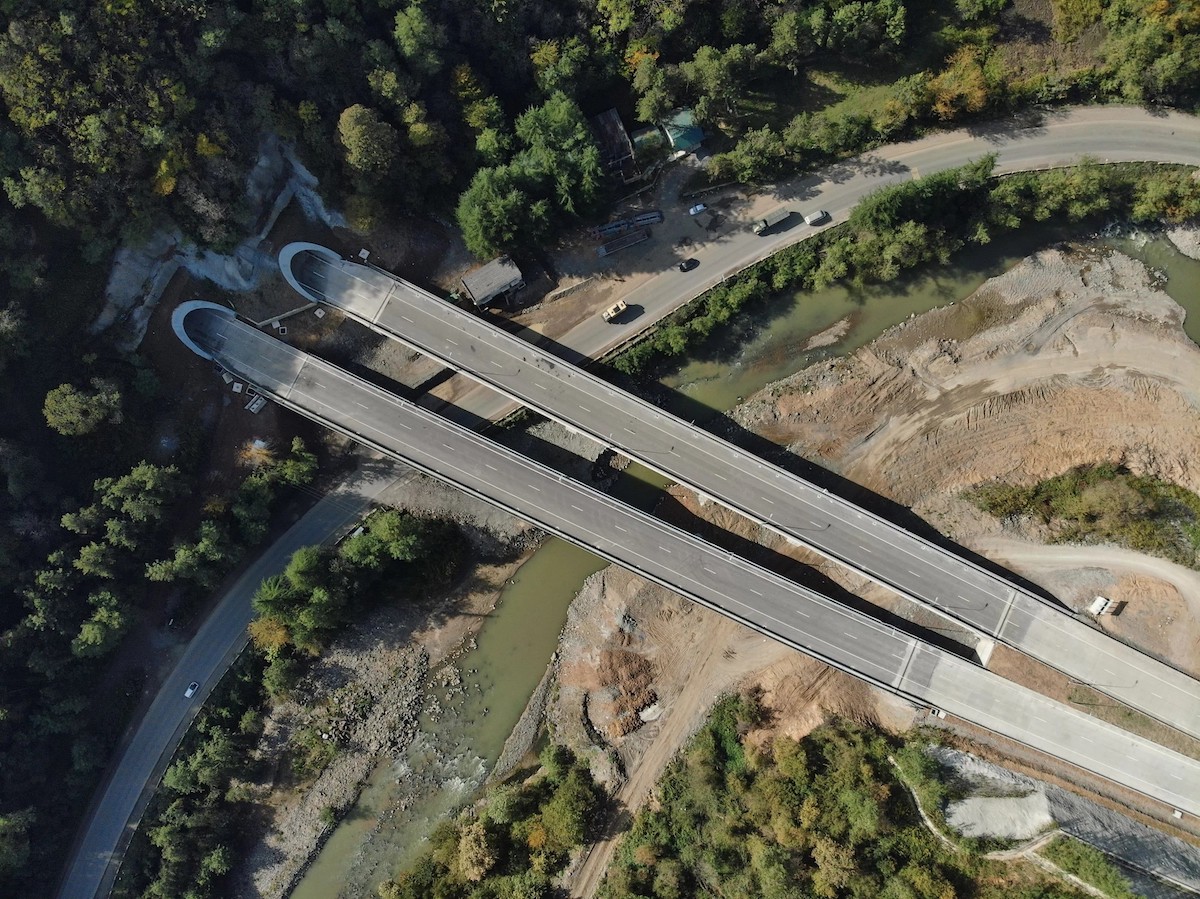
One of the key points of the Washington meeting is a proposed transit road linking Azerbaijan with its Nakhchivan exclave, which would run through Armenian territory.
The road has been the subject of a years-long dispute between the two countries. Azerbaijan insisted that the 40km stretch running through Armenian territory should be extraterritorial, while Armenia maintained it would control all territory within its borders.
A solution was reached at the Washington meeting: the stretch will be managed by a US–Armenian company, and the route has been named the “Trump route for international peace and prosperity,” or TRIPP for short.
The road will bypass Georgia, and Georgian experts see this as a painful loss for the country.
Georgia’s ambassador to the UK, Giorgi Badridze, said in a discussion on the YouTube channel Listen that Georgia is losing the status that has protected it from regional conflicts since the 1990s and ensured its strategic importance for the West.
“A new road is being built, and it no longer passes through Georgia. Today Georgia no longer has a monopoly on connecting Azerbaijan and Armenia – and by extension Central Asia – to western markets,” Badridze said.
Political analyst Ghia Nodia agrees, but adds that despite the economic blow, Georgia still benefits from the agreement:
“There is an obvious downside – we lose our exclusivity on transit routes through the Caucasus. That’s true, because our exclusivity was, to some extent, based on this unresolved conflict.
But if we follow that logic, it would mean we have to hope Armenia and Azerbaijan stay at war forever.
That’s a very narrow and short-sighted view. So yes, from a purely economic standpoint, some flows may go elsewhere and we may lose some income – but in the end this is a win for us, because it means a defeat for Russia.”
Russia’s influence wanes as the US returns to the region
Overall, Georgian experts say the main outcome of the agreement is that Russia has lost one of its key levers of influence in the region – the Karabakh conflict.
“Russia’s influence in the South Caucasus was strategically based, above all, on the Karabakh conflict. As long as it remained unresolved, it was the Kremlin’s main instrument of leverage,” said Ghia Nodia.
He said US involvement and the signing of the agreement show that “the myth of Russia’s superiority” has once again been dispelled – something that, in the long term, increases the chances of a stronger western role in the region.
The fact that the Armenia-Azerbaijan conflict is being shaped in Washington rather than Moscow radically changes the geopolitical balance in the region – at least for now.
“Moscow has lost its main leverage in the region, and the U.S. has become the key player,” the expert says.
Nodia added that this shift was only possible because of Turkiye’s rise:
“Without Turkiye’s support, it’s unclear whether Azerbaijan could have restored its territorial integrity through military means – which ultimately became the basis for the peace agreement.”
Security outlook: pros and cons
Experts also believe that despite the economic losses, ending the conflict could reduce direct security risks for Georgia.
“If two neighbouring countries are at war, there is always a chance the conflict could spill over into your territory. Now, that risk has most likely passed,” said Sandro Sharashenidze, a foreign policy expert.
Ghia Nodia agrees, and says it is better for Georgia to live in a region at peace and with countries that lean towards the West:
“Strategically, in the long term, it’s better for us to be in a region where two out of three countries are not at war with each other – and where none of them is pro-Russian, since their pro-Russian attitudes were largely shaped by this conflict,” Nodia said.
The myth of Russia’s ‘invincibility’ and a new reality for Georgia
The peace process between Armenia and Azerbaijan has a double-edged meaning for Georgia: on the one hand, regional stability and the weakening of Russia are strategically positive; on the other, under the current government the country lacks the resources to take advantage of this new reality.
“If in the future Georgia manages to restore relations with the West, this new balance of power could work in our favour. But today, with the current government, we cannot make use of this opportunity,” said Sandro Sharashenidze.
At the same time, experts warn that under the ruling Georgian Dream party, the change also brings a risk of Georgia’s economic and geopolitical isolation:
“Today, only Georgia is seen as Russia’s ally in the South Caucasus. This isolation increases the temptation for Russia to use Georgia against Armenia and Azerbaijan,” said Giorgi Badridze.
Analysts note that over the years Georgia has turned its transit importance into a tool for political bargaining – something that would be virtually impossible under the peace agreement.
According to Ghia Nodia, the Washington agreement has once again made it clear that
“Georgia’s strategic failure lies in the fact that Bidzina Ivanishvili is in power”:
“If we think we will forever be in the hands of this government, then whatever happens in the region and the world will be a loss for us,” he said.
However, Nodia believes
the Washington agreement indirectly weakens Ivanishvili’s rule.
“He [Ivanishvili], among other things, relied on the public image of a pragmatic politician: Russia may be an enemy, but when it is strong and the West is not interested in the region, there is no other choice.”
But the settlement of the Karabakh conflict with US mediation, he said, once again dispels the myth of Russia’s invincibility.
“Russia is only strong when its opponents are weak. Peace between Armenia and Azerbaijan automatically means Russia loses its leverage,” Nodia said.
In such circumstances, he added, it will be much harder for Georgian Dream’s propaganda to ‘pragmatically’ justify its pro-Russian course to any reasonable person.
“It’s painful to admit we’ve become Russia’s last stronghold in the region. But that’s not Trump’s fault. I repeat: nothing beneficial for us will happen in the hands of this regime. This agreement goes against the interests of Russia and its Georgian partners – but is objectively good for Georgia,” Nodia said.
Trump’s role: a bid to restore his political image
Experts agree that Trump also has his own political interest in the process.
“He failed to end the Russia–Ukraine war, but if the 35-year Karabakh conflict is resolved, he will have the chance to present himself as a ‘president of peace’,” said Ghia Nodia.
Analysts add that Trump’s goal may align with Georgia’s interests – namely, to strengthen US influence in the region and weaken Russia.
News in Georgia
