
Bank promotions often pay you just for opening an account or referring a friend. Take a look at the best bank bonuses available today.
Day: August 4, 2025
The recent court decision to authorize the forced transfer of detained activist Nino Datashvili to a psychiatric facility for examination has fueled fears that Georgian Dream authorities might be resorting to repressive methods characteristic of Soviet rule or fascist regimes.
On August 2, Tbilisi City Court granted prosecutors’ request for Datashvili’s involuntary examination, which would mandate her transfer to a psychiatric facility for 20 days. The request was based on 2019 medical records submitted by the defense, which indicated “emotional lability” as a symptom accompanying a serious and painful spinal condition.
“In the Soviet Union, isolating dissidents from society through forced placement and ‘treatment’ in psychiatric institutions was a common method of political reprisal,” read the joint statement signed by hundreds of mental health professionals.
The statement cited global statistics indicating that one in four individuals experiences common mental health conditions, such as anxiety, depression, post-traumatic stress disorder, and related emotional lability, at least once in their lifetime. “Subjecting individuals to psychiatric examinations on this basis, without their participation in making decisions on such examination, constitutes a violation of fundamental human rights and may amount to inhuman and degrading treatment,” the statement read.
The statement noted such practices were characteristic of “fascist political regimes.”
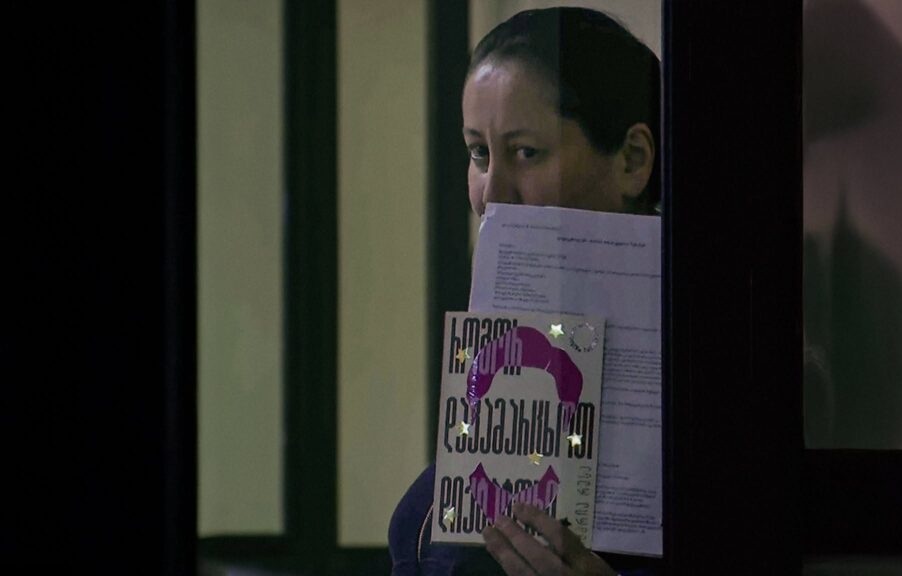
Datashvili, activist and teacher, was arrested on June 20 and faces four to seven years in jail over charges of attacking an officer, based on a June 9 episode when she was forcibly removed from court by several bailiffs. Video footage from the scene appears to show her frantically swinging her hands at a bailiff while being restrained and removed, though the nature or force of the contact is unclear from the video.
The court’s August decision authorizing coercive methods of psychiatric examination has led representatives of various groups, including psychologists, social workers, lawyers, and educators, to condemn what they saw as an abuse of psychiatry in the crackdown on critics.
Datashvili’s lawyers from Partnership for Human Rights, a local group, have argued that the move was an attempt to discredit and stigmatize the detainee and served to remove her from activism.
Chilling Comparisons
The controversy has particularly evoked chilling comparisons to the case of Nasi Shamanauri, a Soviet-era Georgian journalist who was forcibly institutionalized over her outspoken criticism of local policies. Shamanauri spent months in confinement, during which she undertook a hunger strike and reportedly succumbed to beatings and torture in 1983.
“If this toxic process isn’t stopped now, tragedies like that of Nasi Shamanauri will become our everyday life,” Jana Javakhishvili, a prominent psychologist and professor of Tbilisi’s Ilia State University, warned.
The Prosecutor’s Office of Georgia said that their request for the activist’s examination was indeed based on the medical records submitted by the defense, “where psycho-emotional lability is indicated as an accompanying disease.” Prosecutors claimed psychiatric evaluations are routinely ordered in such cases.
But according to Nona Kurdovanidze, head of the Georgian Young Lawyers’ Association, a local human rights group, the examination “was ordered without sufficient evidence,” particularly the evidence that would mandate Datashvili’s transfer to a psychiatric facility.
The Public Defender’s Office said on August 4 that they “continue monitoring” Datashvili’s case, and their representatives have visited her multiple times. During the recent visit on August 2, Datashvili “spoke about various issues, including her health condition and imprisonment conditions, which in turn significantly affect the defendant’s health condition,” the agency said.
The Office said it has requested Datashvili’s medical records, but chose not to disclose them “since this data constitutes personal information of a special category regarding Nino Datashvili’s health condition.”
Datashvili’s case is among several recent prosecutions that critics say demonstrate the ruling Georgian Dream party’s increasing use of harsh criminal charges against activists and journalists for relatively minor incidents. Another high-profile example is the case of journalist Mzia Amaghlobeli, whose verdict is expected on August 6.
Also Read:
Georgia: Verdict for Mzia Amaghlobeli
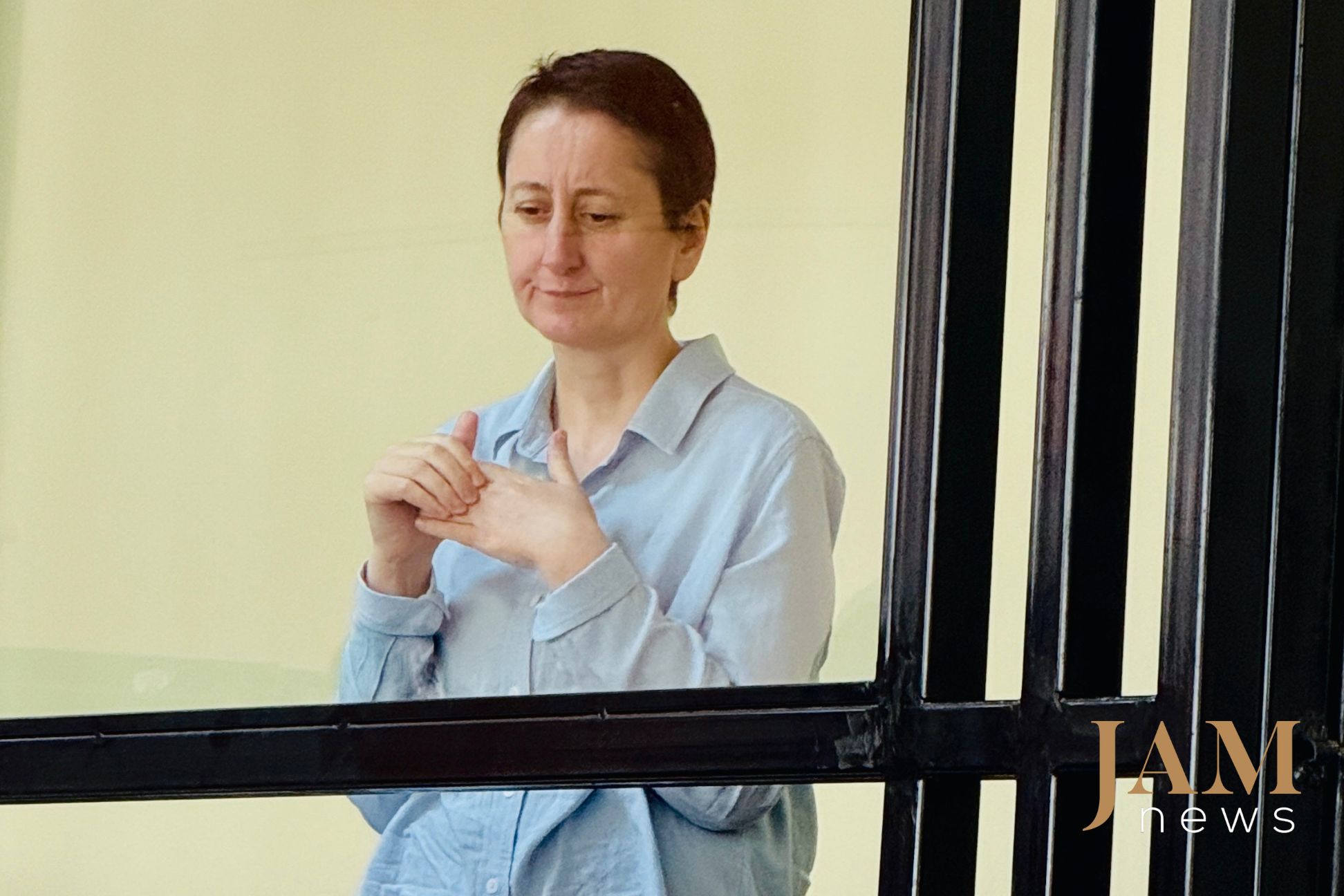
On August 4, the court hearing of journalist and founder of Georgian independent media outlets Batumelebi and Netgazeti, Mzia Amaglobeli, lasted only 30 minutes. Amaglobeli delivered her final statement, after which the judge announced a break until 2:00 PM on August 6, when the verdict is expected.

Mzia Amaghlobeli has become the first journalist to face trial in Georgia. She was arrested in January 2025 for slapping the Batumi police chief during a protest after he insulted her.
This was classified as “assaulting a police officer,” and she now faces four to seven years in prison.
The outlets Batumelebi and Netgazeti are known for their critical approach and high-quality journalism. They have received numerous international awards, including the European Press Prize.
As in previous hearings, the courtroom was packed, and many supporters couldn’t get in. Among those present were Georgia’s fifth president, Salome Zurabishvili, and EU delegation representative Marie-Caroline Vertommen.
During her closing remarks, Amaglobeli grew emotional – her voice faltered at times, and tears welled in her eyes.
Mzia Amaglobeli’s statement in court
“I’m happy to see my family, friends, and supporters again. But I feel uneasy that you have to keep coming back here. I once said that from one hearing to the next, the courtroom gets so crowded that I can’t focus on my case or on being in detention. The same is true today.
I had marked August 4 as the day Nino Datashvili – prisoner of conscience and single mother – was to appear in court for a hearing to possibly change her pretrial detention. She’s held in the same facility as I am, yet the conditions are such that we can’t even cross paths by chance. Nino, stay strong – you are not alone.
When I found out that prosecutors plan to send Nino to a psychiatric hospital, I completely lost my mind.
I can’t remember a time when the system in Georgia was this immoral.
Then I remembered Nino’s words: ‘I am not a victim,’ and everything came back into focus. Nino, this regime will be held accountable.
Out of anger and injustice, dear prosecutors, my eyes fill with tears, my tongue stumbles, and I can’t find the words. Tell me – do I also need a psychiatric evaluation for that, too?
Because of the incident with Datashvili, much of what I had planned to say today suddenly feels insignificant.
I had wanted to speak about the mission of Batumelebi and Netgazeti, about impartiality. The prosecutor mentioned responsible journalism and the value of unbiased investigations. Laws were changed, and real lives were saved.
I had also hoped to speak in detail about the importance of solidarity and the danger of Russian-style legislation. We call it Russian – and that’s exactly what it is.”
“In the prison where I’ve been unlawfully held for the past seven months, the authorities have offered many plea deals to other inmates – so-called ‘humane’ steps by the state. I can’t forget one little girl, whose voice I heard from my cell.
She was crying and saying, “I miss my mom.” When I learned that her mother was offered a plea deal, I was so relieved.
But my case is different. A guilty plea would be like being buried alive. Even the offer itself was deeply insulting, and my lawyers have repeatedly conveyed my position:
I will not sign a plea deal for the simple reason that what happened was not an assault (on the Batumi police chief).
From the day of my arrest, I’ve clearly stated in court that I do not avoid responsibility – unlike the so-called “victim,” Batumi police chief Dgebuadze.
There is an appropriate article in the law to address what I did – a slap.
I remember during one hearing the prosecutor asked me: “If you disagree with the current charge, which article do you think applies?”
He asked this after the investigator had already closed the case and submitted it to court – without ever questioning me or hearing my side of the story.
I’m certain that if investigators had acted professionally and impartially – rather than protecting Dgebuadze’s interests – this case would never have been labeled an “assault.”
The prosecution, following Dgebuadze’s lead, has requested 4 to 7 years in prison for me. Now it’s up to the court to decide what is appropriate.
But this verdict won’t only be my punishment – it will also be yours, dear prosecutors. It will be a professional reckoning for everyone who took part in this case on behalf of the state.
The court denied my request for the right to question witnesses. I’ve been labeled a criminal. They’ve claimed I’m supported by a so-called “global war party.”
They even said I was trained to slap police officers during special training exercises and was paid for it.
They claim I’m trying to undermine the police and destabilize the country.
A thousand absurd accusations and delusions – and they don’t come from random people. These are officials, representatives of the ruling political party.
I’ve said it before and I’ll say it again: the prime minister from the “Georgian Dream” party, Irakli Kobakhidze, is particularly active in spreading such claims.
But the U.S. State Department doesn’t need to damage the reputation of the Georgian police – the police are doing that all by themselves.
The crisis of trust began when you shielded criminals in your own ranks and refused to investigate crimes – such as the attacks on my fellow journalists Rogava, Keshelashvili, and others.
When you attacked peaceful protesters – people whose constitution you took away, and whose future you claimed no longer lies in Europe.
You arrested them, then beat them in your police vans – and you didn’t even investigate that violence.
All of this is so overwhelming that I won’t even speak about the degrading treatment I personally endured at the hands of the police.
Ms. Judge, I have no video recordings. So I ask you to simply imagine what I’m about to tell you – what I’ve already said more than once.
In a completely calm setting, police suddenly appeared, causing panic. People in masks surrounded me. From the heavy pushing, I fell onto the asphalt. They kicked me. Stepped on me.
Now imagine the second episode. After the slap, I was sitting barefoot in a police station. Minutes earlier, I had been beaten. A man burst into the room, shouting and cursing, ready to attack me. I deeply regret not remembering the faces of those who protected me from him.
The assaults and verbal abuse happened three times, each one more degrading than the last. During one of them, he spit in my face. Then he ordered his officers not to give me water or let me use the toilet.
That man was the so-called “victim,” Irakli Dgebuadze.
After that, his officers continued the abuse. They handcuffed me, tying my hands behind my back.
Please, don’t consider the fact that I’m a woman. Don’t even consider the state of my health. The evidence is enough.
Whatever decision you make, I want you to know: I consider myself a winner.
For that, I want to thank my lawyers and human rights defenders. They confronted propaganda and those who shamelessly tried to silence me – with facts and reason. They shared my truth both inside and outside this courtroom, persuasively and powerfully. They helped me keep faith in people and continue fighting for justice.
Remember their names – they will become pillars of Georgia’s justice system.
Countless people deserve my thanks. Even another lifetime wouldn’t be enough to repay or fully express the gratitude I’ve felt for over 200 days.
Don’t lose heart. I believe in you. No matter how hostile or dangerous your environment, may your steps remain honorable – guided by the defense of freedom of thought and speech.
Freedom for all political prisoners. We are not criminals.“

After Mzia Amaghlobeli finished her statement, the judge adjourned the hearing and scheduled the next session for 2:00 p.m. on August 6, when the verdict is expected.
As the session ended, a protest took place outside the courthouse. Supporters chanted: “Freedom for political prisoners!” and “Freedom for Mzia Amaghlobeli!”
They addressed Judge Nino Nameshavili, saying her name would go down in history with shame.
Then, the supporters marched to the office of Batumelebi, thanking its and Netgazeti’s staff for their resilience during this difficult time. The rally continued toward government buildings involved in the case – to make sure the voices of protest were heard.
News in Georgia