
Day: July 24, 2025
Pashinyan’s plan to remove Catholicos
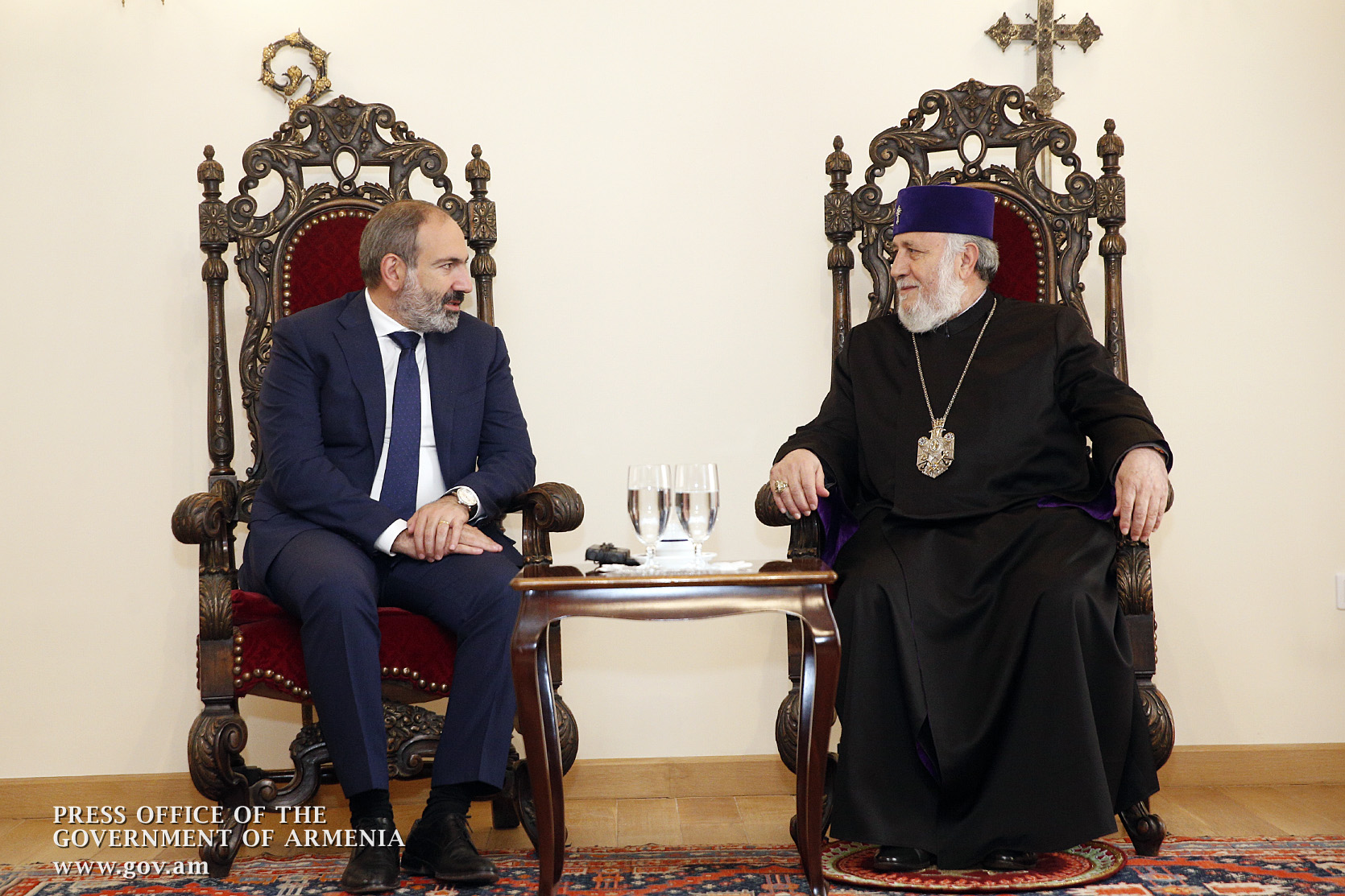
Armenian Prime Minister Nikol Pashinyan has shared his plan to remove Catholicos of all Armenians Garegin II from the throne, publishing the proposal on social media. He suggests appointing a locum tenens – an acting head of the Church – adopting a new ecclesiastical charter, and holding elections for a new patriarch.
Pashinyan has long argued that the country needs a new spiritual leader. He justifies this by claiming that Garegin II broke his vow of celibacy and has a child. At the same time, the prime minister insists that his actions are not aimed against the Church. According to him, they stem from the need for the “renewal of the Church, the state and society”. He stresses that he is pursuing this agenda first and foremost as a believer and a follower of the Armenian Apostolic Church – and only then as prime minister.
“Our goal cannot be to replace Ktrich Nersisyan [the Catholicos’s secular name] with another clergyman who has violated the vow of celibacy. That would be political fraud, not a spiritual renewal agenda,” he wrote.
Political analyst Robert Ghevondyan notes that the standoff between the ruling authorities and the Church leadership is not dying down – on the contrary, tensions are rising. The demand to remove the Catholicos has moved beyond a personal dispute and has become “the epicentre of a political conflict.” Gevondyan shared his views on how events might unfold and what kind of outcome can be expected.
- Pashinyan remains Armenia’s most trusted politician, but his approval rating has declined: IRI poll
- Arrested Russian-Armenian businessman Samvel Karapetyan forms a political party
- Armenian security services say attempted coup foiled, release evidence
Pashinyan proposes appointing a “married, upstanding priest” as acting Catholicos
According to the prime minister, a locum tenens (acting head of the Church) should not be eligible to stand for the position of Catholicos. In addition, before the election of a new patriarch, the Church’s charter must be updated. He emphasises that the revised version should be written in modern Armenian so that every citizen can understand the legal code:
“After the charter is approved, the election of the Catholicos of All Armenians must take place. And during the election, the moral integrity of all candidates must be verified.”
Pashinyan did not specify how candidates’ moral integrity would be assessed. He only noted that both the vetting process and the election procedures should be set out clearly in the new charter:
“And it must be adopted by the National Ecclesiastical Council or an equivalent body.”
The National Ecclesiastical Council is the Church’s highest governing body. It is convened by the Catholicos of All Armenians.
The National Ecclesiastical Council is the Church’s highest governing body. It is convened by the Catholicos of all Armenians.
- Blackmail or message to Catholicos? Analysing Pashinyan’s social media posts
- Archbishop’s diary and attempted coup in Armenia
“The renewal agenda does not imply theocracy in any way”
Prime Minister Pashinyan confirmed that he will personally lead the movement titled “Sanctuary for the Holiest!”. He reminded the public that he had previously outlined the criteria a leader of the movement must meet and assured that he himself fulfils them, stating that he is “baptised, prays daily, believes in Jesus, and has read the Bible from beginning to end.”
“The renewal agenda does not in any way imply a theocracy. It will not and cannot restrict the rights or freedoms of any citizen. But through it, society must send a clear message that it has the right to demand full accountability from its state, church, and political leaders — both in their personal and public lives. Anyone uncertain about this should not aspire to spiritual or political leadership,” the prime minister declared.
When the appointment of a locum tenens is permitted
According to the current Church charter, a married priest cannot be appointed as locum tenens (acting Catholicos). Furthermore, the charter only allows such an appointment under two circumstances:
- if the Catholicos voluntarily abdicates,
- or in the event of the Catholicos’s death.
Notably, the clergy had already expressed their support for the Catholicos before Pashinyan made his plan public.
“We express our filial support to Catholicos of all Armenians Garegin II in these troubled times, so that, as a kind and courageous shepherd, with God-given wisdom, composure, and a vigilant spirit, he may continue to lead the Holy Armenian Apostolic Church and all our faithful people towards peaceful and secure havens,” the statement reads.
- ‘Russian trace’ suspected in Armenian clergy: Another priest faces criminal charges
- Impeachment proceedings against Pashinyan: Armenia debates whether opposition can even initiate them
“Great spiritual gathering in Etchmiadzin”: date and time unknown
A few days ago, Prime Minister Nikol Pashinyan called on citizens to prepare for a “great spiritual gathering on the central square of Etchmiadzin.” While the location of the event is known, no official date has been announced. There is speculation that it may be planned for Sunday, the Feast of the Transfiguration of Christ.
Former President Levon Ter-Petrosyan has urged Pashinyan to cancel the event, warning that the prime minister will bear “responsibility for any potential clashes or bloodshed.”
The clergy, in turn, have appealed to the country’s competent authorities to “halt Pashinyan’s announced encroachment on the Church,” and called on citizens “not to fall for the authorities’ provocations”:
“Holy Etchmiadzin condemns this attempt to provoke violence and assault. It is a blatant interference in the life and self-governance of the Armenian Church. We call on the ruling political force to end its anti-Church, unlawful campaign and to focus instead on overcoming the serious challenges facing the country,” the statement reads.
Commentary by political analyst Robert Ghevondyan
“It is evident that both sides have passed the point where a mutually acceptable solution could be reached by fully maintaining their positions. Victory for one will now mean defeat for the other.
The Armenian authorities hold the stronger position, as they are legitimate and possess the legal instruments of force. Therefore, the removal of the Catholicos and new elections within the Church appear more likely than the removal of the prime minister ahead of the 2026 parliamentary elections.
However, scenarios for removing the Catholicos vary, and each could lead to more or less problematic consequences.
The history of the Armenian Apostolic Church contains precedents for the removal of a sitting Catholicos.
For example, Catholicos Vahan I Syuni, ordained in 968, was deposed just one year later in 969 and replaced by Catholicos Stepanos III of Sevan. A few decades later, Catholicos Sargis I of Sevan, ordained in 992, voluntarily abdicated in 1019 and himself ordained his successor, Catholicos Petros I Getadardz. In 1418, Catholicos Grigor VIII Khndzoghat, who held the throne in Sis, was deposed and replaced by Catholicos Poghos II of Garni. Catholicos Grigor IX Musabekyants, ordained in Sis in 1439, refused to travel to Vagharshapat to assume the throne, leading to the ordination of Catholicos Kirakos I of Virap, who was later deposed in 1443 and succeeded by Grigor X Jalalbegyants.
As we can see, there have been cases in the Armenian Apostolic Church when a new Catholicos was ordained while the previous one was still alive.
Given this, one way to resolve the current tensions could be the voluntary abdication of the Catholicos or his removal by the clergy. It could be argued that this would be the most constructive outcome. However, for such a development to take place, the Church leadership — including Garegin II — must recognise the fundamental importance of Armenia’s statehood.
The worst-case scenario would be the use of force by the authorities if sufficient grounds emerge to suspect the Catholicos of illegal activity. In such a case, the societal split could lead to unpredictable consequences.
Another possible scenario is a public expression of discontent with Garegin II’s leadership by the faithful. This could take the form of a large protest in Etchmiadzin.
However, such a demonstration may prove ineffective in resolving the issue, as the clergy might simply ignore the demands of the crowd. Furthermore, as tensions escalate, some opposition figures — seeking to benefit politically — may attempt to rally citizens with opposing views and organise counter-protests.”
Follow us – Twitter | Facebook | Instagram
Pashinyan’s plan to remove Catholicos
Once again, the Armenian lobby in the United States has mobilized its well-known supporters in Congress to push a dangerous and destabilizing agenda. This time, 87 lawmakers—led by the usual suspects from the Armenian Caucus, including Frank Pallone, Gus Bilirakis, Brad Sherman, and David Valadao—have urged the Trump administration to support the return of Armenians to Azerbaijan’s Garabagh region.
In a surprise move, prosecutors reclassified the charges against Saba Skhvitaridze, an activist and member of the opposition Ahali party, reducing the severity of the criminal accusations as courts continue to try and sentence dozens of those arrested amid protests on serious charges.
Skhvitaridze was initially charged with the attack against a police officer resulting in health damage, carrying a jail penalty of 7 to 11 years. As the proceedings entered their final phase, however, the prosecutors shared the arguments of the defense that Skhvitaridze couldn’t know the man was a police officer, leading to a reduced charge of “intentional minor bodily harm,” punishable by a fine, correctional labor, house arrest, or one to three years in prison.
Skhvitaridze continues to maintain his innocence, arguing he acted in self-defense. Despite the reduced charges, Judge Jvebe Nachkebia denied the defense’s request to release him from pre-trial custody.
“Since it was confirmed that the defendant may not have clearly known that the individuals were police officers performing their official duties, we therefore made an objective and fair decision regarding the change of the legal qualification,” prosecutor Roin Khintibidze told journalists following the court hearing on July 24.
The charges stem from a December 4, 2024, incident near the Courtyard Marriott Hotel at Tbilisi’s Liberty Square, close to the protest epicenter, during the first week of ongoing protests. The confrontation broke out after a group emerged from the hotel following an opposition meeting and was approached by men in black plain clothes wearing medical masks.
According to the defense, which cites video evidence from the scene, the incident incident when opposition member Teona Chalidze pulled down the hood of one of the men, reportedly believing he was a thug, a so-called Titushka. Violent Titushki attacks were frequently reported during the early weeks of the protests.
The man responded by slapping Chalidze in the face, which, according to the defense, prompted Skhvitaridze to intervene as part of self-defense. The prosecution later identified the man, who wore no insignia at the time of the incident, as police officer Mirian Kavtaradze and as the alleged victim.
Skhvitaridze was detained on December 5, a day after the incident. He later alleged inhuman treatment at the hands of police, including beating and rape threats.
On June 24, Amnesty International, a legal watchdog, addressed a letter to Georgia’s Prosecutor General, urging authorities “to ensure a prompt, impartial, independent and effective investigation into the allegations of torture and other ill-treatment of Saba Skhvitaridze and to bring all those responsible to justice in fair trials.”
Dozens of those arrested in the context of protests since November 2024 are currently tried on criminal charges, with seven already sentenced to years in jail. The proceedings continue as no police officer has been held accountable despite numerous documented abuses during dispersals.